TikTok Video Brief Template: One Page Before Every Clip
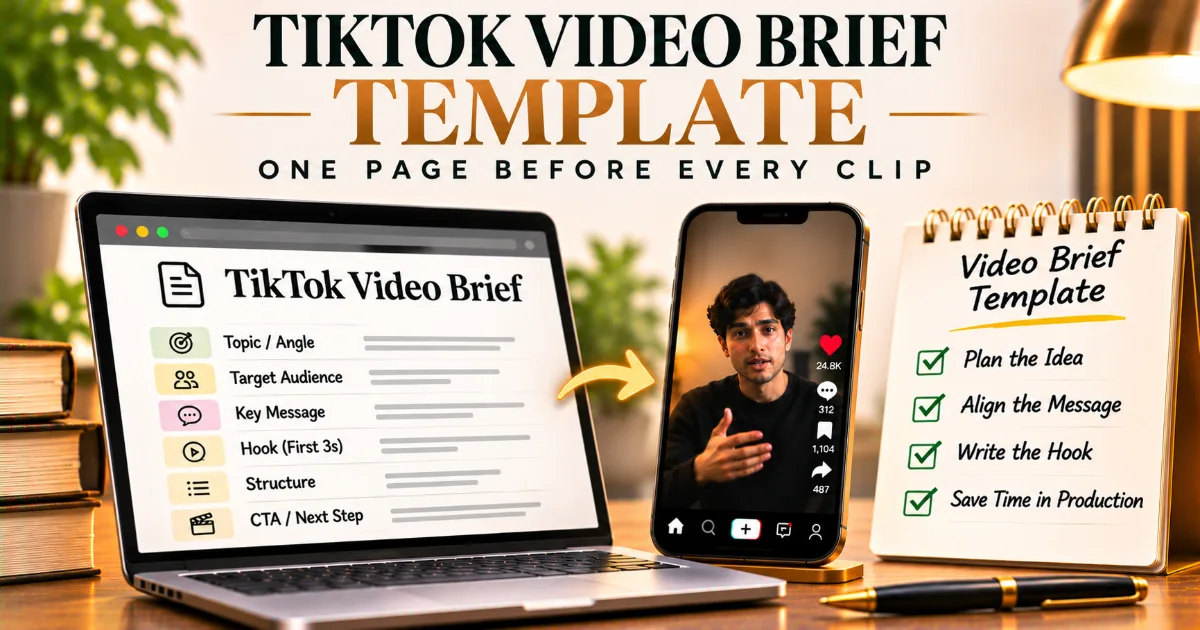
A TikTok video brief template is one page per clip with four fields: the viewer's problem in their own words, an opening that needs no context, the one thing the clip should leave them with, and one next step. It is written before the clip is cut, for a viewer who has never heard of the business, and it is what every later step checks against. This post sets out each field and its test, the extra lines a regulated business adds, how a model can draft briefs for a person to check, and one mortgage adviser's briefs from start to finish.
The four fields of a TikTok video brief, each built on the one before
- 01The viewer’s problemwho the clip is for, in their words
- 02The openingthe subject first, no context needed
- 03One takeawaythe single point, with its limit
- 04One next stepwhere the viewer can honestly go
Relative, not measured
- TikTok video brief template: four fields on one page
- Why every clip needs a brief written for a stranger
- Field 1: the viewer's problem, in their own words
- Field 2: an opening that needs no context
- Field 3: one takeaway, with its limits
- Field 4: one next step, and where it really leads
- The extra lines a regulated business adds
- Drafting briefs with a model, checked by a person
- A worked example: one mortgage adviser's briefs
- What a brief costs, and what it saves
- Frequently asked questions
- Where to start
TikTok video brief template: four fields on one page
The brief exists to answer one question before anyone edits: what will a stranger get from this clip? Most short-form video is made by people who know the subject well, which is exactly what makes it hard to see the clip as someone arriving with no context does. Four fields force that view. Each is short, each has a test, and a clip whose brief cannot pass all four is not ready to cut.
The test each field of the brief must pass
- The problem in a viewer’s words someone would type or say it
- An opening with nothing before it a stranger can say what it is about
- One takeaway it fits one sentence without “and”
- One next step three steps listed, so it fails
| Field | What goes in it | The test |
|---|---|---|
| The viewer's problem | The question or frustration, in the words a viewer would use | Would someone type this, or say it to a friend? |
| The opening | The first line and anything shown on screen with it | Does it make sense with nothing before it? |
| The one takeaway | The single point, with any limit the speaker put on it | Can it be said in one sentence without "and"? |
| The next step | One thing the viewer might do after watching | Is it one thing, and is it honest about where it leads? |
The page also carries a few practical lines that are not fields: the source of the clip, its timestamps, what needs rebuilding, and who approves it. Those lines come from the queue the clip sits in; our guide to TikTok clips from YouTube videos describes that queue and where the brief falls in it. The four fields are the brief itself.
This is a brief for one clip, not a content plan. The plan decides which topics a business covers and in what order; our guide to the TikTok content research workflow builds that queue of topics. The brief takes one moment that has already been chosen and decides exactly what it will be for one viewer.
Why every clip needs a brief written for a stranger
Every clip needs a brief because the people making it are the worst-placed to judge it. A founder, an editor and a marketing lead all know what the clip is about before it starts, so they hear the point even when the clip never states it. A viewer on TikTok has none of that. They see a face, hear a few words, and decide in seconds whether the clip is for them.
Who a business’s TikTok viewers mostly are
- Followers people who already know the business
- A cold audience strangers with no context and no reason to trust it yet
The shape of the problem, not a measurement
The platforms say this about themselves. TikTok's page on how TikTok recommends content lists whether a viewer watches a video "in full or skip[s]" among the interactions it uses to choose what to show. Instagram's creator team, writing about helping creators of all sizes break through, tells creators to make content "that can stand on its own" for people "who may not know you." A brief is simply that advice turned into a form someone has to fill in.
A brief also saves time later. Selection decides which moments could stand alone; the brief says how. When it is clear that a clip needs its question on screen or a new first line, that decision is made once, on paper, rather than discovered in the edit and argued about in approval. Shots are decided the same way once the script exists: the TikTok B-roll planning workflow reads it line by line and lists only the footage a line needs. The same page is where a clip that needs a person, a piece of footage or a song nobody has cleared yet is spotted, before the TikTok video rights checklist has to stop it at approval. The same goes for any cutaway the clip borrows: noting on the brief whether it is filmed, licensed or generated, as our guide to Higgsfield AI and stock footage recommends, saves a guess at review.
Marketers call this viewer a cold audience: people who have never heard of the business, have no reason to trust it yet, and owe it nothing. Most of a business's TikTok viewers will be cold, because the feed is built to show clips to strangers. A brief written for a cold audience is therefore not a special case for a few clips; it is the normal case. Writing for the follower who already knows the business is the exception, and it is a mistake when it happens by accident. Our guide to content automation for multi-platform content makes the same point across other feeds, where the share of viewers who are strangers is lower but still large.
Field 1: the viewer's problem, in their own words
The first field names the problem the viewer has, written the way they would say it, not the way the business would describe it. A mortgage adviser might call a topic "affordability assessment"; a viewer asks "how much can I borrow?" The brief uses the viewer's words, because those are the words that make someone stop, and they are often the words people type into TikTok's search.
The business’s words for a problem, and the viewer’s words for it
The business saysThe viewer says
An affordability assessment
how much can I borrow
The deposit requirements
how much deposit do I really need
A heading from an internal document
a question someone would ask a friend
TikTok gives creators a direct view of those words. Its help page on Creator Search Insights describes it as "personalized information on topics people are searching for on TikTok," with filters including one for content gaps. It is a reasonable place to check how people phrase a question. It is not a reason to make a clip about a topic the business cannot speak to honestly, and the brief should name the problem the clip genuinely answers.
Write the problem as one line, and test it by reading it aloud as the viewer. If it sounds like a heading from an internal document, rewrite it. If several viewers' problems could fit, choose one; a clip that tries to answer three questions answers none of them well, and the brief is the cheapest place to make that cut. The viewer's exact words are often sitting under the business's earlier clips, and the TikTok comment research workflow is how they are collected without copying anyone's personal details.
The problem line also connects the clip to the business's wider subjects. Over a few months, the problem lines from every brief form a list of the questions the business's audience actually has, in their words. Grouped by subject, that list shows which topics the business answers well and which it keeps circling without a clear clip. Our guide to identifying your knowledge pillars describes how those groupings become the subjects a business commits to, and the brief's problem line is one of the most honest sources of evidence for them, because each one was written about a clip that was really made.
Field 2: an opening that needs no context
The second field is the opening: the first line the viewer hears and anything shown on screen with it, written so that it makes sense with nothing before it. The test is literal. Read the opening to someone who has not seen the recording and ask what the clip is about. If they cannot say, the opening still depends on the conversation it was cut from. Nielsen Norman Group's guidance on writing headlines and other microcontent notes that people form opinions from headlines and summaries without digging deeper, and an opening is judged the same way.
How viewers stay with a clip, depending on how it opens
the first line the viewer hears
Left to right: how long the viewer watches
Bottom to top: how many viewers get the main point
- an opening that still depends on the conversation
- an opening with the most important information first
The principle is an old one from writing for the web. Nielsen Norman Group's article on the inverted pyramid describes starting "with the most important piece of information so readers can get the main point, regardless of how much they read." On TikTok, regardless of how much they read becomes regardless of how long they watch. The opening should carry the subject and, ideally, the shape of the answer.
The brief does not invent the opening; it chooses among honest ones. Usually that means starting at the speaker's strongest line, putting the question on screen, or asking the speaker to record a new first sentence, the three moves set out in our TikTok hook rewrite workflow. The brief records which move is needed so the editor and the speaker both know before the cut. Where the move is text on screen, TikTok on-screen text SEO sets the rules for its wording and where it sits in the frame.
Field 3: one takeaway, with its limits
The third field is the single thing the viewer should leave with, written as one sentence, including any limit the speaker put on it. One sentence is the test: if the takeaway needs "and" to fit, the clip is two clips. The limit matters as much as the point, because it is the part that keeps the clip true once it is cut away from its context.
What a single takeaway rests on
- One sentencethe point the viewer leaves with
- The limitwords like “for most first-time buyers”
- The speaker’s claimwhat was actually said in the recording
Limits are what short clips lose first. A speaker who said "for most first-time buyers" made a different claim from one who said "for buyers", and a clip that drops the qualifier has changed what the business is saying in public. Writing the limit into the brief means every later step, the opening, the captions, the description, is checked against it. For a product, the limit comes from somewhere fixed: the TikTok product demo content workflow takes it from the approved fact sheet rather than leaving it to the edit. If a limit or a fact changes after the clip is posted, the TikTok content refresh workflow finds every clip that stated the old version.
The takeaway is also where a clip's usefulness is decided. A viewer who leaves with one clear, correct idea has been helped, whether or not they ever contact the business. That is the standard Google's guidance on creating helpful, people-first content applies to pages, and it transfers well to video: the clip should leave the viewer feeling they learned something, not that they were sold to.
Field 4: one next step, and where it really leads
The fourth field is one thing the viewer might do after watching, and it has to be honest about where it leads. It can be watching the next clip in a series, reading a longer guide, saving the clip, or visiting the business's profile. It is one thing, not three, and it is never a promise the business cannot keep. Whether the profile can carry a link at all depends on the account: TikTok's Business Help Center page on account entitlements sets out which levels of business account can show a bio link. When the step is a longer guide, the TikTok to blog content workflow records which page the clip sends people to and checks that link on a schedule.
The range of honest next steps a clip can end on
The point alone
A named guide
- End on the pointthe viewer looks at the profile unprompted
- The next episodethe series continues the question
- A longer guidethe full answer to the same question
For most clips the next step is quiet. A business clip is usually more useful when it ends on the point than when it ends on an instruction, and a viewer who found the clip helpful will look at the profile without being told to. Where there is a genuine next step, such as a longer article on the same question, the brief names it so the description can point to it.
The next step is also where the clip connects to the rest of the business's content. A clip from a series points to the next episode; our guide to TikTok content series planning covers how episodes are sequenced so each one has a natural next step. A clip from an article points back to it, so the reader who wants more finds the full answer. A newsletter series links its parts the same way, as Substack newsletter series planning explains for issues sent over several weeks.
The extra lines a regulated business adds
A business in a regulated field, such as finance, health or law, adds two lines to the brief: the claims the clip must not make, and any statement or disclosure the clip must carry. Those lines are filled in before the clip is cut, by someone who knows the rules for that business, because a clip that has to be withdrawn costs far more than a line on a form.
How a regulated business sorts a draft takeaway before the cut
No statement · no promise
add the statementthe takeaway is fine, the required line is missing
Statement · no promise
ready to cutthe claim is honest and the line is carried
No statement · a promise
rewrite itthe takeaway promises and the line is missing
Statement · a promise
rewrite ita disclaimer does not fix a promise
Left column: the required statement is missing
Right column: the required statement is carried
TikTok's own rules point the same way. Its policy on regulated commercial activities says commercial content must be disclosed using the content disclosure setting, and that undisclosed commercial content may have its visibility reduced. For advertising, TikTok's financial services ad policy requires advertisers of loans, including mortgages, to be licensed by the relevant authorities and to comply with disclosure requirements, including disclaimers.
An organic clip is not an ad, but the ad rules are a useful floor. TikTok's policy on deceptive practices lists exaggerated financial claims and guarantees among the things it does not allow in ads. If a clip's takeaway would fail that test as an ad, rewrite the takeaway. The local rules that actually govern the business, set by its regulator, sit above all of this, and the brief should name who checks them.
Drafting briefs with a model, checked by a person
A model can draft a brief for every shortlisted clip from the transcript, as long as it returns the four fields in a fixed shape and a person checks each one before the clip is cut. Drafting is the slow part of the work and the part a model does well: it reads the passage, proposes the problem in plain words, picks the strongest line for the opening, and states the takeaway with its limit. The person's job is to check that each field is true to the recording. That check is quicker when the draft shows its sources, and Anthropic's documentation on citations describes returning the exact passages that support each claim, so every field can point to its line in the transcript.
How a model drafts a brief for a person to check
the shortlisted passage
the four definitions and their tests
claims to avoid and statements to carry
returns the four fields in a fixed shape
all four fields, or none
a field that cannot be filled truthfully
in the table beside the clip
Give the model the transcript of the passage, the four field definitions with their tests, and any regulated-business lines, and ask it to say when a field cannot be filled honestly rather than forcing one. A draft that admits the passage has no single takeaway is more useful than one that invents a tidy sentence, because it tells the checker the moment may not be a clip at all. The checker then confirms or rejects that judgement, which takes far less time than discovering it in the edit. Whatever the brief misses, the TikTok clip quality checklist catches on the finished cut, where a moment that needs its conversation to make sense is rejected rather than forced. When a clip will carry a generated illustration, that picture gets a page of its own as well, and our Higgsfield AI visual brief workflow shows how its limits are read off the source. The look of any generated footage is not the clip brief's job; it comes from the campaign's style brief for Higgsfield, decided once for every clip.
A fixed shape is what makes checking fast. Anthropic's documentation on structured outputs explains that they constrain responses to a specific schema, which means a brief arrives with all four fields or not at all. In Claude Code, the instructions for writing briefs can live in a skill, so every brief is drafted by the same written rules rather than from whoever remembers them.
The briefs then need somewhere to live that the whole team can read. In n8n, the Airtable node can create and update records, so each drafted brief becomes a row beside its clip, with a field for the checker's changes and one for approval. Our guide to the TikTok content approval workflow shows how the approved brief becomes the checklist for the finished clip.
A worked example: one mortgage adviser's briefs
Take an illustration, not a client: a mortgage adviser records a long session answering first-time buyers' questions and wants a handful of TikTok clips from it. Four candidate moments are shortlisted, and a model drafts a brief for each from the transcript. The adviser's compliance contact has already written the two extra lines that apply to every clip: no statement about what any individual will be able to borrow, and the adviser's standard statement that the clip is general information, not advice.
What the mortgage adviser’s four briefs became
Four briefs
- Passed as drafted the deposit question, limit kept
- Split in two a takeaway with two “and”s
- Rebuild marked a question to go on screen
- Stopped a promise the adviser never made
Rough shares — a shape, not a measurement
The first brief passes as drafted: the problem is "how much deposit do I really need?", the opening starts at the adviser's line about deposits, the takeaway carries the limit "for most first-time buyers", and the next step is the adviser's longer guide. The second brief's takeaway needed "and" twice, so it becomes two clips. The third brief's opening still referred to "the example I gave earlier", so the checker marks it for a question on screen.
The fourth brief is stopped. Its draft takeaway read as a promise that a particular approach would get a buyer a better rate, which the adviser never quite said and which fails the no-promises line. The checker sends it back with a note, the adviser reads the passage again and agrees it should not be posted, and the reason is kept in the row. Three briefs, one of them split into two, move on to the cut.
What a brief costs, and what it saves
A drafted brief costs a person a few minutes to check, and it saves the edits, re-cuts and approval arguments that happen when nobody decided what the clip was for. The check is quick because the fields are short and the model has done the first draft. The saving is larger than it looks, because a clip that is cut without a brief is often cut twice.
The set-up cost is the template itself and, for a regulated business, the two extra lines agreed with whoever checks compliance. Both are written once. After that the template barely changes; what improves is the drafting instructions, as the checker's corrections show where the model's first drafts tend to go wrong.
The failure to watch for is the brief that becomes a formality: four fields filled in after the clip is already cut, to satisfy the process. Make the brief the thing the editor cuts from, not a record written afterwards. Everything downstream in our TikTok content automation is cut from this brief; our TikTok content guides follow a clip from it to the post, and our multi-platform content guides cover the same planning when a recording feeds several platforms.
Frequently asked questions
What should a TikTok video brief include?
Four fields: the viewer's problem in their own words, an opening that makes sense with no context, the one takeaway with any limit the speaker put on it, and one next step. Add the clip's source, timestamps, what needs rebuilding and who approves it as practical lines, and for a regulated business, the claims to avoid and any required statement.
Why write a brief for a short clip?
Because the people making a clip already know what it is about, so they cannot easily see it as a stranger does. TikTok and Instagram both show clips to people who do not know the creator, and a brief forces the question of what that viewer gets before anyone spends time editing.
How long should a TikTok video brief be?
One page, and each field one or two lines. If the takeaway needs more than one sentence, or the opening needs a paragraph of explanation, the clip is not ready, and the brief has done its job by showing that before the edit.
Can AI write the briefs?
A model can draft them well from a transcript, especially if it returns the four fields in a fixed shape. A person should check each field against the recording before the clip is cut, because the model may state a takeaway more strongly than the speaker did or miss a limit they put on it.
What extra does a regulated business need in a brief?
Two lines: the claims the clip must not make and any statement or disclosure it must carry, filled in by someone who knows the business's rules. TikTok's own ad policies for financial services require licensing and disclaimers, which is a sensible floor even for organic clips, but the business's regulator sets the real rules.
Should every TikTok clip end with a call to action?
No. One next step is enough, and for many business clips the most useful ending is the point itself. Where a genuine next step exists, such as a longer guide on the same question, name it in the brief so the description can point to it honestly.
Where to start
Take the next clip you plan to post and fill in the four fields before anyone edits it. If the problem line sounds like internal language, rewrite it as a viewer would say it. If the takeaway needs "and", split the clip. If the opening only makes sense after the conversation it was cut from, mark the rebuild now. For clips that come from customer questions rather than recordings, our TikTok FAQ video workflow starts the brief from an approved answer, and our TikTok case study video ideas post shows the same brief applied to a client story. A brief that names its facts before filming is half of what lets TikTok review take minutes, as explained in the Content Operating System for TikTok.
Disclosure
This post was written by Shreyas Dave, founder of Paper Eagle AI. We sell content automation services, which is the category this article is about, so we have a commercial interest in you concluding that a system beats ad-hoc effort — read it knowing that. No tool vendor was involved in writing it, nobody paid for a mention, and there are no affiliate links anywhere on this site. Where a third-party figure appears, it’s attributed to the publisher it came from; anything we couldn’t source is written as a direction rather than a number.
Paper Eagle AI builds Content Operating Systems that turn a business’s knowledge and expertise into consistent, multi-platform content, and we deliver them as content automation services. Working as a content automation specialist, we capture what a business knows and how it sounds, set the strategy, and build the workflows that research, draft, repurpose and publish — with a named person approving every piece before it goes out. Every build runs through discovery, design, build and handoff. The system lives in the client’s own accounts, it is documented, the team is trained to run it, and the business owns it outright. We don’t write content on a retainer, and we don’t build lead generation, CRM or sales automation.
One source of thinking becomes native content for every platform a business publishes on: the founder’s LinkedIn and the company page, YouTube and Shorts, Instagram and Reels, TikTok, Reddit, Medium, newsletters, and the company’s own website, written to be found in Google and understood by AI search. Our multi-platform content automation page shows how they share one source, and our case studies document the systems behind our own publishing, file by file. You can follow the work on the company’s own channels: Paper Eagle AI on Instagram, Paper Eagle AI on YouTube, the Paper Eagle AI company page on LinkedIn, Paper Eagle AI on Substack, Paper Eagle AI on Reddit and Paper Eagle AI on Medium. Paper Eagle AI is also listed where clients can review its work: Paper Eagle AI on Clutch, Paper Eagle AI on GoodFirms and the Paper Eagle AI Google Business Profile.
Keep reading
- TikTok clips from YouTube videos, interviews and webinars — how a moment is chosen before it gets a brief.
- Content automation for multi-platform content — how one brief serves several platforms.
- How to design human approval gates — why a person checks the brief before the cut.