TikTok Content Series Planning: One Pillar, Many Questions
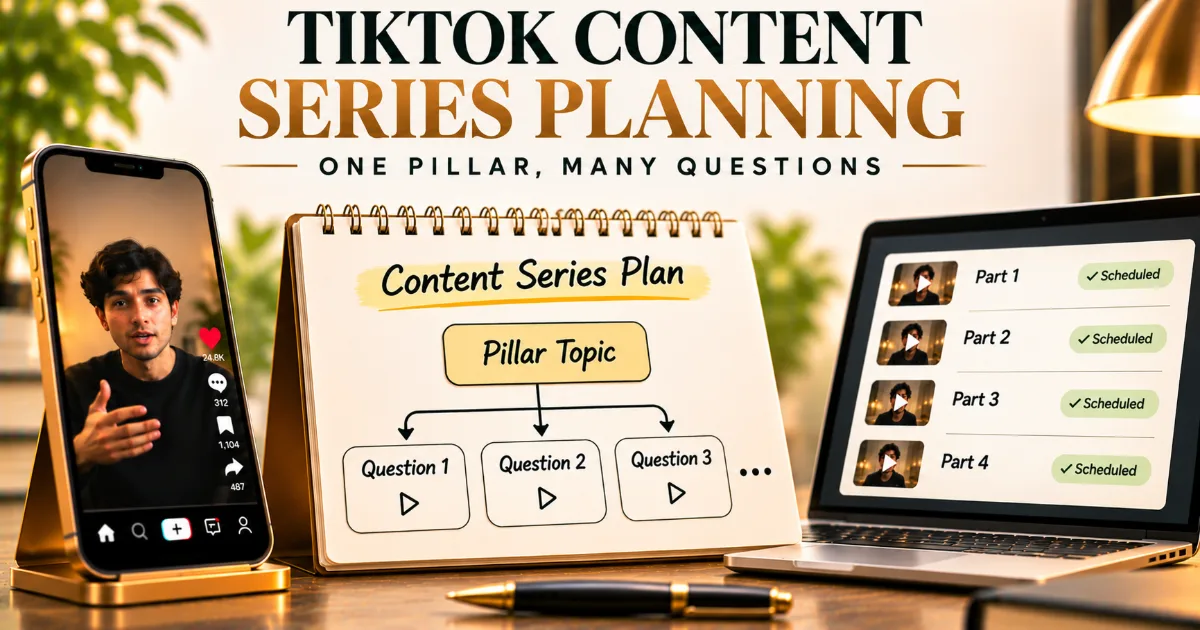
TikTok content series planning takes one subject a business knows deeply and turns it into a run of episodes, each answering a distinct question in full. Every episode has to stand alone, because most viewers will meet the series in the middle, and every episode points honestly to the next. The plan is a short list of questions in order, each with its own takeaway, checked so no two overlap. This post sets out how to choose the pillar, find its questions, order them, write the episode briefs, and keep the series running, with one structural engineer's renovation series as the example.
How one pillar becomes a planned TikTok series
- 01Choose the pillarone sentence naming who it serves
- 02Find the questionsin customers' words, split and merged
- 03Order themfrom the common to the specialist
- 04Brief each episodeone page, drafted side by side
- 05Connect and runa series name, a playlist, a rhythm
- TikTok content series planning: one pillar, asked as separate questions
- Why a series beats a stream of unrelated clips
- Step 1: choose the pillar the series lives in
- Step 2: find the questions inside the pillar
- Step 3: put the questions in an order that builds
- Step 4: write one brief per episode
- Step 5: connect the episodes for the viewer
- Step 6: keep the series running without forcing it
- A worked example: a structural engineer's renovation series
- What a series costs, and where it saves time
- Frequently asked questions
- Where to start
TikTok content series planning: one pillar, asked as separate questions
A series on TikTok is a set of clips on one subject, each answering a different question, published in an order that builds. It is not one long explanation cut into parts. A clip labelled "part three" that only makes sense after parts one and two is useless to the viewer who meets it first, and on TikTok that is most viewers, because the feed shows clips one at a time to people who have seen none of the others. The questions a series answers are often already in the comments under earlier clips, which the TikTok comment research workflow gathers and groups.
One long explanation cut into parts, and a series of questions
Parts of one video
- Part three needs parts one and two
- One explanation, cut where it is long
- Useless to a viewer who meets it first
A series of questions
- Every episode complete on its own
- One distinct question per episode
- Worth watching wherever a viewer starts
TikTok says as much about its own feed. Its page on how TikTok recommends content explains that it aims to diversify feeds with new creators, and that it generally won't recommend two posts in a row from the same creator. A viewer who meets episode three is unlikely to be shown episode four next, so episode three has to be worth watching by itself.
Each episode also has to clear TikTok's For You feed eligibility standards on its own. They count extremely short clips as low-quality content, ineligible for the For You feed, so an episode cut down to a teaser that only makes sense with the next one may not be recommended at all. Each brief in step 4 is written so the episode answers its question completely. The TikTok clip quality checklist then confirms it on the finished episode, where a clip that only makes sense beside the next one fails the stand-alone check.
So every episode in a good series is complete on its own: it names its question, answers it, and stops. The series adds something on top: a viewer who likes one episode can find the others, and the order means that someone who watches them all learns the subject properly. The planning is how both of those things happen without sacrificing either.
The starting point is a pillar, one of the few subjects a business has committed to being known for. Settling on those pillars comes before any series, and identifying your knowledge pillars walks through that decision. A pillar is large enough to hold many questions and specific enough that each question belongs to it. That combination is what makes it a series rather than a topic or a whole channel. The written counterpart is our guide to a Medium publication topic series, which splits one pillar into separate stories by the question each answers.
Why a series beats a stream of unrelated clips
A series beats a stream of unrelated clips because it lets a viewer who found one useful clip keep learning from the same business, and because it makes the business's expertise visible as a whole rather than as scattered fragments. One good clip earns a moment of attention. Five good clips on one subject, clearly connected, earn a reason to follow.
What a viewer’s interest does with connected and unconnected clips
the first useful clip
Left to right: the clips a viewer finds from one business
Bottom to top: how much the viewer learns and trusts the business
- a stream of unrelated clips
- episodes on one subject, clearly connected
Platforms reward the habit that series encourage. Instagram's creator team, in its post on helping creators of all sizes break through, names posting regularly as one of the most effective ways to grow, and also says each reel should "make sense to those who may not know you." A series is the plan that lets a business do both: post regularly on a subject it knows, without any episode depending on another.
A series is also easier to make. Once the questions are listed, nobody has to invent a topic each week; the next episode is the next row. The research, the expert's time and the recording can be batched, and the series becomes a reusable asset that other formats can draw on. Our guide to creating content that compounds over time explains why connected pieces keep earning attention long after unconnected ones fade. A series also gives visual tests a fair setting, because each episode follows one brief, which is how our guide to Higgsfield AI TikTok visual testing compares one scene with another.
Step 1: choose the pillar the series lives in
Choose a pillar where the business has deep, first-hand expertise, where customers have many distinct questions, and where the answers do not change every month. That last test matters for a series more than for a single clip, because a series is meant to be watched over weeks and found for months. A pillar built on fast-changing facts turns into a maintenance problem.
The pillar sentence every candidate episode is tested against
The series pillar, written once
- 01Who it is for: homeowners planning a renovation
- 02What they are trying to do: know what is safe to change
- 03Deep, first-hand expertise from the business
- 04Answers that do not change every month
The pillar should also be one the business is genuinely the right voice for. A structural engineer can run a series on whether walls can come down; a series on interior styling would be off to one side, however popular. Our guide to the knowledge architecture framework describes how a business maps its subjects, and the series pillar is usually the one where the map is densest.
Write the pillar down in one sentence that names who it is for and what they are trying to do: "homeowners planning a renovation who want to know what is safe to change". That sentence is the test every candidate episode must pass. A question that does not serve that person doing that thing belongs in a different series, or none.
Step 2: find the questions inside the pillar
Find the questions by listing everything customers ask about the pillar, in their words, and then splitting any question that contains more than one. The sources are the same ones that feed any topic research: enquiries, calls, site search, Search Console and TikTok's own search tools. Our guide to the TikTok content research workflow describes how to collect and weigh them.
How a pile of customer questions becomes a list of episodes
- Every question asked in customers' words
- Split into single questions one takeaway each
- Merged where answers match no two alike
- The episode list each teaches something new
A useful series usually needs between a handful and a dozen questions to start with. Fewer and it is a pair of clips; more and the plan becomes a list nobody finishes. Each question should be answerable in one clip, which in practice means one takeaway in one sentence. A question that needs a long caveat or several steps is often two questions, or a sign that the subject belongs on the website rather than in a clip. TikTok's own Creator Search Insights shows topics people search for in the app, which is a quick check that each question on the list is phrased the way viewers phrase it.
Check the list for overlap. Two questions that would get the same answer are one episode. Two questions that look different but share most of their answer should be merged, with the difference kept for a later episode. The goal is a list in which every episode teaches something the others do not, so a viewer who watches three learns three things.
| Test for each episode | What passes | What fails |
|---|---|---|
| Serves the pillar sentence | A question that person, doing that thing, would ask | A popular question for a different audience |
| One takeaway | An answer in one sentence without "and" | An answer that needs several steps or caveats |
| Stands alone | Makes sense to a viewer who saw nothing else | "As I said in the last one" |
| Adds something new | Teaches what no other episode does | The same answer with a different opening |
Step 3: put the questions in an order that builds
Order the questions so each episode makes the next one easier to understand, while still not depending on it. The usual order runs from the question most people ask first to the ones that only make sense once the basics are clear. A viewer who arrives at episode five should still follow it; a viewer who watches from episode one should find the series getting deeper rather than repeating itself.
The order of a series, from the first question to the specialist one
- 01The first question
answered plainly for anyone
- 02The questions that follow
each building on the basics
- 03The specialist questions
for viewers who want depth
The principle is an old one in interface design. Nielsen Norman Group's article on progressive disclosure describes deferring advanced features to a secondary screen so that applications are "easier to learn and less error-prone." A series does the same with ideas: the first episodes answer the common questions plainly, and the specialist ones come later for the viewers who want them.
Each episode still opens as if it were the first. The opening names its own question and states the most important point straight away, the pattern journalists call the inverted pyramid. The order affects which questions come first and which come later; it never means an episode can skip setting up its own subject.
Step 4: write one brief per episode
Every episode gets its own one-page brief before recording: the viewer's question, an opening that needs no context, the one takeaway, and the next step, which in a series is usually the next episode. The brief is where an episode is tested against the four rules in the table above, and where any overlap with another episode is spotted before anyone records it. An episode that needs footage beyond the speaker gets a shot list as well, which the TikTok B-roll planning workflow writes from the approved script, line by line. If an episode needs footage nobody filmed, the brief is also where its source is decided, using the tests in our post on Higgsfield versus stock footage. An episode built from generated footage also gets a storyboard, approved against the script, as our Higgsfield storyboard guide describes.
All the episode briefs drafted together from approved answers
- >Draft a brief for each question in order, every one standing alone
- ·Read the pillar sentence, the ordered questions and the approved answers
- ·Drafted every brief with its question, opening, takeaway and next step
- ·Two briefs repeat the same explanation of what a beam does
- >Keep it in the beam episode and cut it from the other
- +episode-briefs.md with every brief side by side
- Every brief drafted, one overlap resolved before recording
The briefs can be drafted together from the list. A model given the pillar sentence, the ordered questions and the approved answers can draft every brief in one pass, which makes overlaps easier to see, because the drafts sit side by side. Anthropic's prompting best practices recommend giving Claude the context and motivation behind a task, and here that means stating plainly that every episode must stand alone. Our TikTok video brief template sets out the four fields.
The answers behind the briefs should be approved before the briefs are written. For a series in a field with safety or legal limits, that matters even more, because a series is watched together and a mistake repeated across episodes compounds. Our TikTok FAQ video workflow describes how approved answers are written and kept, and a series is often several of those answers in a planned order. A newsletter series on a regulated subject needs the same approval of answers first, a step built into Substack newsletter series planning.
Step 5: connect the episodes for the viewer
Connect the episodes so a viewer who finds one can find the rest: a consistent name for the series on the frame and in the post caption, an honest pointer to the next question at the end of each episode, and a playlist where the platform offers one. The connection should be quiet. An episode that spends its last seconds advertising the series has spent seconds that belonged to its answer. A small label naming the series is usually enough, and TikTok on-screen text SEO covers keeping it readable and clear of the parts of the frame TikTok draws over. If an episode is generated, that series name goes on as type in the edit, never as lettering the model draws, as our guide to text in generated video explains.
What connects the episodes for a viewer who found one
one subject, one ordered list of questions
the same on the frame and in the caption
an honest pointer at the end of each
related posts watched in sequence
every episode on the business’s site
TikTok offers a direct way to group them. Its help page on playlists says playlists let creators categorise their public content and let viewers "watch related posts in a sequence," and notes that playlists are not yet available to every account. Where the business also posts long-form video, YouTube's help page on how to create and manage playlists does the same job on YouTube, and the same order can be used on both. If the business also records the whole subject as one long video, YouTube's help page on video chapters describes timestamps and titles in the description that split it into sections, and the chapter titles can be the same questions as the TikTok episodes.
On the business's own website, the series can become one page that lists every episode and links each to its fuller answer. That page is also where a viewer who wants the whole subject can find it in one place. Each episode can sit on that page as itself, since TikTok's developer documentation on embedded videos describes embedding TikTok videos in a website with the creator and the video's description shown.
Step 6: keep the series running without forcing it
Keep the series on a rhythm the business can actually sustain, and end it when its questions run out rather than stretching it to fill a schedule. A series that publishes one episode a week for six weeks and then stops cleanly is better than one that promises every day and trails off after three. The list of questions is the length of the series.
The weekly cycle that keeps a series on its rhythm
which episode is next
brief approved, clip passed its checks
nag the owner, or hand off
The rhythm can be enforced by the workflow rather than by memory. In n8n, the Schedule Trigger node runs a workflow at fixed intervals, so a weekly run can check which episode is next, whether its brief is approved and its clip is ready, and remind the right person if not. The schedule nags; it never posts an episode that has not passed its checks.
The schedule could not post an episode by itself even if it were asked to. TikTok's Direct Post reference keeps everything an app posts private until the app passes TikTok's audit, and n8n has no built-in TikTok node. So an approved episode goes either to the creator's inbox as a draft, through TikTok's Upload route, to be finished and posted in the app, or to a scheduler whose TikTok integration TikTok has approved.
Every episode must still be worth posting on its own merits, because a viewer judges each one alone and TikTok does not reward reused material that adds nothing new. A series padded with episodes that restate earlier ones fails that test and the viewer's patience at the same time. When the list runs out, the series is done, and the next pillar is the next series. One quiet episode is not that signal: TikTok's help page on videos that aren't getting views acknowledges that views on posts fluctuate, so the list, not one week's numbers, decides when the series ends.
A worked example: a structural engineer's renovation series
Take an illustration, not a client: a structural engineering practice that works mostly with homeowners wants a TikTok series. Its pillar sentence is "homeowners planning a renovation who want to know what is safe to change". The practice's enquiries are full of the same few questions, and the engineer lists them in customers' words, then splits and merges them into six episodes.
How the structural engineer’s renovation series was planned
Start
Pillar — written as one sentencewhat is safe to change
Questions
Six — two merged, one droppedplanning permission belongs elsewhere
Briefs
Overlap — moved to one episodethe beam explanation kept once
Weekly
Episodes — posted with a playlisteach ends on the next question
After six
Stop — the next pillar beginsits own list of questions
The order runs from the most common question to the most specialised: how to tell whether a wall is load-bearing, whether a load-bearing wall can come out at all, what a steel beam actually does, which cracks in walls matter, when a loft conversion needs an engineer, and what an engineer's report should say. Two candidate questions are merged because they had the same answer, and one about planning permission is dropped because it belongs to a different professional. Each episode's takeaway includes the engineer's limit: a clip explains what to look for, and never tells a viewer that a wall is safe to remove.
The briefs are drafted together, and side by side they show that the beam episode and the wall-removal episode repeated the same explanation, so the overlap moves into one of them. Each episode ends by naming the next question. The practice posts weekly, adds the episodes to a TikTok playlist, and puts the full series on one page of its website with links to the longer guides. When the sixth episode is posted, the series stops, and the next pillar's questions start their own list.
A few weeks later the practice reviews the series. The episode on which cracks matter was saved and shared far more than the others, and several enquiries mention it by name. That tells the engineer two things: the question deserves a fuller answer on the website, and the next series should go deeper into the same area. Neither conclusion needed a dashboard; the enquiries said it in customers' own words.
What a series costs, and where it saves time
A series costs more planning at the start than a single clip, an afternoon to list, split, merge and order the questions and a session to approve the answers, and less effort per episode afterwards, because nobody has to choose a topic each week. Recording can be batched: an expert who knows the next six questions can answer them in one session, which is far easier than six separate requests. Recording time is a fixed cost spread across the episodes, the split the TikTok content production cost model asks every business to make before it counts anything.
The ongoing cost is checking that each episode still stands alone as it is cut, and keeping the series page and playlist in step with what has been posted. Both are small. The bigger saving is that a planned series makes later work easier: the questions become an FAQ page, the episodes become a longer article, and the next series starts from a proven pattern. Our guide to content multiplication covers how one planned body of knowledge becomes many formats.
The failure to watch for is the series that keeps going after its questions are answered, because the schedule says so. Watch which episodes viewers save and share, as our guide to the TikTok content performance review describes, and let that shape the next series rather than the length of this one. A series is planned before any clip is cut, so it sits at the very front of the TikTok content automation pipeline; what happens to each episode after that, from the brief to the review, is covered in our TikTok content guides.
Frequently asked questions
What is a TikTok content series?
It is a set of clips on one subject, each answering a different question in full, published in an order that builds. Every episode stands alone, because most viewers meet a series in the middle, and each one points honestly to the next question so a viewer who wants more can keep learning.
How many episodes should a TikTok series have?
As many as the subject has distinct questions, usually between a handful and a dozen to start. Each episode should teach something the others do not. When the questions run out, end the series rather than stretching it with episodes that restate earlier ones.
Should TikTok series episodes be numbered parts?
Numbering is fine as a label, but no episode should depend on an earlier one. A clip that only makes sense after "part one" fails the viewer who meets it first. Name each episode's question on screen so it works on its own, and use the series name and a playlist to connect them.
How do I choose a subject for a TikTok series?
Choose a subject where the business has deep first-hand expertise, where customers ask many distinct questions, and where the answers do not change every month. Write it down as one sentence naming who it is for and what they are trying to do, and use that sentence to test every candidate episode.
Can I plan a TikTok series with AI?
A model can help split and merge questions and draft all the episode briefs together, which makes overlaps easy to spot. The expert should approve the answers behind the briefs, and a person should check that every episode stands alone before recording.
How often should a series post?
On a rhythm the business can sustain for the whole series, often weekly. A short series that posts steadily and ends cleanly is better than one that promises daily episodes and trails off. A scheduled workflow can remind the right person when the next episode is due without posting anything that has not been checked.
Where to start
Pick the subject your customers ask you about most and write one sentence naming who it is for and what they are trying to do. List their questions in their words, split any that contain two, merge any that share an answer, and put them in the order a newcomer would ask them. If you end up with five or six, you have a series. For a series built from one client's story rather than a subject, our TikTok case study video ideas post shows the same planning applied to problem, process and outcome, and our TikTok founder content workflow covers how the expert records episodes in their own words. The written counterpart, a plan of stories by reader question, is our guide to a Medium editorial calendar.
Disclosure
This post was written by Shreyas Dave, founder of Paper Eagle AI. We sell content automation services, which is the category this article is about, so we have a commercial interest in you concluding that a system beats ad-hoc effort — read it knowing that. No tool vendor was involved in writing it, nobody paid for a mention, and there are no affiliate links anywhere on this site. Where a third-party figure appears, it’s attributed to the publisher it came from; anything we couldn’t source is written as a direction rather than a number.
Paper Eagle AI builds Content Operating Systems that turn a business’s knowledge and expertise into consistent, multi-platform content, and we deliver them as content automation services. Working as a content automation specialist, we capture what a business knows and how it sounds, set the strategy, and build the workflows that research, draft, repurpose and publish — with a named person approving every piece before it goes out. Every build runs through discovery, design, build and handoff. The system lives in the client’s own accounts, it is documented, the team is trained to run it, and the business owns it outright. We don’t write content on a retainer, and we don’t build lead generation, CRM or sales automation.
One source of thinking becomes native content for every platform a business publishes on: the founder’s LinkedIn and the company page, YouTube and Shorts, Instagram and Reels, TikTok, Reddit, Medium, newsletters, and the company’s own website, written to be found in Google and understood by AI search. Our multi-platform content automation page shows how they share one source, and our case studies document the systems behind our own publishing, file by file. You can follow the work on the company’s own channels: Paper Eagle AI on Instagram, Paper Eagle AI on YouTube, the Paper Eagle AI company page on LinkedIn, Paper Eagle AI on Substack, Paper Eagle AI on Reddit and Paper Eagle AI on Medium. Paper Eagle AI is also listed where clients can review its work: Paper Eagle AI on Clutch, Paper Eagle AI on GoodFirms and the Paper Eagle AI Google Business Profile.
Keep reading
- How to identify your knowledge pillars — where every series starts.
- TikTok content research workflow — how the questions in a series are found and weighed.
- TikTok video brief template — the one-page brief each episode gets.