TikTok Clip Quality Checklist: When to Reject or Re-Record
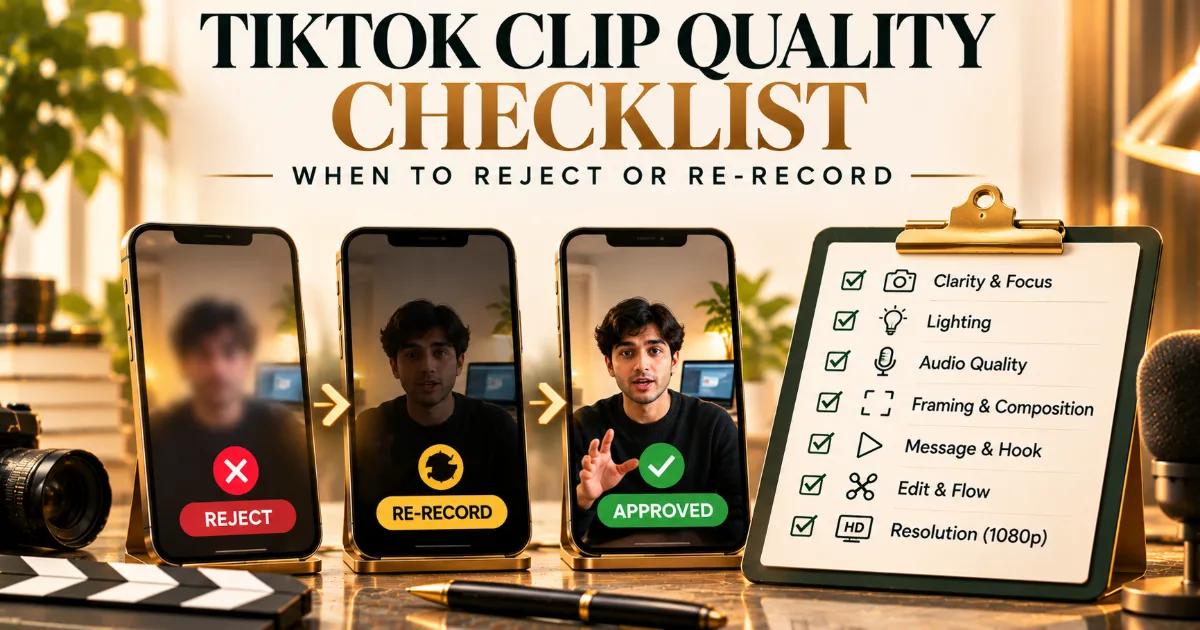
A TikTok clip quality checklist is the last test a clip faces before approval, and its most useful feature is that every failure has a name. A moment that needs context it does not have, makes its point too late, mixes two voices, sounds poor, makes a claim nobody can support, or exposes someone who did not agree is not forced into shape in the edit. It is rejected, rebuilt or re-recorded, and the reason is written down. This post sets out the checks, the three verdicts, how a first pass can be automated, and one recruitment agency's podcast clips.
From a finished clip to one logged verdict
- 01A finished clipedited, captioned, ready to judge
- 02Seven named checkseach check names one failure
- 03One verdictapprove, re-record or reject
- 04A logged reasonthe check name kept beside the clip
- TikTok clip quality checklist: every failure has a name
- Why forcing a weak clip costs more than dropping it
- Check 1 and 2: it stands alone, and it pays off in time
- Check 3 and 4: one clear voice, and it sounds and looks fine
- Check 5: every claim holds up
- Check 6 and 7: people agreed, and it adds something new
- Automating the first pass, and keeping the verdict human
- A worked example: a recruitment agency's podcast clips
- What the checklist costs, and what the log teaches
- Frequently asked questions
- Where to start
TikTok clip quality checklist: every failure has a name
A quality checklist only helps if it says why a clip fails, because the reason decides what happens next. "It doesn't feel right" leads to more editing, which is the most expensive way to fail. "The point arrives after the clip has lost its viewer" leads to a rebuild of the opening. "It names a candidate who never agreed to be discussed" leads to rejection, immediately, whatever else the clip has going for it. A newsletter needs the same discipline before each send, with reasons attached, which is how the Substack newsletter QA checklist is written.
The seven checks one finished clip has to pass
- Stands alone a stranger can follow it with nothing before it
- Pays off in time the point lands in the opening seconds
- One clear voice two people talk over the key line
- Sounds and looks fine audio clean, text on screen readable
- Every claim holds up a figure quoted from memory, no source
- People agreed everyone named or shown said yes
- Adds something new not a point the account already posted
The checklist below has seven checks, each with a short name the team can use in conversation, and three possible verdicts: rebuild, re-record or reject. A clip that passes all seven goes to approval. A clip that fails one goes to the verdict that check calls for, and the reason is logged against the clip so the same failure can be spotted next time.
| Check | What failure looks like | Usual verdict |
|---|---|---|
| Stands alone | Needs a question or a name the viewer never heard | Rebuild with context on screen, or reject |
| Pays off in time | The point arrives after a long warm-up | Rebuild the opening, or re-record |
| One clear voice | Two speakers talk over the point | Re-record, or reject |
| Sounds and looks fine | Muffled audio, a frozen frame, bad light | Re-record |
| Claims hold up | A figure or "always" nobody can source | Rebuild without it, or reject |
| People agreed | Someone named or shown without consent | Reject |
| Adds something new | Repeats a recent clip, or reuses footage unchanged | Reject |
The checklist runs on the finished clip, after the opening is settled and the captions are verified. It does not replace those steps; it confirms them and adds the questions only the finished version can answer. The selection tests in our guide to TikTok clips from YouTube videos, interviews and webinars come first, and this checklist is the final pass before the TikTok content approval workflow. Verified here means the captions came through TikTok caption automation, which corrects the transcript before a single caption is drafted.
Why forcing a weak clip costs more than dropping it
Forcing a weak clip costs more than dropping it because each fix adds a new risk. A moment that needs context gets a long caption; the caption covers the speaker's face. A point that arrives late gets cut to the strong line; the cut drops a qualifier. A muffled clip gets heavy audio processing; the voice sounds artificial. Every repair is reasonable alone, and together they produce a clip that is worse than either the original or nothing.
What each reasonable repair takes from a weak clip
- 01One weak clipa moment forced instead of dropped
- 02A long captionit covers the speaker’s face
- 03A cutit drops a qualifier
- 04Heavy processingthe voice sounds artificial
- 05What is leftworse than the original or nothing
Relative, not measured
The deeper cost is to the account. A business that posts every clip it records, however weak, trains its audience to expect little from it. Platforms push the same way. YouTube's channel monetization policies say content should not be "mass-produced, generic, repetitive, or manipulative" and should be made for viewers' enjoyment or education, "rather than for the sole purpose of getting views." That is YouTube's rule for monetised channels, but it describes what any feed is trying to avoid.
Rejection is also cheaper than it feels. The moment is not lost; the reason it failed is recorded, and many rejected moments come back as a better clip after a re-record or as a line in a longer piece. A clip that is not posted costs nothing with the audience. A clip that is posted badly costs the business a little of the attention it was trying to earn.
Check 1 and 2: it stands alone, and it pays off in time
The first two checks ask whether a viewer who arrives with nothing can follow the clip, and whether its point arrives before they leave. They are the same two tests that chose the moment in the first place, asked again of the finished clip, because editing can break either one. A cut that removed a sentence may have removed the only reference to what "it" was.
The two first checks, and what each failure asks for
Stands alone · late payoff
re-record from the pointclear, but the point arrives too late
Stands alone · early payoff
approvea stranger follows it and stays
Needs setup · late payoff
rejectneither test can be rescued
Needs setup · early payoff
rebuild the openinga question on screen supplies the context
Left column: the point lands late
Right column: the point lands early
The test for standing alone is to watch the clip as a stranger would: no knowledge of the recording, no idea who the speaker is. If a name, a question or an earlier point is needed, the clip fails, and the verdict depends on whether a question on screen can supply it. Our TikTok hook rewrite workflow covers how an opening can be rebuilt honestly; if it cannot be, the clip is rejected or the speaker re-records the idea in a self-contained way.
The test for payoff is where the point lands. The opening seconds are read the way a headline is: Nielsen Norman Group's guidance on writing headlines and other microcontent notes that people form opinions from headlines and summaries without digging deeper. A clip whose first seconds are warm-up has spent its headline on nothing. If the point cannot be moved earlier without changing it, ask the speaker for a re-record that starts with it.
Payoff has a floor as well. TikTok's For You feed eligibility standards list extremely short clips among the low-quality content they do not recommend, so a clip trimmed until it is all opening and no point fails the second check from the other side. The cut stops where the point has landed, not before.
Screen recordings fail these two checks in their own way. A demo that opens on a loading screen, or walks through three menus before showing the result, has buried its payoff in navigation. The fix is usually to start on the result and then show the two or three steps that produced it. Our TikTok product demo content workflow covers how a demo is planned so the finished state is on screen early, which makes this check far easier to pass. A B-roll plan written line by line helps for the same reason: each cutaway is there to show a step the speaker names, not to fill time.
Check 3 and 4: one clear voice, and it sounds and looks fine
The third check asks whether one voice carries the point clearly, and the fourth whether the sound and picture are good enough that a viewer notices the content rather than the flaws. Podcasts and panels fail the third check often: the point is real, but two people finish each other's sentences, and the clip makes sense only as a conversation.
Which quality problems decide a re-record most often
Relative, not measured
Overlapping speech also breaks the captions. Captions should identify who is speaking as well as what is said; the W3C's explanation of the success criterion for captions for prerecorded media notes that captions include dialogue and identify who is speaking. When two voices overlap on the key line, neither the captions nor the viewer can follow it, and the honest verdict is a re-record with one speaker making the point.
Sound matters more than picture. Viewers forgive a plain background and soft focus; they swipe away from muffled or echoing audio. Picture problems that do fail the check are the ones that distract: a frozen frame, light so poor the speaker's face is lost, text on screen too faint to read. The W3C's contrast minimum is a useful reference for any text placed over the video. Poor recordings are re-recorded rather than rescued with processing.
Two picture problems are technical rather than editorial, and a script can catch them before anyone watches. TikTok's Media Transfer Guide, which sets the files an app may post through TikTok's API, accepts video at 23 to 60 frames a second, with each side between 360 and 4,096 pixels, and recommends MP4 with H.264. A slideshow exported at a low frame rate, or a preview downscaled for a review link, falls outside that range before its content is judged at all. Picture problems of the editorial kind are cheaper to catch before the clip exists, on the storyboard our Higgsfield AI storyboard workflow approves.
Audio-first podcasts need one more question under the fourth check: is there a picture at all? Many shows are distributed as audio, and a still image with a waveform rarely holds a cold viewer. YouTube's help page on how to deliver podcasts using an RSS feed explains that it turns each episode into a static-image video built from the show art. That is fine for listeners who already follow the show, but it is not a TikTok clip. If the source is audio only, the clip either gets a picture worth watching, such as the guest on camera at the next recording, or it waits. Our YouTube guides cover the long-form side of the same recording.
Check 5: every claim holds up
The fifth check reads every claim in the clip, spoken or on screen, and asks whether the business could back it up if a viewer asked. A figure needs a source the business can name. An "always", a "never" or a "most" needs to be true. A claim the speaker made confidently in a relaxed recording is often the one that fails here, because conversation rounds things up in a way a public clip should not. A claim that holds up today can still fail later, which is why the TikTok content refresh workflow records each changeable fact a clip states once it is live. Pictures make claims too, and a generated one is checked against the visual brief behind it, whose last line says what the image may not suggest. Pictures count too: a stock cutaway that is nearly right can imply something untrue, which our comparison of Higgsfield and stock footage treats as a hidden cost of fixed footage.
What happens to each kind of claim before a clip is approved
As said on the recordingAs approved for the clip
A figure quoted from memory
a source named, or the figure removed
A promise about every client
the claim with its stated limit
A study nobody can name
the speaker’s real point, kept without it
Most failures can be rebuilt by cutting the claim and keeping the point around it, or by having the speaker restate it with its honest limit. Where the claim is the point, the clip is rejected. TikTok's business rules on misleading and false content forbid exaggerated promises in ads, and a business clip should meet the same bar: a statistic nobody can source does not become acceptable because it was said on a podcast.
The check is not about removing every number. A number the business measured itself, stated with what it measures, is fine and often the most useful thing in a clip. The test is whether the business would be comfortable being asked "where does that come from?" in the comments, and whether it has an answer ready.
Check 6 and 7: people agreed, and it adds something new
The sixth check asks whether everyone named, shown or clearly identifiable has agreed to appear, and the seventh whether the clip adds something new rather than repeating a recent one. The sixth is the only check with no rebuild verdict: a clip that exposes someone without their agreement is rejected, because no edit undoes a person's name having been said on a public platform.
What a clip about real people needs before it can be posted
Safe to post
- 01Agreedeveryone named or shown said yes
- 02Identifiable or notdetails removed when nobody agreed
- 03Adds something newnot a point already posted
a clip about people that is fair and fresh
Recruitment, healthcare, finance and legal businesses meet this check most often, because their conversations are about real people. A story about a candidate, a patient or a client is only usable if that person agreed, or if every identifying detail is gone and the story still makes sense. Our TikTok video rights checklist covers consent for people who appear, and our TikTok case study video ideas post covers consent for client stories. Consent matters just as much when a client's story is written up at length, which is where our guide to a content automation case study for Medium begins.
The seventh check guards against the account repeating itself. A clip that makes the same point as one posted last month, with a different opening, adds nothing for followers and little for strangers. TikTok's help page on content violations and bans explains that content under review may be removed or made ineligible for the For You feed under its Community Guidelines, and reused material with nothing new is one of the things that guidelines describe. A repeated point is rejected, and the log notes which earlier clip it duplicated.
TikTok's own wording draws the line more precisely than "repeated". The feed standards above rule out reproduced content uploaded without new or creative edits, naming a video that still shows another account's watermark as one case. In the originality policy explained by TikTok's Creator Academy, a post is unoriginal when it is largely repurposed from another source with no creative edits added. So for a clip cut from the business's own long recording, the seventh check asks two plain questions: what this edit gives a TikTok viewer that the recording did not, and whether the exported file still carries another platform's watermark.
Automating the first pass, and keeping the verdict human
A model can run a first pass of the checklist on a clip's transcript and frames, flagging likely failures with the check name and a reason, so the reviewer's attention goes straight to the problems. It is good at some checks and poor at others. It can spot a claim with a figure, a name that may be a person, a point that arrives late in the transcript, and a clip that repeats an earlier one. It cannot judge whether audio sounds natural or whether a person agreed to appear. If the transcripts come from a tool your team already uses, our ChatGPT guides show where a general assistant fits into the same review.
What the first pass flags, and what the reviewer decides
The first passThe reviewer
Read
scans the transcript and frames
reads only the flags
Flag
names the check and the reason
confirms or clears each flag
Route
sends flagged clips to review
listens to the audio itself
Verdict
records the clean clips as unflagged
approves, asks for a re-record or rejects
Anthropic's guide to defining success criteria and building evaluations describes grading from exact-match checks to grading by a model against a rubric, and notes that rule-based checks are fastest but lack nuance for complex judgements. The clip checklist uses both: rules for what can be matched, like a figure or a known name, and a written rubric for judgements, like whether a moment stands alone. Speaker labels from transcription help with the voice check; OpenAI's guide to speech to text describes models that identify who speaks during different parts of a recording.
The flags can route themselves. In n8n, the If node splits a workflow on a condition, so a clip with any flag goes to a reviewer with the flags attached, while a clean clip goes straight to approval with a note that the first pass found nothing.
A small script can make the first pass consistent before the split. The n8n guide to using the Code node describes running custom JavaScript or Python once for each item, which suits a queue of clips: the same rule checks every transcript for a figure or a person's name, and writes the check name beside each one it finds. Writing the rules down this way also stops them drifting between reviewers. Our n8n guides collect the other workflows built the same way.
The reviewer gives the verdict. Our post on automated content checks covers which checks a machine can enforce and which need a person.
A worked example: a recruitment agency's podcast clips
Take an illustration, not a client: a recruitment agency records a weekly podcast with two hosts and a guest hiring manager, and wants several TikTok clips from each episode. The editor shortlists six moments from one episode, and a first pass runs on each clip's transcript and frames before the editor reviews them. The same episode can also feed a written letter to subscribers, a job described in turning a Substack podcast into a newsletter.
What the recruitment agency’s six podcast clips came to
Six clips
- Approved two clips that passed every check
- Rebuilt the CV clip without the unsourced figure
- Re-recorded two hosts talking over the key line
- Rejected a named candidate and a repeated point
Rough shares — a shape, not a measurement
Two clips pass every check and go to approval. One is flagged for a claim: the guest says recruiters read a CV in a few seconds and quotes an exact figure from memory. Nobody can name the source, so the clip is rebuilt without the figure, keeping the guest's real point that a CV's first lines matter most. One is flagged for two voices: both hosts talk over the key line, so it is marked for a re-record, and the host who made the point records it alone at the start of the next episode.
The last two are rejected. One tells a story about a candidate by first name and employer, and the candidate never agreed to be discussed; no edit can fix that. The other makes the same point about interview preparation as a clip posted three weeks earlier. Both rejections are logged with their check names. Over the following episodes, the log shows that the claim check fails most often, so the agency adds a line to its guest briefing asking guests to bring sources for any figures they plan to quote.
What the checklist costs, and what the log teaches
The checklist costs a reviewer a few minutes per clip, less once a first pass flags the likely problems. The verdicts save time rather than costing it, because a rejected clip stops absorbing editing effort the moment it is rejected. The real cost is emotional: rejecting a moment the team liked is uncomfortable, and the named reasons make it a decision rather than a judgement on anyone. A speaker asked to re-record hears that their idea was good enough to say again, which is a far easier message than silence.
Three rejection logs, and what each one says about the checklist
some rejections in it every week
rejections fall to none and stay there
the standard slips, then the sample restores it
Three shapes, not three measurements
The log is where the checklist pays for itself. After a few weeks it shows which checks fail most, and those point to fixes upstream: a guest briefing, a recording habit, a microphone, a rule about naming people. Each fix removes a class of rejection before it happens. Our guide to content scoring covers how a quality rubric becomes something a team can apply consistently. The log has a second reader once clips are live: a TikTok content performance review shows whether clips that passed every check still lost viewers early, which is a reason to question a check, and the stage scores in our guide to how to audit a TikTok content workflow show whether an upstream fix held.
The failure to watch for is the checklist that stops rejecting. If every clip passes for weeks, check whether the checks are still being applied or whether a busy team is ticking boxes. A healthy log has some rejections in it. Reviewing a sample of passed clips once a month, with someone who did not approve them, is a cheap way to see whether the standard has slipped, and it gives the checklist a second reader before a viewer becomes one. Nothing is scheduled in the TikTok content automation we build until this checklist has passed it, and the earlier work it takes for granted, from choosing the moment to rebuilding the opening, is written up across our TikTok content guides.
Frequently asked questions
What should a TikTok clip quality checklist include?
Seven checks: the clip stands alone, its point arrives in time, one clear voice carries it, the sound and picture are good enough, every claim holds up, everyone named or shown agreed, and it adds something new. Each failure has a name and a verdict: rebuild, re-record or reject.
When should a clip be rejected instead of edited?
When the fix would change what the clip says, when someone is named or shown without their agreement, when the clip repeats a recent one, or when the claim that fails is the clip's whole point. Forcing those into shape adds risk with each repair; rejecting them, with the reason logged, costs nothing with the audience.
When should a clip be re-recorded?
When the point is good but the recording is not: two voices talk over the key line, the audio is poor, or the point only arrives after a long warm-up that cannot be cut honestly. A short re-record by the speaker, starting with the point, is usually quicker than rescuing the original.
Can AI check clip quality?
It can run a useful first pass on the transcript and frames, flagging claims with figures, possible names, late points and repeats, each with the check name and a reason. It cannot judge whether audio sounds natural or whether a person agreed to appear, so a reviewer always gives the verdict.
Why log the reason a clip was rejected?
Because the log shows which checks fail most, and those point to fixes earlier in the process, such as a guest briefing about sources or a better microphone. Each fix stops a whole class of rejections before they happen, which is cheaper than catching them one clip at a time.
Should every recorded clip be posted?
No. Posting every clip, however weak, trains an audience to expect little and spends the attention the business was trying to earn. A clip that is not posted costs nothing with viewers, and many rejected moments come back later as a better re-recorded clip.
Where to start
Take the clips you posted last month and run the seven checks on each, writing a check name beside every failure. If one check fails again and again, that is your first upstream fix. Then run the checklist on the next batch before approval, and keep the log. For moments that fail because they came from a long recording rather than a planned one, the same guide shows how a webinar's slides and attendee questions are handled before they reach this checklist. The quality checklist sits at the gate with the rights check and the approval, the three stages placed together in our Content Operating System for TikTok.
Disclosure
This post was written by Shreyas Dave, founder of Paper Eagle AI. We sell content automation services, which is the category this article is about, so we have a commercial interest in you concluding that a system beats ad-hoc effort — read it knowing that. No tool vendor was involved in writing it, nobody paid for a mention, and there are no affiliate links anywhere on this site. Where a third-party figure appears, it’s attributed to the publisher it came from; anything we couldn’t source is written as a direction rather than a number.
Paper Eagle AI builds Content Operating Systems that turn a business’s knowledge and expertise into consistent, multi-platform content, and we deliver them as content automation services. Working as a content automation specialist, we capture what a business knows and how it sounds, set the strategy, and build the workflows that research, draft, repurpose and publish — with a named person approving every piece before it goes out. Every build runs through discovery, design, build and handoff. The system lives in the client’s own accounts, it is documented, the team is trained to run it, and the business owns it outright. We don’t write content on a retainer, and we don’t build lead generation, CRM or sales automation.
One source of thinking becomes native content for every platform a business publishes on: the founder’s LinkedIn and the company page, YouTube and Shorts, Instagram and Reels, TikTok, Reddit, Medium, newsletters, and the company’s own website, written to be found in Google and understood by AI search. Our multi-platform content automation page shows how they share one source, and our case studies document the systems behind our own publishing, file by file. You can follow the work on the company’s own channels: Paper Eagle AI on Instagram, Paper Eagle AI on YouTube, the Paper Eagle AI company page on LinkedIn, Paper Eagle AI on Substack, Paper Eagle AI on Reddit and Paper Eagle AI on Medium. Paper Eagle AI is also listed where clients can review its work: Paper Eagle AI on Clutch, Paper Eagle AI on GoodFirms and the Paper Eagle AI Google Business Profile.
Keep reading
- Content scoring — how a quality rubric becomes something a team applies consistently.
- TikTok clips from YouTube videos, interviews and webinars — the tests that choose a moment before this checklist sees it.
- Automated content checks — which checks a machine can run and which need a person.