ChatGPT content guides.
ChatGPT writes quickly and competently, and for many businesses it is the first AI tool they use for content. These guides are about what it does well, what it leaves untouched — deciding what to write, knowing your business, holding a standard — and when it is enough on its own.
The engine, and the rest of the car.
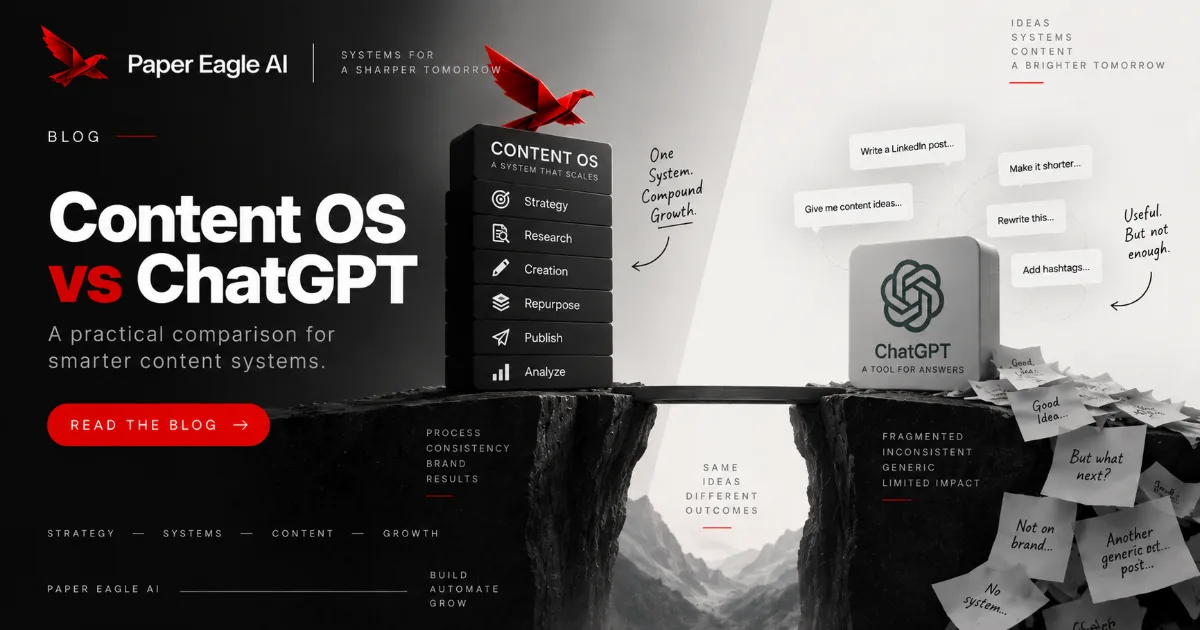
Can you just use ChatGPT for content? gives the straight answer. A capable general model is excellent at turning a clear instruction into competent prose, restructuring messy thinking and producing a first draft faster than a person can. What it leaves untouched is the rest of the content problem: deciding what to write, knowing your business, keeping the voice from drifting, holding a standard, and letting anything accumulate.
The same request, run two ways shows the difference in one example: a prompt typed from memory, then the identical request pointed at a knowledge layer. It shows which of those gaps written-down knowledge closes and which it does not. This page collects every guide on the blog that covers ChatGPT, and the section below sets out the rest.
ChatGPT for business content, in detail.
When ChatGPT on its own is enough
Sometimes it genuinely is. If you publish occasionally and content is not a meaningful route to customers, a system is overhead you do not need. If you are one person who writes well and holds the voice in your head, a saved prompt and good instincts will carry you a long way. A system starts paying when more than one person touches the content, when consistency over time matters more than any single piece, or when content is a real acquisition channel.
Projects close part of the gap
ChatGPT has a tidier way to stop retyping background: a project keeps related chats, files, instructions and sources together, and it is worth using. What it does not close is ownership. The context lives in one person's habits and one vendor's account, goes stale with nobody responsible for noticing, and describes only what that person thought to upload.
Every session starts cold
OpenAI's own documentation notes that each text-generation request is independent and stateless, with continuity supplied by whatever is sent along with it. So what you worked out last month — the framing that landed, the objection that keeps coming up — has to be supplied again, and a later piece costs roughly what the first one did. A Content OS is built the other way round: each piece feeds the knowledge the next one draws on.
What a system adds around it
A Content OS is not a competitor to ChatGPT; a general model is one component inside it. What the system adds is a map of what to write, knowledge captured once and supplied to every draft, a written voice that can be checked rather than felt, and an explicit standard applied to every piece before it is published.
The rest of the car, built for you.
A Content OS is what we build around models like ChatGPT. These pages describe it, and our pricing page sets out what each setup costs.
Talk it through with us.
If something here describes a problem you have, a short conversation is the quickest way to find out whether a system would fix it, and what it would take to build. No pitch: if we can't help, we'll say so.
Start a Conversation