YouTube content guides.
On YouTube, the long video is usually the richest thing a business makes — and the source every other platform can be built from. These guides cover where automation belongs in that work, what YouTube's own policy forbids, and how one video feeds everything else.
The video is the source.
Why the video is the source opens the multi-platform guide. You cannot fill a long video with a slogan: you have to explain the reasoning, give the example and answer the objection, which is exactly the raw material every other platform needs. The rest of that guide follows the video out to each of them.
The YouTube section of our three-platform guide covers the long-form branch of a pipeline: automation belongs almost entirely before the camera — the script, the chapters, the description — and almost nowhere after it. The cut, the title and the thumbnail stay with a person, and the guide explains why YouTube's reused-content rules make that a requirement rather than a preference.

Content Automation Specialist for Multi-Platform Content
One YouTube video can feed ten platforms, but only if each one gets content written for its own audience. Here is what each platform rewards, and how the translation works.
Read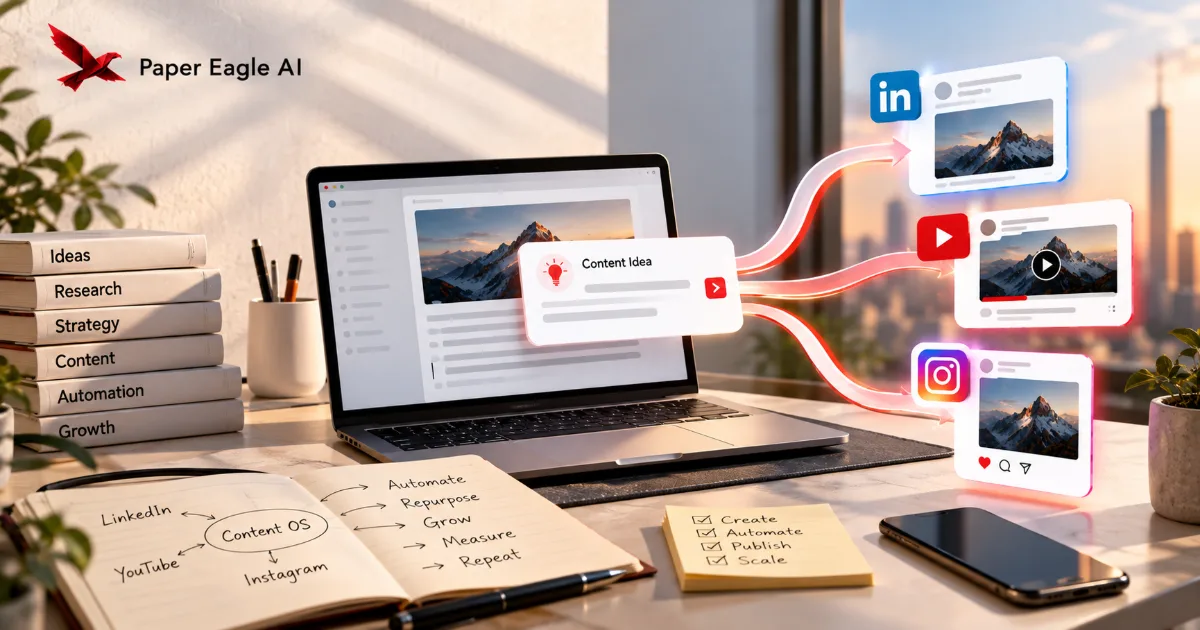
Content Automation Specialist for LinkedIn, YouTube & Instagram
Most businesses run three content calendars and call it a strategy. A pipeline runs one source of thinking through one translation layer into three platform-native outputs — and each platform has rules about what a machine may do.
ReadYouTube for a business, in detail.
The richest thing most businesses make
A long video holds an argument whole: the claim, the reasoning, the objection answered and the story that makes it land, in the speaker's own voice. Nothing shorter can carry all of that at once. YouTube is also a search engine, and its videos appear in Google results, so a clear explanation can keep being found for years instead of for an afternoon. Judged alone, a channel is a slow bet; judged as the source of everything else a business publishes, the recording earns its keep long before the channel finds an audience.
What YouTube's rules allow
Using AI for scripts, ideas or captions needs no disclosure on YouTube. What does is realistic synthetic media: a real-looking person, place or event that did not happen. Mass-produced or repetitive uploads are not eligible for monetisation, so every video has to be a new argument rather than a template with the words swapped. And only apps Google has audited can publish public uploads through its API, which means the last step, scheduling the video, belongs to a person in YouTube Studio or an approved app.
What a system automates, and what it leaves alone
Almost everything before the camera: researching topics people actually search for, gathering the sources and your own material into a brief, an outline you approve, a script written to be spoken, and the packaging — title options, a description, chapters and a thumbnail brief. Almost nothing after it. The argument, the delivery, the edit and the final choice of title stay with people, because those are the parts a viewer is judging.
Where the video goes next
The moment a video is published, its transcript becomes the raw material for every other platform: a distinct claim becomes a LinkedIn post, a self-contained moment becomes a Short or a Reel, a framework becomes a carousel, and the full argument becomes an article on your own site with the video embedded. Each one is rebuilt for where it is going, never trimmed and re-uploaded. That hand-off is what makes the channel worth running before it is worth watching.
YouTube, built for you.
Turning your expertise into videos, and those videos into everything else, is work we do for clients.
Talk it through with us.
If something here describes a problem you have, a short conversation is the quickest way to find out whether a system would fix it, and what it would take to build. No pitch: if we can't help, we'll say so.
Start a Conversation