TikTok FAQ Video Workflow: Scripts From Approved Answers
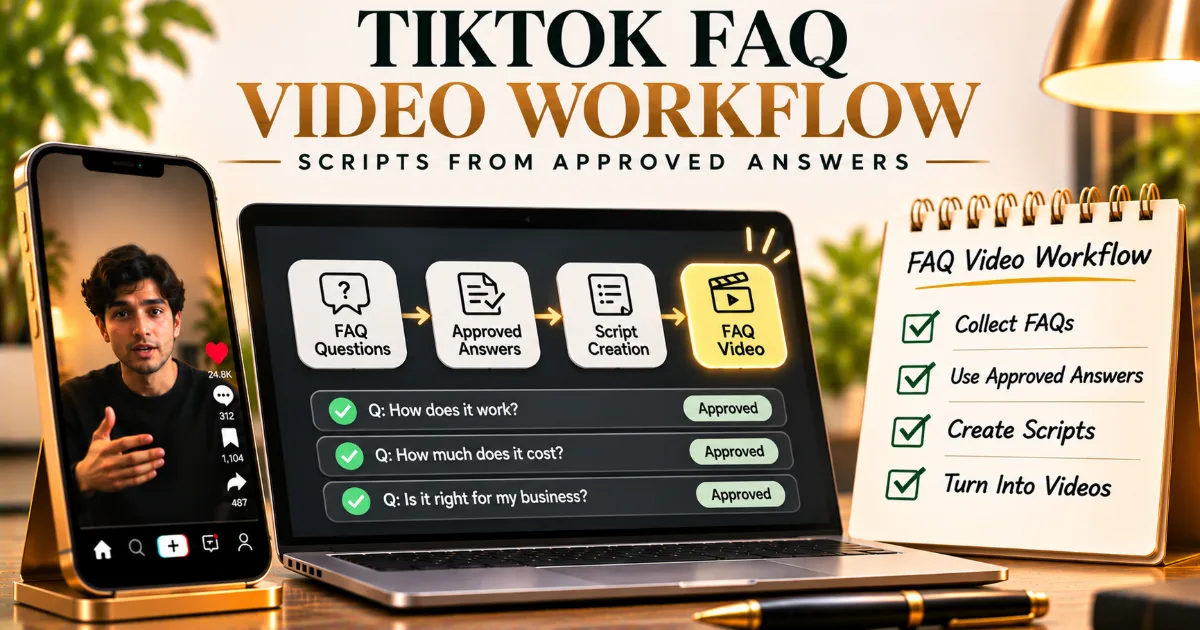
A TikTok FAQ video workflow turns the questions customers really ask into short scripts, and grounds every script in an answer the business has already approved. The question is collected in the customer's own words; the answer is written, checked and stored once with a source reference; the script is drafted only from that answer; and the reference travels with the clip, so anyone can see where each sentence came from. This post walks through each step, explains why scripts drafted from memory drift, and follows one heating-and-plumbing firm's recurring call questions into clips.
How a customer’s question becomes a TikTok clip with its source attached
- 01Collectthe question in the customer’s own words
- 02Approveone answer, signed by the person who knows
- 03Drafta script from that answer, each line cited
- 04Checkevery line compared with its source
- 05Post, referencedthe clip’s record keeps the answer it came from
- TikTok FAQ video workflow: approved answers first, scripts second
- Why scripts drafted from memory drift
- Step 1: collect the questions in the customer's own words
- Step 2: write one approved answer per question
- Step 3: draft the script from the answer, with citations
- Step 4: check the script against its source
- Step 5: keep the reference with the clip
- What the workflow does, and what people approve
- A worked example: one heating-and-plumbing firm's questions
- What the workflow costs, and where the time goes
- Frequently asked questions
- Where to start
TikTok FAQ video workflow: approved answers first, scripts second
An FAQ video is only as good as the answer behind it, so the workflow settles the answer before anyone thinks about the video. Each clip starts as a row in the business's knowledge base: the question as a customer asked it, the approved answer, the person who approved it, and the date. The script is then drafted from that row and nothing else. If a sentence in the script cannot be traced to the approved answer, it comes out. The same order holds for the pictures: an approved answer, then a storyboard approved against it, which our Higgsfield AI storyboard workflow builds in Popcorn. When the approved answer is a diagram, our diagram-to-explainer storyboard guide shows how its steps become the clip's frames in the same order.
The knowledge-base row every FAQ clip starts from
- Question
- as a customer asked it
- Approved answer
- the only text a script may draw on
- Approved by
- the person who would answer it on the phone
- Date
- when the answer was approved
- The row
- one answer, reused in clips, pages and emails
That order sounds slow and is the opposite. A business that answers the same question on the phone every week already has the answer in someone's head; writing it down and approving it once is the work. After that, the answer can become a TikTok script, a page on the website, a line in a support email and a reply to a comment, all saying the same thing. Our guide to what goes into a business content knowledge base describes the record that makes this possible. When the TikTok answer sends viewers to the page on the website, the TikTok to blog content workflow puts the two in one row of a clip-to-page map so each can link to the other.
This post covers questions that already have an answer the business stands behind. Questions that arrive in TikTok comments are a related but different source, because they have not been checked yet; our TikTok comment research workflow covers how those become candidate entries for the knowledge base before any script is written from them.
Why scripts drafted from memory drift
Scripts drafted from memory drift because the person writing them remembers the answer they gave last time, not the answer the business decided on. Over months, the phone answer, the website answer and the video answer move apart: one mentions a condition the others forget, one promises a turnaround the business no longer offers. Each version is close enough to sound right, which is why nobody notices. A recurring synthetic presenter for FAQ clips drifts in the same way without a written character sheet, the subject of our guide to a Soul ID character for a brand.
A script drafted from memory and one drafted from an approved answer
From memory
- The answer given last time
- Close enough to sound right
- An expert re-checks every sentence
- No way to say where it came from
From an approved answer
- The answer the business decided on
- The same on phone, page and video
- Anyone careful compares it with the source
- The reference travels with the clip
A model drafting from memory has the same problem in a sharper form. It has no memory of the business's answer at all, only of how answers to similar questions usually sound. The research behind retrieval-augmented generation names the issue directly: the paper by Patrick Lewis and colleagues on retrieval-augmented generation for knowledge-intensive tasks notes that language models' ability "to access and precisely manipulate knowledge is still limited" and that "providing provenance for their decisions" remains an open problem. Giving the model the approved answer to work from is the practical fix.
Grounding also changes what a checker has to do. Without a source, checking a script means asking an expert whether every sentence is right. With a source, it means comparing the script with the approved answer, which anyone can do. That is a much smaller job, and it is the reason the reference is kept with the clip rather than thrown away after drafting.
There is a platform reason too. TikTok's rules on integrity and authenticity say it aims "to ground those conversations in facts" and that content containing misinformation which may cause moderate harm is ineligible for the For You feed. An FAQ clip that gets a safety step wrong is exactly the kind of content that rule exists for, which is another reason to treat the approved answer as the only source.
Step 1: collect the questions in the customer's own words
Collect the questions exactly as customers ask them, from calls, emails, forms and the counter, and keep their wording, because their wording is what other customers will recognise. "Why does my boiler keep losing pressure?" is a question; "Pressure loss diagnostics" is a heading. The clip that answers the first will be watched by people who have the problem; the clip titled with the second will be watched by people who already know the term.
Where the questions come from, and the one thing they share
the wording other customers recognise
recorded with agreement, names stripped
the question as it was written
the box where people type it
questions asked in person
Nielsen Norman Group's article arguing that FAQs still deliver great value puts the reason well: a business's "vocabulary and your users' vocabulary probably talk past each other," and FAQs with made-up questions are a long-standing mistake. "If you're listening to your users, you know what their questions are." A list collected from real conversations is the opposite of a made-up one.
TikTok offers a second view of the same wording. Its help page on Creator Search Insights shows topics people search for on TikTok, which is a useful check on whether customers phrase a question the same way in the app as they do on the phone. The phone remains the better source for a local service business, because the people calling are the customers the business actually serves. Calls are one signal among several, and the TikTok content research workflow looks for a second, such as a search term or an enquiry, before a topic is ready for a brief.
Recorded calls are the richest source if the business records them with customers' agreement. A speech-to-text step can turn them into text; OpenAI's guide to speech to text describes how a prompt and keywords improve recognition of names and specialist vocabulary. Strip anything that identifies the customer before the question is stored. The knowledge base needs the question, not the caller. The same customer wording later goes on screen, and TikTok on-screen text SEO covers checking it for contrast and placement on a phone.
Step 2: write one approved answer per question
For each question that comes up often, write one answer, have the person who knows the subject approve it, and store it with their name, the date and a reference number. That answer is the only source any script may draw on. It can be longer than a clip needs, because the script will select from it, but it must be complete enough that nothing important has to be remembered.
The parts of an approved answer, with the reference underneath
An approved answer has four parts: the direct answer in one or two sentences, the conditions under which it is true, what the customer should do, and what the customer should not do themselves. The last part matters for any business whose work has safety or legal limits. A clip that explains why a boiler loses pressure should say plainly which checks a householder can make and which need a qualified engineer, and the approved answer is where that line is drawn.
Keep the answers in one place that both people and workflows can read. The knowledge base can live in a database, a document store or a set of files in a Claude Code project; what matters is that each answer has a stable reference that a script can point to. Our guide to building a knowledge base for AI content covers the structure in more detail.
As the knowledge base grows, the drafting step needs to find the right answer before it can use it. Anthropic's engineering post on contextual retrieval starts from the same observation, that a customer support assistant "needs knowledge about the specific business" it serves, and describes how retrieval finds the relevant passages in a large collection. Hosted tools do this too: OpenAI's guide to file search describes retrieving information from "a knowledge base of previously uploaded files." For a small business with a few dozen answers, a simple lookup by reference is enough; retrieval matters once nobody can remember which answer covers which question.
| Part of the answer | What it holds | Why the script needs it |
|---|---|---|
| The direct answer | One or two sentences that answer the question | It becomes the clip's takeaway |
| Conditions | When the answer is true, and when it is not | It keeps the clip from overclaiming |
| What to do | The customer's sensible next step | It becomes the clip's next step |
| What not to do | Anything that needs a qualified person | It keeps the clip safe to follow |
| Reference | An ID, the approver and the date | It travels with every clip made from the answer |
Step 3: draft the script from the answer, with citations
Draft each script from its approved answer and nothing else, and have the drafting step show which part of the answer each line came from. A short FAQ script is usually the question on screen or spoken, the direct answer, one condition, and the next step. Everything in it should be recognisable as a shortened version of the approved text.
A script drafted from an approved answer, line by line
- >Draft a short script from the pressure answer only, citing each line
- ·Opened the approved answer and its reference
- ·Drafted the question, the direct answer, one condition and the next step
- ·Cited the passage behind each line
- ·The approved answer does not cover older systems: leave it out?
- >Leave it out and flag the answer for the engineer
- +script draft with a citation beside every line
- A cited script and one flagged gap in the approved answer
The citation can be produced mechanically. Anthropic's documentation on citations describes a feature that returns "the exact passages that support each claim," so a model given the approved answer as a document can return a script with each line linked to the sentence it came from. The checker then reads the script beside its sources rather than asking an expert to re-verify the subject. In a written story the same support is shown to the reader as a link, placed the way our guide to Medium article source citations describes. For a written draft, the claim-by-claim version is our guide to Medium AI article fact checking.
Tell the model it may leave a line out rather than invent one. A draft that says "the approved answer does not cover this" is a correct result, and a sign the answer needs updating, not the script. The person who owns the answer then decides whether to extend it, and the next draft has something to cite.
Write the script in plain words: everyday terms, short sentences, one instruction at a time. An FAQ clip that gives a householder two steps should say them as two sentences, in order, not as one sentence with a clause in the middle.
Step 4: check the script against its source
Before recording, a person compares every line of the script with the approved answer it cites, and anything that is not supported is removed or sent back to the answer's owner. The check is a comparison, not a fresh review of the subject, so it can be done by anyone careful, not only the expert. The expert's time goes into the answers, once, instead of into every clip.
The four kinds of drift a checker looks for before recording
- Every condition kept the conditions match the answer
- Every number unchanged nothing rounded or moved
- No promise added the script adds a guarantee the answer never makes
- Warnings not softened the what-not-to-do line survives
The check looks for four kinds of drift: a condition dropped, a number changed, a promise added, and a "what not to do" line softened. Those are the four ways a short version of a careful answer becomes a careless one. A checker that did not draft the script is best placed to see them; a separate checking step, given only the script and its sources, can compare the two without the reasoning that produced the draft.
The same check runs on the captions and the post caption, because both are written from the script. Our guide to TikTok caption automation covers the captions; the post caption simply has to say nothing the script does not. Once the script, captions and description agree with the answer, the clip goes into the same approval flow as any other, described in our TikTok content approval workflow.
Step 5: keep the reference with the clip
Store the approved answer's reference in the clip's record after it is posted, so anyone can trace a clip back to the answer it came from and the person who approved it. This is the step that pays off months later. When a customer quotes a clip back to the business, or a rule changes, the reference shows exactly which clips said what.
How a changed answer reaches every clip that used it
the owner updates the approved answer
the reference lists every clip, page and email that cites it
each one is updated, replaced or taken down
The reference makes updates possible. When an approved answer changes, a workflow can list every clip, page and email that cites it, so each can be reviewed. Without references, the business has to search its own content by memory, and old clips keep giving the old answer. When clips go out through TikTok's API, the record can hold TikTok's own id for each post too: the Get Post Status reference returns it only once the post is public and has passed TikTok's moderation, so a clip still in review has no id to store yet. Our guide to the TikTok content refresh workflow covers what to do with a clip whose answer has changed.
The knowledge base can drive the whole loop. In n8n, the Notion node can search databases and create pages, so a workflow can read an approved answer, start a script draft and write the clip's reference back to the answer's page. On the website, the same approved answers can appear as an FAQ page, which keeps the site and the clips answering in the same words. Build that page for readers rather than for a search feature: Google's Search Central changelog records that the FAQ rich result is no longer shown in Google Search results, after it was withdrawn in May 2026.
What the workflow does, and what people approve
The workflow collects questions, groups similar ones, drafts scripts from approved answers with citations, checks them against their sources and keeps the references; people write and approve the answers, decide which questions become clips, and record them. The split follows where judgement is needed. Knowing the right answer is expertise. Keeping every clip consistent with it is bookkeeping.
Bookkeeping by the workflow, expertise by the business
The workflowThe business
Questions
collects and groups similar ones
decides which become clips
Answers
stores each with its reference
the expert writes and approves it
Scripts
drafts with citations and checks them
compares lines with sources
Recording
keeps the reference in the record
the expert answers on camera
Two decisions stay with the business by design. The first is the approved answer itself, which belongs to the person who would be accountable for it on the phone. The second is which questions become clips at all: some questions are common but have answers that depend so much on the individual case that a clip would mislead more people than it helps. The approved answer can say so, and that question stays on the phone.
The recording stays human too. An FAQ clip is most useful when the person who answers the question for a living is the one answering it on camera, in their own words, from the script. Our guide to turning business knowledge into content explains why expertise is most convincing when it is heard from the person who has it.
Three things about the finished clip are settled by TikTok's rules rather than by the workflow. Length comes first: TikTok's creator info reference says every creator can post videos of up to three minutes and some can post five or ten, and an app is told each creator's own ceiling. An approved answer that needs longer than that becomes two questions, not one rushed clip.
Then the label. TikTok's page on AI-generated content asks creators to label content that shows realistic images, audio or video made with AI. A script drafted with AI help and spoken on camera by the firm's own engineer is not what that label describes; the same script read by an AI voice or an AI avatar is. TikTok can also apply the label itself: its newsroom post on advancing AI transparency explains that it reads C2PA Content Credentials attached to images and videos from some other platforms and labels that content automatically, so an avatar clip rendered by a tool that attaches those credentials is labelled whether or not anyone ticks the box. A tool that does not say whether it attaches them leaves the label to you, which is the case our news story on Higgsfield’s Seedance 2.5 previews and 4K clips describes.
And when a clip is posted through an app, TikTok's Content Sharing Guidelines make marking it as promotional content a toggle the creator turns on, never a default, so a clip about the firm's own boiler service is labelled by someone who chose to.
A worked example: one heating-and-plumbing firm's questions
Take an illustration, not a client: a heating-and-plumbing firm notices that its office takes the same handful of questions every winter, about boilers losing pressure, radiators that stay cold at the top and whether an annual service is really needed. The office manager collects the questions as customers phrase them from a few weeks of call notes, stripped of names and addresses, and groups them.
Where the heating-and-plumbing firm’s FAQ clips stood after one morning
complete
three common questions answered and signed
one fixed
a draft that dropped a condition was matched again
fully
every record carries its answer’s reference
A judgment, not a score
The firm's lead engineer writes one answer per question and approves it. The answer to the pressure question gives the direct answer, the conditions, the check a householder can safely make, and a clear line that anything beyond that is a job for a qualified engineer. Each answer gets a reference and the engineer's name and date. A model drafts a short script from each answer with citations, and the office manager compares the scripts with their sources.
One draft is caught: it said the householder could "top up the pressure and you're done", dropping the condition that a boiler needing frequent top-ups has a fault to find. The line goes back to match the answer. The engineer records three clips in one morning, each opening on the customer's question shown on screen. That is the question-on-screen move from the TikTok hook rewrite workflow, used here from the start rather than as a repair. The clips' records carry their answer references, and when the firm later changes its service booking process, the references show exactly which clip mentions it. The engineer on camera is staff, but a staff member's consent still belongs on file, and a TikTok video rights checklist records it alongside any footage or music the clip uses.
What the workflow costs, and where the time goes
Most of the cost is the first set of approved answers, which takes the expert a few focused sessions; after that, each FAQ clip costs a short check and a short recording. The answers are reusable everywhere, so the cost is shared with the website, support emails and anything else that answers the same questions. The scripts are cheap because the hard thinking was done once. The TikTok content production cost model would put that thinking in the fixed column and the short recordings in the per-clip one.
The ongoing cost is keeping answers current. Every approved answer should have a review date, and the workflow should list answers due for review along with every clip that cites them. That is a few minutes a month for most small businesses, and it is the difference between an FAQ library that stays useful and one that slowly starts giving last year's advice.
The failure to watch for is the script that drifts back towards memory: a busy week, a clip recorded straight from the expert's head, no reference stored. It may well be right, but nobody can tell. Keep the rule simple: no reference, no post. The references these scripts cite come from the knowledge base our business knowledge guides describe; after that, an FAQ clip takes the same route as any other through our TikTok content automation, and every step on that route has a write-up in our TikTok content guides.
Frequently asked questions
What is a TikTok FAQ video workflow?
It is a process for turning the questions customers ask most into short TikTok clips. Each question is collected in the customer's own words, answered once by the person who knows the subject, stored with a reference, and then turned into a script drafted only from that approved answer, so every clip says what the business has actually decided.
Where do the best FAQ video questions come from?
From real conversations: calls, emails, enquiry forms and questions at the counter. Keep the customer's wording, because that is how other customers will recognise the problem. Made-up questions are a long-standing FAQ mistake, and they make clips that only people who already know the subject will understand.
How do you stop AI from making up the answer?
Give it the approved answer as a document and ask for a script drafted only from that, with each line citing the passage it came from. Allow it to leave a line out when the answer does not cover something. Then have a person compare every line with its source before the clip is recorded.
Who should approve the answers?
The person who would be accountable for that answer on the phone, usually the most experienced person on the subject. Their approval, name and date are stored with the answer. Scripts then only need checking against the approved text, which anyone careful can do.
What happens to old clips when an answer changes?
Because each clip's record keeps the reference of the answer it came from, a changed answer can be traced to every clip, page and email that used it. Each one is then reviewed and updated, replaced or taken down, instead of the old answer continuing to circulate.
Should a business answer every common question on TikTok?
No. Some questions are common but their answers depend so much on the individual case that a short clip would mislead more people than it helps. The approved answer can say that, and those questions are better answered in a conversation with the customer than in a public clip.
Where to start
Ask whoever answers your phone to list the five questions they hear most, in the customers' words. Write one approved answer for the most common of them, with the conditions, what to do and what not to do, and give it a reference. That single answer is your first FAQ clip and the start of the knowledge base the rest will come from. When the answers start forming groups, our TikTok content series planning guide shows how a group of related questions becomes a series, and our guide to organising business knowledge covers where the answers should live. Approved answers like that one are what keep a TikTok review fast enough to follow trends, the argument of a Content Operating System for TikTok.
Disclosure
This post was written by Shreyas Dave, founder of Paper Eagle AI. We sell content automation services, which is the category this article is about, so we have a commercial interest in you concluding that a system beats ad-hoc effort — read it knowing that. No tool vendor was involved in writing it, nobody paid for a mention, and there are no affiliate links anywhere on this site. Where a third-party figure appears, it’s attributed to the publisher it came from; anything we couldn’t source is written as a direction rather than a number.
Paper Eagle AI builds Content Operating Systems that turn a business’s knowledge and expertise into consistent, multi-platform content, and we deliver them as content automation services. Working as a content automation specialist, we capture what a business knows and how it sounds, set the strategy, and build the workflows that research, draft, repurpose and publish — with a named person approving every piece before it goes out. Every build runs through discovery, design, build and handoff. The system lives in the client’s own accounts, it is documented, the team is trained to run it, and the business owns it outright. We don’t write content on a retainer, and we don’t build lead generation, CRM or sales automation.
One source of thinking becomes native content for every platform a business publishes on: the founder’s LinkedIn and the company page, YouTube and Shorts, Instagram and Reels, TikTok, Reddit, Medium, newsletters, and the company’s own website, written to be found in Google and understood by AI search. Our multi-platform content automation page shows how they share one source, and our case studies document the systems behind our own publishing, file by file. You can follow the work on the company’s own channels: Paper Eagle AI on Instagram, Paper Eagle AI on YouTube, the Paper Eagle AI company page on LinkedIn, Paper Eagle AI on Substack, Paper Eagle AI on Reddit and Paper Eagle AI on Medium. Paper Eagle AI is also listed where clients can review its work: Paper Eagle AI on Clutch, Paper Eagle AI on GoodFirms and the Paper Eagle AI Google Business Profile.
Keep reading
- What goes into a business content knowledge base — the record every approved answer sits in.
- TikTok video brief template — the one-page brief an FAQ script fills in.
- How to build a knowledge base for AI content — the structure that lets a model draft from approved answers.