SEO content clusters.
An SEO content cluster is a set of pages on one subject: a pillar page that answers the broad question and spoke pages that each answer one narrower question, all linked to each other. These guides cover how a cluster is planned from a keyword list, built, linked and kept current.
Plan the cluster before the pages.
Start with what a content cluster is, which explains the pillar and the spokes and how a cluster turns what a business knows into a publishing plan. The SEO playbook for a Content OS shows why clusters beat scattered posts in search, with one cluster worked through from pillar to spokes.
Planning starts from a keyword list. How to automate keyword clustering covers the two ways to group search phrases, by shared results or by shared meaning, and the check against the pages you already have that stops a new page competing with an old one.
Then each group has to earn its page. The existence gate for automated SEO content decides which clusters become pages before anything is drafted, automated internal linking wires every spoke to its pillar, and a Medium topic series applies the same plan to a publication off your own site.
Clusters sit inside wider subjects. The SEO and AI search guides cover how engines and language models read the pages, and the business knowledge guides cover the knowledge pillars a cluster is built from.
Build a Semantic Keyword Clustering System with Python in Claude Code
Who does what in a semantic keyword clustering system: Python runs it, an embedding model reads meaning, an algorithm groups, Claude Code helps build it, and a person corrects the clusters.
ReadBuild an SEO Keyword Clustering Engine in Claude Code
How to package keyword clustering as a Claude Code skill: the folder, the scripts, the table of pages you already own, and the tests that catch a bad merge before it becomes a page.
Read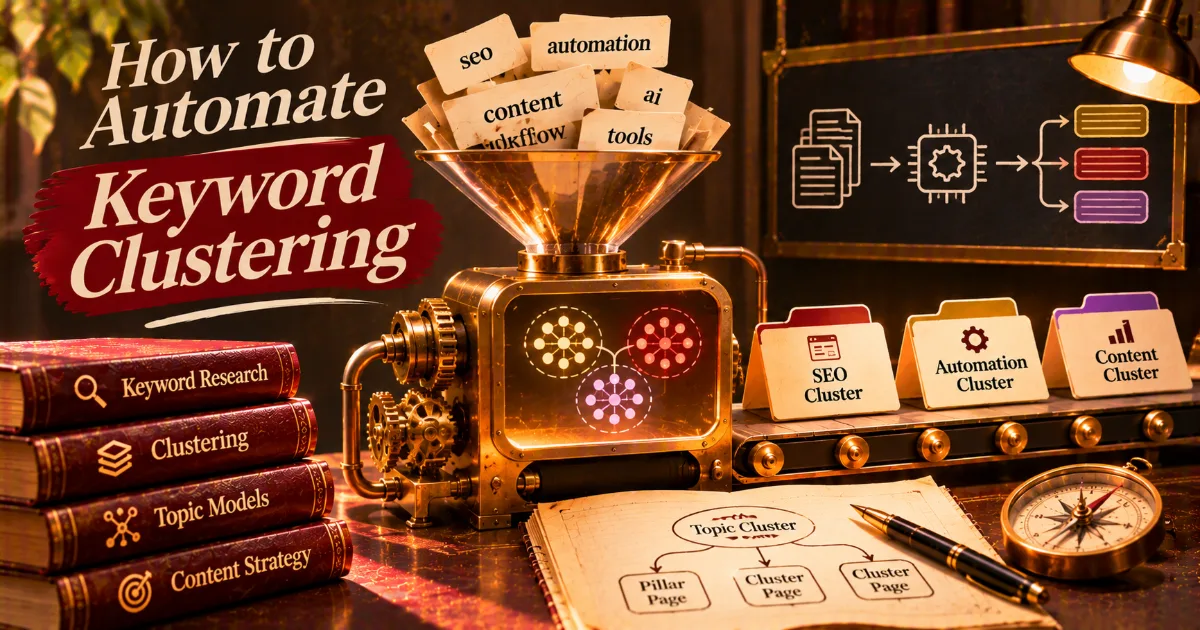
How to Automate Keyword Clustering: From a Keyword List to an SEO Content Cluster
A keyword export is not a content plan until it is grouped by intent and checked against the pages you already have. Here is how to automate that grouping, and what a person still decides.
Read
Medium Publication Topic Series: Several Stories From One Knowledge Pillar
Divide one subject your business knows into Medium stories that each answer a different reader question, using a topic map and a near-duplicate test before anything is written.
ReadHow to Automate Internal Linking in a Content Automation System
Internal links as a checked step in the pipeline: the map before the draft, anchors that name the page, orphan detection, and the edit older posts owe a new one.
Read
SEO Content Automation: How to Scale Without Search Spam
Which stages of an SEO content pipeline a machine can run safely, and the gates that refuse a page Google would call scaled content abuse before anyone drafts it.
Read
The SEO Playbook for a Content OS
Search strategies for businesses that have structured their knowledge. How to make your Content OS the most discoverable asset you own — and keep it that way as search changes.
Read
Content Clusters: The Bridge Between Knowledge and Content
How to organize your knowledge into clusters that serve your audience, answer real search intent, and build topical authority. Includes examples, a cluster planning template, and a maintenance workflow.
ReadAn SEO content cluster, in detail.
What a cluster is made of
A cluster has three parts. The pillar page answers the broad question a buyer asks first and links out to every spoke. Each spoke page answers one narrower question in full and links back to the pillar. The links between them, written into sentences that name where they go, are what tell a search engine and a reader that the pages belong together. A pillar page and a cluster page do different jobs, and a cluster needs both.
How a cluster is planned
Planning turns a list of search phrases into a cluster map: one row per page, its pillar, the phrases it answers and the reason for each decision. Phrases are grouped first, either because the same pages rank for them or because they mean the same thing, and every group is then checked against the pages the site already has. A group that an existing page already answers becomes a refresh of that page, not a new URL. From groups to a cluster map sets out the steps.
What can be automated
The repeatable steps can run as a workflow: grouping phrases by meaning with embeddings, comparing the draft groups with the queries Search Console reports for each page, flagging groups that overlap an existing page, and checking that every spoke links to its pillar. In our own builds those steps run in Claude Code and n8n. A safe SEO pipeline puts the cluster step first, before any brief is written.
What stays with a person
A person decides what the business wants to be found for, which groups are worth a page, and every close call a similarity score cannot settle: a group that mixes a buying search with a learning search, or one whose phrases already belong to a service page. A person also approves every page before it is published. What the script groups, and what a person decides lists the cases worth checking by hand.
Clusters and AI search
Google says its AI features need no special optimisation, and the same pages that rank well are the ones those features draw on. A cluster helps because it answers a subject's real questions on a sensible number of pages, each one quotable on its own. Clusters, authority and AI search explains why a connected set of pages earns more trust than the same words spread across unrelated posts.
The mistakes that cost a cluster
Three mistakes recur. Building a page for every phrase, which produces near-duplicate pages that compete with each other. Skipping the check against existing pages, so a new post takes searches from an older one. And publishing spokes that never link to the pillar, which leaves the cluster as scattered posts that only look planned. Where the effort usually goes wrong covers the rest.
Clusters, built into the system.
We plan and build clusters as part of the search layer of a content system. These pages describe that work, and website SEO automation pricing explains how it is quoted.
SEO content automation
The search layer we build: clusters mapped to real demand, one page per cluster, and the review before anything is published.
What we buildSEO content writing
How each page in a cluster is written: answer first, one question per heading, from the business's own knowledge.
Talk it through with us.
If something here describes a problem you have, a short conversation is the quickest way to find out whether a system would fix it, and what it would take to build. No pitch: if we can't help, we'll say so.
Start a Conversation