How to Audit a Medium Publishing Workflow With One Tested Article
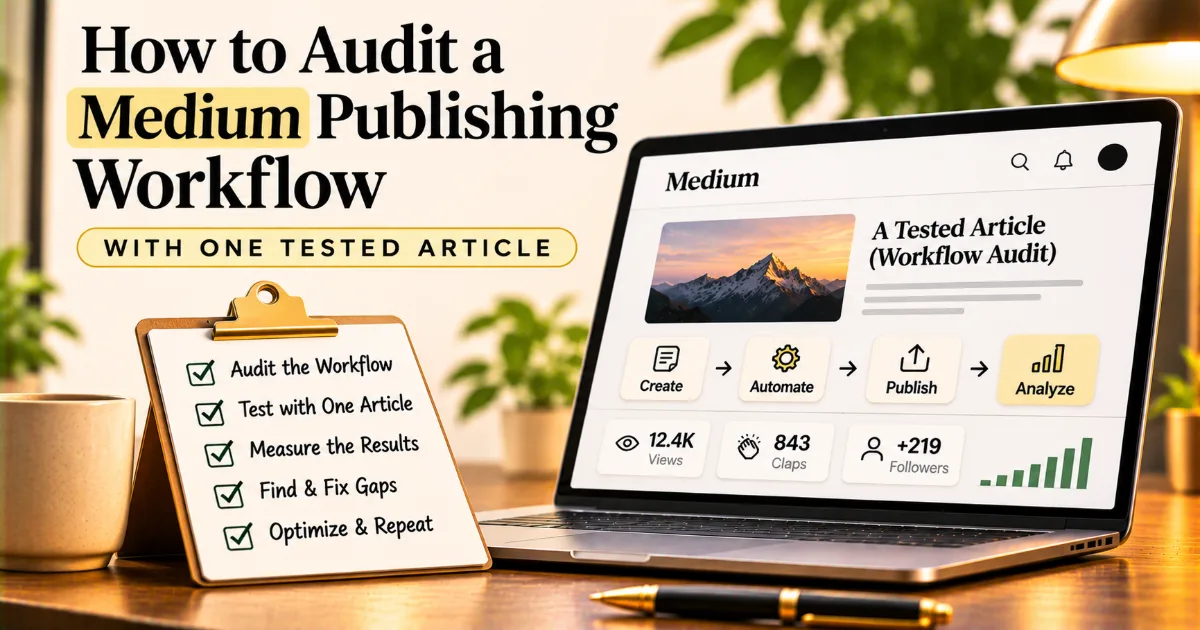
The way to audit a Medium publishing workflow is to send one real article through it, from the website to Medium, and score what arrived against five checks: the canonical link, the headings, the images, the links and the story's status after publishing. Each check gets a score of pass, partial or fail on one audit sheet, with the evidence written beside the score, so the result is a list a team can act on rather than an impression. A workflow that passes all five on a tested article is ready to carry more stories to Medium; one that fails the canonical or the links is not, however smoothly it seems to run. This post covers the sheet, each of the five checks, what a workflow can check for you, a two-person SaaS marketing team's audit, and how to read the score before publishing more.
How one tested article scored on five checks, before and after fixes
- 01Canonical
- 02Headings
- 03Images
- 04Links
- 05Status
- the first tested article
- the second, after the fixes
A judgment, not a score
- How to audit a Medium publishing workflow: one article, five checks
- The audit sheet: five checks, a score and the evidence
- The Medium canonical check: three places to look
- Checking that the headings arrived as headings
- Checking images: alt text, captions and files
- The broken link audit: every link in the Medium copy
- Checking the story's status after publishing
- What a workflow can check, and what a person scores
- A worked example: a two-person SaaS marketing team
- Reading the score: fix, rebuild, or keep publishing
- Frequently asked questions
- Where to start
How to audit a Medium publishing workflow: one article, five checks
An audit judges a publishing workflow by its output, not by its description. The workflow here is every step between a finished article on the business's website and a published Medium story: the import or copy, the formatting, the links, the canonical link, the publishing itself and whatever is recorded afterwards. A diagram of those steps can look complete while the story that comes out the other end is missing half its headings, so the audit starts from the story and works backwards to the step that caused each fault. Checking output against a diagram matters just as much when a diagram becomes video, which our guide to a Higgsfield AI explainer storyboard sets out frame by frame.
Choosing the one article that tests the workflow
- A few headings the outline either arrives on Medium or it does not
- Images something for the images check to open and read
- Internal links every link can be requested on the far side
- Several articles at once a wider scope makes the audit less detailed
- A diagram of the steps it can look complete while the story is missing headings
One article is enough for a first audit, and it is better than several. Nielsen Norman Group's guide to conducting a heuristic evaluation advises that the narrower the scope, the easier and more detailed the evaluation will be, and that evaluators should work independently before comparing notes. The same two habits suit a workflow audit. Choose an article with at least a few headings, images and internal links, so every check has something to look at, and have two people score it separately.
The audit is a decision tool. Its score says whether the workflow is ready to carry more stories, needs a short list of fixes first, or needs rebuilding. That decision is the same one a business faces when it chooses between running the work itself and buying it in, which is why the audit is often the first thing we do in the Medium content automation setups we build, and why its findings map directly onto what a content automation project includes.
The audit sheet: five checks, a score and the evidence
The audit sheet has one row per check and four columns: what is compared, what counts as a pass, the evidence recorded, and the score. Keeping it to five rows is deliberate. Each row describes something that can go wrong between the website and Medium and that a reader or a search engine would notice, and nothing on the sheet measures effort or tidiness for its own sake.
When a score on the audit sheet counts
Holds · evidence recorded
Passthe check holds and the sheet shows it
Holds · no evidence
Not counteda claim nobody wrote down
Gap · evidence recorded
Partial or failthe fault is shown and can be fixed
Gap · no evidence
Not countedthe scorer has to look again
Left column: evidence recorded
Right column: no evidence
| Check | What is compared | A pass looks like | Evidence recorded |
|---|---|---|---|
| Canonical | The Medium story's canonical link, the website article's own canonical, and Search Console's view | All three name the same website address | The canonical line from each page source, and the report row |
| Headings | The website article's outline against the Medium story's, in order | Every heading arrives as a heading, at a level the team chose | Both outlines side by side, with each difference marked |
| Images | Every image in both versions, with its alt text and caption | Each image present, in place, described and captioned | A list of images with alt text copied from each version |
| Links | Every link in the Medium copy, requested one at a time | Every link answers directly, and none is missing | The link list with the status each returned |
| Status | Where each copy stands once the workflow says it is done | Published where intended, dated as expected, website copy indexed | Both addresses, the date checked, and the index status |
Each score follows a fixed rule. A pass means the check holds in both versions and the evidence shows it. A partial means it holds only because someone fixed it by hand, or holds with a gap that a reader would not notice but a search engine or a screen reader would. A fail means the thing is missing or wrong. A score without evidence beside it does not count, which is what keeps the sheet honest when the person scoring it also built the workflow.
The two people scoring the article fill in separate copies, then compare. Disagreements are useful: a check one person passed and the other failed usually means the pass condition was vague, and the row is rewritten before the next audit.
The Medium canonical check: three places to look
The Medium canonical check confirms that both copies tell search engines the same thing: the website article is the original. RFC 6596, the canonical link relation, describes it as designating the preferred address among resources with duplicative content. Google's explanation of URL canonicalization adds the part that matters for an audit: indicating a canonical preference is a hint, not a rule, and Google may choose a different page as canonical than you do.
Medium's guide to setting a canonical link gives the test itself: view the published story's page source, search for canonical, and the first result shows the link it was imported from; which address that should be for each article is decided in our Medium duplicate content strategy.
Where the Medium canonical check looks, in order
- 01The articleSelfits own canonical names its own address
- 02The import toolAdds itthe original becomes the canonical link
- 03Medium’s sourceNames itthe canonical line shows the website address
- 04Search ConsoleAgreesthe website copy is the indexed canonical
Because it is a hint, the check looks in three places rather than one. First, the Medium story's own page source must name the website article's address; Medium's help page on importing a post says the import tool adds a canonical link to the original automatically, and the step-by-step import is covered in our guide to the Medium article republishing workflow. Second, the website article's own canonical must point to itself, not to a staging address, a tagged address or the Medium copy. Third, Search Console must agree.
Search Console's Page indexing report says the goal is to get the canonical version of every important page indexed, and that a page marked duplicate or alternate is usually a good thing, because it means Google found the canonical and indexed it. The check passes when all three places agree. It is partial when Medium names the right address but the website article has no canonical of its own. It fails when the Medium copy names no canonical, or names an address with a tracking query, an old domain or plain http. A canonical that is wrong in any one place can leave the Medium copy competing with the original it was meant to support.
Checking that the headings arrived as headings
The headings check compares the website article's outline with the Medium story's, heading by heading, and confirms that each one arrived as a heading rather than as bold text. Medium's guide to using the story editor describes two heading sizes, a header and a subheader, and says a header on the first line of a story converts into the story's title line. A website article with three levels of heading therefore arrives on a platform that offers two, and someone has to decide how they map. The opening is the one part expected to differ, when it has been redone as our guide to a Medium article introduction rewrite describes.
The same outline, on the website and on Medium
On the websiteOn Medium
The first heading
the article’s main heading
turned into the story’s title line
Section headings
the second level
headers, the large size
Smaller headings
the third level
subheaders, or lost as bold text
The check itself is two lists. Write the website article's headings in order, write the Medium story's headings in order, and compare them line by line. A fail is a heading that became a bold paragraph, two headings merged into one, a section that lost its heading altogether, or the first heading swallowed into the title. A partial is every heading present but the levels flattened unevenly, so two sections that were equals on the website now look like a section and its subsection.
The headings carry the argument for a reader who scans before deciding to read, so this check is not cosmetic. The fix is usually one written mapping rule, website levels to Medium's two sizes, kept in the same place as the rest of the publication's conventions, such as a Medium publication style guide, so the next import follows it without anyone remembering.
Checking images: alt text, captions and files
The images check confirms that every image on the website version reached the Medium story, in the right place, with a description and a caption. Google's image SEO best practices call alt text the most important attribute for providing metadata about an image, note that it also improves accessibility for people using screen readers, and advise short, descriptive filenames rather than generic ones. The same guide warns against filling alt attributes with keywords. Medium's using images page says the editor supports images up to 25MB in JPG, GIF and PNG formats and offers alt text and a caption for each, so the audit checks both fields; our Medium technical tutorial workflow covers preparing screenshots.
What an image has to carry to pass the check
- Captionedthe website’s caption, carried across
- Describedalt text a screen reader can use
- In placebeside the text it illustrates
- Presentthe image arrived at all
The check counts images in both versions first, because a missing image is the easiest fault to miss on a long page. Then it opens each image on the Medium copy and reads its alt text and caption against the website's. A pass is every image present, placed beside the text it illustrates, described and captioned. A partial is every image present with some descriptions missing. A fail is a missing image, a broken placeholder, or a diagram whose labels can no longer be read at the width Medium shows it. Whether each image belonged there at all is a question for the planning step, which our guide to Higgsfield AI images for a Medium article ties to the section each image clarifies.
Alt text is the part most often lost, and the reason is that it is invisible: a story can look perfect to every sighted reader while describing none of its images. That is why the check opens each image rather than looking at the page, and why the same review belongs in any editorial gate the workflow already runs, such as the one in our guide to the Medium AI editorial workflow.
The broken link audit: every link in the Medium copy
The broken link audit lists every link in the Medium copy, requests each one, and records the status it returns. The meanings come from RFC 9110, HTTP Semantics: a 404 means the server did not find a current representation of the page, a 410 is preferred when the server knows the page is gone permanently, and a 301 means the page has a new permanent address that future references ought to use. A link that answers directly passes. A 301 is a partial, fixed by updating the link to its destination. A 404 or a 410 fails. The Medium Rules require a link to your own platform's sign-up to be disclosed as leading offsite, so the link check reads the words next to each link as well as its address; our Medium referral linking workflow covers placing them.
What the broken link audit removes from the link list
- 01Every linkthe full list from the website version
- 02Missing on Mediumdropped during the import
- 03Movedanswered with a 301, updated to the destination
- 04Gonea 404 or 410, a fail on the sheet
- 05Answer directlythe links that pass as they are
Relative, not measured
Three kinds of link deserve a second look. Links back to the business's own website must use its full, live address, not a staging site, a draft preview or a path that only worked inside the website. The one deliberate link back must keep any tracking values it was given, because the measurement in our guide to Medium referral traffic measurement depends on them. And the link list is compared with the website version's, so a link that quietly disappeared during the import is caught as well as one that broke.
Links that pass today can fail next quarter, because the pages they point to are renamed, merged or retired. So the link check is the one part of the audit worth repeating on a schedule across every published story, alongside the routine in our guide to the Medium article update workflow.
Checking the story's status after publishing
The status check confirms where each copy stands once the workflow reports that it is done. On Medium, the story should be published in the intended place, the profile or the publication, rather than left as a draft, and its date should be the one the team expected; the import tool, as Medium's help page notes, backdates an imported story to the original date. On the website, the article should be live at its final address and indexed. Which of the two is the intended place is decided long before the audit, with the questions in our Medium publication vs profile guide.
Where each copy stands after the workflow says done
Import day
Publishedthe story is in the publication, backdated to the original date
The first days
Waitingthe website copy is live but not yet indexed
Indexed
ConfirmedSearch Console shows the website copy as indexed
Next quarter
Recheckedthe link check runs again across every published story
Search Console is the record for the website half. Google describes Search Console as a free service that helps a site owner monitor, maintain and troubleshoot the site's presence in Google Search results, and the Page indexing report used in the canonical check shows whether the article is indexed. A pass is both copies in the expected state on the day of checking. A partial is one copy right and the other waiting, such as a website article not yet indexed. A fail is a story stuck in drafts, published to the wrong place, or a website article that is not live. A website article that is not indexed also cannot answer the search questions it was briefed on, the questions found through the method in our guide to Medium SEO content research. Which of those website SEO checks can run without a person, and which only flag, is covered in our Content Operating System for website SEO.
The status check ends by writing both addresses and the date checked into the record the team already keeps of what has been published where, the kind of record set out in our guide to Medium content library structure. An audit that leaves no record has to be repeated from the beginning next time.
What a workflow can check, and what a person scores
Most of the evidence can be collected automatically. In n8n, the HTML node extracts content from an HTML source using a CSS selector, returning an attribute, the inner HTML or the text, which is enough to pull the canonical link, every link address, every heading and every image's alt text out of both versions. The Compare Datasets node then compares two input streams on the fields you choose and separates the items that match from the ones that differ, which turns the website's link list and the Medium copy's into a list of what went missing.
The instruction that collects the audit’s evidence
Evidence collection, run before each import
- 01Read the website version and the Medium copy of the article
- 02Extract the canonical link, every heading and every image’s alt text from both
- 03List every link in both versions and request each one
- 04Record the status each link returns and any link missing on Medium
- 05Write the evidence columns of the sheet and leave the score column empty
The same collection can be written as a small script. A team that works in Claude Code can have it read both addresses, request every link, and write the evidence columns of the sheet, so the check runs before every import rather than once. Either way, the automation fills in the evidence and leaves the score column empty.
The scores stay with a person, because each one is a judgement. Whether a flattened outline still reads correctly, whether an alt text describes the image or only names it, whether a 301 is worth updating today, and whether the whole workflow is ready to carry more stories all depend on knowing what the article is for. The workflow being audited may itself be built from the owned stages in our guide to Medium publishing workflow automation; the audit is how a team finds out whether those stages did their jobs.
A worked example: a two-person SaaS marketing team
A SaaS company selling appointment-scheduling software to physiotherapy clinics has a marketing team of two: a content lead who writes the website articles and a marketer who republishes them on Medium with the import tool. After a month of republishing they audited the workflow with one tested article, a guide to reducing missed appointments, before committing to a second month. The company, the article and every result below are invented for this illustration.
The order the marketing team fixed the faults in
- 01The canonical
the website article’s own link corrected
- 02The links
the renamed page updated, the retired one replaced
- 03A heading rule
three website levels mapped onto Medium’s two
- 04Alt text
written for the two undescribed images
- 05A second article
audited a week later before publishing resumed
The canonical was partial: the Medium copy named the website article correctly, but the website article's own canonical pointed to an address carrying a campaign parameter. The headings failed: the article's three levels had become two, and two of its smaller headings had arrived as bold paragraphs. The images were partial: all four were present, but only two carried alt text. The links failed: one internal link led to a renamed pricing page and returned a 301, and another led to a retired webinar page and returned a 404. The status passed: the story was in the company's publication, backdated as expected, and the website article was indexed.
They fixed the faults in order of consequence. The website canonical was corrected first, then the two links, then a written rule mapping the website's three heading levels onto Medium's two, then the missing alt text. They added the link and canonical collection to the step before import, so the evidence columns now fill themselves. A second tested article, audited the following week, passed every check except images, which was partial for one diagram, and they resumed publishing.
Reading the score: fix, rebuild, or keep publishing
The score decides what happens next by one rule. Any fail on the canonical or the links means the workflow is not ready to carry more stories, because each new story repeats a fault that affects search or sends readers to a dead page; fix those first. Partials on headings and images can be fixed while publishing continues, because they lower quality without misleading anyone. A second tested article that still fails two or more checks means the problem is the workflow's design rather than its settings, and that is the point to rebuild it or bring in help.
The audit is cheap to run by hand, a couple of hours for one article and two people, and cheaper still once the evidence collection is automated. Waiting is the expensive option: every story published through an unaudited workflow is another one to check and fix later. A setup that includes the audit and the automated checks is set out on our Medium pricing page, and a team that would rather keep running the work itself has everything it needs in the sheet above.
No audit can promise more than it measures. A clean sheet does not guarantee a ranking, because Google makes its own canonical choice, and it does not guarantee distribution, because Medium decides what it recommends. It guarantees that what a team intended is what was published. The same scored-evidence method suits other platforms, as our guide on how to audit a TikTok content workflow shows, and a wider review of a whole site's articles follows our guide on how to conduct a content audit. Other Medium guides are on the Medium hub.
Frequently asked questions
How do I audit a Medium publishing workflow?
Send one real article through the workflow from your website to Medium, then score what arrived against five checks: canonical link, headings, images, links and status after publishing. Score each pass, partial or fail on one sheet, with the evidence written beside every score.
Which three places does the audit read to confirm a canonical?
The audit reads three places: the Medium story's page source should name your website article's address, the website article's own canonical should point to itself, and Search Console's Page indexing report should show the website version indexed as the canonical.
Why do headings change when an article is imported to Medium?
Medium's editor offers two heading sizes, a header and a subheader, and turns a header on a story's first line into its title. A website article with more levels has to be mapped onto those two, so the audit compares both outlines line by line.
What should a broken link audit check?
Every link in the Medium copy, requested one at a time, with the status recorded. A direct answer passes, a 301 redirect is updated to its destination, and a 404 or 410 fails. Compare the link list with the website version too, so missing links are caught.
Can the audit be automated?
The evidence can be. A workflow or a small script can extract canonical links, headings, alt text and link addresses from both versions and record each link's status. The scores stay with a person, because each one is a judgement about what the article needs.
When is a Medium workflow ready to publish more stories?
When a tested article passes the canonical and links checks with no fails. Partials on headings or images can be fixed while publishing continues; two or more fails on a second tested article mean the workflow needs rebuilding.
Where to start
Pick one published article with headings, images and internal links, and open its website and Medium versions side by side. Copy the five-row sheet above, have two people score it separately with the evidence beside every score, and compare. Fix any canonical or link fail before the next story goes out, then audit a second article to confirm the fixes held. The stages that tested article passes through, from the website original to the import, are laid out in our Content Operating System for Medium.
Disclosure
This post was written by Shreyas Dave, founder of Paper Eagle AI. We sell content automation services, which is the category this article is about, so we have a commercial interest in you concluding that a system beats ad-hoc effort — read it knowing that. No tool vendor was involved in writing it, nobody paid for a mention, and there are no affiliate links anywhere on this site. Where a third-party figure appears, it’s attributed to the publisher it came from; anything we couldn’t source is written as a direction rather than a number.
Paper Eagle AI builds Content Operating Systems that turn a business’s knowledge and expertise into consistent, multi-platform content, and we deliver them as content automation services. Working as a content automation specialist, we capture what a business knows and how it sounds, set the strategy, and build the workflows that research, draft, repurpose and publish — with a named person approving every piece before it goes out. Every build runs through discovery, design, build and handoff. The system lives in the client’s own accounts, it is documented, the team is trained to run it, and the business owns it outright. We don’t write content on a retainer, and we don’t build lead generation, CRM or sales automation.
One source of thinking becomes native content for every platform a business publishes on: the founder’s LinkedIn and the company page, YouTube and Shorts, Instagram and Reels, TikTok, Reddit, Medium, newsletters, and the company’s own website, written to be found in Google and understood by AI search. Our multi-platform content automation page shows how they share one source, and our case studies document the systems behind our own publishing, file by file. You can follow the work on the company’s own channels: Paper Eagle AI on Instagram, Paper Eagle AI on YouTube, the Paper Eagle AI company page on LinkedIn, Paper Eagle AI on Substack, Paper Eagle AI on Reddit and Paper Eagle AI on Medium. Paper Eagle AI is also listed where clients can review its work: Paper Eagle AI on Clutch, Paper Eagle AI on GoodFirms and the Paper Eagle AI Google Business Profile.
Keep reading
- Medium article republishing workflow — the import itself, step by step, which this audit then tests.
- How to audit a TikTok content workflow — the same scored-evidence method applied to a video pipeline.
- Medium publishing workflow automation — the six owned stages a workflow like the audited one is built from.