How to Conduct a Content Audit: Step-by-Step Guide
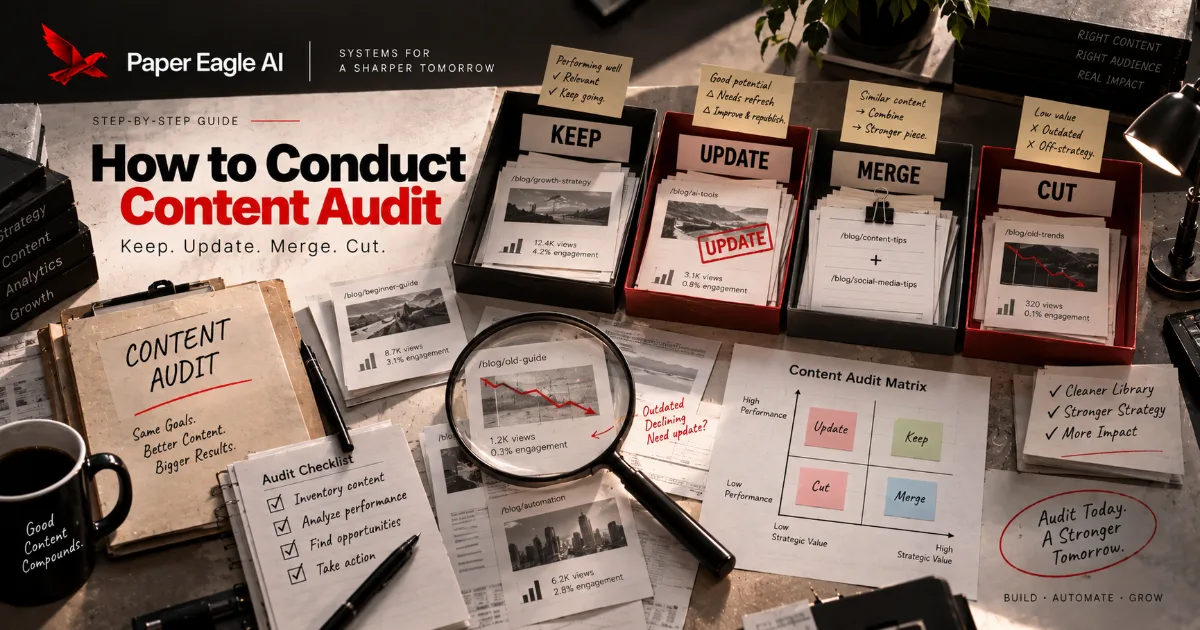
You can't improve what you can't see. Before you build a system for making content — or decide what to make next — you need an honest picture of what you already have, how it's actually performing, and where the holes are. That's a content audit. Done right, it's not a chore; it's the map that tells you exactly where to spend your next hour of effort. Here's how to run one you'll actually finish.
How a piece performs, against how good it actually is
Earns attention · still good
KeepProtect it, and use it as the model for whatever you write next.
Quiet · still good
MergeA good answer nobody finds. Fold it into the piece that does get found.
Earns attention · aged badly
UpdateSomething already works here. Fix the piece instead of starting again.
Quiet · aged badly
CutIt isn't sitting there harmlessly. It dilutes everything around it.
Left column: it earns attention today
Right column: it doesn't
- Why audit before you build
- Step 1: Inventory everything
- Step 2: Judge how each piece performs
- Not everything ages the same way
- Step 3: Decide keep, update, merge, or cut
- The keep/update/merge/cut decision
- Step 4: Find the gaps
- Step 5: Turn findings into a plan
- The audit, run with the tools you already have
- What an audit actually costs
- Three ways an audit goes wrong
- Frequently asked questions
- Where to start
Why audit before you build
Most businesses make content the way they clean a garage — by adding more. New pieces pile on top of old ones, nothing gets thrown out, and after a few years there's a lot of stuff and very little clarity. An audit is the moment you stop adding and take stock: what's here, what's earning its place, and what's quietly dragging everything down.
Everything you've published, sorted the way you'd sort it honestly
- You'd send a prospect to it the work you're proud of
- You'd forgotten it existed neither good nor bad, just there
- You'd rather they didn't find it old, wrong, or not you
The shape of a typical library, not a measurement
Skipping this step is expensive in a way that hides. Without an audit you keep producing into a fog — repeating topics you've already covered, leaving your best-performing pieces to decay, and never noticing the obvious gaps a prospect falls straight through. Worse, weak content doesn't just sit there harmlessly; it dilutes the strong content around it and muddies what your business appears to stand for.
The audit fixes that by replacing guesswork with a map. Once you can see the whole library at once, decisions that felt arbitrary — what to write next, what to fix, what to retire — become obvious. This is also the natural first step before building a Content OS, because you can't design a system for content without first knowing what you've got.
Step 1: Inventory everything
Start by listing every piece of content you own in one place. A simple spreadsheet is perfect — one row per piece, with columns for the title, the link, the format, the topic it covers, and the date it was published or last updated. Don't judge anything yet. The only goal of this step is to make the invisible visible: to get the whole scattered library into a single view you can actually reason about.
The whole audit, as five files
- audit-2026/ one folder, one afternoon
- inventory.csv one row per published piece
- scores.csv performance and quality, high to low
- decisions.csv keep, update, merge or cut
- gaps.md questions with no good answer yet
- plan.md five actions, in order
The audit is finished when plan.md has five rows in it — not when the spreadsheet is complete.
Cast a wide net. Blog posts and articles are obvious, but include the landing pages, the guides, the resources, the newsletters, and the pieces living on other platforms too. Businesses are almost always surprised by two things at this stage: how much content they've made, and how much of it they'd completely forgotten existed. Both are useful to know.
The cheapest way to build the inventory is to stop clicking. Most sites already publish a list of everything they own — the sitemap, which Google notes most content management systems generate on their own — and every CMS can export its pages with their dates attached. Start from that export rather than from memory, because memory is precisely what the audit exists to replace, and the pieces you'd forget to list by hand are disproportionately the ones worth finding.
By the end of this step you have a complete inventory. It'll look a little overwhelming, and that's the point — you can't make good decisions about a library you've never seen whole.
Step 2: Judge how each piece performs
Now add judgment to the inventory. For each piece, note how it's actually doing on two fronts: performance and quality. Performance is what the numbers say — traffic, engagement, whether it brings in the right people — which you can pull from your analytics. Quality is what your own honest eye says — is it accurate, is it still true, does it sound like you, would you be happy for a prospect to land on it today?
Five questions, about ninety seconds a piece — scored here on one real page
- "Would you send a prospect here today?" Yes — it's still the clearest answer we have on the topic.
- "Is every claim in it still true?" Yes, apart from one tool that has since changed its name.
- "Does it sound like you now?" Half. The opening three paragraphs are three years old.
- "Does anything else cover this ground?" Two other posts do, thinly, and neither is better.
- "Would you write it again today?" Not as three separate pieces, no.
Keep the scoring simple, because a complicated rubric is a rubric you won't finish. (If you want the fuller version, we set one out in content scoring.) High, medium, or low on each of the two dimensions is enough. You're not producing a research report; you're sorting a library into rough piles so you can act. A piece that's high-performance and high-quality is an asset to protect. One that's low on both is a candidate for the exit. The in-between cases are where the interesting decisions live.
Set a limit before you open the analytics, because this is the step where audits go to die. Two numbers per piece is plenty — what it brings in, and whether that's rising or falling — and a third has never once changed a keep-update-merge-cut decision. If you find yourself building a weighted score out of six metrics, you've stopped auditing and started avoiding the judgment the audit exists to force.
Two numbers worth pulling specifically: which pages bring in search traffic, and which have quietly lost it over time. Decay is the silent killer of content libraries — a piece that ranked two years ago and has slowly slipped is often your highest-return fix, because the hard work of earning the position is already done.
Not everything ages the same way
The reason an audit has to be done piece by piece, rather than by a rule, is that content of the same age behaves completely differently. Two articles published the same month, by the same person, on the same site, can end up in opposite places two years later — and nothing about the publish date predicts which is which. The same is true of anything produced on a workflow rather than by hand, which is why automated content stops working gradually rather than all at once.
Three pieces published in the same month, looked at two years later
Answers a question nobody has stopped asking. Leave it alone.
Ranked once, overtaken since. The highest-return fix you own.
Being found by more people each quarter. Feed it links.
Three shapes, not three measurements
The middle case is the one to look for on purpose. A page that used to rank and has slipped has already proved two things: the question is real, and your answer was once good enough to win. Neither is true of a blank page. Refreshing it is usually cheaper than writing something new and returns more, which is why it sits in the marked square of Fig 01 — and why an updated page rather than a replacement is what makes content compound at all.
The practical version of this is a single comparison: pull each page's search impressions for the last quarter and for the same quarter a year ago, and sort by the difference. Search Console's performance report is where those two numbers live, and its own methodology is worth reading once before you trust the delta — an impression is counted on rules you did not choose. The pages at the bottom of that sort are your update list, in order, and you didn't need judgment to produce it. Everything else in the audit is judgment; this one part is arithmetic, so let it be arithmetic.
Step 3: Decide keep, update, merge, or cut
With performance and quality scored, every piece falls into one of four decisions. Keep the pieces that are strong on both dimensions — protect them, and note them as models for what good looks like. Update the pieces where the topic still matters but the execution has aged; this is usually the highest-return category, because you're building on a foundation instead of starting from zero.
The library, after each decision has been applied
- Everything you've published the inventory
- Still on strategy cut removes the rest
- Not covered twice merge removes the rest
- The library you'd stand behind keep and update
Merge the pieces that overlap — where you've covered the same ground three times in three thin articles, combine them into one strong, definitive piece and redirect the rest to it. Redirect rather than simply unpublish: Google ranks a redirect as the strongest signal of which URL should be the canonical one, so the merged page inherits what the three were earning separately. Overlap of this kind is far easier to spot once the library is arranged as content clusters, because two spokes cannot occupy the same position. Cut the pieces that are off-strategy or beyond saving; content that no longer reflects what you do isn't neutral, it's a liability, and removing it genuinely helps the pieces that remain by sharpening what your library says about you.
Assign one of these four decisions to every row in your inventory. When you're done, the fog is gone: you're no longer looking at a vague pile of content, you're looking at a to-do list sorted by return.
One caution as you assign these decisions: be honest, but don't be ruthless for its own sake. The goal isn't the smallest possible library — it's the strongest one. A piece with modest numbers that perfectly answers a question your best clients ask is worth keeping, even if a purely metrics-driven pass would cut it. Resist the opposite pull too: the sunk-cost instinct that keeps a weak piece alive only because it took effort to write. Judge each piece by what it does for a reader today, not by what it cost you to make or where the raw numbers rank it. That balance — data informing judgment, not replacing it — is where a good audit actually lives.
The keep/update/merge/cut decision
The heart of the audit is one decision, applied to every piece. Here's how to make it.
| Decision | When it applies | What you do |
|---|---|---|
| Keep | Strong performance, still accurate and on-brand | Protect it; use it as a model |
| Update | Topic still matters, but the piece has aged | Refresh it — usually the best return |
| Merge | Overlaps with other thin pieces on the same topic | Combine into one strong piece, redirect the rest |
| Cut | Off-strategy, inaccurate, or beyond saving | Remove it so it stops diluting the rest |
Step 4: Find the gaps
The audit so far has looked at what exists. This step looks at what's missing — and it's often the most valuable part. Walk through the questions your best prospects and clients actually ask, from first curiosity to final decision, and check which ones your content answers well. The questions with no good answer, or a weak one, are your gaps.
The questions a buyer asks, in the order they ask them
- 01Is this even my problem?
months before they buy anything, and where most libraries are strongest
- 02What are my options?
comparing approaches rather than vendors, still reading widely
- 03Why you and not them?
a comparison they run privately, whether or not you help them run it
- 04What could go wrong?
the last question before a decision, and the one almost nobody answers
Look especially for the expensive gaps: the questions people ask right before they decide whether to work with you, where a missing or thin piece of content costs you the conversation. A business often has plenty of top-of-funnel content and almost nothing for the moment a serious prospect is weighing the decision — exactly where good content earns its keep.
The cheapest way to find these is to stop guessing and read your own inbox. The questions clients ask in the fortnight before they sign, and the ones they ask in the fortnight after, are a gap list written by the people whose opinion counts. If the same question has come up three times in email and nowhere on your site, that's not a content idea — that's a page you already owe someone.
Gaps map directly onto what your business knows but hasn't yet written down. That's why an audit pairs so naturally with organizing your knowledge — the two exercises feed each other. We cover that side in how to organize your business knowledge.
Step 5: Turn findings into a plan
An audit that ends in a spreadsheet is a study. An audit that ends in a plan is an audit. So finish by turning your four piles and your gap list into a short, ordered set of actions — not a wish list of everything, but the handful of moves with the highest return, sequenced.
Effort against return, for the actions the audit just produced
Refresh
Rebuild
Delete
Reformat
Across: how much effort it takes
Up: what it returns
Order by impact and effort together. The quick, high-return moves come first: updating a decayed piece that used to perform, merging three thin articles into one strong one, filling a single expensive gap near the decision point. The bigger projects — a new pillar, a full rebuild — come after, once the fast wins have banked some momentum. A realistic plan of five prioritised actions beats an ambitious plan of fifty you'll never touch.
Write the plan where the work will actually happen, not in the audit document. Five rows in whatever you already use to track work beats a beautifully formatted appendix nobody opens again, and it means the audit's output competes for attention alongside everything else rather than sitting in a folder marked "strategy". An action that isn't scheduled somewhere real is a note, not a plan.
That prioritised plan is the whole payoff of the audit. You started with a fog of content and no idea where to spend your effort; you end with a clear, ranked list of exactly what to do next. Everything downstream — writing, updating, building the system — gets easier because the map exists.
The audit, run with the tools you already have
You don't need special software to run a good audit. A spreadsheet for the inventory and your existing analytics — Google Search Console for what's ranking and slipping, Google Analytics for engagement — will carry you through every step above. The valuable part of an audit isn't the data-gathering; it's the judgment about what to keep, fix, merge, and cut, and that judgment is yours.
Keeping the inventory current, as a board in n8n
Schedule trigger first of the month, before anyone thinks about it
Fetch the list every published URL and the date it last changed
Untouched for eighteen months? everything else waits its turn
Search Console this quarter against the same quarter last year
Claude Code flags what slipped, and writes one line saying why
Both branches write into the same sheet, already scored — leaving the one step that needs a person: keep, update, merge or cut.
Where tools earn their place is in the tedious parts and the upkeep. Automations built with Claude Code, n8n, Zapier or Make.com can assemble the inventory, pull the performance numbers into one sheet, and keep it current so your next audit is a review rather than a rebuild — the ordinary shape of content automation applied to your own library rather than to your publishing. Building the board above takes an afternoon once, and it removes the reason most second audits never happen: the inventory has gone stale and nobody wants to rebuild it from scratch.
Claude Code is doing something specific in branch B, and it's worth naming because it's easy to over-claim. It isn't deciding anything. The capability it brings is the dull one its documentation leads with: it works across a whole project rather than one file at a time. So it reads the two quarters of numbers alongside the page itself and writes one sentence — "impressions down by half since last spring; three competitors now cover this in more depth" — so that when a person opens the sheet, each flagged row already carries its reason. That sentence is what turns a column of numbers into something you can act on in ninety seconds.
But at Paper Eagle AI we design the process first and let the tools serve it — technology is a tool, never the goal. A tool that gathers data faster is only useful if a human is making good decisions with it, and no automation on this board is allowed anywhere near the keep, update, merge or cut column.
What an audit actually costs
Audits get postponed because they sound like a project, and projects need a slot nobody has. In practice a first audit of a normal library — fifty to eighty pieces — is two days of attention, and only the first of them is dull.
A first audit of fifty to eighty pieces, honestly costed
Day one, one afternoon
The inventoryListing everything you've published, with dates and links. Mechanical, mildly depressing, and the step people skip.
Day two, one morning
Scoring and decidingFive questions per piece at about ninety seconds each. Fifty pieces fits in a morning if you don't relitigate every one.
The fortnight after
The first five actionsThe merges and the refreshes. This is the only part that returns anything, and it's the part the two days exist to point at.
Every quarter after that
A review, not a rebuildAbout an hour, because the sheet already exists and only what changed needs attention.
The honest catch is that the two days buy you nothing on their own. An audit returns exactly as much as the actions that follow it, and the most common failure isn't a bad audit — it's a good audit that ends at the spreadsheet, gets circulated, gets admired, and changes nothing. If you only have half the time, spend it on the first three actions rather than on scoring the last thirty pages perfectly.
There's also a cost worth naming that isn't measured in hours: it stings a bit. You will find pages you were proud of that nobody has read since the month they went up, and a topic you have now covered four separate times without ever covering it well. That discomfort is the audit working. It's also why running one with a second person in the room is easier — they can be honest about your library in a way you can't be at four in the afternoon.
Three ways an audit goes wrong
The stalled spreadsheet is the famous failure, and it isn't the only one. Three others show up often enough to be worth naming, and each produces a plausible-looking audit that leaves you worse off than not having done it.
The first is auditing without a standard. If you haven't decided what good looks like for your business before you start scoring, the judgements drift as you go — piece four gets marked against a stricter bar than piece forty, because by then you're tired and generous. Worse, "good" quietly becomes "recent" or "I remember liking this one". Write the standard down first, even roughly. It takes twenty minutes and it is the difference between an audit and an opinion survey.
The second is cutting things that were quietly working. Traffic is the visible signal and it is not the only one. A page with forty visits a month can be the one every sales conversation links to, or the only thing on the site that answers a question prospects genuinely ask, or the piece that ranks for a term nobody else covers. Before anything gets cut, check two things: is anyone linking to it, and does it appear in any query you actually want? Deleting a low-traffic page that was doing a specific job is the one audit outcome that is genuinely hard to undo.
The third is treating the audit as an event rather than a habit. A two-day audit every eighteen months means you spend two days rediscovering the same drift you fixed last time, because nothing changed about how content gets published in between. The version that compounds is much smaller: a standing half-hour each quarter over the pieces published since the last one, while you still remember why they were written. The big audit is what you do once, to catch up. The quarterly one is what stops you ever needing another.
Frequently asked questions
How often should I run a content audit?
A full audit once a year is plenty for most businesses, with a lighter check each quarter on your most important pages. The goal isn't constant auditing — it's catching decay before it costs you. Once you have a Content OS, much of this becomes ongoing maintenance rather than a periodic project you have to schedule and dread.
What if I only have a handful of pieces of content?
Then the audit takes an afternoon, not a week — and it's still worth doing. A small library benefits most from being deliberate, because every piece carries more weight. Inventory what you have, judge it honestly, decide keep or cut, and you'll know exactly where to point your next few pieces instead of guessing.
Should I delete underperforming content or update it?
It depends on the piece. Update it if the topic still matters and the piece is fixable — that's usually the highest-return move. Merge it if it overlaps with something stronger. Cut it if the topic is off-strategy or the piece is beyond saving. Deleting weak content can genuinely help, because it stops diluting the strong content around it.
Do I need special tools to run a content audit?
No. A spreadsheet and your analytics — Google Search Console and Google Analytics — are enough to run a solid audit. Tools speed up the data-gathering, and automations built with Claude Code, n8n, Zapier, or Make.com can keep the inventory current, but the judgment is the valuable part, and that's yours.
How long does a content audit take?
About two days of attention for a library of fifty to eighty pieces — an afternoon to build the inventory and a morning to score and decide. The scoring is faster than people expect, at roughly ninety seconds a piece, provided you use a simple high/medium/low rather than a detailed rubric. Every audit after the first is closer to an hour a quarter, because you are reviewing changes rather than rebuilding the sheet.
What should I do with the pages I cut?
Redirect them to the closest surviving piece rather than deleting them outright. A cut page usually has some history — a few links, an occasional visitor — and a redirect passes that to the page you kept instead of throwing it away. Delete outright only when nothing on your site is a reasonable destination, and check first whether anything still links to it.
Who should run the content audit?
Whoever can be honest about the library, ideally with a second person in the room. The scoring goes faster and lands truer with two people, because it's genuinely hard to judge your own writing at four in the afternoon. The one thing that shouldn't happen is delegating the keep, update, merge and cut decision to someone who doesn't know what the business is trying to say.
Where to start
Don't wait for the perfect moment or the perfect tool. Open a spreadsheet, list everything you've published, and give yourself an afternoon to score it honestly. That single view — the whole library, seen at once — is where the clarity comes from. From there the four decisions and the gap list almost make themselves, and you'll walk away knowing exactly where your next hour of effort should go instead of guessing. That's the audit's real gift: not judgment on the past, but direction for what's next.
An audit tells you what's worth keeping. What to do with it afterwards is the next system: content repurposing systems.
Disclosure
This post was written by Shreyas Dave, founder of Paper Eagle AI. We sell content automation services, which is the category this article is about, so we have a commercial interest in you concluding that a system beats ad-hoc effort — read it knowing that. No tool vendor was involved in writing it, nobody paid for a mention, and there are no affiliate links anywhere on this site. Where a third-party figure appears, it’s attributed to the publisher it came from; anything we couldn’t source is written as a direction rather than a number.
Paper Eagle AI builds Content Operating Systems that turn a business’s knowledge and expertise into consistent, multi-platform content, and we deliver them as content automation services. Working as a content automation specialist, we capture what a business knows and how it sounds, set the strategy, and build the workflows that research, draft, repurpose and publish — with a named person approving every piece before it goes out. Every build runs through discovery, design, build and handoff. The system lives in the client’s own accounts, it is documented, the team is trained to run it, and the business owns it outright. We don’t write content on a retainer, and we don’t build lead generation, CRM or sales automation.
One source of thinking becomes native content for every platform a business publishes on: the founder’s LinkedIn and the company page, YouTube and Shorts, Instagram and Reels, TikTok, Reddit, Medium, newsletters, and the company’s own website, written to be found in Google and understood by AI search. Our multi-platform content automation page shows how they share one source, and our case studies document the systems behind our own publishing, file by file. You can follow the work on the company’s own channels: Paper Eagle AI on Instagram, Paper Eagle AI on YouTube, the Paper Eagle AI company page on LinkedIn, Paper Eagle AI on Substack, Paper Eagle AI on Reddit and Paper Eagle AI on Medium.
Keep reading
- What is a Content OS? — the system to build once the audit shows you where you stand.
- How to organize your business knowledge — turn the gaps you found into an organized foundation.
- The SEO playbook for a Content OS — how to make the content you keep discoverable.