Medium Referral Linking Workflow: One Useful Link Back per Story
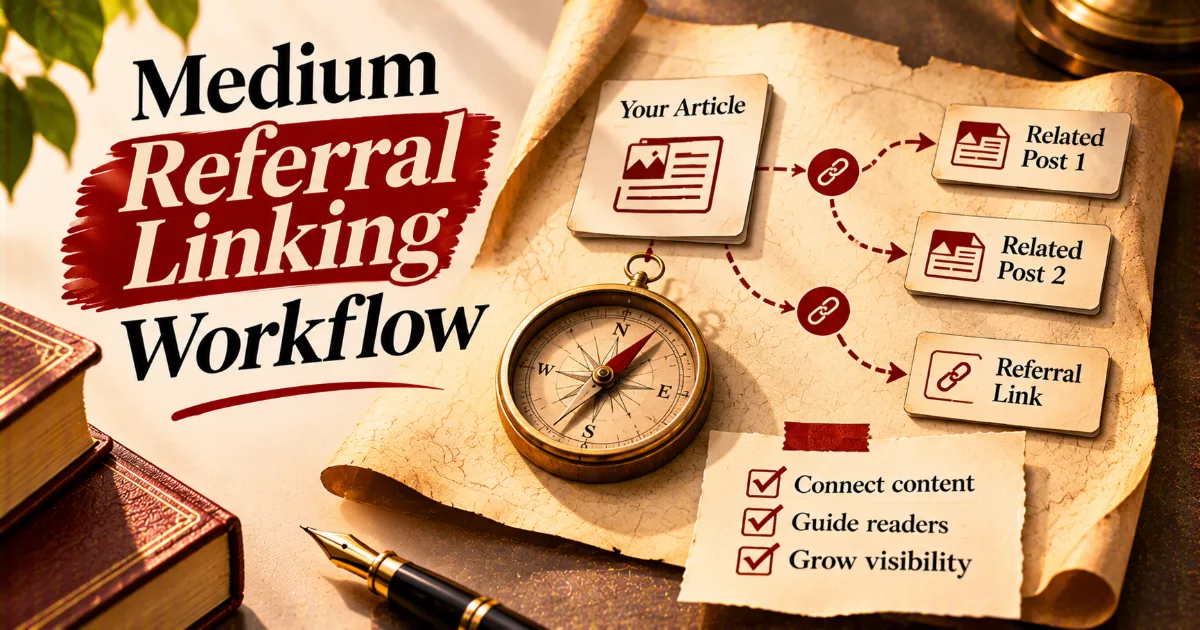
A Medium referral linking workflow chooses, for each published story, the one website resource that most helps a reader who has finished reading, and links to it once, at the point in the story where the reader's next question arises. It starts with a list of the website's useful resources, asks what each story's reader will want to do next, picks the single resource that answers it, places the link with words that say where it goes, discloses an offsite link where Medium's rules ask for it, and records the choice so it can be checked later. Medium treats a story posted mainly to send traffic elsewhere as spam, so the link has to serve the story, not the other way round. This post covers why a link in every section backfires, the resource list, choosing, placement, disclosure, the link record, what a workflow can suggest, and an industrial-pump supplier linking its technical stories.
How one story gets its one link back
- 01The resource listevery useful page, with its question
- 02The next questionwhat this story’s reader wants next
- 03The one resourceit answers that question, or nothing does
- 04The placementwhere the question arises, with its purpose
- 05The recordthe choice, checked against the site
- Medium referral linking workflow: one useful link per story
- Why a sales link in every section backfires
- The resource list: what on the website is worth linking
- Choosing the one resource: the reader's next question
- Where the link goes in the story
- Telling readers the link leaves Medium
- The link record: what was chosen and why
- What a workflow can suggest, and what an editor chooses
- A worked example: an industrial-pump supplier's technical stories
- What the workflow costs, and how it fails
- Frequently asked questions
- Where to start
Medium referral linking workflow: one useful link per story
A Medium referral linking workflow is the routine that decides which link from a story back to the business's website is worth including, where it goes and why. The output for each story is small: one resource, one placement, one sentence of purpose. The work is in the deciding, because most stories could link to a dozen pages and almost none of them would help the reader.
Which links back earn their place in a story
A detailed guide
A checklist
A product page
A contact form
Across: how much it helps a reader who finished the story
Up: how hard it sells
The principle is that a link from a Medium story is a recommendation. The reader has trusted the story enough to finish it, or to reach the point where it gets practical, and the link says "the next useful thing is over here". If the next useful thing is a detailed guide, a checklist or a reference page on the website, the link earns its place. If it is a contact form or a product page that the story did not prepare the reader for, the link spends the trust the story built.
Referral linking is a stage of its own in a Medium content automation build: each article's canonical version lives on the website, and the Medium copy sends interested readers back to it. The same decision made between pages on the website itself, which page should link to which, is covered in our guide to automating internal linking. This post is about the single link that crosses from one platform to the other.
Why a sales link in every section backfires
A sales link in every section backfires on Medium for reasons of rules, distribution and trust. On rules: Medium's page on reasons for suspensions or restrictions lists posting content primarily to drive traffic to, or increase the search rankings of, an external site, product or service. A story that reads as a vehicle for links is the pattern that rule describes, however good the rest of it is. Medium's distribution guidelines exclude from General Distribution stories whose primary point is gathering sign-ups or traffic, which is the reason a story earns its link by being useful first; whether the links were followed is the subject of our Medium referral traffic measurement guide.
What goes wrong when every section sells
Posting primarily to drive traffic
Medium’s rulesGathering sign-ups or selling first
curation guidelinesThe label promised pump sizing
the linkFive links that look like adverts
the reader skips
On distribution: Medium's curation guidelines exclude stories whose primary point is gathering sign-ups or traffic, or selling something, from general distribution, so a story that keeps pointing at a product is shown to fewer readers. On trust: Nielsen Norman Group's article A Link is a Promise says the words in a link label make a strong suggestion about the page being linked to, that the destination should fulfil what the anchor text promises, and that any broken promise chips away at trust and credibility. A link reading "learn more about pump sizing" that opens a request-a-quote form is exactly that kind of broken promise. A comparison written to favour the writer's own tool fails the same test, the risk our guide to a Medium tool comparison article is built to avoid.
One useful link avoids all three. It does not make the story's purpose traffic, it does not turn the story into a sales piece, and it keeps its promise. It is also easier to notice: a reader who meets one well-placed link is not being asked to skip five that look like advertisements.
The resource list: what on the website is worth linking
The resource list is every page on the website that would help a reader who has finished a story, written down once before any linking is decided. It is usually shorter than the site's page count suggests. The best candidates are pages that let a reader do something: a detailed guide, a checklist, a reference table, a calculator, a glossary, a troubleshooting page. Service and product pages belong on the list too, but they are the right link only when the story is about the decision those pages support.
The website resources worth linking from a story
- resource-list/ every page that helps after a story
- guides/ detailed answers to one question each
- checklists/ something the reader can run themselves
- reference/ glossaries, tables and calculators
- service-pages/ only for stories about that decision
- gaps.md questions the stories raise and the site cannot answer
Each row records the reader question the page answers.
Each row on the list records the page, the reader question it answers in one sentence, and the stories it already supports. The question column is what makes the list usable. "Pump selection guide" is a page name; "which pump type suits a given flow and head" is the question a reader would bring to it, and it is the question a story's reader has to have for the link to fit.
The list also shows what is missing. A business that writes stories about troubleshooting and has no troubleshooting page on its website has found a gap: its stories create a question the website cannot answer. Filling that gap is often worth more than any linking decision, because it gives the most common next question a page of its own. Where the archive is already grouped by reader problem, as described in our guide to Medium content library structure, each problem's website page is usually the first candidate for every story in it.
Choosing the one resource: the reader's next question
The one resource is chosen by asking what the reader of this story will want to do immediately after reading it. Not what the business wants them to do, and not what the story is broadly about, but the specific next step a reader who found the story useful would take. A story explaining why pumps cavitate leaves its reader wondering whether their own pump is at risk; the next resource is a way to check that, not a catalogue.
The three tests for the one resource
The link
- 01Answers it directlynot one item on a long page
- 02Goes furthermore than the story already said
- 03Usable aloneno conversation needed first
the one resource passing all three
Three tests decide between candidates. The resource answers the next question directly, not as one item on a long page. It goes further than the story, rather than repeating it, so the click is worth making. And it is something the reader can use without speaking to anyone, because a story read on Medium is usually read by someone who is not yet ready for a conversation. A resource that passes all three is the link; when two pass, the one that answers the more common question wins.
Sometimes no resource passes, and the honest answer is no link back at all. A story that stands complete, or whose next question the website does not answer, is better left without a forced link than given one that breaks its promise. The other links in the story, the sources that back its claims, are a different kind of link and follow different rules, covered in our guide to source citations in Medium articles. A question the website does not yet answer is also a candidate subject, the kind our guide to Medium SEO content research collects from search data.
Where the link goes in the story
The link goes where the reader's next question first comes up, not at the end by default. In a story about cavitation, that might be the paragraph that explains the warning signs, because that is where a reader starts wondering about their own pump. A link placed at the moment of need is read as help; the same link in a closing paragraph is read as a sign-off, and often not read at all. In a publication the link is the writer's to place: Medium's publications best practices and guidelines tell editors not to add large footers or calls to action to a writer's story, a rule worth weighing in our Medium publication vs profile comparison. How such a link is worded, in a company’s own phrasing rather than a sales line, is one of the rules in Substack brand voice guidelines.
The three parts of a well-placed link
- Position
- where the reader’s next question first comes up
- Anchor text
- says exactly what the reader will find
- Purpose sentence
- why they might want it, in the story’s voice
- Without a click
- the sentence still makes sense to the reader
The anchor text says what the reader will find. Nielsen Norman Group's guidance on writing hyperlinks says good links are descriptive, unique and start with keywords, because people scan pages looking for clues about where to go next. "Our cavitation check for existing pumps" tells the reader what they will get; "click here" and "learn more" tell them nothing. The same anchor text works on the website version of the story, where it also tells search engines what the linked page is about.
The sentence around the link carries its purpose. It says why the reader might want the resource, in the story's own voice, so the link reads as part of the argument rather than an insertion. One sentence is enough, and the sentence should still make sense if the reader never clicks, because most readers will not, and the story has to work for them too.
Telling readers the link leaves Medium
Some links back to the website need a short disclosure next to them under Medium's rules. The Medium Rules say that if a link takes readers to your own platform to subscribe to your newsletter, blog or other content you create, you must disclose, immediately next to the link, that it takes them offsite outside Medium. A form that sends a reader's information to you or a third party needs a similar disclosure next to or within it.
Which links back need a disclosure beside them
Your newsletter · a sign-up
disclose next to the linkthe rules ask for it
A form · reader details
disclose next to the formit sends information offsite
A guide · your website
say so in the sentenceon our website
A source · someone else
cite it as a sourceno relationship to state
Left column: asks the reader to sign up or send details
Right column: only asks them to read
A link to a guide or checklist on the business's own website is the case to treat carefully. The simplest practice is to write the disclosure into the sentence that carries the link, such as "the full checklist is on our website", which tells the reader both where they are going and whose site it is. It costs a few words and removes any doubt about whether the reader knew they were leaving. Links to sign-up pages and forms always carry the explicit disclosure the rules describe.
Disclosure also covers the relationship. A business linking to its own resource is promoting itself, mildly, and the story should be honest about it rather than presenting the resource as neutral. Google's guidance on qualifying outbound links applies the same honesty to link markup on a business's own pages, asking for paid or sponsored links to be marked as such. On Medium, the platform controls the markup; the writer controls the words, and the words are where the relationship is stated. A write-up of a client build states that relationship near the start, as in our guide to a content automation case study for Medium.
The link record: what was chosen and why
The link record is one row per story with the resource chosen, where it sits, the purpose sentence, and the date the link was last checked. It is what lets a business see its whole pattern of website content distribution at once: which resources carry most of the stories, which have none, and which stories have no link back at all. Without the record, each choice is made fresh and the pattern drifts toward whichever page someone remembered. Medium's detailed stats page for a story lists the top external sources of its views but not what readers did after leaving, so the record is completed from the website's side; the house rule for how many links a story may carry belongs in the one-page Medium publication style guide.
The monthly check of the link record
Compare the record against the site’s pages
Unchanged the story’s link still works
Compare the row has no matching page
Flag the stories every one using that resource
Redirect the old address on the website, then update the record’s rows
The record is also how broken links are caught. A website reorganisation that moves the cavitation check breaks the link in every story that uses it, and the record shows which those are. n8n's Compare Datasets node compares data from two inputs, which is how a workflow can match the record against the website's current list of pages and flag every story whose resource no longer exists. The fix starts on the website: Google's guidance on redirects describes a permanent redirect as the way to send people from a removed page to its new one, so old links keep working while the record's rows are updated to the new address.
The rows below show part of the record for the worked example later in this post. The stories and resources are illustrative, chosen to show how each column is filled.
| Story | The reader's next question | The one resource | Placement | Purpose sentence |
|---|---|---|---|---|
| Why centrifugal pumps cavitate | Is my own pump at risk? | Cavitation check for existing pumps | After the warning signs | Run the same check on your own installation |
| Sizing a booster set for a building | Which pump type fits my flow and head? | Pump selection guide | After the sizing example | The guide covers the cases this story leaves out |
| Reading a pump curve | What do the terms on the curve mean? | Glossary of pump terms | First mention of the duty point | Every term on the curve, defined in one place |
| When to repair and when to replace | What would a replacement involve? | Replacement planning page | The decision section | The questions to answer before choosing |
| Commissioning a new pump | None the website answers yet | No link back | None | A commissioning checklist is on the list to write |
What a workflow can suggest, and what an editor chooses
A workflow can do the finding and leave the choosing. For a new story, it can extract the existing links from the draft, using a step such as n8n's HTML node to pull link targets out of the page, and check whether any already point to the website. It can then compare the story with the resource list and suggest the three closest candidates. Anthropic's guide to embeddings describes text embeddings as numerical representations of text that let you measure semantic similarity, which is one way to rank the resource list against a story's text. Run over a keyword list instead of a resource list, the same comparison by meaning becomes semantic keyword clustering, which our Python guide builds step by step.
What the linking workflow is asked to do for a new story
The link suggestion, written once
- 01Extract every link already in the draft
- 02Mark any link that points to the website
- 03Rank the resource list by similarity to the story
- 04Suggest the three closest resources, with their questions
- 05Never choose the resource or write its purpose sentence
The editor chooses. Similarity finds resources about the same subject; it does not know which one answers the reader's next question, which one goes further than the story, or whether the honest answer is no link. Those are judgements about the reader, and they need someone who knows both the story and the website. The editor also writes the purpose sentence and the disclosure, because they speak in the story's voice.
The record can also be described in structured data on the website's own version of a story. Schema.org's significantLink property marks one of the more significant links on a page, and isBasedOn marks a work derived or adapted from another, which describes a Medium copy and the website article it came from. Neither is required, and neither changes what readers see, but both keep the website's record of what links where machine-readable.
A worked example: an industrial-pump supplier's technical stories
An industrial-pump supplier publishes technical stories on Medium for engineers and facilities managers: how pumps fail, how to size them, how to read their curves. Its early stories ended with a link to the request-a-quote page and a second link to the product catalogue, in every story regardless of subject. The supplier wanted the stories to lead readers to its technical guides instead, and to stop linking where nothing fitted. The example is a composite made to show the workflow, and its details are illustrative rather than one supplier's records.
How the pump supplier’s stories were relinked
failures, sizing, pump curves
guides, glossary, cavitation check
one resource per story, or none
placed where each question arises
kept for the replacement story only
three stories, until the checklist exists
The resource list came first: the selection guide, the glossary, the cavitation check, the replacement planning page, a handful of application notes, and the quote and catalogue pages, each with the reader question it answers. Writing the questions showed two gaps. Nothing on the site answered "how do I commission a new pump", which three stories led readers towards, and the cavitation check was buried at the bottom of a long page and needed its own.
Each story was then given its one resource by the next-question test, placed where that question arises, with a purpose sentence and, where the link went to a sign-up, the offsite disclosure. The quote page kept one story, the one about planning a replacement, where it genuinely is the next step. Three stories got no link back until the commissioning checklist exists. The record holds every choice, and a monthly workflow run compares it with the website's pages so a moved guide is caught before a reader finds the broken link.
What the workflow costs, and how it fails
The workflow costs one pass over the archive and a few minutes per new story. The pass writes the resource list and makes one choice per existing story, most of which are quick once the list has its reader questions. After that, each new story needs its choice, its placement and its purpose sentence on the day it is drafted. The monthly comparison against the website's pages is a small automation, and it is among the checks a setup on our Medium pricing page can carry.
It fails in four ways. Choosing by what the business wants rather than by the reader's next question, which turns the link back into a sales link. Linking in every story because every story should have one. Placing the link at the end out of habit. And keeping no record, so a site reorganisation quietly breaks links nobody knows about. Each is avoided by the test, the willingness to leave a story without a link, the placement rule and the record.
The same thinking applies to a republished article, which carries a canonical link back to the original as well as its one resource link; our guide to the Medium article republishing workflow covers that step, and our Medium duplicate content strategy explains why the original stays on the website. Every story still passes the review gate in our guide to the Medium AI editorial workflow before it is imported.
A technical story built as a tutorial usually has the clearest next question of all, as our guide to the Medium technical tutorial workflow shows. A story drawn from a recorded session, as in our guide to Medium webinar repurposing, can link to the recording itself when hearing the argument is the next step.
The Medium hub collects the guides on importing and measuring that sit either side of this step, and how links are read by search engines belongs to our SEO and AI search topic.
Frequently asked questions
What is a Medium referral linking workflow?
A routine that chooses, for each Medium story, the one website resource that answers the reader's next question, places the link where that question arises, writes its purpose and any offsite disclosure, and records the choice so the link can be checked later.
How many links back to my website should a Medium story have?
Usually one, and sometimes none. One well-chosen link to a useful resource helps the reader; several sales links make the story read as a vehicle for traffic, which Medium's rules treat as spam and its curation guidelines exclude from general distribution.
Should I link to my product or contact page?
Only when the story is about the decision that page supports, such as planning a replacement. For most stories a guide, checklist or reference page answers the reader's next question better, because a reader on Medium is rarely ready for a sales conversation.
Where in the story should the link go?
Where the reader's next question first comes up, which is often in the middle of the story rather than at the end. The anchor text says what the reader will find, and the sentence around it explains why they might want it.
Do I have to disclose that a link leaves Medium?
Medium's rules require a disclosure immediately next to a link that takes readers to your own platform to subscribe to your newsletter, blog or other content, and next to a form that sends their information offsite. Saying "on our website" in the sentence carrying any link back is a simple habit.
Can a workflow choose the link for me?
It can suggest. A workflow can extract a draft's links, rank the resource list by similarity to the story and flag records whose resources have moved. Choosing the resource, writing its purpose and deciding when no link fits stay with an editor.
Where to start
Write the resource list: every website page that would help a reader after a story, with the one question it answers. Take your five most-read Medium stories and, for each, write the reader's next question, pick the resource that answers it or decide there is none, and move the link to where that question arises. Add a purpose sentence and any disclosure, record each choice, and compare the record with your site's pages once a month. That one referral link is part of the import package a person opens in our Content Operating System for Medium, alongside the website URL and the disclosure.
Disclosure
This post was written by Shreyas Dave, founder of Paper Eagle AI. We sell content automation services, which is the category this article is about, so we have a commercial interest in you concluding that a system beats ad-hoc effort — read it knowing that. No tool vendor was involved in writing it, nobody paid for a mention, and there are no affiliate links anywhere on this site. Where a third-party figure appears, it’s attributed to the publisher it came from; anything we couldn’t source is written as a direction rather than a number.
Paper Eagle AI builds Content Operating Systems that turn a business’s knowledge and expertise into consistent, multi-platform content, and we deliver them as content automation services. Working as a content automation specialist, we capture what a business knows and how it sounds, set the strategy, and build the workflows that research, draft, repurpose and publish — with a named person approving every piece before it goes out. Every build runs through discovery, design, build and handoff. The system lives in the client’s own accounts, it is documented, the team is trained to run it, and the business owns it outright. We don’t write content on a retainer, and we don’t build lead generation, CRM or sales automation.
One source of thinking becomes native content for every platform a business publishes on: the founder’s LinkedIn and the company page, YouTube and Shorts, Instagram and Reels, TikTok, Reddit, Medium, newsletters, and the company’s own website, written to be found in Google and understood by AI search. Our multi-platform content automation page shows how they share one source, and our case studies document the systems behind our own publishing, file by file. You can follow the work on the company’s own channels: Paper Eagle AI on Instagram, Paper Eagle AI on YouTube, the Paper Eagle AI company page on LinkedIn, Paper Eagle AI on Substack, Paper Eagle AI on Reddit and Paper Eagle AI on Medium. Paper Eagle AI is also listed where clients can review its work: Paper Eagle AI on Clutch, Paper Eagle AI on GoodFirms and the Paper Eagle AI Google Business Profile.
Keep reading
- How to automate internal linking — the same choice made between pages on the website itself.
- Medium article source citations — the other kind of link in a story: the sources that back its claims.
- Medium content library structure — the map that tells each story which website page its problem supports.