Medium Article Introduction Rewrite: Adapt a Business Blog Opening for Editorial Readers
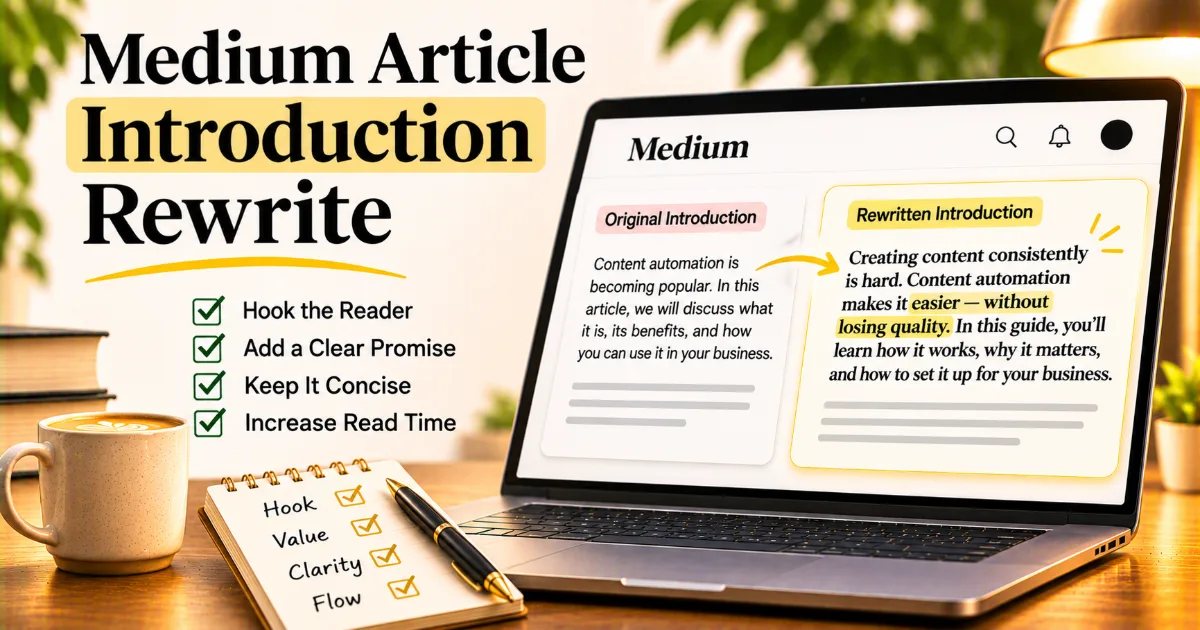
A Medium article introduction rewrite changes the first few paragraphs of a business blog post so a stranger on Medium knows within seconds what the piece is, why it matters to them and why the writer can say it, while every fact, claim and conclusion below stays exactly as the website published it. The website opening was written for someone who searched for the answer or already knows the business; the Medium reader arrived from a feed, a topic page or a publication and owes the piece nothing. So the rewrite is narrow on purpose: four moves in the opening, a matching display title and subtitle, and a check that the new opening claims nothing the article does not. This post sets out why business openings fail on Medium, what must stay locked, the four moves, the check, and one consultancy's opening shown both ways.
The same article, opened for a searcher and opened for a stranger
The website opening
- Confirms the question the searcher typed
- Leans on the site around it for context
- Builds up to the claim through background
The Medium opening
- Names the reader’s situation in their words
- Says in one sentence why this writer can speak
- States the claim in the first paragraph
- Medium article introduction rewrite: change the door, not the house
- Why a business blog opening fails a Medium reader
- What the rewrite must not change
- The four moves of a Medium opening
- Rewriting the display title and subtitle with the opening
- Checking the new opening against the original
- What the workflow drafts, and what a person decides
- A worked example: an HR consultancy's article on probation reviews
- What an opening rewrite costs, and where it goes wrong
- Frequently asked questions
- Where to start
Medium article introduction rewrite: change the door, not the house
A Medium article introduction rewrite replaces the opening of an article, and only the opening, so it works for a reader who has never met the business. The body is the same article: the same sections, examples, facts and conclusion. That limit is the whole method, because a republished article carries a canonical link claiming the Medium story and the website page are one piece of writing, and a rewrite that reaches into the body quietly makes that claim untrue. It suits an article already chosen for republishing under our Medium duplicate content strategy, where the body stays as it is. In a pipeline it is one task at the draft stage of our Medium publishing workflow automation.
How much of a republished article the rewrite is allowed to touch
- The opening the first paragraphs, rewritten for a stranger
- The body the same sections, examples, facts and conclusion
The shape of the problem, not a measurement
The reason the opening needs attention at all is that it does a different job in each place. On the website, an article usually opens for a searcher: someone typed a question, and the first paragraph confirms they have found the answer. On Medium, the same paragraph meets someone scrolling past a dozen other stories, and it has to earn the next paragraph before the argument has started. Our Medium article republishing workflow covers how the article gets there, and the wider Medium content system we build covers everything around it; this post is about the few hundred words a stranger reads first.
| Part of the opening | Written for the website | Rewritten for Medium |
|---|---|---|
| First sentence | Confirms the searcher's question | Names the reader's situation in their words |
| The claim | Often arrives after background | Stated in the first paragraph |
| Why this writer | Implied by the site around it | Said in one plain sentence of first-hand experience |
| What the piece covers | A table of contents or a heading list | One sentence of what the reader will leave with |
| References to the business | Links to services, "as we covered last week" | Removed, or kept only where a stranger needs them |
Everything in the right-hand column is a change of framing, not of substance. None of it adds a fact, and none of it removes one from the body. If a change you want to make does either, it belongs in a new article rather than an adapted opening.
Why a business blog opening fails a Medium reader
Business blog openings usually fail on Medium for one reason: they assume context the Medium reader does not have. They refer to the company's own services, to an earlier post, to a client base the reader has never heard of, or to a problem the reader is assumed to share because they arrived from a search for it. On the website those assumptions are often correct. On Medium every one of them is a small door closed in the reader's face. Medium's stats page counts a view only when a reader stays at least five seconds and a read at thirty, so a weak opening shows up as views without reads, which is the comparison our Medium content angle testing guide is built on. A tutorial is the sharpest case, because a beginner has the least context of all, which is where our Medium technical tutorial workflow starts.
What a business blog opening assumes a Medium reader already knows
“At our consultancy we often get asked”
the about page“As we covered last week”
in the archive“If you need support, our team can help”
above the footer“First, some background”
before the claim
Medium's own guidance names the cost. Its distribution guidelines for curators describe the stories it wants to put in front of readers as ones where the reader is not left feeling their time went on a sales pitch, and where there is a clear reason this writer is writing about this topic. The same page lists content marketing and stories whose main point is to sell something among the kinds of story that are not given general distribution. An opening that leads with the company reads as exactly that, even when the article beneath it is genuinely useful.
The second failure is slower: an opening that saves the point for later. Website articles often build up to the answer through background and definitions, because a searcher has already committed to the page. The Nielsen Norman Group's explanation of the inverted pyramid makes the case for the opposite order online: the most important point first, so a reader who stops after one paragraph still leaves with it. A Medium opening that follows that rule gives the stranger the claim at once and lets the body do the persuading.
What the rewrite must not change
The rewrite must not change any fact, claim, number, name, example or conclusion in the article, and it must not change what the article is for. Those are locked before anyone writes a word of the new opening. In practice that means listing them: the claim the article makes, every figure it states, every person or source it names, and the action it leaves the reader with. The new opening may restate any of them, but it may not add one, soften one or sharpen one.
The locked list, from what decides it to what follows from it
- The purposewhat the article is for
- The claimwhat the article argues
- The facts and namesevery figure, person and source it states
- The new openingmay restate any of them, may add none
The purpose is the easiest thing to change by accident. An article written to explain how probation reviews work can be turned, with a few words in the opening, into an article that seems to promise a template or a legal guarantee, and the body then disappoints the reader the opening recruited. Keep the opening's promise the same size as the body's delivery. A reader who feels misled by the first paragraph does not read the tenth.
The locked list is also what makes the rewrite safe to hand to a model. A model asked to "make this opening more engaging" will happily invent a striking statistic or a scene that never happened; a model given the locked list and told that nothing outside it may appear has much less room to wander. Research on how language models use long inputs, such as the Lost in the Middle study on arXiv, found they tend to use information at the beginning or end of an input more reliably than information buried in the middle, which is one more reason to put the locked list at the top of the instruction rather than after the article. Anthropic's guide to how you reduce hallucinations makes a similar point from the other side: give the model the source material and let it say when something is not there. Our guide to how LLMs use content covers why models fill gaps with plausible inventions.
The four moves of a Medium opening
A Medium opening built from a business article makes four moves, usually in this order. It names the reader's situation in the words they would use, it states the article's claim plainly, it gives one sentence of why the writer can say it, and it tells the reader what they will leave with. That is often two short paragraphs. It replaces whatever the website opening did in the same space, and the article continues from its first real section.
The four moves of a Medium opening, in order
- 01The situationthe reader recognises themselves in their own words
- 02The claimthe article’s point stated plainly, straight away
- 03Why this writerone sentence of real first-hand experience
- 04What they getwhat the article will give them
The first move does the most work. "Probation reviews are often treated as a formality" is a statement about other people; "If you manage someone in their first months, the probation review is probably on your calendar as a formality" is about the reader. The difference is small in words and large in effect, because the reader recognises themselves before they have decided whether to care. It must still be true: the situation named has to be the one the article actually addresses.
The third move is the one business writers skip, because on their own site the site itself provides it. On Medium there is no service page around the story, so one sentence of real, first-hand experience does the job: what the writer has done, seen or been responsible for that makes the claim worth reading. Medium's curators look for exactly that kind of credible first-hand experience. It is not a credential list and it is not a pitch, and it is the same fix our guide to how you automate LinkedIn content without sounding like AI makes for a feed post; it is the reason a stranger should give the next five minutes to this writer rather than another.
The Nielsen Norman Group's study of how users read on the web is blunt about the alternative: most people scan, and a paragraph that does not tell them why it matters is one they skip. A case study has the same gap to fill, and our guide to a content automation case study for Medium fills it with a plain statement of who built what for whom.
Rewriting the display title and subtitle with the opening
The display title and subtitle are part of the opening, and they are rewritten together with it so all three make one promise. Medium lets a story carry a different title and subtitle in its previews from the ones on the story page; its help page on custom titles and subtitles explains that the preview version appears in previews on Medium and on social media. That is where most readers meet the story, so that is where the reader-facing title belongs. In the editor itself, Medium's guide to using the story editor says a header on a story's first line becomes its title and a subheader beneath it becomes the subtitle, and the topics chosen alongside them are the subject of our Medium article tags strategy.
Three fields that have to make one promise
One promise
- 01Display titlewhat the article is about, for a stranger
- 02Subtitlewhat the reader will get from it
- 03Openingthe reader’s situation and the claim
the size of what the body delivers
The same rules apply as to the opening. The title names what the article is about in a way a stranger understands; the subtitle says what they will get. Neither may promise more than the body delivers, and Medium's distribution guidance treats a sensational or misleading title as a reason to withhold distribution. A website title written for a search engine, such as a phrase with a keyword at the front, usually makes a weak Medium display title, and the reverse is true too.
Keep the website's own title as it is. Google's guidance on influencing title links describes how the title element and headings feed what Google shows for a page, and your website page has already been written for that job, usually as the kind of article our SEO content writing page describes. Its guide to writing meta descriptions covers the matching snippet for the site. The Medium preview title is a separate field doing a separate job, which is why the adaptation can be bolder on Medium without touching the page that holds the canonical.
Checking the new opening against the original
The check is mechanical and should be run every time: every claim, number and name in the new opening must already appear in the article, and nothing in the locked list may have changed. A person can do it in five minutes with the two openings side by side. A workflow can do most of it automatically, by pulling every number and proper noun out of the new opening and confirming each one is present in the original text. An opening drafted with AI help goes through this check as one of five in our Medium AI editorial workflow. The check matters on Medium for a second reason: its AI content policy does not allow articles containing easily disprovable AI-hallucinated statistics or events, and our guide to Medium AI article fact-checking covers how each claim in a draft is traced to a source.
How a new opening is checked before the editor sees it
- 01Code nodeextractpulls every number and proper noun from the opening
- 02Code nodecompareconfirms each one is already present in the original article
- 03If nodeholdkeeps the draft back when anything has no match
- 04The editorjudgereads both openings and the last section for the promise
In n8n, a Code node can do that extraction and comparison in a few lines, and an If node can hold the draft back from the editor's queue when anything in the new opening has no match. The check does not judge the writing; it only catches the one failure that matters most, an opening that says something the article does not.
The judgement the check cannot make goes to the editor: does the new opening make the same promise as the old one, at the same size? Read the two openings, then read the article's last section. If the new opening would lead a reader to expect something the last section does not deliver, it is too big, however accurate each word is. Our guide to scoring content quality before publishing covers how a reviewer's judgement is written down so it is the same judgement each time.
What the workflow drafts, and what a person decides
The workflow drafts and checks; a person decides. It can prepare a new opening from the locked list and the article, suggest a display title and subtitle, and run the fact-lock check. In Claude Code, a custom output style is one way to keep those instructions standing; Anthropic's page on output styles describes them as instructions that set Claude's role, tone and response format for a whole session, while noting that an output style does not guarantee what is produced. That caveat is the reason the check exists.
The standing instruction for drafting a Medium opening
The opening rewrite, written once
- 01Rewrite only the opening paragraphs, the display title and the subtitle
- 02Use only the claim, facts and names on the locked list
- 03Name the reader’s situation, then state the claim
- 04Give one sentence of the writer’s first-hand experience
- 05Remove references to the company’s services and earlier posts
- 06Flag anything you could not support from the article
A person decides whether the new opening is honest, whether it sounds like the writer, and whether the article is worth adapting at all. The voice question matters more on Medium than on the website, because a stranger judges the writer by the first paragraph and nothing else. If the business keeps its voice written down, the editor checks against that; our guide to a knowledge base for AI content covers keeping voice and facts where a draft can be checked against them.
The writer of the original should see the new opening before it goes out. They know what the article was trying to do and will spot a shift in purpose faster than anyone. It is also simply fair: their name is on a piece whose first impression has been rewritten. On TikTok the equivalent move is rewriting the first seconds of a clip, and our TikTok hook rewrite workflow keeps the same rule, change the opening and lock the claim.
A worked example: an HR consultancy's article on probation reviews
Take an illustration, not a client: a small HR consultancy publishes an article on its website about running a fair probation review. The website opening reads, in substance: "At our consultancy we often get asked by clients how to handle probation reviews. In this article, we explain the process we recommend, from setting objectives to recording the outcome. If you need support, our team can help." It works on the website, where a reader searched for the process and the consultancy's services sit one click away. A newsletter issue drawn from that same article needs a different opening again, the judgement behind the guide, as the Substack article to newsletter workflow explains.
The probation review opening, website and Medium
The consultancy’s websiteThe Medium story
Clients often ask how to handle probation reviews
a manager with a new hire and a review on the calendar
In this article we explain the process we recommend
fair only if objectives were set early and notes kept since
Our team can help
one sentence on years on the employer’s side of these reviews
Probation review process: a guide
a display title naming the manager’s question
The locked list is written first. The claim: a probation review is fair when the objectives were set at the start and the evidence was recorded as it happened, not reconstructed at the end. The facts: the four stages the article describes, and the point that the outcome should be recorded in writing. The purpose: explain a process to managers, not sell a service. No numbers appear, so none may appear in the new opening.
The Medium opening is rewritten in two short paragraphs. The first names the reader: a manager with a new hire whose probation review is coming up, who has a vague feeling it should be more than a chat. It states the claim straight away: the review is only as fair as the objectives set in the first week and the notes kept since. The second paragraph gives the writer's reason, in one sentence about having sat on the employer's side of these reviews for years, and says the article walks through the four stages from setting objectives to recording the outcome. The service offer is gone; the body is untouched.
The display title moves from the website's "Probation review process: a guide" to a title naming the manager's question, and the subtitle names the four stages. The fact-lock check finds every noun and claim in the new opening already in the article, and the writer approves it with one change, softening a phrase that sounded more certain than she would say aloud. The opening now meets a stranger; the article beneath it is exactly the one the website published.
What an opening rewrite costs, and where it goes wrong
The cost is small per article: writing the locked list, drafting two paragraphs, a title and a subtitle, running the check and getting the writer's approval. For a business article that is usually well under an hour, and much of the drafting can be prepared by a workflow before anyone sits down. A business that prefers the locked list, the draft and the check to arrive ready for approval can see that build on our Medium content automation pricing page.
How each way an opening rewrite goes wrong is caught
Drifting into the body stopped by the locked list
Inventing a fact for effect caught by the fact-lock check
Sounding generic caught only by reading it aloud
A judgment, not a score
It goes wrong in three ways. The rewrite drifts into the body, one sentence at a time, until the Medium story is no longer the article the canonical says it is. The opening is made exciting at the cost of being true, with a scene or a figure the article never contained. Or the opening is rewritten so generically that it could sit on any article in the field, which Medium's guidance treats as just as unhelpful as sensationalism. The locked list stops the first two; reading the new opening aloud, next to the writer's own voice, catches the third. Comparing the two copies after publishing, as our guide on how to audit a Medium publishing workflow does, is how that drift gets noticed.
Most business articles need no more than this. A piece that needs a different structure, different examples or a different conclusion for Medium is a different article, and should be written as one. Our guide to how you build a content repurposing workflow covers when adaptation turns into new writing, and every Medium guide we have published is on our page of Medium content guides. A webinar is the clear case of that, and it gets its own method in our guide to Medium webinar repurposing.
Frequently asked questions
What is a Medium article introduction rewrite?
It is a rewrite of only the opening paragraphs, display title and subtitle of a republished business article, so a stranger on Medium knows straight away what the piece is, why it matters to them and why the writer can say it. The body, facts and conclusion stay exactly as the website published them.
Why not rewrite the whole article for Medium?
Because a republished story carries a canonical link saying the Medium copy and the website page are the same article. Rewriting the body makes that untrue. If an article genuinely needs a different structure or argument for Medium, write it as a separate story without borrowing the original's canonical.
What should a Medium opening include?
Four things, usually in two short paragraphs: the reader's situation in their own words, the article's claim stated plainly, one sentence of first-hand experience showing why the writer can say it, and what the reader will leave with. Anything about the company's services usually comes out.
How do I stop a rewritten opening inventing facts?
Write a locked list before the rewrite: the claim, every number, every name and the article's purpose. Then check that every claim and number in the new opening already appears in the article. A small script can do the extraction; a person judges whether the promise is the same size as the body.
Should the Medium display title match the website title?
Usually not. Medium lets a story show a separate title and subtitle in previews, and that preview is where most readers meet it, so it should name the reader's question plainly. The website title keeps doing its own job for search, and it is left as it is.
Who should approve the new opening?
The person who wrote the original article, wherever possible. They know what the piece was meant to do, so they spot a change of purpose fastest, and their name is on a piece whose first impression has been rewritten. An editor can check facts; only the writer can confirm the voice is theirs.
Where to start
Take one article you would republish and write its locked list on a single page: the claim, the facts, the names and what the article is for. Then read its current opening as if you had never heard of your business, and mark every phrase that assumes you had. Rewrite only those two paragraphs, check every claim in them against the list, and send the result to the original writer. That one exercise shows you how much of your opening was written for people who already know you. The rewritten opening is the main change a person pastes after import in the Content Operating System for Medium.
Disclosure
This post was written by Shreyas Dave, founder of Paper Eagle AI. We sell content automation services, which is the category this article is about, so we have a commercial interest in you concluding that a system beats ad-hoc effort — read it knowing that. No tool vendor was involved in writing it, nobody paid for a mention, and there are no affiliate links anywhere on this site. Where a third-party figure appears, it’s attributed to the publisher it came from; anything we couldn’t source is written as a direction rather than a number.
Paper Eagle AI builds Content Operating Systems that turn a business’s knowledge and expertise into consistent, multi-platform content, and we deliver them as content automation services. Working as a content automation specialist, we capture what a business knows and how it sounds, set the strategy, and build the workflows that research, draft, repurpose and publish — with a named person approving every piece before it goes out. Every build runs through discovery, design, build and handoff. The system lives in the client’s own accounts, it is documented, the team is trained to run it, and the business owns it outright. We don’t write content on a retainer, and we don’t build lead generation, CRM or sales automation.
One source of thinking becomes native content for every platform a business publishes on: the founder’s LinkedIn and the company page, YouTube and Shorts, Instagram and Reels, TikTok, Reddit, Medium, newsletters, and the company’s own website, written to be found in Google and understood by AI search. Our multi-platform content automation page shows how they share one source, and our case studies document the systems behind our own publishing, file by file. You can follow the work on the company’s own channels: Paper Eagle AI on Instagram, Paper Eagle AI on YouTube, the Paper Eagle AI company page on LinkedIn, Paper Eagle AI on Substack, Paper Eagle AI on Reddit and Paper Eagle AI on Medium. Paper Eagle AI is also listed where clients can review its work: Paper Eagle AI on Clutch, Paper Eagle AI on GoodFirms and the Paper Eagle AI Google Business Profile.
Keep reading
- Medium article republishing workflow — the import and the canonical check the new opening travels inside.
- TikTok hook rewrite workflow — the same discipline in three seconds of video: change the opening, lock the claim.
- How to build a knowledge base for AI content — where the facts the rewrite is checked against are kept.