Medium Publication Style Guide: One Page Every Contributor Follows
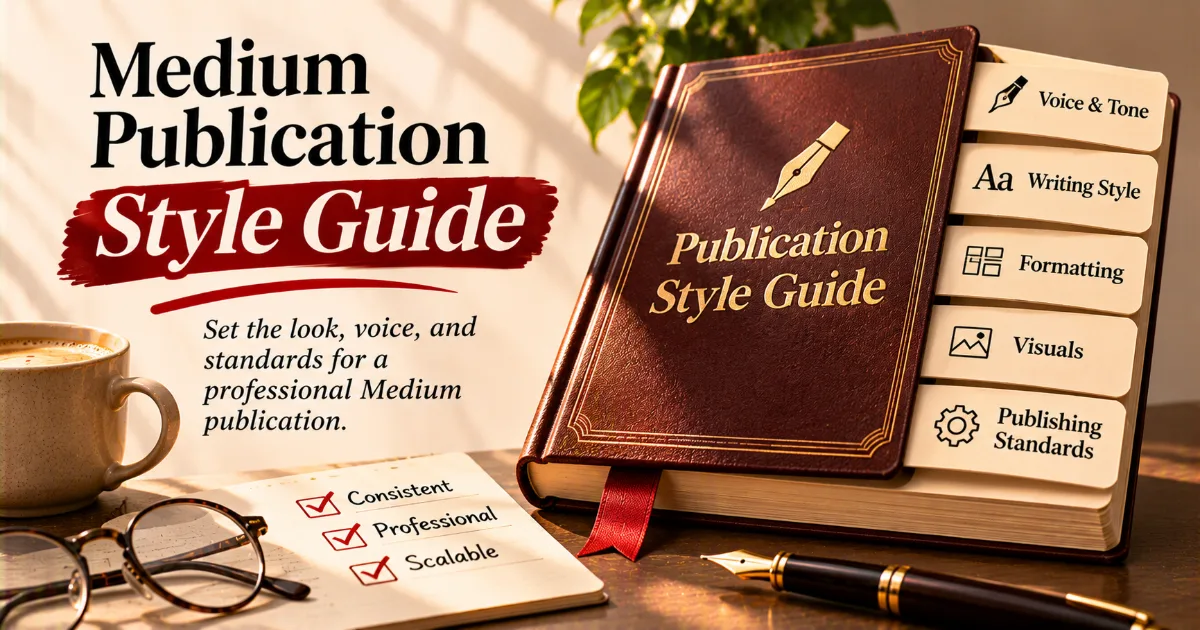
A Medium publication style guide is one page that tells every contributor how the publication writes: who the reader is, how it sounds, how headings work, what counts as evidence, and how AI assistance is disclosed. It is short on purpose, because a guide contributors do not open does nothing, and it is specific, with an example sentence for every rule, so a contributor or an editor can check a draft against it in minutes. It is published where contributors and readers can find it and is handed to any model that drafts for the publication. Medium gives a publication subpages for exactly this kind of standing information. This post covers why one page, each of the five sections, the page itself, where it lives, and an engineering consultancy with five contributors writing its guide.
The five sections of a one-page style guide
- 01Audiencewho the reader is, and is not
- 02Voicehow the publication sounds, in pairs
- 03Headingssentence case, each one a claim
- 04Evidencewhat every claim needs to go in
- 05DisclosureAI help, sponsorship and corrections
Relative, not measured
- Medium publication style guide: one page for every contributor
- Why one page, not a manual
- The audience section: who the reader is
- The voice section: how the publication sounds
- The headings section: how a story is structured
- The evidence section: what a claim needs
- The disclosure section: AI help, sponsorship and corrections
- The page itself, and where it lives
- A worked example: an engineering consultancy with five contributors
- What the guide costs, and how it fails
- Frequently asked questions
- Where to start
Medium publication style guide: one page for every contributor
A Medium publication style guide is the set of writing rules a publication's contributors follow so that its stories read as one publication rather than several people's blogs. For a business publication, the contributors are usually employees who are expert in their subject and occasional writers. Each brings their own habits: one writes long scene-setting openings, one writes in bullet points, one never cites anything, one writes headings as single words. Readers notice the difference long before they can name it. How the finished stories are shelved is a separate page of decisions, covered in our guide to Medium content library structure. What gets written, and when, is planned separately in the Medium editorial calendar.
What five contributors bring without a guide
A long scene-setting opening
one writerEverything in bullet points
anotherNever cites anything
a thirdHeadings as single words
a fourth
The guide fixes the things that should be the same in every story and leaves the rest to the writer. It covers five subjects: the audience, the voice, headings, evidence and disclosure. It does not cover what to write about, which is the editorial calendar's job, or how stories are approved, which is the review gate's. Keeping it to those five subjects is what keeps it to one page. How many images a typical story carries, and how they are captioned, belongs in it too, the rule our guide to images for a Medium article sets section by section.
It belongs in the Medium content automation setups we build for businesses with more than one writer, usually once the decision in our comparison of a Medium publication vs profile has come out in favour of a publication. The style guide sits on top of a wider body of business knowledge, covered in our guide to building a knowledge base for AI content, which holds the facts the guide's evidence rules point to.
Why one page, not a manual
A style guide for a small publication should be one page because its readers are busy experts who will read one page and will not read twenty. Large organisations publish long guides: Google's developer documentation style guide provides editorial guidelines for clear, consistent technical documentation, and it also says to follow project-specific style first and the general guide only where the project's guidance is silent. That layering is the useful idea for a small publication: a short page of its own rules, sitting on top of a general reference it does not need to repeat.
How much each kind of guide gets used
A twenty-page manual rarely opened by busy experts
A list of adjectives read, but cannot be checked
One page, a rule per line read and pointed to
One page with examples read, used and enforced
A judgment, not a score
Nielsen Norman Group's article on content standards in design systems says editorial guidelines help maintain a coherent content process and a consistent voice, tone and writing style. The word that matters is consistent. A one-page guide applied to every story produces more consistency than a thorough manual applied to some of them.
One page also changes how rules are written. Each rule has to earn its line, so the guide keeps only the rules contributors actually break, and states each with an example. "Use sentence case for headings, as in 'How the load is calculated'" is a rule a contributor can follow; "headings should be clear and consistent" is not. The test for every line is whether an editor could point to it when sending a draft back.
The audience section: who the reader is
The audience section describes the reader in two or three sentences specific enough to settle arguments. Not "business owners" but, for an engineering consultancy, "facilities and estates managers who commission engineering work but are not engineers themselves, reading to understand a decision before they make it". That sentence decides how much to explain, which terms need defining, and what the story is for.
What the audience section has to say
- Who reads
- managers who commission work and are not engineers
- What they know
- their buildings and their budgets
- What they do not
- load calculations or code clauses
- Not written for
- engineers looking for design guidance
- The rule it settles
- define technical terms the first time
The section also says what the reader already knows and what they do not. Facilities managers know their buildings and budgets; they do not know load calculations or code clauses. So the guide can say, as a rule, that technical terms are defined in plain words the first time they appear, and that a calculation is explained by what it decides rather than how it is done. A contributor writing for their peers by habit has a line to check against.
Finally, the section names who the publication is not for. Writing for everyone produces stories that serve nobody; a consultancy publication that says "not for engineers looking for design guidance" gives its contributors permission to leave out the detail they love and their readers do not need. The audience usually comes straight from the business's own knowledge, as in our guide to what goes into a business content knowledge base.
The voice section: how the publication sounds
The voice section describes how the publication sounds in three or four plain statements, each with an example sentence and a counter-example. Writing practitioners put the distinction simply: voice is the organisation's personality and should stay consistent, while tone shifts with the context. A style guide fixes the voice and gives contributors room to adjust tone for the subject. A LinkedIn company page fed by several contributors needs the same section, written as "we", which is the voice guide in a Content Operating System for a LinkedIn company page.
Voice statements shown as pairs
Not this
- It may be worth considering replacement
- Somewhat elevated loading may occur
- This could be a serious failure
Write this
- The beam needs replacing within the year
- The racking adds load the floor was not designed for
- The floor is safe now and should be checked yearly
For an engineering consultancy, the voice might be: direct, because readers are deciding something; precise, because vague words in engineering cause real mistakes; and calm, because a story about a failing structure should not alarm. Each statement gets a pair. "Direct: 'The beam needs replacing within the year.' Not: 'It may be worth considering whether replacement could be beneficial.'" Pairs do more than adjectives, because contributors can see what the adjective means.
The voice section is also what a drafting model is given. Anthropic's prompting guidance to be clear and direct notes that Claude responds well to clear, explicit instructions and that being specific about the output helps, which is exactly what a voice section with example pairs provides. A guide written for people turns out to be a good prompt too, as long as it is concrete.
The headings section: how a story is structured
The headings section sets how stories are broken up, because headings are what readers scan first and where contributors vary most. Three rules usually cover it. Headings are written in sentence case. Each heading says what its section argues, not just its topic: "Why the floor deflects under storage racking" rather than "Deflection". And the first sentence under each heading answers it, so a reader who reads only headings and first sentences still gets the argument. Medium's guide to using the story editor gives the page its limits: two heading sizes, a header and a subheader, and no footnotes, only numbered superscript; a step-by-step piece works inside the same limits, as our Medium technical tutorial workflow guide covers.
Which headings the guide accepts
- Why the floor deflects under storage racking says what its section argues
- How the load is calculated sentence case, a clear subject
- Calculating Loads a topic in title case, rewrite it
- Deflection one word, no claim at all
The section also sets the story's shape. A publication of explainers might say every story opens with the answer in its first paragraph, uses three to six sections, and ends when the argument does rather than with a summary. A contributor who writes a long introduction before reaching the point has a rule to check against, and an editor has a reason to move the answer up.
Titles follow the same logic. The guide asks for a title that states the question or the answer in the reader's words, and a subtitle that adds what the title leaves out. Medium shows both in previews, so a title that only makes sense to engineers loses the reader the audience section described before they open the story. The paragraphs straight after the title get the same attention, and for an article brought over from a website that means the Medium article introduction rewrite our guide describes. Topics are the third label a reader sees, and the publication chooses them with its Medium article tags strategy.
The evidence section: what a claim needs
The evidence section says what a statement of fact needs before it can be published. For a business publication, the rules are few and strict. A fact from an outside body links to that body's own page. A number states its source and the date it was read. A client example is used only with the client's permission and is anonymised unless they agree otherwise. And the writer's own experience is labelled as such, because "in our projects we have found" is a different kind of claim from a published figure. A style guide can borrow its evidence rule from Medium's best practices for journalism, which separate fact from conjecture and opinion; the mechanics of linking each source are in our guide to Medium article source citations.
What each kind of claim needs before it is published
from a public body
a limit, a figure, a count
a real project
what the firm has found
checked before review
to the body’s own page
with the day it was read
and anonymised unless agreed
as the firm’s experience
The section also says what not to do. No figures from memory. No "studies show" without the study. No invented composite example presented as a real client. These are the claims a reader cannot check, and a single wrong one damages every other story in the publication, because readers judge the publication rather than the writer.
These evidence rules are what the claims and sources checks in our Medium AI editorial workflow are run against. Writing the rules down once means the reviewer is checking a draft against the publication's standard rather than against their own instinct.
The disclosure section: AI help, sponsorship and corrections
The disclosure section says what the publication tells readers about how its stories are made. The first rule is AI assistance. Medium's AI content policy requires a disclosure whenever AI produced text or images in a story, placed early, inside its opening two paragraphs, while help with grammar, outlines or fact verification needs none. The guide turns that into the publication's own rule and fixes the wording of the disclosure sentence, so every story that needs one uses the same words. The Medium Rules add two more disclosures a guide should carry: anything of value received in connection with a post's topic, and affiliate links; a comparison is where they come up most, as our Medium tool comparison article guide notes.
The publication’s position on AI assistance
The disclosure
- 01AI may helpdrafting, outlining, checking
- 02A person answersnamed for every story
- 03Readers are toldwhen AI wrote text
one fixed sentence, used every time
Other publishers' policies are useful models. Nielsen Norman Group publishes its own generative-AI content policy, which permits AI throughout the creation and editorial process while stating that AI does not replace human responsibility, and that authors are responsible for every draft they submit for review. Google's guidance on creating helpful content asks whether the use of automation, including AI generation, is self-evident to visitors through disclosures or in other ways. A business publication can take the same position in a sentence: AI may help, a named person is responsible, and readers are told when AI wrote text.
The section also covers anything of value received in connection with a story, which Medium's rules ask writers to disclose, and corrections. A correction rule is short: when a published story is found to be wrong, it is fixed on the website and on Medium on the same day, with a dated note saying what changed if the change affects the story's advice. The routine for that is described in our notes on keeping published stories up to date.
The page itself, and where it lives
The page is the five sections, each with its rules and an example, on a single screen or a single printed sheet. The table below is the guide from the worked example later in this post, shortened to one rule per section, and its wording is illustrative.
Where the one page is kept and used
five sections on one page
beside the submission rules
changes suggested, history kept
handed to the model
linked as publishing principles
| Section | The rule | Example |
|---|---|---|
| Audience | Facilities and estates managers who commission engineering work and are not engineers | Define "load path" the first time it appears |
| Voice | Direct, precise and calm | "The beam needs replacing within the year", not "replacement could be beneficial" |
| Headings | Sentence case; each heading says what its section argues | "Why the floor deflects under storage racking", not "Deflection" |
| Evidence | Outside facts link to the source; numbers are dated; client examples need permission | "The guidance, read on the date shown, says…" |
| Disclosure | One fixed sentence when AI wrote text; corrections dated on both versions | The publication's standard AI-assistance sentence, in the second paragraph |
The page lives in two places. On Medium, a publication can add subpages beyond its homepage, each with a title, link and description, which is the natural home for the guide and the submission rules beside it. The working copy, the one contributors comment on and editors change, sits in a shared document where Google Docs' suggestion mode lets a contributor propose a change without altering the original, and its version history shows what changed and when.
The website can point to it as well. Schema.org's publishingPrinciples property links an organisation or a work to a document describing its editorial principles, and its correctionsPolicy property links to a statement of how errors are disclosed and corrected. A business that publishes its guide on its own site can declare both, so the standard its stories follow is stated in the same place as the stories.
A worked example: an engineering consultancy with five contributors
An engineering consultancy started a Medium publication for facilities managers, with five contributors: three engineers, a project manager and a director. After the first ten stories, an editor read them in a row and found five publications. Two opened with long histories of the building, one was written as a list, one cited nothing, and the headings ranged from one word to a full sentence. The example is invented to show the method, and none of its details are a real firm's.
How the consultancy built its guide
- 01Read ten stories
in a row, listing every difference
- 02Rules from breaks
each broken sentence becomes the example
- 03Agree the voice
direct, precise and calm, in one meeting
- 04Publish and prompt
a subpage, and the drafting prompt
- 05Accept suggestions
units, and no closing summaries
The editor drafted the page in an afternoon, working from the ten stories rather than from scratch: every rule on it was something at least one story had broken, with the broken sentence rewritten as the example. The audience line came from the firm's own description of who commissions its work. The voice section was agreed in one meeting, where the director's preference for "authoritative" became "direct, precise and calm" with pairs everyone could see. The disclosure sentence was fixed word for word.
The guide went up as a subpage on the publication and into the shared document, and the same page was added to the drafting prompt the firm runs in Claude Code for first drafts, so a model draft starts from the publication's voice rather than its own. Each new draft was checked against it before the review gate. Over the next stories, the variation the editor had found mostly disappeared, and the guide changed twice, both times by a contributor's suggestion accepted in the document: a rule for units, and a rule against ending stories with a summary.
What the guide costs, and how it fails
The guide costs an afternoon to draft and an hour to agree, then a few minutes per change. It saves editing time from the first story it is used on, because the editor sends back drafts with a line reference rather than a rewrite. The workflow around it, giving the guide to the drafting model, checking drafts against it and keeping the subpage current, is part of the setup our Medium pricing page describes.
It fails in four ways. Growing past one page until nobody reads it. Writing rules as adjectives without examples. Leaving it out of the drafting prompt, so model drafts ignore it. And never changing it, so it stops matching what the publication actually does. Each is avoided by the one-page limit, the example rule, the prompt, and accepting contributors' suggestions in the shared document.
A guide often accompanies a series of stories on one subject, as in our guide to the Medium publication topic series, and it is easier to write when the business's processes are already written down, as in our practical guide to process documentation. Briefs drawn from search data, as in our guide to Medium SEO content research, hand the writer the reader question; the guide tells them how to answer it.
Each story still links once to the right page on the website, as in our guide to linking Medium stories back to the website. Guides to the checks that enforce this page are on the Medium hub, and writing down how a business sounds is one part of our business knowledge topic.
Frequently asked questions
What is a Medium publication style guide?
One page that tells every contributor to a Medium publication how it writes: who the reader is, how it sounds, how headings work, what counts as evidence, and how AI assistance and corrections are disclosed, with an example for every rule.
How long should a publication style guide be?
One page for a small business publication. Contributors are busy experts who will read one page, and a short guide applied to every story produces more consistency than a long one applied to some.
What should the voice section say?
Three or four plain statements of how the publication sounds, each with an example sentence and a counter-example. Voice stays consistent across stories; tone can shift with the subject.
Where should the style guide live on Medium?
As a subpage of the publication, beside the submission rules, with the working copy in a shared document where contributors can suggest changes. The website version can be linked with schema.org's publishingPrinciples property.
Should the style guide cover AI use?
Yes. It should say when AI-generated text is disclosed, fix the wording of the disclosure sentence, and say who is responsible for each story. Medium asks for AI-generated text to be disclosed within the first two paragraphs.
Can I give the style guide to an AI model?
Yes, and it helps. A guide with concrete rules and example pairs works as clear, explicit instructions for a drafting model, which is what prompting guidance recommends.
Where to start
Read your last ten stories in a row and list every difference you would not want a reader to notice. Turn each into a rule with an example taken from the stories, under audience, voice, headings, evidence or disclosure, and stop at one page. Agree the voice statements with your contributors, fix the disclosure sentence word for word, publish the page as a subpage, and add it to your drafting prompt. The style guide is one of the checks a Medium draft must pass before the import step of the Content Operating System for Medium.
Disclosure
This post was written by Shreyas Dave, founder of Paper Eagle AI. We sell content automation services, which is the category this article is about, so we have a commercial interest in you concluding that a system beats ad-hoc effort — read it knowing that. No tool vendor was involved in writing it, nobody paid for a mention, and there are no affiliate links anywhere on this site. Where a third-party figure appears, it’s attributed to the publisher it came from; anything we couldn’t source is written as a direction rather than a number.
Paper Eagle AI builds Content Operating Systems that turn a business’s knowledge and expertise into consistent, multi-platform content, and we deliver them as content automation services. Working as a content automation specialist, we capture what a business knows and how it sounds, set the strategy, and build the workflows that research, draft, repurpose and publish — with a named person approving every piece before it goes out. Every build runs through discovery, design, build and handoff. The system lives in the client’s own accounts, it is documented, the team is trained to run it, and the business owns it outright. We don’t write content on a retainer, and we don’t build lead generation, CRM or sales automation.
One source of thinking becomes native content for every platform a business publishes on: the founder’s LinkedIn and the company page, YouTube and Shorts, Instagram and Reels, TikTok, Reddit, Medium, newsletters, and the company’s own website, written to be found in Google and understood by AI search. Our multi-platform content automation page shows how they share one source, and our case studies document the systems behind our own publishing, file by file. You can follow the work on the company’s own channels: Paper Eagle AI on Instagram, Paper Eagle AI on YouTube, the Paper Eagle AI company page on LinkedIn, Paper Eagle AI on Substack, Paper Eagle AI on Reddit and Paper Eagle AI on Medium. Paper Eagle AI is also listed where clients can review its work: Paper Eagle AI on Clutch, Paper Eagle AI on GoodFirms and the Paper Eagle AI Google Business Profile.
Keep reading
- How to build a knowledge base for AI content — the larger body of knowledge a style guide sits on top of.
- Medium publication vs profile — the decision that comes before a publication needs a style guide.
- Medium AI editorial workflow — the review gate that checks each draft against the guide.