Medium AI Editorial Workflow: A Five-Check Review Gate Before Import
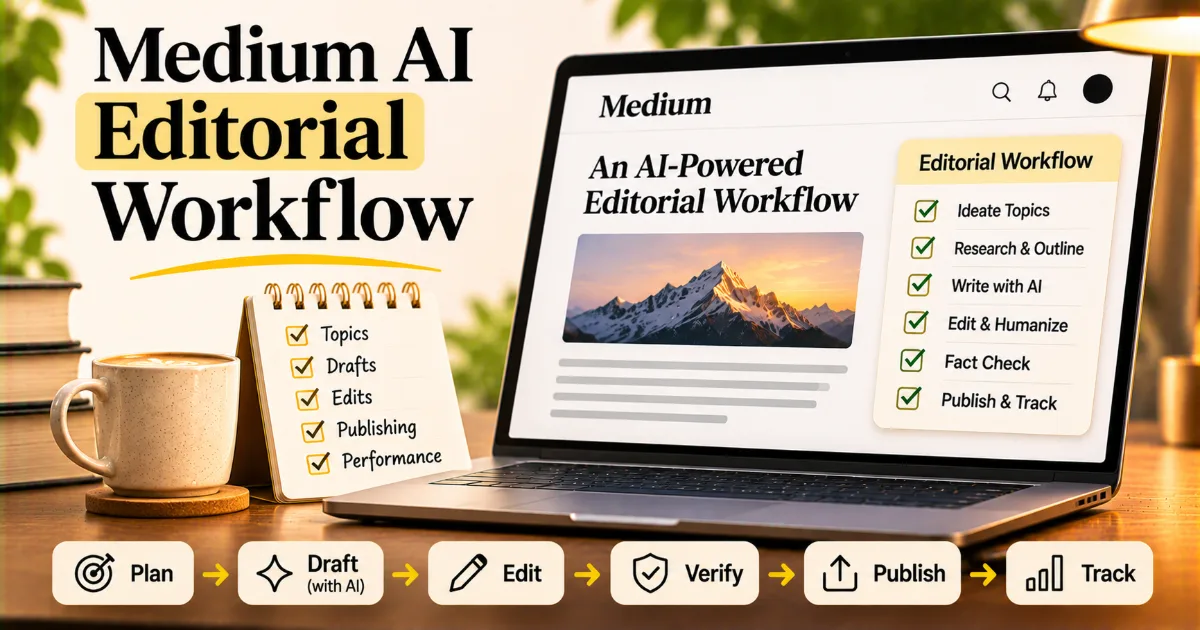
A Medium AI editorial workflow puts every AI-assisted draft through a fixed review gate before it is imported, so the story that reaches readers has been checked rather than merely read. The gate has five checks, each with its own question and its own record: voice (does it sound like the publication), claims (is every fact traced to a source), originality (does it contain something only the writers could add), structure (does it answer first and hold together), and sources (does every link open and say what the story claims). A draft that fails one goes back with a reason; a draft that passes all five gets its disclosure decided and is imported. Medium asks for AI-generated text to be disclosed, and the gate is where that decision is made on evidence. This post covers each check, the gate record, what a workflow can run, and a two-person travel publication using it on one draft.
The gate every AI-assisted draft goes through
written from notes with a model
voice, claims, originality, structure, sources
a result for each check, and who ran it
disclosure decided, then into Medium
- Medium AI editorial workflow: five checks before import
- The voice check: does it sound like the publication
- The claims check: is every fact traced
- The originality check: something only the writers could add
- The structure check: does it answer first and hold together
- The sources check: does every link open and say what it claims
- The gate record and the disclosure decision
- What a workflow can run, and what the reviewers decide
- A worked example: a two-person travel publication
- What the gate costs, and how it fails
- Frequently asked questions
- Where to start
Medium AI editorial workflow: five checks before import
A Medium AI editorial workflow is the routine a team follows between an AI-assisted first draft and a published story. Its centre is a gate: a point the draft cannot pass until named checks have been run and recorded. The gate exists because AI drafting changes where the effort goes. A draft that used to take a day now takes an hour, and the risk moves from "is it finished" to "is it right, is it ours, and would we stand behind it". A quick read cannot answer those, because a fluent draft reads well whether or not it is true.
Why a fluent draft is the one that needs the gate
Fluent · checked
ready to importit reads well and is right
Fluent · unchecked
the riskit reads well whether or not it is true
Rough · checked
needs editingright, not yet readable
Rough · unchecked
not a draft yetnobody would trust it
Left column: checked against sources
Right column: not checked yet
Medium's AI content policy draws the line the gate works to. It treats writing as AI-generated when most of it was created by an AI program with little or no editing, improvement or fact-checking, and undisclosed AI-generated writing is distributed only to the author's own network. AI assistance with outlines, grammar or fact verification needs no disclosure; text generated by AI does, in a simple sentence within the first two paragraphs. A gate that records what was checked and changed is how a team knows which side of that line each story is on.
The gate is part of the Medium content automation setup we build, where drafting, checking and importing are separate stages with one owner each. The general idea, a point where a named person has to say yes before work moves on, is covered in our guide to designing human approval gates, and the other stages from brief to import are in our guide to Medium publishing workflow automation.
The voice check: does it sound like the publication
The voice check asks whether the draft sounds like the people who sign it. AI drafts drift toward a generic register, confident, even and slightly promotional, and a publication's readers notice the change before they can name it. The check compares the draft against a short written description of the publication's voice and a handful of its best past stories, not against the reviewer's mood on the day. Medium's publications best practices and guidelines ask editors not to make major changes to a story without the writer's input, so the voice check ends with the writer agreeing to the edits; the voice itself is written down in the one-page Medium publication style guide. A decision model can flag the drafts most likely to fail this check so the reviewer reads them first, the role our news story on Gemini Decision 1 and yes-or-no checks on drafts gives it, while the agreement with the writer stays a conversation.
Where one publication sits on three tone dimensions
serious
a light touch, never jokes about the place
casual
written as a friend who has been there
respectful
of the city and the people in it
A judgment, not a score
Nielsen Norman Group's work on the four dimensions of tone of voice gives the description a usable shape: funny or serious, formal or casual, respectful or irreverent, enthusiastic or matter-of-fact. A publication that writes down where it sits on each, with an example sentence for each, has something a reviewer can check a draft against, and something a model can be given before it drafts. Anthropic's prompting guidance on giving Claude a role notes that even a single sentence of role in the system prompt focuses a model's behaviour and tone, which is why the voice description belongs in the drafting prompt as well as in the check.
The reviewer reads the draft aloud, or at least the first three paragraphs and every heading, and marks each sentence the publication would never write: the stock phrases, the inflated claims, the hedges that say nothing. A draft passes when the marked sentences have been rewritten, not when there are few of them. The record notes how many were rewritten, which over time shows whether the drafting prompt is improving.
The claims check: is every fact traced
The claims check lists every statement of fact in the draft and traces each to a source the team has actually opened. A model drafting from notes fills gaps with plausible detail: a date, an opening time, a price, a rule, a quote. Each of those reads exactly like a checked fact. The Survey of Hallucination in Natural Language Generation describes the same pattern in research terms: generation has become more fluent and coherent, and it is still prone to hallucinate unintended text. The check does not ask whether a claim sounds right; it asks where it came from, and a claim with no answer is cut or confirmed before the draft moves on.
Which kinds of claim the check traces
- A name or a date traced to notes or an official page
- A rule or a quotation traced, and attributed in the story
- A price or an opening time traced, and dated when it was read
- A detail the model supplied no source found, so it is cut
The method is mechanical, which is why it can be shared. Highlight every name, number, date, rule and quotation. For each, record the source: the writer's own notes from the trip, an official page with its date, or a document. Anthropic's guide to reducing hallucinations recommends having a model cite a supporting quote for each claim and retract any claim it cannot support, which makes a useful first pass, but the team still opens each source itself.
The full checklist, one source at a time, is in our guide to Medium AI article fact checking. In the gate the claims check has one extra rule: any claim that will go out of date, such as a price, an opening time or a timetable, is recorded with the date it was read, so the story can be checked again later by the routine described in our notes on keeping published stories up to date.
The originality check: something only the writers could add
The originality check asks what is in the draft that a reader could not get by asking a model the same question. For a publication, the answer has to be something specific: an experience, an observation, a judgement, a photograph, a mistake made and learned from. A draft that contains none of these may be accurate and well written and still not worth publishing, because it adds nothing to what already exists. Medium's plagiarism guidelines count using AI tools to rephrase, summarise or remix existing content into a derivative work that closely resembles the original as plagiarism; reusing your own website article is a different case, covered in our Medium duplicate content strategy. On a LinkedIn company page that something usually comes from a team member, and our Content Operating System for a LinkedIn Page collects it through a short contributor brief.
What only the writers could add to a draft
- 01An experiencesomething they saw or tried
- 02An observationa detail nobody else noticed
- 03A judgementa decision, and the reason for it
- 04A mistakewhat went wrong, and what it taught
Relative, not measured
Google's guidance on generative AI content makes the same point from the search side. It says generative AI can be useful for research and for adding structure to original content, and that using it to generate many pages without adding value for users may violate its spam policy on scaled content abuse. Its Search Essentials set out those spam policies alongside the practices that help a site appear well, and a gate that demands something original in every story keeps a publication on the right side of both. On the business's own blog the same rule decides whether a post is written at all, as the Content Operating System for a blog describes.
The check is simple to run. The reviewer marks every passage that comes from the writers' own experience or judgement and every passage that could have come from anywhere. If the first kind is missing, the draft goes back with a question: what did you see, try or decide that this story should say? The answer usually becomes the strongest paragraph in the piece. Ownership is part of this too: the U.S. Copyright Office's work on copyright and artificial intelligence centres on human authorship, and a story built on the writers' own contributions is one they can more clearly call their own.
The structure check: does it answer first and hold together
The structure check reads the draft as a reader arriving cold would, looking at the title, the opening and the headings before anything else. Does the opening answer the question the title asks? Does each heading say what its section argues? Does the story end when its argument does, or does it summarise itself? AI drafts tend toward a familiar pattern, a long scene-setting opening, headings that are labels rather than claims, and a closing paragraph that repeats the introduction, and the check is where that pattern is broken.
The three levels at which a draft can fail a reader
- 01Legibility
can the words be seen and recognised
- 02Readability
are the sentences simple enough to parse
- 03Comprehension
does the reader get the point, and early
Nielsen Norman Group's article on legibility, readability and comprehension separates three levels at which text can fail: whether the words can be seen, whether the sentences are simple enough to parse, and whether the reader understands the meaning. The structure check works at the third. A draft can be easy to read sentence by sentence and still be hard to understand because the point arrives in the fifth paragraph.
For a Medium version, the check also covers the opening a Medium reader sees. A website introduction often assumes the reader already knows the publication, and our guide to the Medium article introduction rewrite covers adapting it without changing what the story says. The reviewer also confirms the title and subtitle describe this story's argument, because those are what appear in previews. Its topics are a separate choice, made with our Medium article tags strategy.
The sources check: does every link open and say what it claims
The sources check opens every link in the draft and confirms three things: it works, it is the original source rather than a page repeating it, and it says what the sentence linking to it claims. Models produce links that look right and lead nowhere, or lead to a real page that says something slightly different. A broken or mismatched link is the most visible mistake a reader can find, so it is checked one by one, not sampled.
How each link in the imported draft is checked
- 01It opensnot broken, not a dead end
- 02The originalnot a page repeating it
- 03Says the claimthe sentence matches the source
- 04Checked in Mediumon the imported draft, shared by link
The check also covers attribution beyond links. A quotation is attributed to the person who said it, in their words, and only with their agreement if it came from a private conversation. An image carries a credit and alt text that describes it. A fact from an official body links to that body's own page, not to a news story about it. The guidance on source citations in Medium articles covers how each kind of source is cited in the story itself. A generated image needs its own record of what it is allowed to show, and a Higgsfield visual brief taken from the approved article is that record, written before the picture is made. When the image is a library photo or a generated one, the credit differs, and our comparison of stock footage and Higgsfield output explains what each source's rights document says.
For the Medium version specifically, the sources check runs on the draft in Medium after import, not only on the website version, because links can change during import. Medium's help page on sharing drafts and getting feedback explains that a draft link can be shared before publishing, and that anyone logged in who has it can read the draft and leave private notes for the author, which lets the second reviewer check the imported version where readers will see it. Checking links after import is also one of the five checks in our guide on how to audit a Medium publishing workflow.
The gate record and the disclosure decision
The gate record is one row per draft, with a result for each of the five checks, who ran it, and when. It turns the gate from a habit into something a team can look back on. It shows which checks fail most often, which tells the team where the drafting process needs work, and it shows for every published story what was checked and by whom. Medium's revision history keeps a reverse-chronological list of saved versions that the author can view and restore, which complements the gate's own record; a founder's sign-off on the final version is covered in our Medium founder thought leadership guide.
How the record decides the disclosure
Grammar or spelling help no disclosure needed
An outline or fact verification no disclosure needed
Drafted by a model, heavily rewritten disclosed by the publication’s rule
Generated text, lightly edited a sentence in the first two paragraphs
A judgment, not a score
| Check | The question | Passes when | What the record keeps |
|---|---|---|---|
| Voice | Does it sound like the publication? | Every off-voice sentence has been rewritten | How many sentences were rewritten |
| Claims | Is every fact traced to a source? | Every claim has a source, or has been cut | The claim list, with sources and dates read |
| Originality | What could only the writers add? | At least one passage from their own experience | Which passages are first-hand |
| Structure | Does it answer first and hold together? | The opening answers the title; headings say what each section argues | What was moved or cut |
| Sources | Does every link open and say what it claims? | Every link checked on the imported draft | Each link, its status and the date checked |
The disclosure decision is made last, from the record. If the draft's text was generated by a model and the team's changes were light, Medium's policy asks for a disclosure sentence within the first two paragraphs. If the model was used only for outlining, grammar or fact verification, no disclosure is needed. Most AI-assisted drafts that pass this gate have been substantially rewritten, but the publication decides on the evidence in the record, and when in doubt it discloses. The wording of the sentence stays the same from story to story, so readers learn what it means. Substack handles the same question through a "How I make this" statement and a reader-side AI scan, and a Substack Content Operating System fills that statement from this kind of record. The record that decides disclosure is also the one a fact-check reads, as Substack newsletter fact-checking shows for newsletter issues.
What a workflow can run, and what the reviewers decide
A workflow can make the gate easier to run without running it. It can extract every link from a draft and test each one. It can list every number, date and proper noun for the claims check. It can compare the draft against a list of phrases the publication never uses. And it can hold the draft until the record is complete: n8n's Wait node pauses a workflow until a condition is met, such as a reviewer submitting the record, and its Stop And Error node can fail the run on purpose, so a draft with a failed check never reaches the import step.
Who runs which checks in a two-person team
The person who prompted itThe second reviewer
Voice
knows what the model was given
reads the imported version
Claims, originality
knows what went in
asks what is first-hand
Structure, sources
hands over the draft
reads it as a reader would
What a workflow cannot do is make any of the five judgements. Whether a sentence sounds like the publication, whether a source says what the story claims, whether a passage is genuinely first-hand, and whether the structure works for a reader are all decisions about meaning. A model can flag candidates for each, and the flags save time, but a draft is passed by a person who has read it, and the record says who.
For a small team, the split also decides who reviews. The person who prompted and edited the draft runs the voice, claims and originality checks, because they know what went in. A second person runs the structure and sources checks on the imported Medium draft, because they come to it as a reader would. Neither check is skipped because a draft looks good: a fluent draft is exactly the one most likely to be trusted without being checked.
A worked example: a two-person travel publication
A two-person travel publication on Medium, an editor and a writer, publishes practical guides to small cities: how to arrive, where to stay, what to see in two days. The writer travels and keeps notes; a model turns the notes and the editor's outline into a first draft. The gate runs on every draft before import. The example is a composite made to show how the gate works, and its details are illustrative rather than taken from one publication's records.
Where the travel guide’s changes came from
Every change
- Voice stock sentences rewritten
- Claims the rail price replaced with a link
- Originality the morning train passage added
- Structure arrival moved above history
- Sources one changed link fixed
Rough shares — a shape, not a measurement
On one guide, the gate changed something at every one of the five checks. Voice: the draft called a market "a vibrant tapestry of local culture", which the publication would never write, along with several similar sentences, all rewritten. Claims: the draft gave the market's opening days and the price of a regional rail pass; the opening days matched the writer's notes, but the rail price did not appear in any source, so it was replaced with a link to the operator's fares page and the date it was read. Originality: the strongest passage in the final story, about which platform the morning train actually leaves from, came from the reviewer asking the writer what had gone wrong on the trip.
Structure passed with one change, moving the practical arrival section above the history. Sources caught one link to the city's tourism office that had changed during import, fixed in the Medium draft. The record shows all five checks, who ran each, and the disclosure decision: the text had been substantially rewritten from the model's draft, the model had been used for drafting from the writer's notes, and the publication added its standard AI-assistance sentence in the second paragraph anyway, because that is its rule for any model-drafted story.
What the gate costs, and how it fails
The gate costs reviewing time on every draft. That is the honest trade: AI drafting is faster, but only because some of the saved time moves into checking. A workflow that extracts links and claims shortens the mechanical parts; our Medium pricing page gives the one-time price for a setup with this gate in it.
It fails in four ways. Running the checks as one read rather than five, so each gets less attention than it needs. Letting the person who prompted the draft review it alone. Skipping the sources check on the imported version. And treating the record as paperwork rather than as information, so the same check fails story after story and the drafting prompt never changes. Each is avoided by keeping the five checks separate, the record honest, and the second reviewer real.
Once a story passes, it joins the archive, and our guide to Medium content library structure covers where it sits. Drafts made from recorded material go through the same gate, as our guide to Medium webinar repurposing describes.
The Medium hub holds our guides to the stages either side of this gate, and content automation is the topic page for the question underneath it: where a person has to decide.
Frequently asked questions
What is a Medium AI editorial workflow?
The routine between an AI-assisted first draft and a published Medium story, centred on a review gate of five checks: voice, claims, originality, structure and sources. Each check has its own question and result, recorded before the disclosure is decided and the draft is imported.
Do I have to disclose AI assistance on Medium?
Medium asks you to disclose text or images generated by AI, with a simple sentence within the first two paragraphs. Using AI only for outlines, grammar or fact verification does not need disclosure. Undisclosed AI-generated writing is limited to your own network.
Why five checks instead of one careful read?
Because a fluent AI draft reads well whether or not it is accurate, original or in your voice. Five named checks, each with its own question, make sure each risk is looked at on purpose, and the record shows which ones fail most often.
Who should run the gate in a small team?
The person who prompted and edited the draft runs the voice, claims and originality checks, because they know what went in. A second person runs structure and sources on the imported Medium draft, because they read it as a reader would.
Can the review gate be automated?
Parts of the preparation can: extracting links and testing them, listing claims, flagging stock phrases, and holding the draft until the record is complete. The five judgements themselves stay with people who have read the draft.
What happens when a draft fails a check?
It goes back with the reason written in the record: the sentences to rewrite, the claims without sources, the question about what is original. It comes back through the whole gate, not only the check it failed, because fixes can introduce new problems.
Where to start
Write down your publication's voice on the four tone dimensions, with an example sentence for each. Make a gate record with one row per draft and a column for each of the five checks. Run it on your next AI-assisted draft before import, with a second person doing structure and sources on the imported version, and decide the disclosure from the record. After ten drafts, look at which check fails most and change the drafting prompt to match. The gate sits between adapting a website article and importing it, as the review stage of the Content Operating System for Medium.
Disclosure
This post was written by Shreyas Dave, founder of Paper Eagle AI. We sell content automation services, which is the category this article is about, so we have a commercial interest in you concluding that a system beats ad-hoc effort — read it knowing that. No tool vendor was involved in writing it, nobody paid for a mention, and there are no affiliate links anywhere on this site. Where a third-party figure appears, it’s attributed to the publisher it came from; anything we couldn’t source is written as a direction rather than a number.
Paper Eagle AI builds Content Operating Systems that turn a business’s knowledge and expertise into consistent, multi-platform content, and we deliver them as content automation services. Working as a content automation specialist, we capture what a business knows and how it sounds, set the strategy, and build the workflows that research, draft, repurpose and publish — with a named person approving every piece before it goes out. Every build runs through discovery, design, build and handoff. The system lives in the client’s own accounts, it is documented, the team is trained to run it, and the business owns it outright. We don’t write content on a retainer, and we don’t build lead generation, CRM or sales automation.
One source of thinking becomes native content for every platform a business publishes on: the founder’s LinkedIn and the company page, YouTube and Shorts, Instagram and Reels, TikTok, Reddit, Medium, newsletters, and the company’s own website, written to be found in Google and understood by AI search. Our multi-platform content automation page shows how they share one source, and our case studies document the systems behind our own publishing, file by file. You can follow the work on the company’s own channels: Paper Eagle AI on Instagram, Paper Eagle AI on YouTube, the Paper Eagle AI company page on LinkedIn, Paper Eagle AI on Substack, Paper Eagle AI on Reddit and Paper Eagle AI on Medium. Paper Eagle AI is also listed where clients can review its work: Paper Eagle AI on Clutch, Paper Eagle AI on GoodFirms and the Paper Eagle AI Google Business Profile.
Keep reading
- How to design human approval gates — the gate idea in general, for any workflow where a person has to say yes.
- Medium AI article fact checking — the claims check in full, one source at a time.
- Medium publishing workflow automation — where the gate sits among the other stages from brief to import.