Medium Publication vs Profile: Where a Business Should Publish
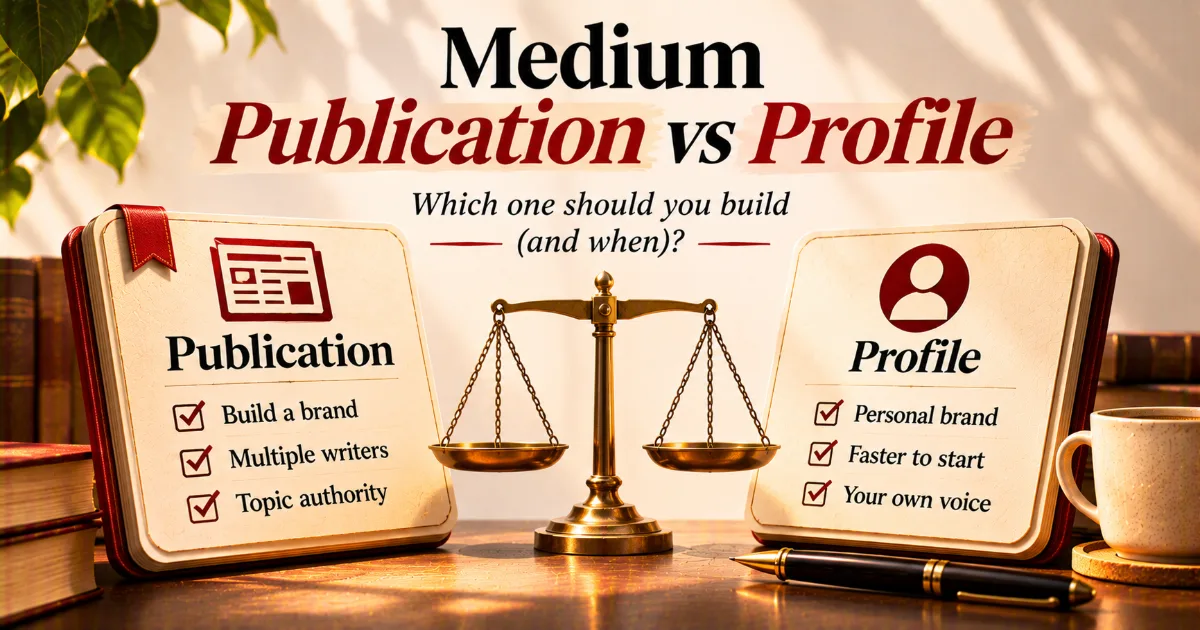
The choice between a Medium publication and a profile comes down to who writes, who edits, and what should happen to the work when someone leaves. A profile is one person's account: their name, their voice, their stories, and the simplest thing to run. A publication is an editorial home that collects stories from several writers under one name, with an owner, editors and writers, its own homepage and its own followers, and it can outlast any one contributor. For a single founder writing alone, a profile is usually right. For a business with several contributors, or one that needs a second person to review every story, a publication usually is, provided someone has the time to edit it. Medium lets the two work together: writers keep their own profiles and submit their stories to the business's publication. This post compares them on ownership, editorial control, credibility and workload, then gives a decision table and a small insurance broker's choice.
A profile and a publication, side by side
A profileA publication
Identity
one named person
a shared subject and name
Ownership
the person’s account
an owner, editors, writers
Review
by shared draft link
inside Medium, by an editor
Cost
the writing only
the writing and an editor’s time
- Medium publication vs profile: one person's voice or an editorial home
- What a profile gives a business, and what it costs
- What a publication gives a business, and what it costs
- Ownership and continuity: what happens when someone leaves
- Editorial control: what an editor can and cannot do
- Credibility: whose name readers see
- The decision table: team and publishing model
- Using both: profiles inside a publication
- A worked example: a small insurance broker
- What each setup costs to run, and how each fails
- Frequently asked questions
- Where to start
Medium publication vs profile: one person's voice or an editorial home
A Medium profile is an individual account. Every story on it is published by that person, appears under their name, and is followed by readers who chose to follow them. A Medium publication is a collection of stories about a common theme, run by an owner with a staff of editors and writers. Each story in a publication is still written and published by an individual, under their own byline, but it also appears on the publication's homepage and reaches the publication's followers.
How a profile and a publication compare for a business
- 01Named voice
- 02Continuity
- 03Editorial review
- 04Low overhead
- 05Shared identity
- a profile
- a publication
A judgment, not a score
The difference that matters for a business is where the identity sits. On a profile, the identity is the person: readers follow a named expert and trust what that person writes. In a publication, the identity is shared: readers follow the publication's subject and editorial standard, and individual writers come and go inside it. Neither is better in general. A business choosing between them is really choosing whether its voice on Medium belongs to a person or to the organisation.
This decision is the first one in any Medium content automation setup we build, because it decides where stories are imported, who approves them and where the website's canonical articles point. Most other platforms ask a business the same question in their own way. YouTube, for example, describes a Brand Account as an account created for a business or brand, which a channel can be created under, and the reasons a business uses one there are the same reasons it might want a publication here. Its help page on channel permissions describes giving other people access to a channel, which is the equivalent of adding editors.
What a profile gives a business, and what it costs
A profile gives a business a named voice with almost no overhead. The founder or expert writes, publishes and replies under their own name, and the stories build that person's reputation directly. Many readers follow people rather than organisations, and a story from a named practitioner who explains how they actually work tends to carry more weight than the same story from an anonymous brand. The writing approach for that case is covered in our guide to Medium founder thought leadership. Medium's page on publishing on Medium as a company says most brands create a general account under the organisation's name for what the organisation as a whole has to say, and either route can carry a customer story written as our Medium case study article guide describes.
What a profile’s value is made of
- The person’s name the voice readers trust
- Their followers readers who chose them
- Their archive every story, on their account
The shape of the problem, not a measurement
The costs are about continuity and control. The stories are that person's, on their account, so if they leave the business the archive leaves with them, along with the followers they built. The business has no editorial role: there is no built-in way for a colleague to review a story inside Medium before it goes out, other than sharing a draft link. And a profile mixes topics if the person writes about more than the business, which can blur what readers expect from it.
A profile is also the only option for a person who writes alone and wants nothing more. There is no publication to manage, no staff to add and no homepage to keep current, which is exactly why it is the right starting point for most single founders.
What a publication gives a business, and what it costs
A publication gives a business a home on Medium that belongs to the organisation's subject rather than to one writer. Medium's publications best practices and guidelines describe publications as collections of stories about a common theme, functioning as editorial communities that connect writers with readers. Owners can add editors and writers, editors can add writers, and the publication has its own homepage, its own followers, topics that describe it and, if the owner wants one, a custom domain. Medium's Info and Homepage settings build a publication's homepage from sections that can show the latest stories, an editor's picks or the stories in one topic, which is where a series gets its own shelf; our Medium publication topic series guide plans what goes on it.
What a publication is built from
stories on one common theme
adds editors and writers
review, edit and publish
submit stories under their byline
sections showing the stories
describe what it covers
an optional identity
It also gives the business an editorial stage. Editors and writers in a publication can edit stories submitted to it and leave private notes, so a second person can review a story inside Medium before it appears under the publication's name. That makes a publication the natural home for a team that wants every story checked, as described in our guide to the Medium AI editorial workflow, where the second reviewer works on the imported draft.
The cost is an editor's time. A publication with no active editor is a homepage that goes stale: the latest stories are months old, the sections no longer match what is published, and submissions sit unanswered. The publication also needs its own decisions, a name, a description, topics, a homepage structure and submission guidelines, before the first story goes in. A business that cannot give someone a regular hour or two for that is usually better served by profiles.
Ownership and continuity: what happens when someone leaves
Ownership is where the two differ most, and where businesses most often discover the difference too late. On a profile, the account and its stories belong to the person. In a publication, the publication belongs to its owner, but each story still belongs to the writer who published it. Medium's publication guidelines say that if a publication moves to another platform, its stories may not be republished there without the express permission of each story's author. Medium's guide to getting started with a Medium publication says creating one needs an active Medium membership and that one user can own up to seven publications; the standard its contributors then write to is the one-page Medium publication style guide.
What a publication keeps when a writer leaves
- 01Everything on Mediumthe publication and its stories
- 02The writer’s storiesstill belong to the writer
- 03The writer’s followersfollow the person
- 04The publicationits name, homepage and followers
Relative, not measured
That has a practical consequence for a business. A publication keeps its name, homepage and followers when a writer leaves, and their stories can stay in it, but the stories are theirs. The business's real archive should therefore live on its own website, with the Medium versions as adapted or republished copies that point back to it, which is the approach set out in our guide to linking Medium stories back to the website. The website copy is what the business owns outright, whichever setup it chooses on Medium. Whichever account holds them, stories that began on the website arrive through our Medium article republishing workflow, so the site stays the original. On Substack the same archive is shaped with sections, tags and a start-here post, as Substack newsletter archive structure explains.
Ownership of the publication itself is also deliberate. The guidelines say a publication may not be sold, and that an owner who wants to transfer it to another Medium user contacts Medium's support team. A business should therefore decide at the start which account owns the publication, ideally one tied to the business rather than to whichever employee set it up, and record who the editors are. A publication owned by someone who has left is a problem nobody notices until a setting needs changing.
Editorial control: what an editor can and cannot do
An editor in a publication can review, edit and publish submitted stories, but the guidelines set limits on that power. Editors and writers have equal editing permissions, and Medium encourages them to use private notes to work together. Editors must not use those permissions in ways that harm the writer's work: making major changes without the writer's input, adding large footers or calls to action, or deleting a story without the writer's agreement are all named as things not to do. A company newsletter on Substack faces the same question about whose voice wins an edit, and Substack brand voice guidelines answer it on paper.
What a publication editor can and cannot do
- Edit and approve submitted stories equal editing permissions
- Leave private notes for the writer encouraged for working together
- Set what submissions must include an image or a subtitle
- Make major changes without the writer harms the writer’s work
- Add large footers or calls to action named in the guidelines
That shapes how a business publication should work. The editor's role is to improve and approve, in conversation with the writer, not to rewrite stories into a house sales message. A business that wants every story to end with a promotion will find the guidelines and the curation rules both pushing against it. The editorial standard is better written down as a short guide that writers follow before submitting, so the editor checks against it rather than imposing it after the fact.
Submissions follow rules the owner sets. Medium's help page on submitting a story to a publication explains that writers submit from the story's settings, that a publication can accept drafts, published stories or both, and that owners can set conditions such as requiring an image or a subtitle. A business publication with a small, known staff usually accepts drafts only from its own writers, so every story is reviewed before it is published.
Credibility: whose name readers see
Readers judge a story partly by who wrote it, and the two setups present that differently. On a profile, the byline is the whole identity: the person's name, photo and bio. In a publication, a story carries the writer's byline and the publication's name, so the reader sees both a person and an organisation. For a business, that combination is often the strongest signal available: a named practitioner, writing inside an editorial home with a stated subject.
How much a byline tells the reader about who wrote a story
An unnamed brand
Person plus publication
- A brand accountno person behind the words
- A named practitionera person, photo and bio
- Byline plus publicationa person inside an editorial home
Nielsen Norman Group's work on trustworthiness in web design lists factors that make a site credible, including upfront disclosure of who is behind it, and its article on 'About Us' summaries argues that people who trust an organisation are more open to engaging with it. A publication's description and about page do that job on Medium: they say who runs it, what it covers and why. A profile's bio does the same for one person, and should name the business they write from.
The website versions of the stories say the same thing in structured data. Schema.org's author property names the person who wrote a work, and its publisher property names the organisation that published it.
Google's Article structured data documentation includes author markup best practices, such as including every author, and its guidance on creating helpful content asks whether it is clear who created the content. A person-and-organisation byline on Medium and author-and-publisher markup on the website tell the same story in two places.
The decision table: team and publishing model
The decision follows from two facts about the business: how many people write, and whether every story needs a second person to approve it. A third fact, whether anyone has time to edit, decides whether a publication is workable at all. The table below sets out the common cases.
Two questions that decide where a business publishes
One writer · no review
a profilethe simplest thing to run
One writer · reviewed
a profilereviewed by shared draft link
Several writers · no review
profilesuntil an editor exists
Several writers · reviewed
a publicationwith contributors' own profiles
Left column: one person writes
Right column: several people write
| The team | How stories are approved | Who has time to edit | Usually right |
|---|---|---|---|
| One founder or expert, writing alone | By the writer | Nobody needs to | A profile |
| One writer, with a reviewer before anything goes out | A second person reads every story | The reviewer, briefly | A profile, reviewed by shared draft link |
| Two to five contributors on one subject | An editor approves every story | An editor, an hour or two a week | A publication, with contributors' own profiles |
| Several contributors, nobody to edit | Each writer publishes alone | Nobody | Profiles, until an editor exists |
| A business with outside contributors, such as clients or partners | An editor approves submissions | An editor, regularly | A publication with written submission guidelines |
Two cautions apply to every row. Whichever setup is chosen, the business's canonical articles stay on its website. And the choice can change: a business can start with a founder's profile and add a publication later, moving the founder's future stories into it, because the stories remain on the founder's profile either way.
Using both: profiles inside a publication
Most businesses with more than one writer end up using both. Each contributor keeps their own profile, with their own name and followers, and submits the stories they write for the business to the business's publication. The story appears under the writer's byline and in the publication, so it reaches both the writer's followers and the publication's. When a writer leaves, the publication keeps its name, homepage and followers, and the remaining writers carry on.
How a contributor’s story reaches the publication
- 01The writerTheir own profilethe story is drafted under their name
- 02The writerSubmissionsent from the story’s settings
- 03The editorReviewedited and approved with private notes
- 04The publicationPublishedreaches both sets of followers
The setup needs a little coordination. The publication's homepage sections, topics and description are maintained by its editor, as covered in our guide to Medium content library structure. The editorial calendar decides which writer covers which question, and our guide to the Medium editorial calendar shows how. And the import and approval steps, from the website draft to the published story, are mapped in our guide to Medium publishing workflow automation, with the publication's editor as the approver.
Automation helps at the edges. A workflow can watch a publication's or a profile's feed and add each new story to the business's records; n8n's RSS Read node reads published feeds, which is enough to keep a list of what went out, where, and under whose name. Adding writers, setting submission rules and approving stories are done by hand on Medium itself; the platform stopped issuing new API integrations, so no workflow can do them.
A worked example: a small insurance broker
An insurance broker focused on hard-to-place cover, a small firm with four brokers and a compliance lead, wanted to publish explanatory stories on Medium about the kinds of cover its clients find hardest to understand. Two of the brokers were keen to write; the founder wanted to write occasionally; and the compliance lead had to read anything the firm published before it went out. The example is a composite built to show the decision, and its details are illustrative rather than one firm's records.
How the insurance broker set up its publication
The meeting
the decisionthree writers, every story reviewed
The afternoon
the setupname, description, topics, submission rules
Each week
the review slotthe compliance lead edits drafts
The founder’s pieces
a personal viewkept on the founder’s profile
The team and publishing model pointed one way. Three contributors on one subject, every story reviewed before publication, and a compliance lead with a fixed weekly slot for reviewing: that is the third row of the decision table. The firm created a publication owned by an account tied to the business, made the compliance lead an editor, added the three writers, and set the publication to accept drafts only from its own writers, so nothing could appear under its name without review.
Each broker kept their own profile and submitted their stories to the publication. The founder's occasional opinion pieces stayed on the founder's profile, where a personal view belongs, and linked to the publication's explainers where relevant. Every story's canonical version stayed on the firm's website, so the archive was the firm's whichever broker wrote it. The decision took a meeting; setting up the publication's name, description, topics and submission rules took an afternoon.
What each setup costs to run, and how each fails
A profile costs only the writing. A publication costs the writing plus an editor's regular time, and a one-off afternoon to set up its name, description, topics, homepage sections and submission rules. The workflows around either, importing from the website, recording what was published and checking links, are the same size in both cases, so the choice does not change the build priced on our Medium pricing page.
Each fails in its own way. A profile fails when the business treats a person's account as its own and loses the archive and followers when that person leaves. A publication fails when nobody edits it, so the homepage goes stale and submissions wait; when its owner account is a personal one that leaves with an employee; or when editors use their permissions to turn stories into adverts. Both fail when the website does not hold the canonical version, because then the business owns nothing it published.
The same person-or-organisation question appears on LinkedIn, where a business can publish from a founder's profile or from its own LinkedIn company page, and the reasoning carries across. Stories in either setup still choose their topics carefully, as covered in our Medium article tags strategy, and the essays built from one recorded talk in our guide to Medium webinar repurposing fit a publication especially well when several speakers contributed.
Whichever home you choose, the guides to filling it are on the Medium hub; choosing between Medium and the other channels a business runs is a multi-platform content decision. If the business also has a blog, the canonical home of each story is the blog post, as the Content Operating System for a blog explains.
Frequently asked questions
What is the difference between a Medium publication and a profile?
A profile is one person's account, where every story appears under their name. A publication is a collection of stories on a shared theme, run by an owner with editors and writers, with its own homepage and followers. Stories in a publication still carry their writer's byline.
Should a business publish on Medium as a profile or a publication?
A single founder writing alone is usually best on a profile. A business with several contributors, or one that needs every story reviewed before it goes out, is usually best with a publication, provided someone has regular time to edit it. If that founder wants the essays drafted from their own recordings rather than written from scratch, our content automation for founders covers Medium alongside their other channels.
Who owns the stories in a Medium publication?
Each story belongs to the writer who published it, even inside a publication. Medium's guidelines say a publication that moves to another platform may not republish its stories there without each author's permission, so a business keeps its canonical versions on its own website.
Can a writer keep their own profile and write for a publication?
Yes. Writers keep their own profiles and submit stories to a publication, which then appear under the writer's byline and in the publication, reaching both sets of followers.
What can a publication editor change in a story?
Editors can edit and approve submitted stories, but Medium's guidelines say not to make major changes without the writer's input, add large footers or calls to action, or delete a story without the writer's agreement.
Can I switch from a profile to a publication later?
Yes. A business can start with a founder's profile and create a publication later. Earlier stories stay on the founder's profile, and future stories can be submitted to the new publication.
Where to start
Write down three facts: how many people will write, whether every story needs a second person's approval, and who has regular time to edit. Find your row in the decision table. If it says publication, decide which business account owns it, name its editor, and write its description and submission rules before the first story. If it says profile, make sure the bio names the business, and keep every canonical article on your website either way. Whichever you choose, the publication or profile is the destination at the end of the import stage in the Content Operating System for Medium.
Disclosure
This post was written by Shreyas Dave, founder of Paper Eagle AI. We sell content automation services, which is the category this article is about, so we have a commercial interest in you concluding that a system beats ad-hoc effort — read it knowing that. No tool vendor was involved in writing it, nobody paid for a mention, and there are no affiliate links anywhere on this site. Where a third-party figure appears, it’s attributed to the publisher it came from; anything we couldn’t source is written as a direction rather than a number.
Paper Eagle AI builds Content Operating Systems that turn a business’s knowledge and expertise into consistent, multi-platform content, and we deliver them as content automation services. Working as a content automation specialist, we capture what a business knows and how it sounds, set the strategy, and build the workflows that research, draft, repurpose and publish — with a named person approving every piece before it goes out. Every build runs through discovery, design, build and handoff. The system lives in the client’s own accounts, it is documented, the team is trained to run it, and the business owns it outright. We don’t write content on a retainer, and we don’t build lead generation, CRM or sales automation.
One source of thinking becomes native content for every platform a business publishes on: the founder’s LinkedIn and the company page, YouTube and Shorts, Instagram and Reels, TikTok, Reddit, Medium, newsletters, and the company’s own website, written to be found in Google and understood by AI search. Our multi-platform content automation page shows how they share one source, and our case studies document the systems behind our own publishing, file by file. You can follow the work on the company’s own channels: Paper Eagle AI on Instagram, Paper Eagle AI on YouTube, the Paper Eagle AI company page on LinkedIn, Paper Eagle AI on Substack, Paper Eagle AI on Reddit and Paper Eagle AI on Medium. Paper Eagle AI is also listed where clients can review its work: Paper Eagle AI on Clutch, Paper Eagle AI on GoodFirms and the Paper Eagle AI Google Business Profile.
Keep reading
- Medium founder thought leadership — what a founder publishing under their own name should write.
- Medium content library structure — how a publication's homepage sections are organised once it exists.
- Medium AI editorial workflow — the review every story passes, whichever home it goes to.