TikTok Founder Content Workflow: Opinions That Stay Unscripted
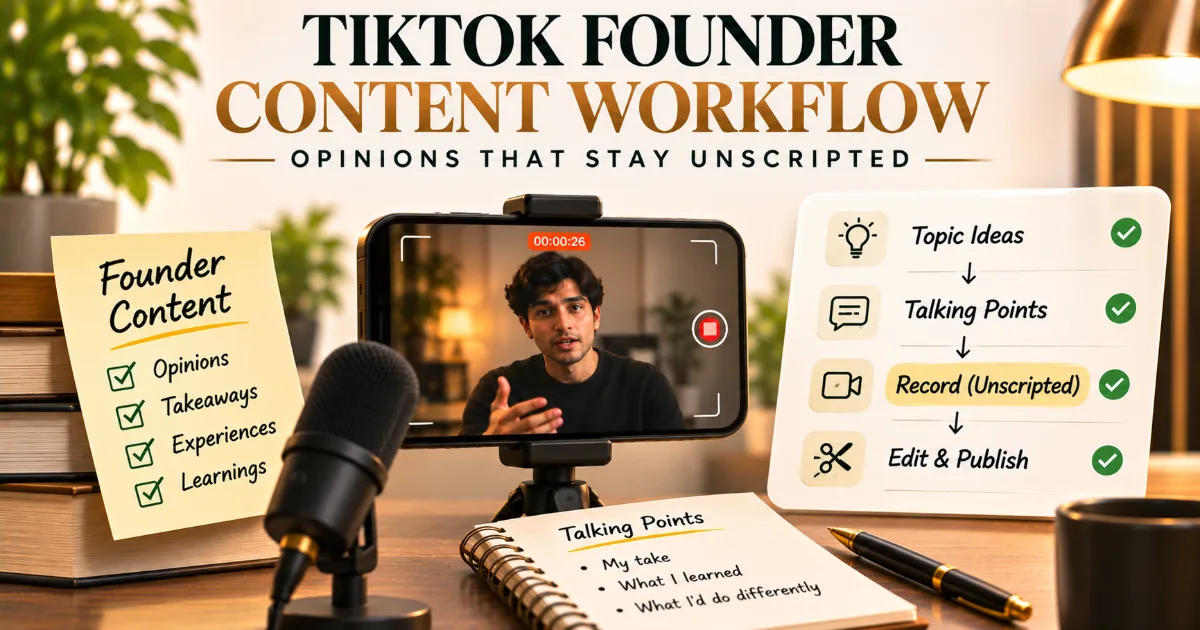
A TikTok founder content workflow turns what a founder actually thinks into short videos without making the founder sound as if they are reading someone else's lines. The rule that makes it work is simple: the founder's opinion is captured in their own voice first, the script is cut from that recording rather than written over it, and every line in the script is checked against the raw transcript before the founder records or approves it. Editing can shorten, reorder and tighten. It does not add words the founder never said. This post sets out how the opinion is captured, how the transcript sits beside the script, how the founder delivers it on camera, where the business draws the line on opinions, and one veterinary practice owner's week of clips.
What each stage adds before a founder clip goes out
- 01The recordingthe founder’s opinion in their own voice
- 02The checked transcripta fixed record of what was said
- 03The cut scriptlines selected, never written over
- 04The line checkevery script line matched to the transcript
- 05The sign-offthe founder approves the finished clip
Relative, not measured
- TikTok founder content workflow: cut the founder's words, never rewrite them
- Why a founder's opinions start to sound scripted
- Capturing the opinion in the founder's own voice
- The raw transcript beside the approved script
- Talking, not reading: how the founder delivers it
- Which opinions the business can stand behind
- What the workflow drafts and what the founder signs
- A worked example: a veterinary practice owner's opinions
- What the workflow costs in founder time
- Frequently asked questions
- Where to start
TikTok founder content workflow: cut the founder's words, never rewrite them
A founder's opinion is one of the few things on TikTok that no other business can copy. It is also the easiest thing to lose in production. The founder says something sharp in a meeting or a voice note, someone turns it into a tidy script, an AI tool smooths the script, and by the time the founder reads it to camera the opinion is still there but the founder is not. Viewers can usually tell. A person reading lines sounds different from a person saying what they think.
The founder’s own words, from recording to script
- 01Recordingthe opinion, recorded first
- 02Transcriptchecked by a person and kept
- 03Selected linesthe script made from the transcript
- 04Unmatched linesremoved, or put back to the founder
The workflow therefore treats the founder's own words as the source material, in the same way a factual post treats an approved document as its source. The opinion is recorded first, in whatever form the founder finds easiest. The transcript of that recording is kept. The script for the clip is made by selecting from the transcript, and the edit is checked against it line by line. Anything in the script that cannot be found in the transcript is either removed or put back in front of the founder as a question.
| Stage | What happens | What it protects |
|---|---|---|
| Capture | The founder records the opinion in their own words, unprompted by a draft | The opinion and the way they say it |
| Transcribe | The recording becomes a transcript that is checked by a person and kept | A fixed record of what was actually said |
| Select | An editor or an AI tool picks the lines for one clip and orders them | Length and clarity, without new words |
| Check | Every script line is matched to a transcript line, and anything unmatched is flagged | The founder's voice and the founder's claims |
| Deliver | The founder records from short cues, or the clip is cut from the original recording | A delivery that sounds spoken, not read |
| Sign off | The founder approves the finished clip beside its transcript lines | The founder's responsibility for what goes out under their name |
This is a narrower job than running a founder's whole publishing week. Our guide to automating a founder's content workflow covers how one recording feeds several channels on their own clocks. This post is about the TikTok clip, and about the single question that decides whether a founder clip works: does it still sound like the founder?
Why a founder's opinions start to sound scripted
Opinions start to sound scripted when someone other than the founder chooses the words. Each editing pass makes a small, reasonable change: a looser sentence tightened, an informal phrase made safer, a hedge removed, a list of three where the founder gave two. None of the changes is wrong on its own. Together they replace the founder's way of speaking with a general, competent way of speaking that could belong to anyone.
Where each version of an opinion sits on one tone of voice scale
Casual and blunt
Formal and safe
- The founder’s recordingthe opinion as the founder said it
- The edited scripttightened, hedges removed
- The polished AI draftgeneral, competent, could be anyone
AI drafting makes this happen faster, and research suggests it is not only a matter of style. In a study posted on arXiv, Barrett Anderson and colleagues found that participants using ChatGPT as a creativity aid tended to produce less semantically distinct ideas from one another than participants using an alternative tool, and felt less responsible for the ideas they generated. A separate study by Maurice Jakesch and colleagues, presented at CHI 2023, found that co-writing with an opinionated language model affected the opinions participants expressed in their writing and shifted their views in a later survey. A founder who lets a tool draft their opinion and then edits the draft may end up approving an opinion that was never quite theirs.
Voice is measurable enough to protect. Nielsen Norman Group describes four tone-of-voice dimensions: formal or casual, serious or funny, respectful or irreverent, and matter-of-fact or enthusiastic. A founder usually sits at a recognisable point on each. Write that point down once, from the founder's own recordings, and an editor can check whether a script has drifted towards formal, safe and enthusiastic when the founder is casual, blunt and dry.
The same problem shows up in the opening seconds, where the pressure to rewrite is strongest. The TikTok hook rewrite workflow locks the claim from the transcript before the opening is touched, and the speaker signs off anything new. This workflow applies the same rule to the whole clip.
Capturing the opinion in the founder's own voice
The opinion is captured before anyone writes anything. The easiest way for most founders is a short voice note or a phone video answering one prompt: what do customers get wrong about this, what would you tell a friend, what changed your mind. The prompt is a question, not a draft. A draft gives the founder something to agree with; a question makes them say what they think.
Who holds the opinion between the founder and the transcript
- 01The founderSay itanswers one question in their own voice
- 02The interviewerAsk itasks the questions and lets the founder talk
- 03The transcriptionType ita first pass from the recording
- 04A personCheck itreviews the transcript against the audio
A conversation works even better than a voice note. When someone on the team asks the questions and lets the founder talk, the founder argues, gives examples and corrects themselves, and that is where the best lines come from. Our guide to TikTok clips from YouTube videos, interviews and webinars covers how a long recording is searched for the moments that stand on their own as clips. Our guide to Medium founder thought leadership turns a conversation like that into an essay.
The recording is transcribed, and the transcript is checked by a person before anything is built on it. Automatic transcription is a good first pass, not a record. Google's help page on YouTube's automatic captioning warns that automatic captions might misrepresent the spoken content because of mispronunciations, accents, dialects or background noise, and asks creators to review and edit them. A founder's transcript is the source every later step is checked against, so a misheard word in it becomes a misquote everywhere. The first pass can be told what to listen for: OpenAI's guide to speech to text describes giving the model keywords for literal terms it should expect to hear, which helps with the names and jargon a founder uses every day. A YouTube channel needs the same checked transcript for its titles and chapters, and a Content Operating System for YouTube files it back into the knowledge base afterwards.
The checked transcript is kept with the recording, with timestamps. The W3C's guidance on transcripts describes a basic transcript as a text version of the speech and non-speech audio needed to understand the content. For this workflow that is exactly what is needed: the words, in order, with enough timing to find each line again in the recording.
The raw transcript beside the approved script
The check that keeps the founder's voice is a side-by-side sheet. On the left are the lines of the script for one clip. On the right, against each script line, is the transcript line it came from, with its timestamp. A script line with a match is the founder's. A script line with no match is someone else's, however good it is.
The edits the side-by-side sheet allows, and the ones it does not
Allowed · the founder’s words
- A cut removes words and leaves the rest
- A join puts two transcript lines together
- A trim removes filler and repeated starts
Not allowed · someone else’s
- A new sentence the founder never said
- A new fact or figure
- A word change that alters the claim
Three kinds of edit are allowed, and each is visible on the sheet. A cut removes words from a transcript line and leaves the rest as the founder said it. A join puts two transcript lines next to each other that were apart in the recording. A trim removes filler such as repeated starts. Three kinds of edit are not allowed: a new sentence, a new fact or figure, and a word change that alters the claim. If a change of word is needed for clarity, the founder is asked to say it again.
An AI tool can do the selecting and build the sheet, as long as it is held to quoting. Anthropic's documentation on citations describes how Claude can return the exact passages from a source document that support each part of a response, with pointers to where they sit in the document. Given the transcript as the document and the job of choosing lines for a 40-second clip, a tool that must cite every line is a tool that cannot quietly write new ones. In Claude Code, the same job can run over a folder of transcripts with the rules kept in a project file.
The comparison itself can be automated. In n8n, the Compare Datasets node compares data from two input streams on the fields you choose and separates what matches from what differs. With the script lines on one side and the transcript lines on the other, the unmatched lines come out in their own branch, ready for a person to look at.
The sheet also catches the commonest failure in captions. Each caption is drafted from the same checked transcript, as TikTok caption automation sets out, so the transcript line that backs a script line also backs its caption. The W3C's guidance on captions is blunt that automatic captions are not sufficient on their own, which is one more reason the checked transcript, not the tool's first pass, is the source.
Talking, not reading: how the founder delivers it
The best founder clips are often not recorded from a script at all. If the original voice note or interview was filmed and the lines are clear, the clip can be cut straight from it, and the founder's delivery is the real one. The side-by-side sheet then becomes an edit list: these lines, from these timestamps, in this order.
How spoken each way of delivering the clip sounds
Cut from the original the founder’s real delivery
A take from cue cards the point said again in their own words
A full script on a screen lines read rather than said
An AI avatar a realistic likeness that needs a label
A judgment, not a score
When the founder does record again, a full script read from a screen is the quickest way to make them sound scripted. Short cue cards work better: three or four lines, each one a few words from the transcript that remind the founder of the point. The founder says the point again in their own words, looking at the camera, and the new recording is transcribed and checked against the old transcript to make sure the claim has not moved.
A second take is still the founder's own words, as long as the point and the claims match. The sheet records which take the clip uses, so anyone checking the clip later can find the recording it came from. If the founder wants to respond to another creator's video, TikTok's help page on Stitch explains that it lets a creator combine part of another video with one they are creating. A response is still an opinion under the founder's name and goes through the same check.
Some founders will be tempted to skip the camera entirely with an AI avatar or a cloned voice. That changes what the clip is. TikTok's help page on AI-generated content says a creator has to label AI-generated content when it shows realistic people, voices or scenes. That temptation now sits one request away: since 3 November 2026 Higgsfield’s Shorts Studio makes an avatar-hosted vertical video inside Claude, which our story on Higgsfield Shorts in Claude and AI hosts reads format by format. Our Higgsfield hub covers what AI video tools are good for in a content system; a founder's own opinion, delivered as the founder, is not usually one of those jobs.
Which opinions the business can stand behind
A founder's opinion goes out under the business's name, so the workflow needs a line between opinions the founder is free to give and claims the business has to be able to back. An opinion about how customers should think about a decision is the founder's to give. A statement of fact about a product, a price, a result or a risk is a claim, and it needs a source in the business's own approved material. A client's result is the hardest claim of the lot, and TikTok case study video ideas handles it by making the client's agreed sentence the only source the outcome clip may use. The same line holds in writing: our guide to a content automation case study for Medium keeps what was measured apart from what was only observed, so a reader can tell a result from a view.
What happens to each line in a founder’s script
the founder’s to give, under the business’s name
- kept
a fact about a product, price, result or risk
- backed
- sent back
a customer or music in the room
- the rights checklist
TikTok draws a similar line for misinformation. Its Integrity and Authenticity guidelines say people will have different opinions but that TikTok aims to ground those conversations in facts, and list personal opinions that don't include harmful misinformation among the things that are allowed. The same guidelines treat health misinformation as harmful, including content that discourages professional care. For a founder in a field like health, finance or law, the boundary matters more, and the side-by-side sheet gets one extra column: is this line an opinion or a claim, and if a claim, where is it backed?
A founder's clip about the business's own product or offer is also commercial content, and TikTok's labels for it are the creator's choice to make. When a clip is posted through an app, TikTok's Content Sharing Guidelines set the disclosure as a toggle that starts off: "Your brand" marks the post as promotional content, and "Branded content" marks it as a paid partnership, which cannot be posted privately. The founder signs off the toggle along with the words. That toggle is one row of the TikTok content approval workflow, checked before any clip is scheduled.
The check is easiest when the business already keeps its approved answers in one place. Our TikTok FAQ video workflow covers how clips are built from approved answers, and a founder clip can point to the same answers when it states a fact. Anything else in the founder's footage, such as a customer in the background or a piece of music, is a rights question; our TikTok video rights checklist covers those.
Opinions also have an audience to match. Some of a founder's thinking is better as a long argument than a short clip. Those can go to Medium as written pieces, and our Medium content guides cover publishing them on your own site first, with the canonical link that keeps Medium from competing with it. Our guide to content strategy for founder-led businesses covers how a founder's ideas are spread across channels so each one gets the length it needs. Where the long piece already exists on the website, our Medium article republishing workflow moves it across with the original still credited.
What the workflow drafts and what the founder signs
The workflow does the work that does not need the founder: transcribing, finding candidate lines, building the side-by-side sheet, flagging unmatched lines and claims, cutting the edit, drafting the caption from the transcript, and packaging the clip. The founder does the parts only the founder can do: saying what they think, answering the questions the sheet raises, and approving the finished clip. A founder's LinkedIn profile splits the same way, and a Content Operating System for LinkedIn draws that line from LinkedIn's own User Agreement.
Where the work on one founder clip actually goes
- The workflow transcribing, selecting, checking, packaging
- The team reviewing the transcript and flagged lines
- The founder recording, answering questions, approving
The shape of the problem, not a measurement
The founder's approval is a short, defined step, not an open-ended review. The founder sees the clip, the sheet beside it, and any flagged lines with the question attached. In n8n, a Wait node can pause a workflow until it receives a call to a resume URL generated at runtime, which suits sending the founder an approval link and continuing only when they answer. Keeping the step this small is deliberate, and designing human approval gates explains why: a gate only works if the person it waits for has time to open it. Sending it can be automated without loosening it: the Slack node in n8n has a send-and-wait operation, so the clip and its sheet reach the founder in one message and the workflow pauses until they answer.
The founder also owns the voice notes that describe how they speak. A short page, written from their own recordings, lists the phrases they use, the words they never use, and where they sit on each tone dimension. Editors check against it; the founder updates it when it is wrong. Our guide to content automation for founder-led businesses covers where the founder's time goes in a system like this, and why it should mostly go on the recording.
A worked example: a veterinary practice owner's opinions
Take an illustration, not a client. A veterinary practice owner wants to post short clips with her views on pet care decisions owners struggle with. Her first attempt is the common one. She writes bullet points, a marketing assistant turns them into scripts, an AI tool polishes the scripts, and she reads them to her phone. The clips are accurate and smooth. She says they do not sound like her, and her receptionist says the same.
The tool proposing clips from the consulting-room transcript
- >Propose three 40-second clips from this week’s transcript, quoting each line with its timestamp
- ·Read the transcript and found five answers that stand on their own
- +Three scripts, every line quoted with its timestamp
- ·One closing line has no match in the transcript, flagged on the sheet
- ·One clip states what the practice charges: opinion or claim?
- Two problems caught before she recorded anything
The practice changes the order. Once a week, the practice manager asks her five questions for fifteen minutes in the consulting room after hours, and films it. The questions come from what owners asked at the front desk that week. The recording is transcribed, a person checks the transcript against the audio, and an AI tool proposes three clips by quoting lines and timestamps from it.
The side-by-side sheet catches two problems in the first week. One proposed script has a smooth closing line about early dental care that she never said, with a percentage attached that appears nowhere in the transcript. The sheet shows the line with no match, and it is cut. Another clip turns her opinion that owners should ask about the cost of a treatment plan before agreeing to it into a statement about what the practice charges, which is a claim. It is sent back to her as a question, and she chooses to keep her opinion and leave the prices to the practice's own pages.
Two of the three clips are cut straight from the consulting-room recording. For the third, she wants a cleaner take, so she records it again from three cue cards and says it differently, in her own words. Her new take is checked against the original transcript; the point and the claims match, so it goes ahead. She approves all three in one sitting, each beside its sheet, in under ten minutes. The receptionist's verdict on the new clips is that they sound like the conversations she has with owners at the desk. That is the test the workflow is built for.
The practice keeps every transcript in one folder, by date. When a clip is questioned months later, the sheet shows exactly which recording each line came from. The same recordings could later become longer LinkedIn posts in the founder's name; our LinkedIn content guides cover founder-led posting on that platform, and the rule would carry over unchanged: cut, never rewrite.
What the workflow costs in founder time
The founder's time goes on recording and approving, not on writing or reading scripts. In the illustration that is a fifteen-minute conversation each week and a short approval session, and the workflow handles everything between the two. That is usually less founder time than the old method, where the founder wrote notes, reviewed drafts and recorded scripts several times over. A weekly conversation like this is easiest to fill when its questions are planned ahead, which is what TikTok content series planning does with one pillar at a time. Filming is the other cost that grows without a plan, and the TikTok B-roll planning workflow writes the shot list from the approved script, so the founder is never asked for footage nobody uses.
Where the founder’s weekly time goes in the workflow
Founder time
- The recorded conversation fifteen minutes of questions each week
- The approval session each clip beside its sheet
- Questions from the sheet lines sent back to the founder
Rough shares — a shape, not a measurement
The team's time goes on the checks. A person reviews each transcript against the audio, reviews the flagged lines on each sheet, and decides which questions go back to the founder. The checking is quick once the tools build the sheet, but it is not optional: it is the step that keeps the clip the founder's. It is also the step a TikTok content workflow audit looks at hardest, since a check that leaves no record cannot be scored as done.
What the workflow saves is harder to count and more important. Every clip can be traced to a recording. Nothing goes out under the founder's name that the founder did not say. And the founder's opinions stay distinct from everyone else's, which is the reason to put a founder on camera in the first place. A founder's clips go through the same short-form pipeline as any other on our TikTok content automation page, with this workflow's sheet travelling beside each one, and the posts on this blog carry their author's name, as you can see on our author page.
Frequently asked questions
What is a TikTok founder content workflow?
It is a workflow that turns a founder's opinions into short TikTok videos while keeping their own words. The opinion is recorded first, the transcript is checked and kept, the script is cut from the transcript rather than written over it, and every script line is matched to a transcript line before the founder approves the clip.
Why do founder videos sound scripted?
Usually because someone other than the founder chose the words. Each editing pass makes a small, reasonable change, and together they replace the founder's way of speaking with a general one. Reading a full script from a screen makes it worse; cutting from the original recording or speaking from short cue cards keeps the delivery natural.
Can AI write a founder's TikTok scripts?
AI is useful for selecting and ordering lines from the founder's own transcript, as long as it is held to quoting and every line it proposes is checked against the transcript. It should not draft the founder's opinion. Research on co-writing with opinionated language models found the model's view can shift what writers express.
How do you check a script against the founder's transcript?
Use a side-by-side sheet: each script line on the left, the transcript line it came from and its timestamp on the right. Cuts, joins and trims are allowed; new sentences, new facts or figures and word changes that alter the claim are not. Any script line without a match is removed or put back to the founder as a question.
Should a founder use an AI avatar or voice clone on TikTok?
It changes what the clip is. On TikTok, AI-generated content showing realistic images, audio or video has to be labelled. For a founder's own opinion, the point of the clip is that the founder is saying it, so recording the founder is usually the better choice.
How much founder time does the workflow need?
In the illustration in this post, a fifteen-minute recorded conversation each week and a short approval session. The workflow handles the transcription, selection, checking and packaging in between, and a person on the team reviews the transcript and the flagged lines.
Where to start
Record the founder's next opinion as a conversation, not a draft. Transcribe it, check the transcript against the audio, and build the first clip by selecting lines from it. Put the script beside the transcript and cut anything without a match. If the clip still sounds like the founder when it is finished, the workflow is working. For the rights questions that founder footage raises, from customers in the background to the music in the room, our TikTok video rights checklist is the next step.
Disclosure
This post was written by Shreyas Dave, founder of Paper Eagle AI. We sell content automation services, which is the category this article is about, so we have a commercial interest in you concluding that a system beats ad-hoc effort — read it knowing that. No tool vendor was involved in writing it, nobody paid for a mention, and there are no affiliate links anywhere on this site. Where a third-party figure appears, it’s attributed to the publisher it came from; anything we couldn’t source is written as a direction rather than a number.
Paper Eagle AI builds Content Operating Systems that turn a business’s knowledge and expertise into consistent, multi-platform content, and we deliver them as content automation services. Working as a content automation specialist, we capture what a business knows and how it sounds, set the strategy, and build the workflows that research, draft, repurpose and publish — with a named person approving every piece before it goes out. Every build runs through discovery, design, build and handoff. The system lives in the client’s own accounts, it is documented, the team is trained to run it, and the business owns it outright. We don’t write content on a retainer, and we don’t build lead generation, CRM or sales automation.
One source of thinking becomes native content for every platform a business publishes on: the founder’s LinkedIn and the company page, YouTube and Shorts, Instagram and Reels, TikTok, Reddit, Medium, newsletters, and the company’s own website, written to be found in Google and understood by AI search. Our multi-platform content automation page shows how they share one source, and our case studies document the systems behind our own publishing, file by file. You can follow the work on the company’s own channels: Paper Eagle AI on Instagram, Paper Eagle AI on YouTube, the Paper Eagle AI company page on LinkedIn, Paper Eagle AI on Substack, Paper Eagle AI on Reddit and Paper Eagle AI on Medium. Paper Eagle AI is also listed where clients can review its work: Paper Eagle AI on Clutch, Paper Eagle AI on GoodFirms and the Paper Eagle AI Google Business Profile.
Keep reading
- How to automate a founder's content workflow — how one founder recording feeds several channels on their own clocks.
- TikTok hook rewrite workflow — how an opening is rebuilt without new words in the speaker's mouth.
- TikTok clips from YouTube videos, interviews and webinars — how a long recording is searched for clips that stand alone.