Medium Article Source Citations: Links in the Sentence, Not a List
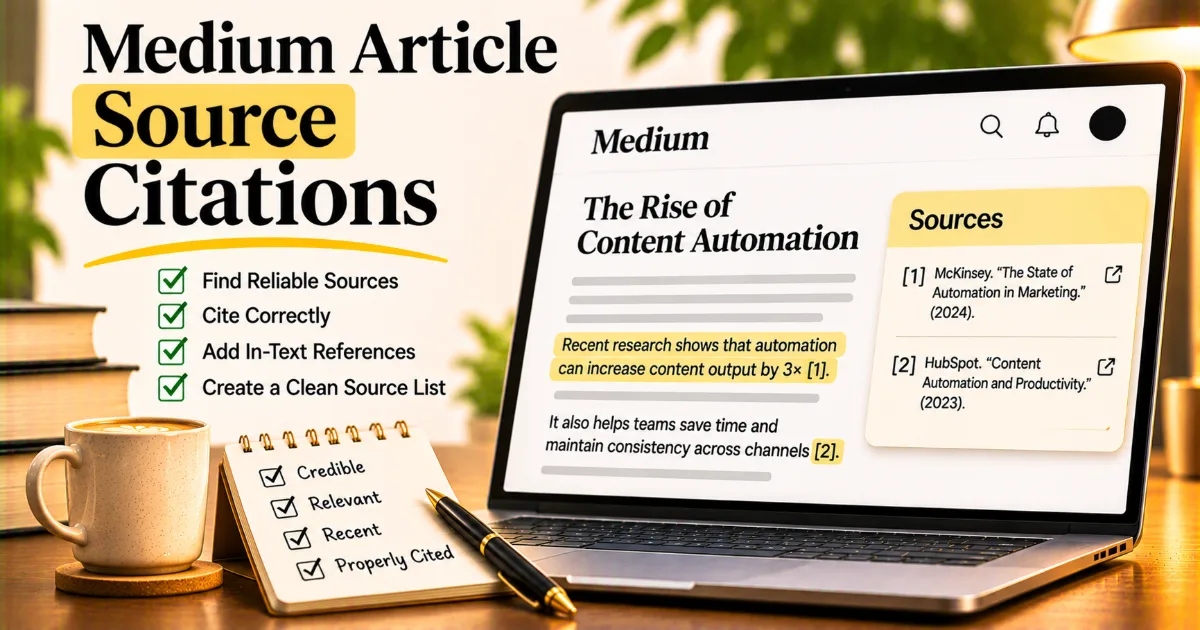
Medium article source citations work best as links inside the sentences that make each claim, pointing at the primary source that backs that claim, with link text that names the source. A link list at the bottom of a story asks the reader to match claims to sources themselves, and most will not. The method is short: list the story's checkable claims, find the original source for each, choose the most authoritative one available rather than the first result, place the link on the words that name the source, and record why that source was chosen. Medium's editor makes inline links easy, and Medium's own journalism guidance asks for citation of references and active correction of errors. This post covers which claims need a source, how to choose it, how to place the link, what to avoid, how AI-assisted drafting changes the job, and a data-privacy consultancy's paragraph on cookie banners annotated claim by claim.
How one claim in a Medium story gets its citation
- 01List the claimsevery checkable claim in the story
- 02Find the originalthe primary source behind each
- 03Link the wordson the words that name the source
- 04Record the reasonwhy that source was chosen
- Medium article source citations: the claim, its source, and the link in the sentence
- Which claims need a source
- Choosing the source: the original, not the first result
- Placing the link: on the words that name the source
- Why a link list at the bottom is not a citation
- AI-assisted drafts and the citation step
- What the system checks, and what the editor decides
- A worked example: a data-privacy consultancy's cookie-banner paragraph
- What citation costs, and the shortcuts to avoid
- Frequently asked questions
- Where to start
Medium article source citations: the claim, its source, and the link in the sentence
Medium article source citations are the links a story uses to show where its facts come from. The useful version is not a bibliography. It is a link on the words that make each claim, so a reader who doubts a sentence can check it in one click without leaving the paragraph or scrolling to a list. Each link goes to the source closest to the fact: the law itself rather than an article about the law, the platform's own help page rather than a forum thread about it. A comparison is the story that needs them most, and our guide to a Medium tool comparison article ties every fact about a tool to that tool's own documentation.
A link list at the bottom against a link in the sentence
A list at the end
- The reader matches claims to sources
- Scrolls away from the paragraph
- Asks for trust up front
A link in the sentence
- The claim carries its own source
- One click without leaving the paragraph
- Earns trust paragraph by paragraph
This matters more on Medium than on many sites, because a Medium reader usually arrives from a topic page or a feed and has no reason yet to trust the writer. A story that shows its sources at the point of each claim earns that trust paragraph by paragraph. A story that asserts and moves on asks for it up front, and a reader who has never heard of the business has no reason to give it. Every guide in this cluster, collected on the Medium hub, follows the inline rule for that reason. Which topic pages those are is decided with our Medium article tags strategy.
It is one of the editorial steps in the Medium content automation setup we build: the website stays the source of truth, the Medium version credits it, and both versions cite the same primary sources. The website side of the same discipline, how to make each claim traceable on your own pages, is covered in our guide to building content Google and AI search can both understand.
Which claims need a source
A claim needs a source when a reasonable reader could doubt it and the writer is not the authority on it. Four kinds almost always do: a statement of what a law or regulation requires, a statement of what a platform or product does, a number of any kind, and a description of what research found. A fifth kind, a quotation, needs the person named and, where possible, the place they said it; a founder quoted in their own essay is sourced by the line-by-line approval our Medium founder thought leadership guide describes. A number borrowed from someone else's context is the claim most often left unsourced, which is why our guide to Medium content angle testing refuses benchmarks it did not measure.
Which claims in a story need a source
A law’s requirement
Any number
Your own experience
A general known fact
Across: how likely a reasonable reader is to doubt it
Up: how far the writer is from being the authority
Two kinds usually do not. The business's own experience, told as experience, is sourced by the business itself: "in our projects, the banner was the part clients redesigned most" needs no link, because the writer is the authority, as long as it is plainly presented as theirs, the same line our Medium case study article guide draws between what was measured and what was observed. And a widely known general fact, such as that websites use cookies, does not need a citation; linking it adds clutter and makes the necessary links harder to see. A case study leans on exactly this kind of first-hand claim, and our guide to a content automation case study for Medium shows how to label it so readers can weigh it.
The test is the doubting reader. Read each sentence and ask whether a sceptical expert in the subject would want to see where it came from. If yes, it gets a source. If the honest answer is that the claim cannot be sourced, it is either the writer's own judgement, said as such, or it should be cut. That is the same rule our Medium AI article fact checking guide applies before publishing, and it runs first: a claim that fails the fact check never reaches the citation step.
Choosing the source: the original, not the first result
For each claim, the source is the original document where the fact was first stated, or the body with authority over it. A regulation's own text, a regulator's published guidance, a platform's help centre, a study's own paper, an organisation's official statistics. Secondary sources, articles that summarise those originals, are useful for finding the original and should rarely be the link itself, because every summary is a chance for the fact to have changed on the way.
Which source to link, from best to weakest
- The original documentthe regulation, the paper, the help centre
- The body with authoritya regulator’s plain-language guidance
- A summary of ituseful for finding the original
- The first search resultrarely the right link
When several primary sources exist, choose the one a reader is most likely to accept and able to read. A regulator's plain-language guidance is often better than the legal text for a general reader, as long as it says the same thing. A study's abstract page is better than a PDF that downloads without warning. The choice is recorded in a sentence, "the regulator's guidance, because it states the requirement in plain words", so an editor can check it and the next writer can reuse it.
Some claims change. Platform features, prices, limits and rules move, and a source that was right last year may not be now. For those, the source must be current, and the story should say when the fact was checked, for example "as of November 2026". A citation that points at an out-of-date page is worse than none, because it looks like evidence and is not.
Broken and stale citations cost more than the one claim they fail. Nielsen Norman Group's research on trustworthiness in web design lists four factors that make a site credible, two of which are content that is comprehensive, correct and current, and a connection to the rest of the web; it also notes that typos and broken links quickly erode credibility. A citation that leads to a missing page is exactly that kind of mistake, made at the moment a reader was checking whether to trust you. That is why the citation step includes a recheck of every link on the live story, not only before import.
Quotations need one more decision: how much to quote. A short quotation, enough to show what the source says, with a link to the whole, serves the reader and respects the source. Long passages copied from a source turn the story into someone else's writing with commentary, which is neither good for the reader nor fair to the author. The habit that works is a sentence or two in quotation marks, the source named in the link text, and the writer's own explanation of why it matters.
Placing the link: on the words that name the source
The link goes on the words that say what the source is, inside the sentence that makes the claim. "The best practices for journalism on Medium ask writers to fact-check, cite references and correct errors" is a good citation: the reader knows before clicking that the link leads to Medium's own guidance. "Medium asks writers to cite references, as you can see here" is a poor one, because the link text tells the reader nothing. Medium's plagiarism guidelines say proper citations can be added with numbered superscript or other appropriate methods; a tutorial's links to tool documentation follow the same rule, and our Medium technical tutorial workflow covers the screenshots and code around them.
Where a citation’s link goes
A poor citationA good citation
A link on here
a link on the words that name the source
A link on this study
the study’s name as the link text
A bare web address
words that say what the page is
A footnote at the bottom
the link inside the sentence
Nielsen Norman Group's advice on writing hyperlinks makes the general case: link text should stand out and accurately describe the page it leads to, ideally starting with the words that carry the meaning. Google's guidance on crawlable links and anchor text says the same from a search engine's side: good anchor text is descriptive and relevant to the page it points to.
Mechanically, Medium makes this easy. Its help page on using the story editor describes selecting text, choosing the link icon in the toolbar and pasting the address. There is no footnote feature and no need for one: an inline link on the right words does the job of a footnote without sending the reader to the bottom of the page.
Why a link list at the bottom is not a citation
A list of sources at the end of a story looks thorough and does very little. It tells the reader that sources exist without saying which one backs which claim, so a reader who doubts paragraph four has to guess which of eight links to open. Most readers will not, which means the list protects the writer's appearance of rigour more than it helps anyone check anything. Links to your own site follow a different rule: the Medium Rules say a link that takes readers to your own platform to subscribe must be disclosed as leading offsite, immediately next to the link, and our Medium referral linking workflow covers where those links go. Images need the same specificity: a caption that credits each one where it appears, which for AI images Medium requires, as our guide to Higgsfield images on Medium explains.
What a citation joins that a link list keeps apart
A checkable claim
- 01The claimmade in the paragraph
- 02The sourcethe primary document
- 03The link textnames the source
one a reader can check
A link list also hides weak claims. When every source sits in one place, a claim with no source behind it is invisible, because nobody can see that its paragraph has no link. Inline citation makes a missing source obvious, which is exactly why it is uncomfortable and exactly why it is better. A "further reading" section is fine for genuinely optional material; it is not a substitute for citing the claims in the story.
There is a search argument too. The structured-data property schema.org calls citation can declare the works a page cites on the website version, and answer engines that quote a page prefer sentences that carry their evidence with them. Our guide on preparing content for AI search explains why a self-contained, sourced sentence is the one most likely to be quoted, and our comparison of SEO, AEO and GEO shows where that sits among the three.
AI-assisted drafts and the citation step
An AI-assisted draft makes the citation step more important, not less, because language models produce fluent claims whose sources may not exist or may not say what the draft implies. A 2023 benchmark of citation quality, ALCE, which tested large language models generating text with citations, reported that even the best models it tested lacked complete citation support about half the time on one of its datasets. A citation produced by the drafting tool is therefore a lead to check, never a finished citation. Medium's AI content policy does not allow articles that contain easily disprovable AI-hallucinated statistics or events, which is why a model's suggested sources are opened before they are cited, a check that sits inside our Medium AI editorial workflow.
What happens to the citations an AI draft suggests
- 01Suggested citationsevery source the draft offers
- 02Page missingthe address does not open
- 03Not supportedthe page says something else
- 04Only a summaryreplaced by the primary source
- 05Opened and keptread by a person, then kept
Relative, not measured
The rule is simple: every source in an AI-assisted draft is opened and read by a person before it stays. The person checks that the page exists, that it says what the sentence says, and that it is the primary source rather than a summary. Research on attributed question answering frames the same problem as attribution: whether a generated statement is actually supported by the source it points to. On Medium, the AI content policy also asks for AI assistance to be disclosed near the start of the story.
A workflow can make the check faster without making it automatic. It can extract every link from the draft, open each one and confirm it returns a page, and put each claim beside its link in a review sheet. In n8n, the HTML node can pull the links and their text out of a draft, and Make.com's text parser can match web addresses in plain text. Whether the page supports the claim is still a person reading it.
What the system checks, and what the editor decides
The system checks the mechanics; the editor decides about evidence. The mechanics are that every link works, every link has descriptive text, no claim in the review sheet is left without a source or an explicit "our experience" label, and the Medium version and the website version cite the same sources. A workflow can run all of that before the story is imported, and again on the live story afterwards, since links break over time. Those mechanical checks sit in the last stage of the pipeline described in our guide to Medium publishing workflow automation.
What the system checks before and after import
every source in the story
the same claims, the same sources
opens, compares and lists
every link returns a page
no here, no bare addresses
each claim beside its source
The editor decides which claims need sources, which source is primary, whether a source says what the sentence says, and whether a claim with no good source should be reworded or cut. Those decisions are reading, and they are the reason the story can be trusted. A workflow that "found sources" for claims automatically would find pages that mention the words, which is not the same thing as pages that support the claim.
One judgement deserves its own line: links that are paid for or sponsored. Google's guidance on qualifying outbound links asks for paid links to be marked as sponsored on a website, and Medium's rules ask writers to disclose anything of value received in connection with a post. A citation is never a paid placement; if a link exists because someone paid for it, it is not a citation and must be labelled as what it is. A publication with several writers records that decision once, in the disclosure section of its Medium publication style guide.
A worked example: a data-privacy consultancy's cookie-banner paragraph
Illustration. A data-privacy consultancy publishes an article on its website about cookie banners and adapts it for Medium. One paragraph carries most of the article's factual weight, so the editor annotates it before import, claim by claim. The paragraph says that consent must be as easy to withdraw as to give, that pre-ticked boxes do not count as consent, that the consultancy's clients most often redesign the reject button, and that many sites still make rejecting harder than accepting.
How the cookie-banner paragraph’s four claims were handled
Four claims
- Primary source linked the regulation and the court judgment
- Labelled as experience the reject-button redesign
- Reworded the vendor-blog claim, now an observation
Rough shares — a shape, not a measurement
| Claim in the paragraph | Source chosen | Why that source |
|---|---|---|
| Withdrawing consent must be as easy as giving it | The regulation's own article text | It is the requirement itself; a summary could soften it. |
| Pre-ticked boxes are not valid consent | The court judgment that decided it | The original ruling, not a vendor blog quoting it. |
| Clients most often redesign the reject button | None; labelled as the firm's experience | The writer is the authority, and the sentence says so. |
| Many sites make rejecting harder than accepting | Cut, then reworded | No primary source found; it became the firm's own observation. |
Two claims got primary sources, each linked on the words that name it: the regulation's article and the court's judgment. One stayed unlinked and was rewritten to begin "In our client work", so no reader mistakes it for a statistic. And the fourth, which had come from a vendor's blog with no source of its own, was reworded as the consultancy's own observation, with "many" removed because nobody had counted.
The annotation took about twenty minutes for the paragraph and set the pattern for the rest of the article. The same sources, with the same link text, were used on the website version and the Medium version, and the review sheet recorded why each was chosen. This is an illustration of the citation method, not legal advice and not a record of a real client's article. Whether those links then survive the trip to Medium is a question for the broken link audit described in how to audit a Medium publishing workflow. Bringing the website version across without losing them is the job of our Medium article republishing workflow.
What citation costs, and the shortcuts to avoid
Citing well costs time at the point of writing, most of it spent finding the original behind a secondary source. For a typical article with a handful of checkable claims, that is an hour or so the first time a subject is covered and much less afterwards, because the sources are recorded and reused. The review sheet is the asset: the next article on the same subject starts with its sources already chosen and justified, much as the question pool in our Medium editorial calendar means next month's plan never starts from nothing.
The shortcuts, from cheapest to most damaging
Saves a minute
Undoes the citation
- Linking herethe link text says nothing
- An end listclaims and sources apart
- The first search resulta summary, not the original
- An unopened AI citationa source that may not exist
Four shortcuts undo it. Citing the first search result instead of the original. Putting the link on "here" or "this study" instead of on the words that name the source. Moving every link to a list at the end. And keeping an AI tool's suggested citation without opening it. Each saves a minute and costs the reader's ability to check the story, which is the thing the citations were for.
The website and Medium versions should never disagree on a source, so the citation step sits inside the same workflow as the rest of the adaptation. If you want that workflow built with the review sheet and link checks included, our Medium pricing page describes the setup. For the writing itself, our SEO content writing service follows the same sourcing rules, and the wider subject is collected under SEO and AI search.
Frequently asked questions
How should I cite sources in a Medium article?
Link each checkable claim, inside the sentence that makes it, to the primary source that backs it, with link text that names the source. Medium's editor lets you select words and add a link from the toolbar, so no footnotes are needed.
Is a list of sources at the end of a Medium story enough?
Not on its own. A list does not say which source backs which claim, so readers cannot easily check a doubtful sentence, and claims without sources stay hidden. Use inline links for the claims and keep any list for optional further reading.
Which claims need a citation?
Statements of what a law, platform or product requires or does, any number, any research finding and any quotation. Your own experience, clearly presented as yours, and widely known general facts usually do not.
What counts as a primary source?
The original document or the body with authority over the fact: a regulation's text, a regulator's guidance, a platform's help centre, a study's own paper. Articles summarising those are useful for finding the original but rarely the right link.
Can I trust citations an AI tool suggests?
Treat them as leads. Research on citation quality has found that even strong models often lack complete support for their statements, so a person opens every suggested source and confirms it says what the sentence says before it stays.
Should the Medium and website versions cite the same sources?
Yes. The two versions should never disagree, so they share one set of sources with the same link text. A review sheet recording each claim, its source and why it was chosen keeps them aligned when either is updated.
Where to start
Take your next story before import and highlight every checkable claim. For each one, find the original source, write one line saying why it is the right one, and put the link on the words that name it. Label your own experience as experience and cut or reword anything you cannot source. Keep the claims, sources and reasons in a review sheet, and use the same sheet for the website version. After two or three stories on one subject, most of the sources will already be chosen when you start.
Disclosure
This post was written by Shreyas Dave, founder of Paper Eagle AI. We sell content automation services, which is the category this article is about, so we have a commercial interest in you concluding that a system beats ad-hoc effort — read it knowing that. No tool vendor was involved in writing it, nobody paid for a mention, and there are no affiliate links anywhere on this site. Where a third-party figure appears, it’s attributed to the publisher it came from; anything we couldn’t source is written as a direction rather than a number.
Paper Eagle AI builds Content Operating Systems that turn a business’s knowledge and expertise into consistent, multi-platform content, and we deliver them as content automation services. Working as a content automation specialist, we capture what a business knows and how it sounds, set the strategy, and build the workflows that research, draft, repurpose and publish — with a named person approving every piece before it goes out. Every build runs through discovery, design, build and handoff. The system lives in the client’s own accounts, it is documented, the team is trained to run it, and the business owns it outright. We don’t write content on a retainer, and we don’t build lead generation, CRM or sales automation.
One source of thinking becomes native content for every platform a business publishes on: the founder’s LinkedIn and the company page, YouTube and Shorts, Instagram and Reels, TikTok, Reddit, Medium, newsletters, and the company’s own website, written to be found in Google and understood by AI search. Our multi-platform content automation page shows how they share one source, and our case studies document the systems behind our own publishing, file by file. You can follow the work on the company’s own channels: Paper Eagle AI on Instagram, Paper Eagle AI on YouTube, the Paper Eagle AI company page on LinkedIn, Paper Eagle AI on Substack, Paper Eagle AI on Reddit and Paper Eagle AI on Medium. Paper Eagle AI is also listed where clients can review its work: Paper Eagle AI on Clutch, Paper Eagle AI on GoodFirms and the Paper Eagle AI Google Business Profile.
Keep reading
- How to build content Google and AI search can both understand — how the same claim-to-source discipline works on the website version.
- Medium AI article fact checking — the check that runs before the links are added, claim by claim.
- Preparing content for AI search — why sourced, quotable sentences are the ones answer engines can use.