Medium Editorial Calendar: One Reader Question per Slot
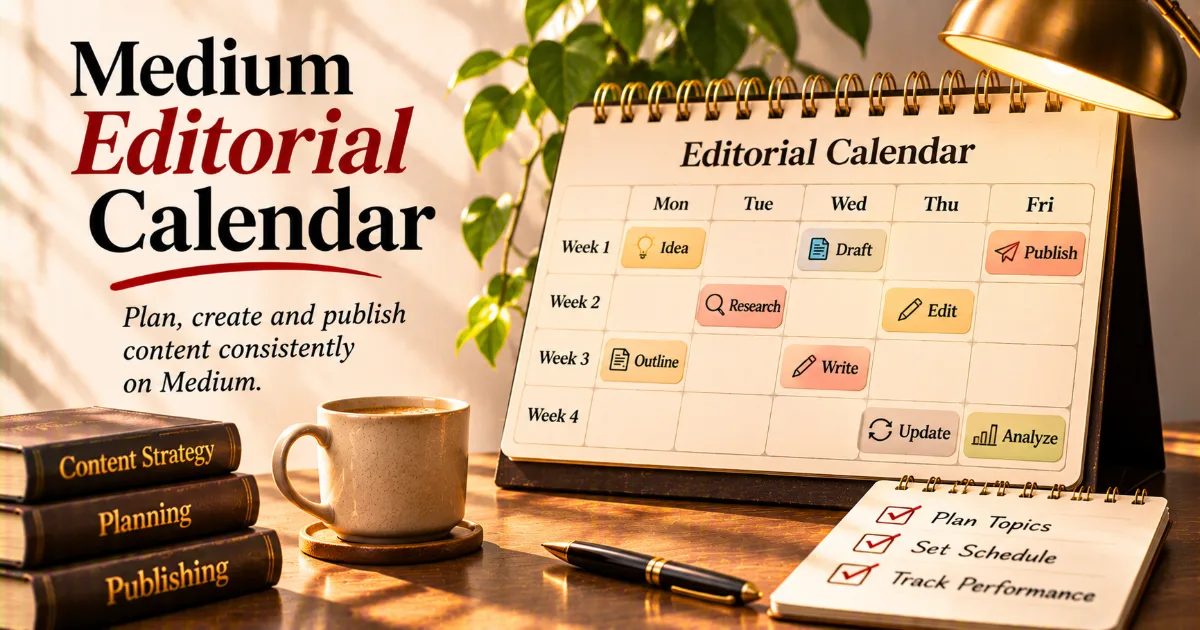
A Medium editorial calendar is a plan in which every slot answers a separate question a reader actually asks, aimed at a reader at a stated stage, with a written reason for why that question goes in that slot. The date is the last thing filled in. Built this way, four weeks of stories cover a beginner's first question, a practising reader's sticking point and a committed reader's deeper question without repeating one another, and every story has a job before anyone writes it. Medium supports the execution: stories can be scheduled ahead and publish within five minutes of the time set, and a publication can send a newsletter to its subscribers. This post covers where the questions come from, how reader stages shape the plan, the reason column, the rhythm, the scheduling, what automation handles, and an independent piano teacher's four-week calendar worked slot by slot.
How one calendar slot is filled, with the date last
- 01The question poolreal reader questions, in their words
- 02One questionnarrow enough for one story
- 03A reader stagestarting, practising or committed
- 04A written reasonwhy this question goes here
- 05The datefilled in last
- Medium editorial calendar: one reader question per slot
- Where the reader questions come from
- Reader stages: why the plan needs more than one kind of reader
- The reason column: why each question gets its slot
- The rhythm: how often, and how far ahead
- Scheduling on Medium, and the newsletter
- What the calendar automates, and what an editor chooses
- A worked example: an independent piano teacher's publication
- What a calendar costs, and the ways it fails
- Frequently asked questions
- Where to start
Medium editorial calendar: one reader question per slot
A Medium editorial calendar is the list of stories a publication or profile will publish over a set period, each one tied to a reader question, a reader stage and a reason. Most calendars are lists of topics with dates beside them: "practice tips" on a Tuesday, "theory" the next week. A topic is too broad to write well and too vague to check. A question is narrow enough to answer in one story and specific enough that anyone can tell whether the story answered it. A customer story can take one of those slots as a Medium case study article, once the customer has agreed. An account of a system built for a client gets a slot on the same terms, and our guide to a content automation case study for Medium covers what it needs before it earns a slot.
A slot that holds a topic, and one that holds a question
A topic per slot
- Practice tips on a Tuesday
- Too broad to write well
- Stories drift towards the same advice
A question per slot
- One question a reader asked
- Narrow enough for one story
- Different by construction
The question-first calendar also solves the commonest failure of a small publication: repetition. When the plan says "practice tips" four weeks running, four stories drift towards the same advice. When the plan says four different questions, from four different points in a reader's progress, the stories are different by construction, and a reader who follows the publication gets something new each week.
This calendar is the planning layer of the Medium content automation work we do: it decides which website articles, or which new pieces, reach Medium readers and when. The stories in a publication usually belong to one or two subjects, and the way a run of stories is drawn from one subject is in our guide to the Medium publication topic series. Keeping those published stories accurate afterwards is the job of our Medium article update workflow.
Where the reader questions come from
The questions come from the people a business already talks to, written down in their own words. Four sources cover most of it: the questions customers ask in emails and calls, the questions asked after a talk or a lesson, the search queries the website already appears for, and the responses readers leave on existing Medium stories. A question heard twice is worth a slot; a question the team thinks readers should ask is not, until someone actually asks it. The subjects the questions cluster around are usually the business's knowledge pillars, which our guide on how to identify your knowledge pillars helps name. Because a creator's stories can take days to weeks to reach the indexing thresholds described in Medium's About SEO and Medium, the questions come from the website's own search data, gathered the way our Medium SEO content research guide describes.
Where the calendar’s reader questions come from
what customers ask
- emails
- calls
- lessons
what the website appears for
- queries
- impressions
what readers leave on stories
- responses
The website's search data is the most systematic source. Search Console's performance report lists the queries a site appears for, and Google's help page on impressions, position and clicks explains what each number means, which matters because an impression is not a reader. A query with many impressions and few clicks is often a question the site half-answers, and a Medium story can answer it fully for a different audience. Reading that Search Console data on a schedule and sorting it into a short list is what the Content Operating System for website SEO is for.
Each question is written as a reader would say it, not as a heading. "How long should a beginner practise each day?" is a question; "Practice duration" is a topic. Nielsen Norman Group's writing on user need statements makes the same point for design work: define who has the need, what they need and why, before deciding what to make. A calendar slot is a small user need statement with a story attached.
The pool needs a simple record so questions are not lost between planning sessions. Five fields are enough: the question in the reader's words, where it came from, the date it was heard, the reader stage, and whether it has been answered yet. A question answered by an existing story is marked with that story's link, and the next time it comes up, the answer is a link rather than a new piece. Over a few months the pool shows which questions keep returning, and those are the ones worth answering on the website first and adapting for Medium afterwards.
Reader stages: why the plan needs more than one kind of reader
Readers arrive at different points in their progress, and a calendar that only serves one point loses everyone else. Three stages are enough for most publications: a starting reader, who is new to the subject and needs orientation; a practising reader, who is doing the thing and is stuck on something specific; and a committed reader, who knows the basics and wants depth, judgement or a view. Each question in the pool is tagged with the stage of the person who asked it.
The three reader stages a calendar serves
- 01Starting
new to the subject, needs orientation
- 02Practising
doing the thing, stuck on something specific
- 03Committed
knows the basics, wants depth and judgement
The stages are a simplified version of what Nielsen Norman Group calls a customer journey map: a view of the steps a person goes through, with their needs at each one. A publication does not need a full journey map. It needs to know that its four weekly slots are not all aimed at the same reader, and the stage tag is how it knows.
The mix shifts with the publication's age. A new publication leans towards starting readers, because that is who finds it first through topic pages. An established one adds more practising and committed questions, because its followers have moved on. The calendar records the mix, so the shift is a decision rather than a drift. The opening of each story has to meet the reader at their stage too, which is the job our guide to rewriting a Medium article introduction covers. Whoever the reader is at each stage, the page that tells contributors how to write for them is the Medium publication style guide. For readers at the practising stage, the natural format is a step-by-step piece, written as our Medium technical tutorial workflow describes.
The reason column: why each question gets its slot
Every slot carries a written reason, one sentence saying why this question goes here and not elsewhere. The reason is the part of the calendar that makes it a plan rather than a list. "A beginner asked it twice this month" is a reason. "It follows last week's story on the same skill" is a reason. "We need something for Thursday" is not.
Which reasons earn a slot
- A beginner asked it twice this month real readers asked it
- It follows last week’s story on the same skill it has a place in the order
- Students ask how to start a practice session written twice, it hides a collision
- We need something for Thursday it says nothing about readers
The reason also catches collisions before they are written. If two slots in the same month have reasons that sound alike, the questions are probably too close, and one of them should move to a later month or be merged. The test is simple: read the four reasons for a month aloud, and if any two could be swapped without anyone noticing, the plan has a repeat in it.
Reasons are cheap to write and expensive to skip. They take a minute per slot when the calendar is built. Without them, the calendar is defended by memory, and the next person to change it has no idea why a question was placed where it was, so the publication slowly fills with whatever was easiest to write.
A collision usually looks harmless at planning time. "How do I warm up before practice?" and "What should the first ten minutes of practice be?" read as two questions in a list, but their reasons give them away: both would say "students ask how to start a practice session". Merged, they make one stronger story; kept apart, they make two thin ones that a follower reads as the same piece twice. The reason column is where the merge is noticed, while it costs nothing. The same habit of a written reason beside every decision runs through our post on the Medium article tags strategy, where each topic on a story has to earn its place in the same way.
The rhythm: how often, and how far ahead
The right rhythm is the one the team can keep for a year, and for most small publications that is one story a week planned four weeks ahead. Weekly is frequent enough that followers notice the publication and infrequent enough that each story gets a real draft, a review and a check. Four weeks ahead is far enough to leave room for review and short enough that the plan can respond to new questions. Medium's stats page shows views and reads per day for a chosen month, which is where a rhythm becomes visible; what those figures can and cannot say about readers who went on to the website is covered in our guide to Medium referral traffic measurement.
A steady weekly rhythm against a burst and a silence
Left to right: a year of publishing
Bottom to top: stories followers can expect
- a burst of three stories, then a month of nothing
- stories published on a weekly rhythm
Consistency matters more than volume, and it is what lets a body of work build on itself, the idea behind our post on creating content that compounds over time. A publication that publishes every week for a year teaches its followers when to expect it; one that publishes three stories in a week and then nothing for a month teaches them nothing. Medium's own guidance on publications describes publications as collections of stories about a common theme, and a steady rhythm is what makes a collection feel looked after. A steady rhythm also gives a test something to be compared with, the baseline that our guide to Medium content angle testing depends on.
The calendar holds a short reserve as well: one or two questions already drafted and reviewed, ready to go out if a planned story slips. A reserve is what keeps a weekly rhythm alive through a sick week or a late review, and it is replaced as soon as it is used. Some questions also have a season: a tutor hears about exams in spring and about new starters in autumn.
The calendar marks those questions with the months they matter in, so the plan can place them ahead of time instead of noticing them when the season has already passed. A founder's essays, if the business publishes them, usually take a monthly slot of their own, built the way our post on Medium founder thought leadership describes. A recorded webinar is one way to fill it, since our guide to Medium webinar repurposing draws several essays from a single session.
Scheduling on Medium, and the newsletter
Medium can hold a finished story and publish it later. Its help page on scheduling to publish describes choosing "Schedule for later" from the publish dialogue and setting a date and time. Three details matter for a calendar: the story publishes within five minutes of the time set, times are in your local timezone, and any edits made before the publish time are published with it, since scheduling is not cancelled by changes. When the calendar feeds a publication, Medium's page on how to submit a story to a publication says a writer's draft stays unpublished until the publication's editors approve it, so the slot needs the editor's time as well; whether to run a publication at all is weighed in our Medium publication vs profile comparison.
The website date and the Medium date for each story
On the websiteOn Medium
Publish
the website version goes first
waits for the website page
Date
a visible date and datePublished
Schedule for later
Timing
the website’s own date
within five minutes, local timezone
Edits
changed on the website first
edits before publishing go out too
A publication can also send a newsletter. Medium's newsletter help page describes creating one from the publication's settings, with a name and a short description that readers see when they sign up. For a calendar, the newsletter is a second slot type: a short note to subscribers pointing to the month's stories, planned with the same question-and-reason discipline, so it adds something rather than repeating the stories. A business that wants the newsletter to be the main event, not a monthly pointer, usually needs a platform built for email first, the case our Substack content automation page covers.
The website version of each story is published first, with its own date. Google's guidance on publication dates recommends a clear visible date and a matching structured-data date, which schema.org records as datePublished. The calendar holds both dates for every story, the website's and Medium's, so nobody has to guess which came first. Whether a given article is republished on Medium or adapted for it is decided the way our post on the Medium duplicate content strategy sets out.
What the calendar automates, and what an editor chooses
A workflow can run the calendar's machinery; an editor chooses what goes in it. The machinery is the question pool, the reminders and the dates. In n8n, a form or an inbox can feed new reader questions into an Airtable table with columns for the question, the stage, who asked it and when, and a Google Calendar node can put each slot's draft, review and publish dates in the right people's calendars.
The calendar’s machinery, run by the workflow
Form or inbox the reader question comes in
Airtable row question, stage, who and when
Google Calendar draft, review and publish dates
Reminder the writer is told a draft is due
The editor schedules each approved story on Medium by hand
The reminders follow the dates. Make.com can schedule a scenario to check each morning which drafts are due and tell the writer, and in Zapier a delay step can hold a reminder until a set number of days before a story is due. None of this publishes anything: Medium allows no new API integrations, so the account holder schedules each story by hand once it is approved. Comparing tools like these for readers is its own kind of story, covered in our guide to a Medium tool comparison article.
The editor chooses which questions get slots, which stage each slot serves, what the reason is, and what order the month runs in. Those are judgements about readers, and they are the whole value of the calendar. A workflow that picked questions on its own would pick the most frequent ones, which are usually the starting-stage questions, and the publication would never grow past its beginners.
A worked example: an independent piano teacher's publication
Illustration. An independent piano teacher runs a small Medium publication for adult learners, alongside lessons and a website. The questions in the pool come from students' messages, the questions asked at the end of lessons, and the search queries the teacher's website appears for. For the next four weeks, the teacher picks four questions from four different points in a learner's progress and writes a reason for each.
How far along a learner each of the piano teacher’s four weeks sits
Week 1 Am I too old to start
Week 2 hands separately but not together
Week 3 practising in short gaps
Week 4 a piece that stretches me
A judgment, not a score
| Week | Reader question | Stage | Reason for the slot |
|---|---|---|---|
| Week 1 | Am I too old to start learning the piano? | Starting | Asked by three new enquiries this month; the most common first worry. |
| Week 2 | Why do my hands work separately but not together? | Practising | The sticking point students raise most in their second term. |
| Week 3 | How do I practise when I only have short gaps in the day? | Practising | A different practising problem: time, not technique; asked at lessons. |
| Week 4 | How do I choose a piece that stretches me without stopping me? | Committed | Asked by longer-term students; gives the publication's followers depth. |
Reading the four reasons aloud, the teacher checks for collisions: weeks two and three are both practising-stage, but one is about coordination and the other about time, so they stay. A fifth question, about which keyboard to buy, was considered and moved to the next month, because it is a starting-stage question and week one already serves that reader. One drafted story on reading sheet music sits in reserve.
Each story is published on the teacher's website first and scheduled on Medium for the same morning each week, and the publication's newsletter goes out at the end of the month pointing to all four. The calendar shows the question, the stage, the reason and both dates for every slot. What it does not show is how many readers each story reached; it is a plan, and the illustration shows how the plan is made.
What a calendar costs, and the ways it fails
Building a four-week calendar from an existing question pool takes about an hour, most of it reading questions and writing reasons. Keeping the pool full takes a few minutes a week, if new questions are captured as they come in rather than remembered at planning time. The workflow carries the dates and reminders, so the ongoing cost is the editor's judgement, which is the part worth paying for.
What a calendar with questions and reasons fixes
- 01Different stories
- 02Reader stages served
- 03Checkable plan
- 04A rhythm kept
- 05Hour to build
- a calendar of topics and dates
- a calendar of questions, stages and reasons
A judgment, not a score
Calendars fail in four ways. The slots hold topics instead of questions, so stories drift into each other. Every slot serves the same reader stage, so the publication never grows past its beginners or never welcomes them. The reasons are left blank, so the plan cannot be checked or defended. And the rhythm is set by ambition rather than capacity, so a weekly plan collapses into a burst and a silence.
Each failure is visible in the calendar itself, before a word is written, which is why the planning is worth doing on paper first. The question pool, the reminders and the scheduling can run as one workflow, and the Medium pricing page says what building it involves. What fills the slots is covered guide by guide on the Medium hub, and a calendar shared with other channels is a multi-platform content question.
Frequently asked questions
What is a Medium editorial calendar?
It is the plan of stories a Medium publication or profile will publish over a period, where each slot answers one reader question, serves a stated reader stage and carries a written reason. The publish date is filled in last.
How often should a small business publish on Medium?
As often as the team can keep up for a year. For most small publications that is one story a week, planned four weeks ahead, with one or two reviewed stories held in reserve for weeks when a planned piece slips.
Can I schedule stories on Medium?
Yes. Choose "Schedule for later" in the publish dialogue and set a date and time. Medium says the story publishes within five minutes of that time, in your local timezone, and edits made before then are published with it.
Where should calendar questions come from?
From real readers: customer emails and calls, questions after talks or lessons, the search queries your website already appears for, and responses on your Medium stories. A question heard twice is worth a slot.
Why give every slot a reason?
Because the reason is what makes the calendar checkable. Reading a month's reasons aloud shows when two slots are too similar, and a written reason stops the next person from changing the plan without knowing why it was built that way.
Can a workflow plan the calendar for me?
It can collect questions, track dates and send reminders, but the editor should choose the questions, stages and reasons. A workflow picking on its own tends to favour the most frequent beginner questions every week.
Where to start
Collect every reader question you have heard in the last two months into one list, in the reader's words, and tag each with a stage: starting, practising or committed. Pick four questions from at least two stages, write one sentence of reason for each, and read the reasons aloud to check for repeats. Put the dates in last. Then publish the first story on your website, schedule it on Medium, and add new questions to the list as they arrive, so next month's plan starts from a full pool.
Disclosure
This post was written by Shreyas Dave, founder of Paper Eagle AI. We sell content automation services, which is the category this article is about, so we have a commercial interest in you concluding that a system beats ad-hoc effort — read it knowing that. No tool vendor was involved in writing it, nobody paid for a mention, and there are no affiliate links anywhere on this site. Where a third-party figure appears, it’s attributed to the publisher it came from; anything we couldn’t source is written as a direction rather than a number.
Paper Eagle AI builds Content Operating Systems that turn a business’s knowledge and expertise into consistent, multi-platform content, and we deliver them as content automation services. Working as a content automation specialist, we capture what a business knows and how it sounds, set the strategy, and build the workflows that research, draft, repurpose and publish — with a named person approving every piece before it goes out. Every build runs through discovery, design, build and handoff. The system lives in the client’s own accounts, it is documented, the team is trained to run it, and the business owns it outright. We don’t write content on a retainer, and we don’t build lead generation, CRM or sales automation.
One source of thinking becomes native content for every platform a business publishes on: the founder’s LinkedIn and the company page, YouTube and Shorts, Instagram and Reels, TikTok, Reddit, Medium, newsletters, and the company’s own website, written to be found in Google and understood by AI search. Our multi-platform content automation page shows how they share one source, and our case studies document the systems behind our own publishing, file by file. You can follow the work on the company’s own channels: Paper Eagle AI on Instagram, Paper Eagle AI on YouTube, the Paper Eagle AI company page on LinkedIn, Paper Eagle AI on Substack, Paper Eagle AI on Reddit and Paper Eagle AI on Medium. Paper Eagle AI is also listed where clients can review its work: Paper Eagle AI on Clutch, Paper Eagle AI on GoodFirms and the Paper Eagle AI Google Business Profile.
Keep reading
- Medium publication topic series — how a run of stories is planned from one knowledge pillar, which feeds the calendar's questions.
- How to identify your knowledge pillars — where the subjects a calendar draws from come from in the first place.
- TikTok content series planning — the same planning discipline on a platform with a very different rhythm.