SEO vs AEO vs GEO for Automated Content: One Pipeline, Three Readers
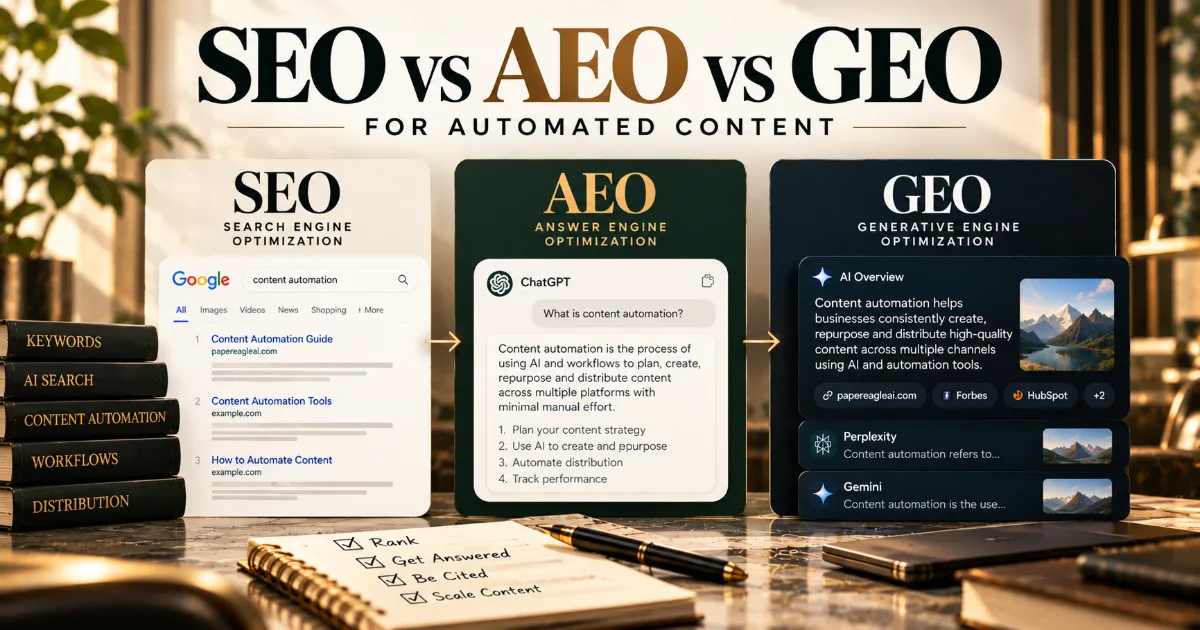
SEO, AEO and GEO are not three kinds of content but three readers of the same page, and an automated pipeline has to satisfy all of them at once. So the real question behind SEO vs AEO vs GEO for automated content is which stage of the pipeline serves which reader. SEO decides whether a search engine finds and ranks the page, AEO whether an answer engine can lift one clean answer out of it, and GEO whether a generative model trusts it enough to name the business as its source. Most of the work is shared and sits upstream, in what the pipeline drafts from.
One page read by three readers at once
One served page
- 01Founda search engine can crawl, index and rank the page
- 02Liftedan answer engine takes one answer from the first sentence
- 03Nameda generative model cites the business as its source
what one pipeline, built on one knowledge record, produces
- Three readers, three things taken away
- The shared knowledge foundation
- Answer-first structure pays all three
- AEO vs GEO: entities and citations
- Internal links, read three ways
- What changes in the pipeline for each
- What the pipeline automates, and what a person decides
- A worked example: three month-two failures
- What serving three readers costs a small team
- Frequently asked questions
- Where to start
Three readers, three things taken away: SEO, AEO and GEO defined
The one difference that matters between SEO, AEO and GEO is what each reader takes away from your page. A search engine takes away a decision about where the page belongs in a list of results, and serving that reader well is search engine optimization. An answer engine takes away one answer it can show on its own, in a featured box, a voice reply or the opening lines of an AI summary, and serving that reader is answer engine optimization. A generative model takes away a claim it is willing to repeat and a source it is willing to name, and serving that reader is generative engine optimization.
What each reader takes away from the same page
takes away where the page belongs
- list of results
- position
takes away one answer it can show on its own
- featured box
- voice reply
- AI summary
takes away a claim it will repeat
- a named source
- trust
The three overlap more than the acronyms suggest. Google's own page on AI features and your website asks nothing extra of a page for AI Overviews or AI Mode beyond ordinary search; a page has to be indexed and eligible to show with a snippet before it can appear as a supporting link. On Google, the search reader is the gate the other two pass through. If you want the definitions argued out at length, with the history of how GEO split off from SEO, our post on what generative engine optimization is covers that ground.
What this post adds is the automated case. A person writing one page makes these decisions one at a time and can correct a bad habit on the next page. A pipeline makes the same decision hundreds of times in exactly the same way, because the decision lives in a template, a prompt or a check, so a habit encoded once is repeated on every page. The useful comparison is therefore a map of which pipeline stage carries each reader's requirement, so a failure is fixed where it starts rather than on every page it reached.
The shared knowledge foundation all three read from
All three readers reward the same thing first, and it has nothing to do with formatting: a page that says something specific and true that the business genuinely knows. A search engine ranks the page that best answers an intent, an answer engine lifts the most precise sentence, and a generative model repeats the claim it can trust. A pipeline that drafts from a blank prompt gives every one of them the generic material every other site already published. So the foundation of a pipeline serving SEO, AEO and GEO together is the knowledge it is allowed to write from.
What the pipeline stands on
In practice that is a knowledge record with a few strict parts: the approved facts about the business, the positions it takes and why, the questions customers ask in their own words, the sources behind every claim with the date each was checked, and one sheet that fixes how the business, its people and its products are named. Deciding what earns a place in that record is its own discipline, and our guide to what goes into a business content knowledge base sets out the admission test item by item, and the rest of our writing on the subject is collected in our business knowledge guides.
Each reader draws on the record differently, and that is the first place the three part company. For SEO, the record supplies the depth that makes one page the best result for one intent instead of a thin page beside a dozen others. For AEO, it supplies the exact sentence: the definition, the step, the yes or no with its condition. For GEO, it supplies consistency, the same facts and the same names everywhere, plus a named source a model can check a claim against. A pipeline without the record still produces pages, and they still pass a formatting check. They just say what everyone says, which is the pattern our post on automating SEO content without search spam treats as the line not to cross.
Answer-first structure: one habit that pays all three readers
Answer-first content is the one structural habit that earns something from every reader at once, which makes it the cheapest win in the whole comparison. Each section opens by answering the question its heading asks, in the first sentence, and only then explains. The search reader gets a page whose topic is unmistakable and whose snippet can come straight from the text. The answer engine gets a sentence it can lift without the paragraph above it. The generative model gets a passage that stands on its own when it is retrieved as a chunk, which is how a model actually reads, as our explainer on how LLMs use content sets out.
The answer-first shape, encoded once in the outline template
- 01Heading asksone question per heading, as a reader asks it
- 02Answer firstthe heading’s key noun and a verb that commits
- 03Then explainthe reasoning and detail, after the answer
- 04Check flagsa draft that opens with context goes to a person
Headings carry half of that habit. The W3C's tutorial on headings and page structure says headings communicate the organization of the content, and that browsers and assistive technologies use them for in-page navigation. Machines that segment a page lean on the same signal. The writing method behind it, including self-contained sections and committing to a definition, is set out in our guide to preparing your content for AI search, so this post only adds where it lives in a pipeline.
It lives in two places. The outline template fixes the shape: one question per heading and an answer slot directly under it. Then a check reads every draft and flags any section whose first sentence lacks the heading's key noun and a verb that commits to something, which catches the commonest automated failure, a paragraph of generated context before the answer. What the check cannot judge is whether that sentence is the right answer, so it routes the draft to a person, never past one.
AEO vs GEO: where entities and citations split them
AEO vs GEO comes down to one extra demand: an answer engine needs a correct answer, while a generative model also needs to know whose answer it is and what stands behind it. That extra demand is carried by entities and citations, and they are where an automated pipeline most often serves AEO well and GEO badly. A page can answer cleanly and still be unusable as a source if the business is named three different ways across the site, or if its central claim points nowhere. An answer engine quotes the sentence; a citing model vouches for the speaker.
How much each reader leans on entities and citations
Partly
quotes the sentence, so a correct answer carries most of the weight
Fully
vouches for the speaker: consistent names, a source per claim
A judgment, not a score
Entities are the named things on the page: the business, its founder, its products, the tools and standards it discusses. Structured data lets the page state them explicitly. The schema.org definition of the sameAs property is the URL of a reference page that unambiguously indicates an item's identity, which is how a page says this business is that profile and not another with a similar name. Google's general structured data guidelines keep it honest: markup must be a true representation of the page content and must not describe content readers cannot see. In a pipeline, the markup is generated from the finished page, never written beside it.
Citations are the outbound half. A generative system that searches the web brings sources back with its answer; Anthropic's documentation for Claude's web search tool says citations are always enabled, each carrying the URL and a short span of the cited text. A page whose claims are tied to named primary sources is easier to cite accurately, because claim and evidence travel together. The 2023 paper that named the field, GEO: Generative Engine Optimization by Aggarwal and colleagues, found that the strategies which raise visibility vary by domain, so there is no single trick to encode. The durable rule is simpler: every claim in the knowledge record carries its source, or it is written as a direction or left out.
Internal links, read three ways
Internal links do a different job for each reader, which is why a pipeline should build them from a map rather than let the drafting model scatter them. For the search reader, links are how pages are discovered and how importance flows through the site. For the answer reader, they let an answer stay short, because the depth is one click away on the page that owns it. For the generative reader, they make the site read as a connected body of knowledge on one subject, which is part of what makes a source look like an authority.
One link map, a different job for each reader
built from the topic structure, not by the drafting model
discovery, and importance flowing through the site
short answers, with the depth one click away
a connected body of knowledge on one subject
no page left without a link pointing at it
Two rules matter most on an automated site. Every page you care about needs at least one link from another page, or a crawler has no path to it. And the words of the link should say what the destination is. The W3C success criterion for link purpose in context makes that second demand from the accessibility side: a reader should be able to tell where a link goes from its text and its sentence, so they can decide whether to follow it. An anchor that names its destination serves a screen reader, a crawler and a model in one stroke.
The drafting model is the wrong place to decide links, because it does not know which pages exist, which one owns a query, or which ones nobody links to yet. A link map built from the topic structure decides those things, a script proposes links onto words that name the destination, and an orphan check catches a page nothing points at. That routine work is what a website SEO automation setup takes off a team's hands.
What changes in the pipeline for SEO, AEO and GEO
What changes between SEO, AEO and GEO is not the content but the stage where each reader's requirement is decided, the unit you count as success, and how you measure it. SEO is decided early, at the query map and site structure, and its success unit is a URL ranking for an intent. AEO is decided at the outline and the first sentence of each section, and its success unit is an answer lifted cleanly. GEO is decided at the knowledge record, the entity sheet and the sources, and its success unit is the business named as a source in a generated answer. The table sets the three side by side.
Where each reader’s requirement is decided in the pipeline
- 01SEOdecided at the query map and site structure
- 02AEOdecided at the outline template and each first sentence
- 03GEOdecided at the knowledge record, the entity sheet and the sources
Relative, not measured
| Dimension | SEO | AEO | GEO |
|---|---|---|---|
| The reader | A search engine ranking pages | An answer engine lifting one answer | A generative model composing a reply |
| What it takes away | Where the page belongs in results | One self-contained answer | A claim it will repeat and a source it will name |
| Unit of success | A URL ranking for one intent | A passage shown on its own | The business cited as the source |
| Pipeline stage that decides it | Query map, site structure, links | Outline template, first sentence of each section | Knowledge record, entity sheet, sources |
| What automation does well | Duplicate-intent checks, titles, sitemaps, link maps | Heading and opening-sentence checks | Markup from the page, name consistency, source fields |
| What a person must decide | Whether the page should exist at all | Whether the answer is actually right | Whether a source says what the sentence claims |
| How it is measured | Queries, impressions, clicks, indexing | Which passages appear as answers | Recorded prompt checks: engine, prompt, date, citation |
| Typical failure | Two pages competing for one query | The answer buried under generated context | One business named three ways, claims with no source |
Two differences sit outside the page. The first is crawler access: other answer systems run their own crawlers, and a robots rule decides whether they can read you. OpenAI's overview of its crawlers says sites opted out of OAI-SearchBot will not be shown in its search answers, and Anthropic's page on whether it crawls the web and how site owners block it separates a training crawler from the Claude-SearchBot that indexes for search. Writing for GEO while blocking the crawlers that would read you is a contradiction no prose can fix.
The second is measurement, and here the three really do diverge. SEO has first-party data: Google counts AI feature traffic inside the Web search type of the Search Console performance report, and the URL Inspection tool shows Google's indexed version of a specific page. AEO and GEO have no report covering every engine, so they are measured by a fixed set of real questions put to real engines, with the engine, prompt, date and any citation written down each time. That record is directional, and how it sits beside a content system's other numbers is covered in our guide to measuring whether a content system works. Teams that want this run as a managed layer usually look at AI search content automation built around the same knowledge record.
What the pipeline automates, and what a person decides
The pipeline can automate almost every check the three readers need, and almost none of the judgements. Everything that compares a draft against a rule a machine can read is safe to automate: whether a query already has a page, whether each section opens with an answer-shaped sentence, whether the business is named the way the entity sheet says, whether every claim has a source field, whether the markup matches the page, whether a new page has inbound links, whether the robots rules admit the crawlers you chose. Those checks run on every draft without getting tired, which is precisely where a person is weakest.
The same draft, checked by the pipeline and judged by a person
The pipeline checksA person decides
Should it exist
the query is compared with pages already published
whether it is a new question or a rewording
The opening
the first sentence is checked for an answer shape
whether that answer is actually right
The sources
every claim is checked for a source field
whether the source says what the sentence claims
The names
each name is checked against the entity sheet
which positions the business takes
What stays human are the decisions where being wrong is expensive and invisible to a rule. A person decides whether a page should exist at all, because only someone who knows the business can tell a new question from a rewording of one already answered. A person decides whether the first sentence is right, and whether a cited source says what the sentence claims, because a model can produce a plausible citation for a claim the source never made. Our broader line between the two is drawn in what to automate in your content, and what not to.
The handoff should be explicit in the workflow. A draft that fails a mechanical check goes back to the stage that produced it, with the failed check named, so the fix lands upstream. A draft that passes goes to a named reviewer with the three questions only a person can answer printed beside it, and a written scorecard keeps that review consistent between reviewers.
A worked example: three month-two failures in one pipeline
The clearest way to see the three readers apart is to watch one pipeline fail each of them differently. Take an illustrative garden-design studio that publishes planting guides: an n8n workflow pulls the week's approved questions from the knowledge record, Claude Code drafts each guide against the outline template, and the head designer approves every page before it goes live. In the second month, three readers stop rewarding it for three reasons, none visible from any single page.
The garden-design pipeline, and where each failure was fixed
- 01n8nBriefa duplicate-intent check now stops a reworded question
- 02Claude CodeDrafta hook blocks names that differ from the entity sheet
- 03n8nOpening gatethe If node returns a context-first opening
- 04Head designerApprovaldecides whether each source says what the sentence claims
The SEO failure arrives first. The brief generator had produced one guide answering when to plant a hedge and, three weeks later, another on the best time to plant hedging; the two pages split one intent and neither settled into a stable position. Rewriting either page would not fix it, because the fault was upstream, in a query map that did not recognise a rewording. The repair was a duplicate-intent check at the brief stage that compares each new question against the questions already published and stops a match before drafting. One of the two guides was merged into the other and redirected, and the check now runs on every brief.
The AEO failure was the outline template. It opened every guide with a short paragraph about the studio's approach before the answer, so the planting window for each shrub sat in the second paragraph, where nothing lifts it. The fix lived in two places. The template moved the answer slot directly under each heading, and a gate was added in the workflow: n8n's If node, which splits a workflow on a comparison, sends a draft back to drafting when the opening-sentence check fails and forward to review when it passes. The guides already published were then corrected by the studio's refresh routine, the same loop described in how to automate content refreshes.
The GEO failure was the subtlest. Across thirty pages the studio's name appeared in three spellings, its head designer's in two, and one guide repeated a figure about hedge survival from a supplier's brochure with no source in the record. A model has little reason to trust a source that cannot agree with itself. The fix went into the record: one entity sheet fixing every name, and a rule that a number without a source field becomes a direction. In Claude Code, a PreToolUse hook runs before a page file is written and blocks the write, by exiting with code 2, when a name differs from the sheet or a figure has no source. Three failures, three readers, three stages, and none fixed by hand-editing a published page. Which tool carries which check is a separate decision, and our guides to content automation tools compare them.
What serving three readers costs a small team
Serving SEO, AEO and GEO from one pipeline costs far less than running three programmes, and most of the cost is front-loaded into the knowledge record rather than spread across the pages. The heaviest work is the first few weeks: gathering the facts, positions and customer questions, fixing the entity sheet, and attaching a dated source to every claim the business wants to make. That is senior time, because only the people who know the business can approve it. After that, each new page costs a review, not a research project, because the record already holds what the page is allowed to say.
Where the cost of serving three readers goes
Relative, not measured
The running cost is the reviewer's attention and a small measurement habit. Each draft still needs a person to confirm the answer and the sources. Measurement splits along the line in the table: Search Console for the search reader on a regular rhythm, and a fixed list of real questions put to the engines that matter, recorded with the date and the result. Its value is the trend across months, not any single check.
What goes wrong in month two is drift: the record falls behind the business, a new product gets named two ways, a source expires, a template edited for one page quietly changes all of them. The countermeasure is ownership, with each part of the record given a named owner and a review date. If you would rather have it built, a pipeline that serves your website alongside other platforms is scoped as a Custom Content OS, and our page on Custom Content OS pricing explains how that is quoted, and every guide we have written on the subject sits on the SEO and AI search guides page.
Frequently asked questions
Is AEO just SEO under a new name?
No, though it is built on SEO and rarely works without it. SEO serves a reader that ranks whole pages for an intent; AEO serves a reader that lifts one answer out of a page and shows it on its own. A page can rank well and still bury its answer under context, which is an AEO failure on a page with no SEO failure at all. In practice AEO is the discipline of making each section answer its question in its first sentence, on top of the crawlability and relevance SEO already provides.
Can an automated pipeline handle SEO, AEO and GEO without a person?
It can handle the checks, but not the judgements, so a person still has to approve each page. A pipeline can test for duplicate intents, answer-first openings, consistent names, source fields and matching markup on every draft. It cannot know whether a page should exist, whether its answer is correct, or whether a cited source says what the sentence claims. Those are the decisions where an error is both costly and invisible to a rule, and they belong to someone who knows the business.
Does structured data get a page cited by AI search?
Structured data alone does not get a page cited, and Google says no special schema is needed for its AI Overviews or AI Mode. What markup does is state the page's entities explicitly, such as the business and its official profiles through sameAs, which helps systems resolve who is speaking. It must describe what the page visibly says, never more. Treat it as a way to remove ambiguity about identity, not as a lever that produces citations by itself.
Should a business block AI crawlers to protect its automated content?
Blocking every AI crawler also blocks the search crawlers that would let answer engines read and cite the site, so it is a trade, not a safeguard. Several providers separate a crawler that gathers training data from one that indexes for search, and they can be allowed or refused independently in robots rules. A business that wants GEO visibility generally needs to admit the search crawlers of the engines it cares about. Which ones to admit is a business decision, and it should be written down rather than left at whatever default the host applied.
How can AEO and GEO be measured when Search Console does not split them out?
Measure them with a fixed set of real questions asked of the engines your buyers use, and record the engine, the prompt, the date and any citation each time. Google counts AI feature traffic inside the Web search type in Search Console, so that report shows whether search visibility is growing but not which answers were lifted. The question set gives a directional view of whether the business is being named as a source. Its value is the trend across several months, never a single result.
Which should a small business fix first: SEO, AEO or GEO?
Fix the shared foundation first, then SEO, because the other two depend on both. If the knowledge record is thin, every page says what competitors say and no reader rewards it; if the site cannot be crawled and indexed, no answer engine or model will find the page. Once those hold, answer-first structure is the cheapest improvement, since one template change reaches every page. Entity consistency and sourced claims come next, and they matter most for being named as a source.
Where to start
Pick the five pages that matter most to your business and read only the first sentence under each heading. Next to each, write which reader it fails: the search reader if two of your pages answer the same question, the answer reader if the first sentence is context rather than an answer, the citing reader if a name or a number cannot be traced to one agreed source. The pattern across five pages will tell you which stage of your pipeline to fix first, and that one fix will reach every page the pipeline publishes after it.
Disclosure
This post was written by Shreyas Dave, founder of Paper Eagle AI. We sell content automation services, which is the category this article is about, so we have a commercial interest in you concluding that a system beats ad-hoc effort — read it knowing that. No tool vendor was involved in writing it, nobody paid for a mention, and there are no affiliate links anywhere on this site. Where a third-party figure appears, it’s attributed to the publisher it came from; anything we couldn’t source is written as a direction rather than a number.
Paper Eagle AI builds Content Operating Systems that turn a business’s knowledge and expertise into consistent, multi-platform content, and we deliver them as content automation services. Working as a content automation specialist, we capture what a business knows and how it sounds, set the strategy, and build the workflows that research, draft, repurpose and publish — with a named person approving every piece before it goes out. Every build runs through discovery, design, build and handoff. The system lives in the client’s own accounts, it is documented, the team is trained to run it, and the business owns it outright. We don’t write content on a retainer, and we don’t build lead generation, CRM or sales automation.
One source of thinking becomes native content for every platform a business publishes on: the founder’s LinkedIn and the company page, YouTube and Shorts, Instagram and Reels, TikTok, Reddit, Medium, newsletters, and the company’s own website, written to be found in Google and understood by AI search. Our multi-platform content automation page shows how they share one source, and our case studies document the systems behind our own publishing, file by file. You can follow the work on the company’s own channels: Paper Eagle AI on Instagram, Paper Eagle AI on YouTube, the Paper Eagle AI company page on LinkedIn, Paper Eagle AI on Substack, Paper Eagle AI on Reddit and Paper Eagle AI on Medium.
Keep reading
- What Is Generative Engine Optimization? — the definitions this post leaves out, and how GEO split off from SEO.
- How LLMs use content — why a model reads a page in chunks, which is why a section has to stand on its own.
- SEO Content Automation: How to Scale Without Search Spam — the existence gate that stops an automated pipeline publishing the same answer twice.