The Knowledge Architecture Framework
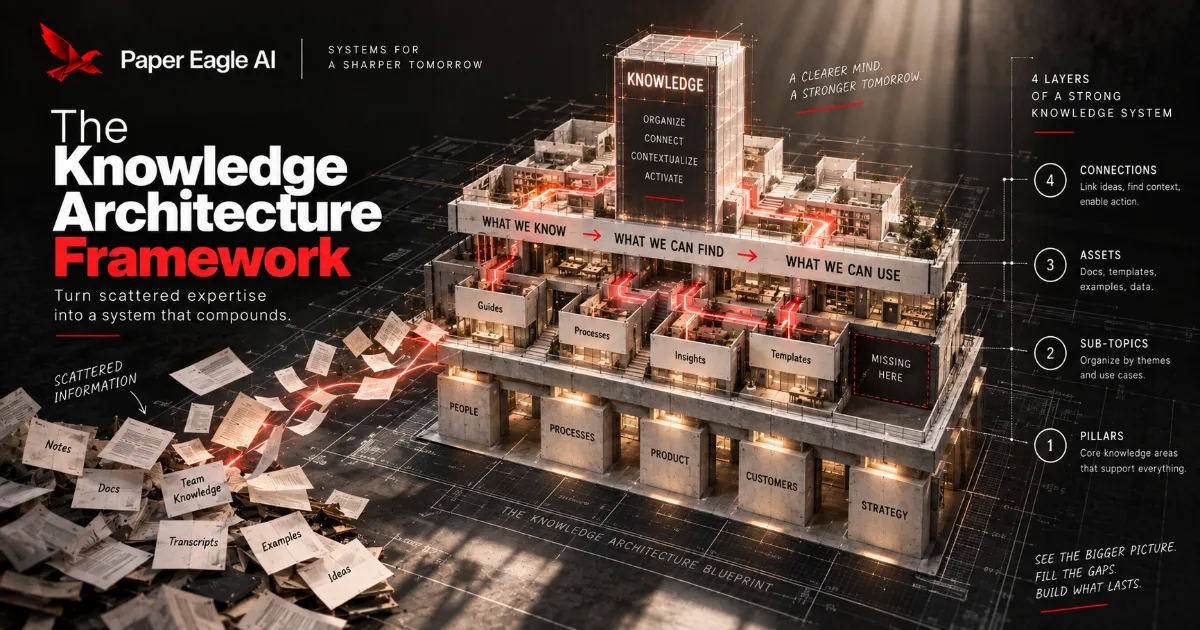
Every business knows more than it can use. The expertise is real, but it's scattered — trapped in people's heads, buried in old documents, mentioned once in a call and never written down. Knowledge architecture is how you give that expertise a structure, so it stops leaking away and starts compounding into an asset. It's the foundation a Content OS stands on, and this framework is how you build it.
What a knowledge architecture is made of, from the ground up
- Why knowledge architecture comes first
- What it is, and what it isn't
- The four layers
- How to build it
- What it looks like in practice
- A worked example: eleven transcripts, one afternoon
- How it feeds creation and automation
- Keeping it alive
- What it honestly costs
- Frequently asked questions
- Where to start
Why knowledge architecture comes first
Most content efforts fail quietly, and they fail at the same place: the blank page. Every time you sit down to write, you start from nothing, reconstructing what you think, deciding what matters, hunting for the example you used last time. That reconstruction tax is invisible but enormous, and it's the reason publishing feels hard even when you have plenty to say.
Writing one piece from a blank page, stage by stage
Relative, not measured — the hatched bars are the reconstruction tax
Knowledge architecture removes that tax by doing the thinking once and keeping it. When what you know is already organized, creation becomes assembly rather than invention. The idea already exists in structured form; the work is shaping it for this audience, in this format, today. That's a fundamentally easier task, and it's why we almost always start here before building anything on top.
There's a compounding reason too. Content built on organized knowledge connects — each piece reinforces the others, builds on a consistent point of view, and adds to a body of work instead of floating alone. Content built on nothing stays disconnected forever. The architecture is what lets knowledge accumulate into something worth more than the sum of its parts.
There is a stricter sense of “asset” worth borrowing here. Accounting’s test for an intangible one, in IAS 38, is separability: it counts as identifiable when it can be separated from the business and sold, transferred or licensed. Expertise living in one person’s head fails that test outright; the same expertise structured and written down passes it. The standard would still not let you carry a number for it in the accounts — internally generated intangibles mostly aren’t recognised — but the test itself is the clearest description of what this work changes.
The tax has a second bill that's easier to miss: inconsistency. When every piece is reconstructed, every piece quietly re-decides the point of view, and a reader who reads three of them meets three slightly different businesses. Nobody notices from the inside, because each piece was defensible on the day it was written. From the outside it reads as a company that hasn't made up its mind — which is a strange impression to give when the expertise underneath is genuinely settled.
It matters more now that most teams have an AI model in the loop. Point a model at a blank page and you get fluent, plausible text assembled from everyone's writing rather than yours. Point it at an organized body of knowledge and it can only assemble what you actually know, in your terms, with your examples attached. The model is not the differentiator; the foundation you point it at is. That's the practical reason this framework has become more valuable, not less, since the tooling got good. Google's guidance on people-first content asks the reader-side version of the same question — whether a piece demonstrates first-hand expertise and a depth of knowledge — and first-hand expertise is exactly what a blank page cannot supply.
What it is, and what it isn't
Knowledge architecture is the deliberate structure you give to what your business knows. It defines what your core areas of expertise are, how they break down, what evidence and examples support them, and how they all relate to one another. It's less a place where documents live and more a map of what matters and how it connects.
The same forty documents, held two different ways
A drive or a wiki
- Everything is somewhere.
- Finding it needs the right word.
- Nothing says what matters most.
- A new page joins nothing.
- You can't see what's missing.
A knowledge architecture
- Everything has one home.
- Finding it needs the subject.
- The centre is named out loud.
- A new page joins four others.
- The gaps are visible as gaps.
It is not a wiki, and it is not a folder of documents. A wiki stores pages; a folder stores files. Both can hold everything you know and still be useless, because storage isn't structure. The difference is meaning: an architecture tells you what's central and what's peripheral, what depends on what, and what's missing — a document graveyard tells you none of that. If your "knowledge base" is a place things go to be forgotten, you have storage, not architecture.
There's a two-part test that settles it quickly. First: can somebody who joined last month find the thing that matters most, without asking a person? Second: can you point at what's missing? Storage usually passes the first test on a good day and fails the second always, because a folder has no opinion about what should be in it. An architecture answers both, and the second answer is the one that turns it from a reference into a plan. Answering that second question is the same discipline as a content audit, pointed at what you know rather than at what you've already published.
One more thing it isn't: a tool decision. The commonest way this work stalls is a month spent choosing the platform, which is a comfortable substitute for the uncomfortable part — naming what you're actually the authority on. Ours lives in plain text files a person can read and an agent can search. Yours can live wherever your team already works. The structure is the asset, and a good one survives you changing tools twice. The convention is not unusual, either: Claude Code reads its own standing instructions out of ordinary files in the repository, for the same reason — a thing a person can open is a thing a person will keep current.
The four layers
A working knowledge architecture is built in four layers, from the most fundamental to the most granular. Each layer gives structure to the one below it.
One pillar, opened out into the two layers underneath it
the question asked in every second call
- the one-page decision record
- the meeting that stopped
the question that arrives as a complaint
- the three-rung ladder
- a client's before and after
the question nobody asks until it hurts
- the drift checklist
- two failure stories
Layer one: pillars. These are the handful of core areas your business has genuine authority in — the three to six themes everything you know clusters around. Pillars are the load-bearing structure; get them right and everything else has somewhere to attach. Most businesses have fewer real pillars than they think, and naming them honestly is the hardest and most valuable step. We walk through it in detail in how to identify your knowledge pillars.
Layer two: sub-topics. Each pillar breaks down into the specific questions, problems, and angles inside it. If a pillar is a subject, sub-topics are the chapters. This is the layer that turns a broad area of expertise into concrete, addressable pieces — the level at which real content and real answers actually live.
Layer three: assets. These are the tangible things that prove and illustrate each sub-topic: the examples, frameworks, data, stories, and answers you've accumulated. Assets are what make content specific and credible rather than generic. Most businesses are sitting on far more of these than they've ever captured — every good client call generates them and then throws them away.
Layer four: connections. This is the layer everyone forgets, and it's what turns a filing system into an architecture. Connections are the relationships between ideas — this framework explains that problem, this example supports that claim, this sub-topic leads naturally to that one. Mapping connections is what lets knowledge compound, because it's how one idea makes the next one richer instead of standing alone.
The four layers each have a job, and each has a telltale symptom when it's skipped.
| Layer | What it holds | Skip it and… |
|---|---|---|
| Pillars | The 3–6 core areas you have real authority in | Your content has no centre; everything feels random |
| Sub-topics | The specific questions and angles inside each pillar | You stay vague where the market wants specifics |
| Assets | The examples, frameworks, data, and stories that prove each point | Content reads as generic instead of credible |
| Connections | The relationships that link ideas to each other | Knowledge stays a list, never compounds into a body of work |
Read the right-hand column as a diagnostic. Most businesses we meet have layers one and three and neither two nor four: a rough sense of what they're known for, a drive full of decks and case studies, and nothing in between to connect the two. That's why their content swings between vague think-pieces and unusable detail — the middle layer, where the actual questions live, was never written down.
How to build it
Building a knowledge architecture follows a natural sequence, and you build it once properly rather than perfectly all at once. Start by capturing: get what's in people's heads into a form you can work with — interviews, transcripts, a sweep of existing material. Don't organize yet; just get it out, because you can't structure what you haven't surfaced.
The build, in the order it has to happen
- 01Captureget it out, unsorted, judgement off
- 02Organizename the few themes it keeps returning to
- 03Structurebreak each theme into real questions
- 04Connectdraw the lines that make it compound
Next, organize the raw material into pillars. Look for the themes the material keeps returning to, and resist the urge to make everything a pillar — a few strong ones beat a dozen weak ones. Then structure each pillar into sub-topics and attach the assets you have, noting the gaps where you're thin. Finally, map the connections: draw the lines between related ideas so the architecture becomes a network, not a list.
The point isn't to finish with a perfect, complete map of everything you'll ever know — that's impossible and would waste months. The point is a solid, honest foundation you can build on and refine, one that's good enough to start feeding your content and operations immediately. If you want the broader method for pulling scattered knowledge into shape, we cover it in how to organize your business knowledge.
The failure mode is worth naming precisely, because it's almost universal. People organize while they capture: they think of something, immediately wonder which folder it belongs in, decide it isn't important enough, and don't write it down. Half the material dies in that moment of judgement. Capture with judgement switched off — messy, duplicated, out of order — and let the organizing step throw things away later, when you can see the whole pile and can tell what's a theme and what's a one-off.
What it looks like in practice
The framework is easier to trust with a concrete picture, so here's one. Imagine an independent consultant who helps manufacturing companies improve their operations. On any given day, their expertise feels like one big undifferentiated blob of experience — too much to organize, too tangled to write about consistently. Knowledge architecture is how that blob becomes a structure.
That consultant's whole architecture, printed as a readout
- Pillars
- Three — waste on the production floor, workflow throughput, leading teams through change
- Sub-topics
- Four to six per pillar, each phrased as a question a client has actually asked
- Assets
- A walk-the-floor checklist, two before-and-after stories, one rule of thumb about where waste hides
- Connections
- Spotting waste leads to prioritising it; the priority story also proves the change pillar
- Time to first version
- One afternoon of talking, one evening of sorting
- In one line
- Nothing new was learned; it was named, written down and joined up
Start with pillars. Pressed honestly, this consultant's authority clusters into three areas: reducing waste on the production floor, redesigning workflows for throughput, and leading teams through operational change. That's it — three pillars, not thirty. Each is something they could talk about for hours and have real results in. Naming only three feels almost too simple, which is exactly the sign it's right.
Now the sub-topics. Under "reducing waste" sit the questions clients actually ask: how to spot hidden waste, how to decide which to tackle first, how to measure the savings, how to keep it from creeping back. Each sub-topic is a specific, answerable question — the level at which an article, a framework, or a process actually lives. Do this across all three pillars and a vague blob has become a map with dozens of concrete places to stand.
Then the assets. For "how to spot hidden waste," the consultant already has a walk-the-floor checklist they use with every client, two before-and-after stories, and a rule of thumb for where waste usually hides. Those were always in their head; now they're captured and attached to the sub-topic they prove. Finally, the connections: spotting waste leads naturally into prioritizing what to tackle, which connects to a story that also illustrates leading teams through change. Mapping those links is what turns three separate pillars into one reinforcing body of knowledge.
Notice what didn't happen here: the consultant didn't learn anything new. Every pillar, sub-topic, and asset already existed — it was just unstructured, which meant it couldn't be used at scale. That's the quiet power of knowledge architecture. It doesn't manufacture expertise; it makes the expertise you already have finally usable.
A worked example: eleven transcripts, one afternoon
The capture step is the one people dread, and it's the one that has changed most. You no longer have to sit down and write your knowledge out from memory; you can start from the record of you already using it. Here's how we do a first pass, with the tools we build on.
Tuesday afternoon · a first architecture from eleven call transcripts
- >Read these eleven transcripts. What subjects do I keep coming back to?
- ·Read 11 files. Four subjects recur; one of them appears in every call.
- +Created pillars.md — three named pillars, one parked as too broad.
- >Under each pillar, list the questions clients actually asked, in their words.
- +Created sub-topics.md — 19 questions, quoted rather than paraphrased.
- ·Waiting on you: two questions fit under either pillar. Which one owns them?
- Elapsed · about 40 minutes · output: two files and one question for a human
Start with material that already exists. Export the transcripts of a dozen recent calls into a folder and open it in Claude Code, which works on whatever directory you start it in. Ask what subjects recur, then ask for the questions clients asked in their own words rather than in a tidy summary. The verbatim part matters: a paraphrase merges two questions that felt similar to the summariser and belong to different pillars, and you won't notice the merge later because the evidence is gone.
You'll have a rough layer one and layer two in under an hour, and both will be wrong in interesting ways. That's the point. It is far easier to argue with a draft pulled out of real conversations than to produce a list from memory, and the argument is where the actual thinking happens. Expect to rename a pillar, park one as too broad, and discover a sub-topic you'd have never listed because it was too obvious to you to say out loud.
Layer three is where automation earns its place. A board in n8n — or Make.com, or Zapier if that's what you already pay for — that fires after every call, pulls the transcript, and appends anything that looks like an example or a framework to the right pillar's file, means assets stop being lost at the rate you currently lose them. It won't judge quality; it just makes sure the thing you said well on a Thursday is still findable in March.
Layer four stays manual, and we'd argue it should. Connections are claims about how your ideas relate, and a model asked to generate them will produce plausible ones that you'd never have made. Half an hour with the two files open, writing "this leads to that" at the bottom of each sub-topic, is the highest-value thirty minutes in the whole build — and the only part where nothing can stand in for you.
How it feeds creation and automation
Knowledge architecture is usually discussed as a Content OS concern, and it is one — but its reach is wider. The same organized foundation feeds everything downstream of it. The Content OS draws on it to create: every article and post is assembled from organized knowledge rather than invented cold. The automation layer draws on the same foundation to run: every workflow that drafts, routes or repurposes reads from the same documented thinking. The order the whole thing is built in, from this foundation up to publishing, is set out in the ten stages of a content operating system.
How load-bearing each layer is, once creation and automation both run on it
Pillars creation and automation, daily
Sub-topics content leans harder here
Assets credibility, and onboarding
Connections quietly, and only over time
A judgement about how much weight each layer carries, not a score
That shared foundation is why Paper Eagle AI treats knowledge architecture as the first move, whatever a business wants to automate first. Structure the knowledge once, and everything downstream draws from one well — the briefs, the drafts, the repurposing, and every automated step that has to know what your business actually says. Which parts of that should run without a person is a separate decision, and we set it out in what to automate in your content.
There's a practical consequence worth planning for: creating and automating pull on the structure differently, and that's fine. Writing wants depth — more sub-topics, more angles, more evidence per claim. Automation wants precision — one document per decision, no essays, so a workflow can find the right passage without guessing. Both can read the same pillars without either winning, as long as you don't try to make one set of documents serve both readerships. Write for the person answering a question, and let the drafting step quote it rather than replace it.
Keeping it alive
The failure mode of every knowledge system is decay. You build it, it's accurate for a quarter, and then reality moves on while the architecture stands still — until it's a museum of what you used to think. Avoiding that is less about effort than about rhythm.
How an architecture stays true without anybody scheduling a review
they answer a real question out of the structure
the answer needed a caveat the page doesn't carry
one sentence, added the same day, by them
The fix is to build maintenance into how you already work rather than treating it as a separate chore. Capture new thinking at the moment it happens — the sharp answer you gave in a call, the framework you sketched on a whiteboard — instead of hoping to reconstruct it later. Review the structure on a light, regular cadence to prune what's stale and add what's grown. A knowledge architecture that's tended stays an asset; one that's abandoned becomes just another folder nobody opens.
Two things make the loop above actually run. The first is permission: whoever spots the gap must be allowed to fix it without asking, or the correction becomes a request and requests queue. The second is friction — if adding a sentence takes longer than the thirty seconds of goodwill somebody has spare, it won't happen. Those are the two knobs, and they're worth more attention than any amount of taxonomy. A slightly untidy structure that everyone corrects beats an elegant one that only its author touches.
What it honestly costs
This is the part most descriptions of knowledge architecture leave out, so here it is plainly. A first working version costs about a week of elapsed time and six to eight hours of real work, most of it capture, which can be done in short sittings between other things.
Effort spent, against structure you can actually use
Left to right: the first year
Bottom to top: how much of each
- The effort it asks of you
- The structure you can use
The hours are not evenly spent, and knowing where they go makes the week much easier to plan. Capture is the largest block and the least demanding — an afternoon of talking, or an hour reading transcripts. Organizing into pillars is short and genuinely hard, because it's a claim about what the business knows rather than a filing decision, and it's the step that stalls if the person who has to make the claim isn't in the room. Structure and connections together are an evening.
After the build it costs a few minutes a week, and only if you set the loop up properly. That's the honest number for maintenance done through use. If instead you plan to keep it current with a monthly review meeting, budget an hour a month and expect the structure to be about as accurate as the last meeting's attendance — which is why we don't recommend it.
The real cost is elsewhere, and it's the same one every structural decision carries: you have to commit to a small number of pillars before you feel ready. Naming three subjects means declining a dozen, in public, at a moment when you don't yet have proof you chose right. That's genuinely uncomfortable. It's also the entire reason it works — an architecture built to keep every option open is a folder with extra steps.
Frequently asked questions
What is knowledge architecture?
Knowledge architecture is the deliberate structure you give to what your business knows — organized into pillars, sub-topics, assets, and the connections between them — so that expertise becomes a reusable foundation instead of scattered notes in people's heads.
Why does knowledge architecture come before content?
Because without it, every piece of content is invented from scratch and nothing compounds. Organize the knowledge first and creation becomes assembly from an organized foundation, which is faster, more consistent, and builds an asset over time.
How is it different from a wiki or a folder of documents?
A wiki or folder stores documents; a knowledge architecture structures meaning. It defines what matters most, how ideas relate, and how the whole thing stays current — so it actively feeds your content and operations rather than sitting as a document graveyard nobody opens.
How long does it take to build a knowledge architecture?
A first working version takes about a week of elapsed time and six to eight hours of real work — most of it capture, which can be done in short sittings. The part that takes longest isn't the writing; it's agreeing on the pillars, because that's a claim about what the business actually knows rather than a filing decision.
What tools do I need to build one?
Nothing beyond plain text files in a folder and something to write in. We keep ours as markdown a person can read and an agent like Claude Code can search, with n8n, Zapier or Make.com moving new material into it automatically. Choosing the tool first is the commonest way this stalls — the structure is the thing that matters, and it survives changing tools.
Who should own the knowledge architecture?
One named person, and it should be someone who uses it rather than someone who curates it. Ownership that sits with a committee produces a structure nobody corrects, because everyone assumes someone else noticed. The owner's job isn't to write everything — it's to keep the pillars honest and to make sure corrections land the day they're spotted.
How often should a knowledge architecture be updated?
Continuously, in small amounts, through use rather than through review meetings. The best architectures are corrected by the people answering questions out of them — a sentence added the day a gap is noticed — with a light quarterly look at whether the pillars still describe the work.
Where to start
You already have the knowledge. What you're missing is the structure that lets it work for you instead of leaking away. Start with your pillars — the few areas you genuinely have authority in — and be honest about how few there really are. Break them into sub-topics, attach the examples you've earned, map the connections between them, and build a light rhythm to keep it current. Get that foundation right, and everything you build on top of it compounds.
If you want one concrete first move: take the transcripts or notes from your last ten client conversations, and read them looking only for the questions you were asked. Not what you said — what they wanted to know. That list is layer two, and it's usually enough to make layer one obvious.
Architecture is worth the effort because of what runs on top of it: content automation, the production system these four layers exist to feed.
Disclosure
This post was written by Shreyas Dave, founder of Paper Eagle AI. We sell content automation services, which is the category this article is about, so we have a commercial interest in you concluding that a system beats ad-hoc effort — read it knowing that. No tool vendor was involved in writing it, nobody paid for a mention, and there are no affiliate links anywhere on this site. Where a third-party figure appears, it’s attributed to the publisher it came from; anything we couldn’t source is written as a direction rather than a number.
Paper Eagle AI builds Content Operating Systems that turn a business’s knowledge and expertise into consistent, multi-platform content, and we deliver them as content automation services. Working as a content automation specialist, we capture what a business knows and how it sounds, set the strategy, and build the workflows that research, draft, repurpose and publish — with a named person approving every piece before it goes out. Every build runs through discovery, design, build and handoff. The system lives in the client’s own accounts, it is documented, the team is trained to run it, and the business owns it outright. We don’t write content on a retainer, and we don’t build lead generation, CRM or sales automation.
One source of thinking becomes native content for every platform a business publishes on: the founder’s LinkedIn and the company page, YouTube and Shorts, Instagram and Reels, TikTok, Reddit, Medium, newsletters, and the company’s own website, written to be found in Google and understood by AI search. Our multi-platform content automation page shows how they share one source, and our case studies document the systems behind our own publishing, file by file. You can follow the work on the company’s own channels: Paper Eagle AI on Instagram, Paper Eagle AI on YouTube, the Paper Eagle AI company page on LinkedIn, Paper Eagle AI on Substack, Paper Eagle AI on Reddit and Paper Eagle AI on Medium.
Keep reading
- How to identify your knowledge pillars — the method for naming the few areas you truly have authority in.
- How to organize your business knowledge — the broader approach to pulling scattered knowledge into shape.
- What is a Content OS? — the system this foundation is built to feed.