How to Build a Content Repurposing Workflow That Does Not Create Generic Content
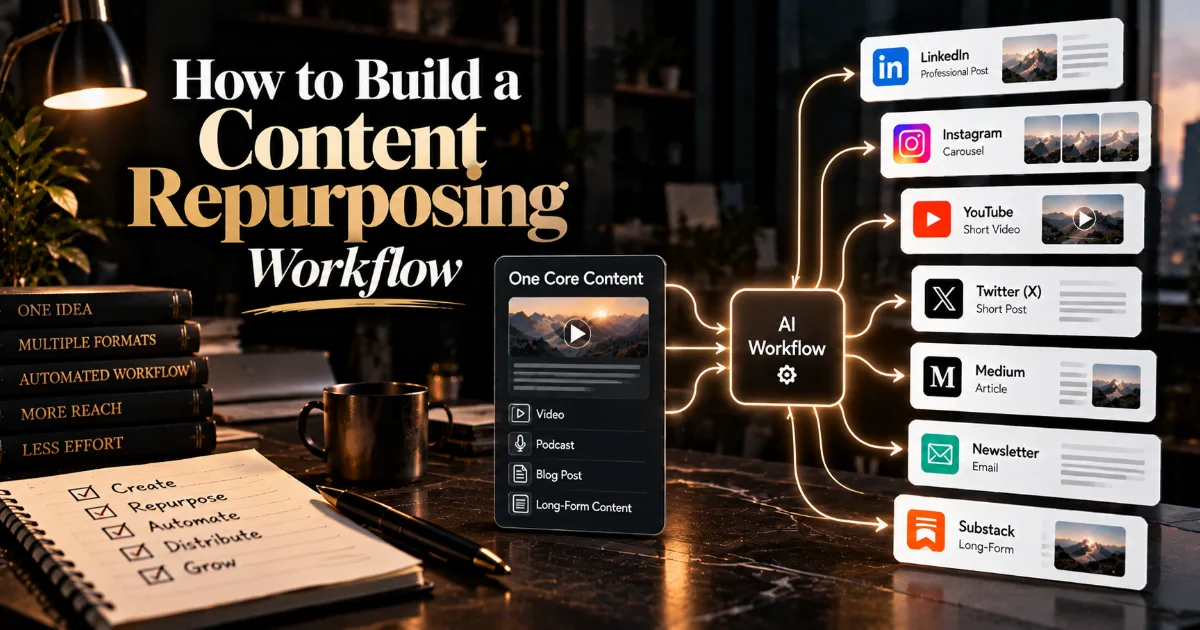
Repurposed content turns generic when the drafting step is given the source and the name of a platform, and nothing else. This is how to build a content repurposing workflow that stays specific: every version is drafted from what the business knows, a written brief for its platform, approved examples of the voice, and a check that asks whether another company could have published it. Each draft a person rejects is tagged with its reason, and the reason becomes a rule or a test case, so the same generic version cannot come back next month.
What a repurposing workflow drafts each version from
the transcript or article itself
positions, proofs, customer language
who reads and what to add
approved pieces for that platform
writes every version from all four
the position and its reason
a proof the firm owns
the customer’s own words
the reasoning the short versions cut
- How to build a content repurposing workflow that stays specific
- Why repurposed content comes out generic
- Ground every version in what the business knows
- Write each platform’s rules as a brief, not a label
- Show the voice with approved examples, not adjectives
- Check for generic before anyone reads it, and turn each rejection into a rule
- What the machine runs, and what only a person can decide
- Worked example: a workflow that drifted generic in month two
- What keeping a repurposing workflow specific costs each week
- Frequently asked questions
- Where to start
How to build a content repurposing workflow that stays specific
A content repurposing workflow stays specific when each version is drafted from five inputs rather than one: the source, the business’s own knowledge on that subject, a brief for the platform, approved examples of how the business sounds there, and a check that runs before a person opens the draft. Most workflows supply only the first. They pass a transcript to a model with an instruction such as “turn this into a LinkedIn post”, and the model does exactly that with the only material it was given. The result is accurate, tidy and interchangeable.
Where repurposing sits in a larger content system
When the workflow is working, a simple test shows it. Take any version it produced, delete the company’s name, and hand it to someone who knows the industry. If they can tell whose it is, from a position the business holds, a mistake it has watched clients make, or the words its customers use, the version is specific. If it could be any of a dozen firms, the workflow has produced filler that happens to be on topic. A specific version also earns its place beside the others: someone who follows the business on two platforms learns something different from each.
That is why repurposing works best as one layer of a larger content system rather than a reformatting job, the wider subject of our content automation guides. The layer underneath holds the knowledge and the voice, and the repurposing step draws on both every time it writes. It is the difference between a content repurposing system built from your own knowledge and a script that changes the length of a paragraph. The script produces volume from day one; only the system still sounds like the business in its third month.
This guide also assumes two other problems are already handled. Echoes and near-duplicates across platforms are covered in our guide to automating content repurposing without echoes, and splitting an idea into its parts before drafting is what content atomization is and how it works. Here the idea has been split well and the versions do not repeat each other, and they still read as though anyone could have written them.
Why repurposed content comes out generic
Repurposed content comes out generic because a language model given nothing but a source and a format falls back on the most probable way to write that format, and the most probable LinkedIn post is everyone’s LinkedIn post. Research on how chat models are trained points the same way: a study on arXiv by Robert Kirk and colleagues, Understanding the Effects of RLHF on LLM Generalisation and Diversity, found that “RLHF significantly reduces output diversity compared to SFT across a variety of measures”. The training that makes a model helpful also narrows what it tends to say.
Where a drafted version lands, by what the model was given
Everyone’s post
Only yours
- From a copyeach step loses what was distinctive
- Source and formatthe most probable version of that format
- With guidancethe model is told what to draw on
The model makers say so too. Anthropic’s guide to prompting best practices for Claude warns that “without guidance, models can default to generic patterns”, and one of its sample prompts tells the model: “You tend to converge toward generic, ‘on distribution’ outputs.” Their example is web design, but the mechanism is the same for a caption.
That middle ground has a vocabulary, and it is now measurable. Dmitry Kobak and colleagues studied over 15 million biomedical abstracts indexed by PubMed from 2010 to 2024, in a paper on arXiv titled Delving into LLM-assisted writing in biomedical publications through excess vocabulary. They found “an abrupt increase in the frequency of certain style words” once these tools arrived, and estimated that “at least 13.5% of 2024 abstracts were processed with LLMs”, which they present as a lower bound. Readers notice those words even when they could not name the study.
Workflows add a second cause by drafting each version from the one before, so every step loses a little more of what was distinctive; the fix is to repurpose from the source, never from a copy. And platforms now price generic in. YouTube renamed its “repetitious content” policy to “inauthentic content” in July 2025, and its YouTube channel monetization policies describe generic content as content “that looks like it’s made with a template”.
Ground every version in what the business knows
The first layer is a retrieval step that hands the drafting model the business’s own knowledge on this idea before it writes, because missing knowledge is the largest single cause of generic output. Anthropic’s write-up Introducing Contextual Retrieval opens on the reason: “For an AI model to be useful in specific contexts, it often needs access to background knowledge.” A webinar transcript holds what was said that afternoon. It does not hold the objection the founder hears on every sales call, or the phrase customers use for a problem nobody in the firm would use.
The knowledge entries a repurposing workflow retrieves from
- knowledge/ the entries retrieval draws from
- positions/ what the business believes, with its reason
- proofs/ a case, a figure it owns, a client mistake
- buyer-words/ the words buyers use for the problem
- boundaries/ claims the business will not make
- prompt.md the knowledge at the top, the brief below
Retrieval returns a few entries per idea, never the whole knowledge base
So the workflow keeps knowledge entries and pulls the few that match each idea. Four kinds carry most of the weight. A position is something the business believes, with its reason. A proof is a case, a figure the business owns, or a mistake it has watched clients make. Customer language is the words buyers use for the problem. A boundary is a claim the business will not make. Building and filing those entries is its own job, set out in how to organize business knowledge so it compounds; the repurposing step only needs them to exist and be findable.
Two details decide whether the entries reach the draft. The first is placement: the same Anthropic guide advises that you “Put long-form data at the top” of a prompt, so the knowledge goes above the platform brief. The second is proof of use. The guide recommends that you “Ground responses in quotes”, and a repurposing workflow can borrow that by asking the drafting step to name the entry each version draws on. A version that names none was written from the source alone.
Retrieve per idea, not per business. Pasting the whole knowledge base into every prompt buries the two entries that matter under forty that do not, and the model averages across them. If retrieval comes back empty, treat that as information rather than something to paper over; the worked example below turns on exactly that moment.
Write each platform’s rules as a brief, not a label
A platform name tells a model roughly how long to write and little else, so each destination needs a written brief that says who is reading, what this version must add that the others do not, what the opening has to do, and what never appears there. “Make it a LinkedIn post” produces the median LinkedIn post. “The reader is an operations director between meetings; this version carries the firm’s position and one proof; the first line states the position; no questions as hooks” produces something only this business would publish. A brief runs to under a page per platform and is corrected whenever a rejection shows it is wrong.
A platform brief for the founder’s LinkedIn
The LinkedIn brief, written once
- 01The reader is an operations director between meetings
- 02This version carries the firm’s position and one proof
- 03The first line states the position
- 04No questions as hooks
- 05No recycled openers, ever
The brief is also where each platform’s own rules go, in its own words. LinkedIn announced its feed would show less generic content and engagement bait, saying it is “reducing recycled and click‑driven posts”, and that line belongs in the LinkedIn brief as a ban on recycled openers. The table below is the minimum a brief has to settle for each destination.
| Destination | Who is reading, and in what state | What this version must add | What the opening has to do | Never here |
|---|---|---|---|---|
| Founder’s LinkedIn | Peers and buyers, skimming between tasks | The founder’s own position and the reason for it | State the position in the first line | A question used as a hook; a lesson with no source |
| Company page | People checking whether the firm is credible | A proof the firm owns: a case, a process, a result in words | Name the situation the proof comes from | First person singular; the founder’s opinions |
| Short video | Someone who has never heard of the business | The customer’s own words for the problem | Show the problem before the speaker | A slide of text read aloud |
| Newsletter | Subscribers who chose to hear more | The reasoning the short versions had to cut | Say why this issue exists this week | One-line paragraphs borrowed from social posts |
| Website article | A searcher with a specific question | The full answer, with the boundary stated | Answer the question in the first sentence | A teaser that withholds the answer |
The third column does the most work. If two destinations would add the same thing, one of them does not need a version of this idea, and the workflow should skip it rather than invent a difference. The last column is where rejected habits go once they have a name, which is how a brief sharpens without anyone rewriting it. Each platform has more to it than one row can hold, and our LinkedIn content guides, Shorts and Reels content guides and Substack newsletter guides go further on each one.
Show the voice with approved examples, not adjectives
A voice is taught with three to five approved pieces the business has actually published, chosen to differ from each other, because adjectives such as “confident, warm and expert” describe nearly every brand and pull the draft toward the average. Anthropic’s prompting guide is direct about which input does the work: “Examples are one of the most reliable ways to steer Claude’s output format, tone, and structure.” The same page recommends three to five and asks that they be relevant and varied, so the model learns the voice rather than copying one post’s structure.
Two ways to teach a drafting model the voice
Describing the voice
- Confident, warm and expert
- Fits nearly every brand
- One set used for every platform
- Pulls the draft toward the average
Showing the voice
- Three to five approved pieces
- Each with a sentence on why it was approved
- A small set per platform
- Shows which part to imitate
The examples have to come from the destination they teach. This mistake is easy to make and hard to see: a business has plenty of approved LinkedIn posts and little else, so those posts become the examples for everything, and the newsletter arrives in one-line paragraphs. Keep a small set per platform, and where a platform has nothing approved yet, write and approve one by hand before the workflow drafts there.
Each example earns its place with one sentence on why it was approved, such as “opens on the firm’s position about hood sizing, and names a client mistake without naming the client”, because that tells the model which part to imitate. Rejected drafts are worth keeping beside their reasons as a short “not this” set. A person’s own voice needs a fuller reference, which is how the voice reference in our LinkedIn guide is built, and a brand holding one voice across a team is covered by the word sheet and the look sheet for Instagram. Replace one example a month with a recent piece a person was proud of, so the set keeps up with the business.
Check for generic before anyone reads it, and turn each rejection into a rule
The check is a separate step that reads every draft against named criteria before a person sees it: could another company publish this, does it carry something from the knowledge entry it cites, and does it use a phrase on the banned list. Anthropic calls this shape the evaluator-optimizer workflow in its essay Building effective agents: “one LLM call generates a response while another provides evaluation and feedback in a loop”, and it works best with “clear evaluation criteria”. Generic is a fuzzy complaint; those three questions turn it into a checklist.
How a rejected draft changes the next one
the drafting step writes the version
the critic and the phrase list read it
a person approves it or picks a reason
the reason becomes a rule, an example or a test case
The first question is the swap test, and it comes from our own caption rules for LinkedIn: “If a line survives being moved to a different caption, it is filler in both.” Any sentence that would read as well under a different post or a different company’s name is marked, and a draft with more than a line or two marked goes back. The phrase list is mechanical and should not be left to a model’s judgement. Our own gate for written posts fails a draft on a fixed list of phrases that read as machine-written, and warns when softer words such as “crucial”, “furthermore” and “powerful” pass six per thousand words.
In Claude Code, Anthropic’s coding agent, both halves have a natural home. The judgement goes in a critic built as a subagent; the documentation on creating custom subagents notes that “Each subagent runs in its own context window with a custom system prompt, specific tool access, and independent permissions”, so the critic cannot be talked round by the writer’s reasoning. The phrase list goes in a hook, which the Claude Code guide to automating actions with hooks says gives “deterministic control: certain actions always happen rather than relying on the LLM to choose to run them”.
The rejections are what make it a loop. A person who rejects a draft picks a reason from a short list, such as “could be anyone”, “wrong opening”, “untrue” or “not our voice”, and the reason decides where the fix goes: a knowledge entry, a brief line, an example or the phrase list. The input behind the bad draft is saved to a test set. The documentation for n8n, the workflow automation tool, has a page called Understand why to test that describes the same practice: add the input that caused a bug to the dataset, then “run the whole dataset over the workflow again as a regression test”.
Scoring finished pieces is a related but different job, set out in how to score content quality before you publish. The generic check only asks whether a draft belongs to this business; a score asks how good it is once it does.
What the machine runs, and what only a person can decide
The machine runs retrieval, drafting, the phrase list, the critic and the regression set; a named person decides what the business believes, which pieces count as its voice, whether a draft is true, and whether a rejection should become a rule. A model can propose a knowledge entry from a transcript, but only someone inside the business knows whether that is still the firm’s position or something the founder said once and has since dropped.
Who holds the work at each stage of repurposing
- 01The machineRetrieve and draftretrieval and drafting from the knowledge entries
- 02The machineCheckthe phrase list and the critic read the draft
- 03A named personTruthdecides whether a draft is true
- 04A named personRulesdecides whether a rejection should become a rule
The split follows the consequence, not the quality of the writing. If a version claims a result the business cannot stand behind, the business carries it, so the truth check stays with a person however good the drafts become. Adding a rule is the same: it changes every future draft, and a rule written from one bad afternoon can make the workflow worse for months, so a person reads the tagged rejections before any reaches the brief.
What a person should not do is the check’s work. If the reviewer is still rewriting openings by hand in month three, the check is too loose or the brief is wrong, and the fix belongs upstream. The broader version of this line is drawn in what to automate in your content, and what not to.
Worked example: a workflow that drifted generic in month two
This example is an illustration, not a client: a small firm that designs commercial kitchens for restaurants, whose lead designer records a short walkthrough every other week on one problem, such as where the dish return should sit or why extraction hoods get undersized. The workflow, built in Claude Code with an n8n queue, turned each walkthrough into a founder’s LinkedIn post, a company page post, a short video script and a newsletter section. In the first month most drafts were approved with light edits. In the second, the reviewer began rewriting nearly every LinkedIn opening, and the posts that got through could have come from any kitchen equipment supplier.
How the kitchen design workflow went generic, and how it was found
Month one
Light editsmost drafts approved with light edits
Month two
Could be anyonethe reviewer rewrites nearly every LinkedIn opening
The trace
Tags and the retrieval logretrieval matched nothing; every voice example was a LinkedIn post
The fix
Four changeseach went into the system, not the reviewer’s routine
Nobody had to guess why, because every rejection carried a tag. Sorting the month’s tags in n8n showed most were “could be anyone”, on the LinkedIn and newsletter versions, with almost none on the video scripts. The retrieval log explained the first half. The walkthroughs had moved from layout to ventilation, and the designer spoke about “make-up air” and “capture”, while the knowledge entries on that subject were filed under the words the firm uses in proposals. Retrieval matched nothing, the drafting step wrote from the transcript alone, and it filled the gap with the industry’s average opinion.
The second half came from the examples. Every voice example was a LinkedIn post the founder had written, so the newsletter had been taught by LinkedIn and arrived in short, punchy lines. The video scripts escaped because their brief carried the customer’s own words for each problem, which was exactly what the other versions lacked.
Four changes fixed it, each in the system rather than the reviewer’s routine. In Claude Code, every knowledge entry gained a field for the other words people use for the same idea, so a walkthrough about make-up air finds the entry on ventilation. The drafting step now refuses to write when retrieval returns nothing and sends the idea to a person with the gap named. The newsletter got three approved examples of its own, written by hand that week. The swap test became the critic subagent’s first question. And the month’s rejected inputs joined the n8n test set, which now runs before any change to a prompt or brief goes live.
What keeping a repurposing workflow specific costs each week
Keeping the workflow specific costs a few hours a week from someone who knows the business well, spread across four jobs: tagging rejections, turning the tags into rules, refreshing the examples, and reading the regression run before any change ships. None can be handed to the model, because each depends on knowing what the business believes. The cost falls as the knowledge base fills and the briefs settle, then rises whenever the business changes its offer or adds a destination.
What keeping a repurposing workflow specific costs
A few
someone who knows the business well
Fewer
the check holds generic versions back
Creeps in
knowledge dates, examples age, the model changes
A judgment, not a score
The second cost is easy to miss: the check holds things back. A workflow that refuses generic versions publishes fewer of them, and some weeks a platform gets nothing because the idea had nothing new to add there. When a new piece is worth more than another version of an old one is set out in content repurposing vs content creation. Google’s guidance on using generative AI content on your website points to the rater guidelines on content with “little to no originality, and little to no added value”, a fair description of the versions the check holds back.
The last cost is decay: knowledge goes out of date, examples age and the model underneath changes, a pattern covered in why automated content stops working. Setting the workflow up is the part an AI content automation specialist can do in weeks; the weekly hours stay with the business, and they are what keep the output sounding like it.
Frequently asked questions
Why does AI-repurposed content all sound the same?
It sounds the same because the model is given a source and a format and nothing that belongs only to the business, so it writes the most probable version of that format. Adding the business’s own positions, proof and customer language to every draft is what moves it away from the average.
Do platforms penalise generic repurposed content?
Some say so in their own policies. YouTube’s monetization policies describe generic content as content that looks like it is made with a template, and LinkedIn has said its feed will show less generic and recycled content. A version that adds nothing for that platform’s audience is one those platforms want less of.
Can a better prompt fix generic repurposed content on its own?
A better prompt helps, but it cannot supply knowledge the model was never given. Instructions such as “be specific” describe a result without providing the material for it. The fix is mostly in the inputs: the knowledge entries for this idea, a platform brief and approved examples.
How many voice examples does a repurposing workflow need?
Three to five per destination is a sound start, chosen to differ from each other and taken from pieces the business approved for that platform. Fewer than three and the model copies one structure; examples borrowed from another platform teach that platform’s habits to the wrong one.
What is the swap test for generic content?
The swap test asks whether a line, or a whole draft, would read as well under a different post or a different company’s name. If it would, it is filler however accurate it is, and it should be cut or rewritten with something only this business knows.
Should a repurposing workflow skip a platform rather than publish a weak version?
Yes, when the idea has nothing to add for that platform’s readers. A brief that names what each destination must add makes the decision mechanical: no addition, no version, and the reader’s attention is spent on something worth it.
Do you need a knowledge base before you can repurpose content well?
You need a small one, not a finished one. A handful of entries per subject, each holding a position, a proof, the customer’s words or a boundary, is enough for retrieval to find something useful, and the drafts tagged “could be anyone” show where it is thin.
Where to start
Take the last ten versions your workflow produced and run the swap test on each: remove the company name, read every line, and mark the ones that would sit just as well under a competitor’s logo. For every draft with marked lines, write down which input was missing, whether knowledge, a platform brief or an example. The input that appears most often is the first one to build, and you will have found it in an afternoon without changing a single tool.
Disclosure
This post was written by Shreyas Dave, founder of Paper Eagle AI. We sell content automation services, which is the category this article is about, so we have a commercial interest in you concluding that a system beats ad-hoc effort — read it knowing that. No tool vendor was involved in writing it, nobody paid for a mention, and there are no affiliate links anywhere on this site. Where a third-party figure appears, it’s attributed to the publisher it came from; anything we couldn’t source is written as a direction rather than a number.
Paper Eagle AI builds Content Operating Systems that turn a business’s knowledge and expertise into consistent, multi-platform content, and we deliver them as content automation services. Working as a content automation specialist, we capture what a business knows and how it sounds, set the strategy, and build the workflows that research, draft, repurpose and publish — with a named person approving every piece before it goes out. Every build runs through discovery, design, build and handoff. The system lives in the client’s own accounts, it is documented, the team is trained to run it, and the business owns it outright. We don’t write content on a retainer, and we don’t build lead generation, CRM or sales automation.
One source of thinking becomes native content for every platform a business publishes on: the founder’s LinkedIn and the company page, YouTube and Shorts, Instagram and Reels, TikTok, Reddit, Medium, newsletters, and the company’s own website, written to be found in Google and understood by AI search. Our multi-platform content automation page shows how they share one source, and our case studies document the systems behind our own publishing, file by file. You can follow the work on the company’s own channels: Paper Eagle AI on Instagram, Paper Eagle AI on YouTube, the Paper Eagle AI company page on LinkedIn, Paper Eagle AI on Substack, Paper Eagle AI on Reddit and Paper Eagle AI on Medium.
Keep reading
- How to automate content repurposing without creating echoes — the six controls that stop versions repeating each other, which this guide assumes are already in place.
- What content atomization is — how to split one expert idea into its parts before any version is drafted.
- Why automated content stops working — the slow decay that turns a specific workflow generic again, and the upkeep that prevents it.