Medium Webinar Repurposing: One Transcript, Three Essays That Never Repeat
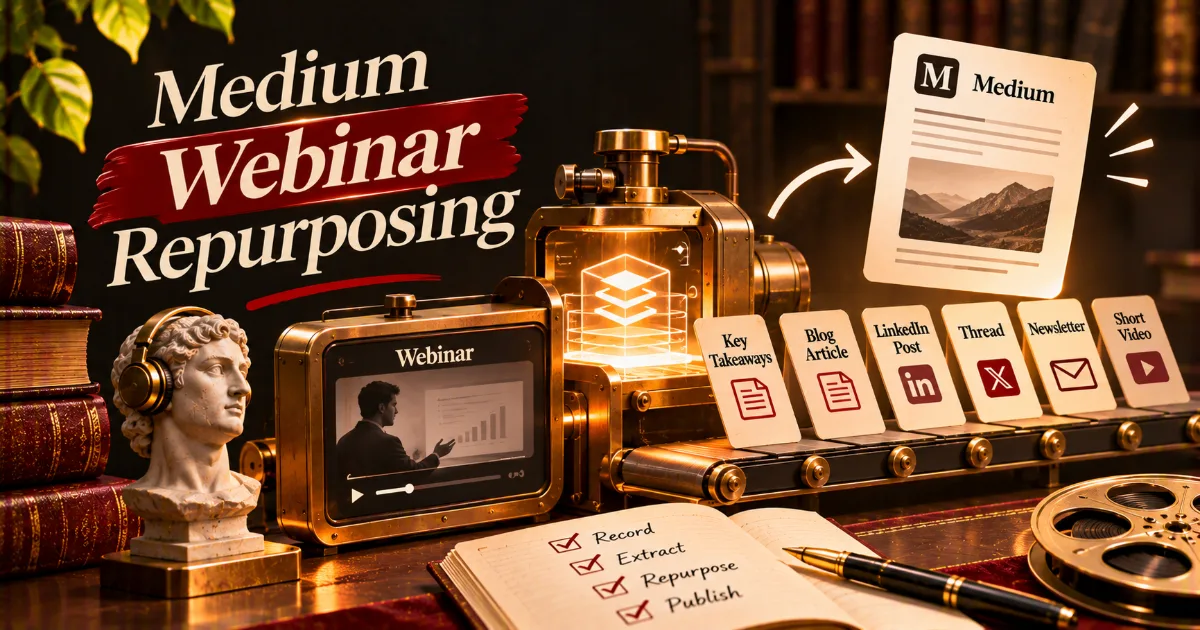
Medium webinar repurposing turns one recorded webinar into several standalone essays, each built on a separate argument the speakers made, rather than one summary of the whole hour. It starts with a clean, checked transcript, maps every argument in it with its timestamp and the evidence the speakers used, keeps only the arguments that pass a standalone test, gives each essay evidence the webinar did not have, and writes each one so it shares no passages with the others. Medium suits the essays well because each can be read on its own by someone who never saw the webinar. This post covers why a summary fails, getting the transcript, the transcript map, the standalone test, new evidence, writing without repetition, what stays human, and a sustainability consultancy turning one webinar into three essays.
How one webinar narrows to essays worth publishing
- The whole hour a checked transcript
- Every argument the transcript map
- Those that stand alone the standalone test
- Three essays each with new evidence
- Medium webinar repurposing: three arguments, three essays
- Why one webinar summary makes a weak story
- Getting a clean, checked transcript
- Mapping the arguments in the transcript
- The standalone test for each argument
- Giving each essay evidence the webinar did not have
- Writing each essay so the three never repeat
- What a model can draft, and what an editor decides
- A worked example: a sustainability consultancy's webinar
- What the work costs, and how it fails
- Frequently asked questions
- Where to start
Medium webinar repurposing: three arguments, three essays
Medium webinar repurposing is the work of finding the separate arguments inside a recorded webinar and developing each into an essay that stands on its own. A webinar is rarely one argument. A forty-minute session with two speakers and a question-and-answer segment usually contains a main claim, a practical method that supports it, a correction to a common belief, and a handful of answers to questions the audience actually asked. Each of those can carry an essay. Bundled into one post, they compete for the reader's attention and none of them is developed enough to be useful. The same webinar can also feed LinkedIn, a newsletter and short video, which is the job of a repurposing automation service built around one source.
The separate arguments inside one webinar
what the session argued
- its own title
how to act on it
- a worked example
what they were stuck on
- answered properly
The output is a small set of essays, often three, each with its own title, its own opening answer and its own evidence. They link to each other where it helps, and each links once to the business's own page on the subject. None of them is a summary of the webinar, and a reader who reads all three should never feel they have read the same paragraph twice.
It is one of the jobs behind the Medium content automation systems we build, and it sits inside the wider practice of content repurposing automation, where one recorded source feeds several platforms. The idea of splitting one source into pieces that each stand alone is covered in our guide to content atomization.
Why one webinar summary makes a weak story
A webinar summary is weak on Medium because it is written for people who did not attend, but structured for people who did. It follows the running order of the session, introductions first, then each speaker in turn, then the questions. A reader arriving from search wants the one answer they came for, and in a summary that answer is somewhere in the middle, a paragraph long, with its reasoning cut out to make room for everything else. Medium's guide to getting started with a Medium publication lists a collection of individual stories that are parts of a larger whole among the uses of a publication, which is the shape a webinar's articles take, and our Medium publication topic series guide plans one. A sales case study fails there for a similar reason, which our guide to the Medium case study article takes up.
What changes when a summary becomes essays
One webinar summaryAn essay per argument
The session’s running order
the argument’s own order
Several main points
one point, opened with
A sentence per question
the strongest question, answered
One long topical page
short pages that link
Nielsen Norman Group's guidance to be succinct when writing for the web notes that people skim rather than read onscreen, and says web text should be short, scannable and structured as linked, topical pages. A summary is the opposite: one long page covering several topics, each of which has to compete for the opening. An essay built on one argument can open with it, support it, and stop, and link to the others for the reader who wants more. Skimmers also read pictures, which is why our guide to Higgsfield AI images for a Medium article keeps only the images that clarify a section.
A summary also wastes the best material. The question-and-answer segment is often the most useful part of a webinar, because it is where the audience said what they were actually stuck on. A summary gives each question a sentence. An essay can take the strongest question, answer it properly and show the working. That difference is why three essays from one webinar usually serve more readers than one summary does, and why each essay can find its own reader through its own title.
Getting a clean, checked transcript
The transcript is the raw material, so it has to be complete and accurate before anything is mapped. Most webinar tools and video hosts can produce one automatically. YouTube's own help says automatic captions are generated by machine learning, that their quality may vary and that they can misrepresent the spoken content, so an automatic transcript is a draft that someone checks against the recording. Its guide to editing captions lets a creator correct both the text and the timestamps, which is worth doing on the published recording too. A YouTube channel recorded in regular sessions files those checked transcripts back into its knowledge base, the step a Content Operating System for YouTube is built around.
Getting the transcript ready to map
- 01Transcribean automatic first pass from the file
- 02Check meaningnames, numbers and technical terms
- 03Label speakerswho said each line
- 04Keep timestampsthey become chapters later
For a recording held as a file, a speech-to-text service can do the first pass. OpenAI's guide to file transcription describes uploading a completed recording and receiving a transcript, and a workflow can do the same with any comparable service. In n8n, the Extract From File node converts a file's contents into data the rest of the workflow can work with, which is how a transcript arriving as a document becomes text the next steps can read.
The check concentrates on the words that carry meaning: names, numbers, product and standard names, and technical terms, which are exactly the words automatic transcription gets wrong most often. Each speaker is labelled, and the timestamps are kept. If the recording is published, YouTube's guidance on video chapters asks for at least three timestamps, starting at 00:00, in ascending order, and the timestamps of the arguments found in the next step make good chapters.
Mapping the arguments in the transcript
A transcript map is a table of every argument the webinar made, one row each, with where it appears and what supports it. The columns are simple: the timestamp where the argument starts, who made it, the claim in one sentence, the evidence the speaker used, and any audience question that touched it. Reading the transcript once with only these columns in mind turns an hour of talk into a page of candidate essays.
From a topic the speakers covered to a claim
A topic
A claim
- Datawhere the speakers spent time
- Questionnaire dataa narrower subject, still no position
- Bills hold the datasomething a reader could disagree with
The rows below show four lines from the transcript map in the worked example later in this post. The timestamps and wording are illustrative, chosen to show how each column is filled in.
| Starts at | Speaker | Claim, in one sentence | Evidence used | Audience questions |
|---|---|---|---|---|
| 04:10 | First consultant | Most of the data for a first questionnaire is already in the energy bills | One anonymised bill, on a slide | Two |
| 12:30 | Second consultant | An answer should say what was estimated and how | A spoken description only | One |
| 19:45 | First consultant | The bills are where the data is kept | None; it repeats 04:10 | None |
| 31:00 | Both, in questions | Say plainly when a customer asks for a figure you do not have | None yet | Three |
The claim column is the hard one. Each claim has to be written as something a reader could disagree with, such as "most of the data for a first emissions questionnaire is already in the energy bills", not as a topic, such as "data". A topic is where the speakers spent time; a claim is what they argued. Writing claims forces the distinction, and it shows quickly which parts of the hour were arguments and which were background, introductions or repetition.
The map also shows overlap. Two speakers often make the same argument in different words, and the map puts those rows next to each other so they become one candidate rather than two. The audience questions column is often the most revealing, because a claim the audience asked three questions about is a claim readers want developed. Nielsen Norman Group's work on information scent describes how people choose what to read from the cues a link or title gives them, and the questions the audience asked are a direct record of those cues in the reader's own words.
The standalone test for each argument
An argument earns its own essay only if it passes three tests. First, a reader who never saw the webinar can understand it without the rest of the session. Second, it can be supported in more than a paragraph, with a reason, a method or an example. Third, it answers a question someone would actually ask, ideally one the audience did ask. An argument that fails any of them is either merged into a stronger one or left as a supporting point inside another essay. Each standalone article also gets its own topics, up to five under Medium's using topics page, chosen from what that article says and not from the webinar's title, by the method in our Medium article tags strategy.
The three tests an argument has to pass
Its own essay
- 01Stands aloneclear to someone who never saw the webinar
- 02Supportablea reason, a method or an example
- 03Asked fora question someone would really ask
it passes all three tests
Most webinars produce two to four arguments that pass. Fewer than two usually means the session was a single argument, and it should become one strong essay rather than a forced set. More than four usually means some of the candidates are really sub-points of a bigger claim, and the map should be redrawn with those rows merged.
The test also decides the order of publication. The argument with the broadest question goes first, because it is the one most readers will arrive on, and the later essays can link back to it. A set of three essays is not a series that has to be read in order, though. Each opens with its own answer, and the links between them are there for the reader who wants more, not as a requirement for understanding. That is also the difference from the angle testing covered in our Medium content angle testing guide, where several angles are written for the same argument. The dates themselves go into the Medium editorial calendar, one slot for each essay.
Giving each essay evidence the webinar did not have
Each essay needs at least one piece of evidence that was not in the webinar, because the webinar's own evidence was chosen to support a forty-minute talk, not a standalone argument. A speaker can make a claim in passing that an essay has to support properly. The new evidence is what turns a recorded remark into something a reader can check and rely on. Medium's best practices for journalism ask that people who act as sources are cited and identified by name, which suits a webinar's speakers, and linking the documents they mentioned follows our guide to Medium article source citations.
Where each essay’s new evidence comes from
- The business’s recordsused with permission, described honestly
- A worked examplethe steps the speaker could not fit in
- The official sourcethe guidance a claim refers to, quoted
Good new evidence comes from three places. The official source a claim refers to: the standard, regulation, documentation or guidance the speaker mentioned but did not quote. A worked example the speaker could not fit in: the actual steps, with real names for the tools and documents involved. And the business's own records, used with permission and described honestly, such as how often a question comes up with clients. Each piece is linked or attributed so the reader can see where it came from.
New evidence also keeps the essays apart. If all three essays rely on the same slide from the webinar, they will start to read alike. Giving each one its own source, its own example and its own data means each has material the other two do not, which is the most reliable way to stop three essays from one hour collapsing into three versions of the same post. Medium's plagiarism guidelines require writers to own or have permission for what they publish, and they also apply to quoting a guest speaker: their words are attributed, and quoted only with their agreement.
Writing each essay so the three never repeat
Each essay is written from its own row of the map, not from the transcript, so its structure follows its argument rather than the order of the webinar. It opens with the claim stated as an answer, supports it with the webinar's reasoning and the new evidence, deals with the strongest objection, and ends with what the reader can do. The transcript is consulted for exact wording and quotes, but it is not the outline.
How each essay is built from its own map row
Three rules stop repetition. No passage is shared between essays: when two essays need the same background, one explains it and the other links to it. Each essay's opening sentence is different in structure as well as words. And each title is distinct, describing that essay's argument rather than the webinar. Google's guidance on title links asks for descriptive, concise titles and warns against repeated or boilerplate text across pages, and three titles that all begin with the webinar's name fail that test at once.
Each essay also gets its own description and subtitle, so three previews describe three arguments, and each opens with a direct answer to its own question. Google's page on featured snippets says a page cannot be marked as one; Google's systems decide which page answers a search well enough to be shown that way, and an essay that answers one question in its first sentence is simply easier to choose than a summary that answers several halfway. When an essay is published on the website first and then republished, the duplicate-content rules described in our Medium duplicate content strategy apply to each essay separately. Each then moves through the stages in our guide to Medium publishing workflow automation, from draft to link check.
What a model can draft, and what an editor decides
A model is useful for the mechanical parts of the job and unreliable for the judgement. It can clean up a transcript's formatting, suggest a first draft of the map, and draft an essay from a map row once the argument and evidence are chosen. Anthropic's guidance on long-context prompting recommends placing a long document such as a transcript near the top of the prompt and asking for relevant quotes first, which suits this job: the model quotes each candidate argument with its timestamp before anything is drafted.
What a model drafts and what an editor decides
A model can
- Tidy the transcript’s formatting
- Quote each candidate argument with its timestamp
- Draft an essay from a chosen map row
The editor decides
- Whether the words match the recording
- Which arguments pass the standalone test
- Whether the draft says what the speaker meant
The editor decides which arguments pass the standalone test, which new evidence each essay gets, and whether a draft says what the speaker meant. Those decisions need someone who knows the subject and was ideally in the session, because a model reading a transcript cannot tell a speaker's considered view from a remark made in passing. The speakers also read the essay that carries their argument before it is published, since it now speaks for them in a form they did not write.
Medium's AI content policy allows AI-assisted writing and treats writing that is mostly generated with little editing as AI-generated: undisclosed, it is limited to the author's own network. An essay drafted with a model and genuinely rewritten by the editor is disclosed as AI-assisted, near the start of the story. A draft made this way then passes the five checks of our Medium AI editorial workflow before anyone imports it. Each factual claim in such a draft is first settled with our Medium AI article fact checking routine.
A worked example: a sustainability consultancy's webinar
A sustainability consultancy that helps small manufacturers ran a webinar on answering the emissions questionnaires their larger customers had started sending. Two consultants spoke for half an hour and then took questions. Previously the recording would have become one summary post. This time it became a transcript map and three essays. The example is a composite built to show the method, so its details are illustrative rather than a record of one client's webinar.
What the consultancy’s seven candidate arguments became
- 01Seven candidatesevery argument on the map
- 02Failed the testcould not stand alone
- 03Mergedbecame supporting paragraphs
- 04Three essayseach with new evidence
Relative, not measured
The map had seven candidate arguments. The standalone test kept three. The first essay argued that most of the data for a first questionnaire is already in the business's energy bills and fuel records, and its new evidence was the official guidance the questionnaire itself referred to, quoted and linked. The second argued that a questionnaire answer should state what was estimated and how, and its new evidence was a worked example of one estimate, step by step. The third came from the questions: what to do when a customer asks for a figure the business does not have, and its new evidence was the consultancy's own description of how it handles that conversation, written with the consultants' agreement. An interview with one founder can be mapped the same way, the approach in our guide to Medium founder thought leadership.
Each essay went up on the website first and on Medium a week apart, with distinct titles and descriptions, and each linked once to the consultancy's page on questionnaire support. The other four candidates became supporting paragraphs inside the three. The recording itself gained chapters from the map's timestamps, so a reader who wanted to hear an argument made aloud could jump to it from the essay.
What the work costs, and how it fails
The work costs most in the map and the evidence, not in the writing. Checking the transcript takes about as long as listening to the recording at speed. Building the map is a careful read. Finding new evidence for each essay is research, and it is the part most often skipped. A workflow can handle the transcription, the file handling and a first draft of the map; the Medium pricing page covers a setup built around those three.
It fails in four ways. Writing three essays that are really three summaries in a different order. Skipping the standalone test, so an essay depends on a webinar the reader never saw. Reusing the webinar's evidence in every essay, so the three read alike. And publishing a speaker's argument in words they have not seen. Each is caught by the map, the test, the evidence rule and the speaker's read, in that order.
The same recording can feed other platforms, and our guide to TikTok clips from webinars and interviews covers cutting it into short clips instead of essays. Once the essays are published, our guide to Medium content library structure covers where they sit in the archive, and our notes on keeping published stories up to date apply as soon as the guidance an essay quotes changes.
A webinar essay that describes a client's results is a case study, and the consent rules in our guide to writing a case study for Medium apply to it. The Medium hub has the guides for importing and tagging each article once it is written, and turning one recording into several formats is the core of our multi-platform content topic.
Frequently asked questions
What is Medium webinar repurposing?
Turning one recorded webinar into several standalone Medium essays, each built on a separate argument from the session, with its own title, opening answer and new evidence, instead of publishing one summary of the whole webinar.
How many essays can one webinar become?
Usually two to four. Each argument has to pass a standalone test: understandable without the session, supportable in more than a paragraph, and answering a question someone would ask. Arguments that fail are merged into stronger ones.
Can I publish the webinar transcript on Medium?
You can, but a transcript reads as talk, follows the session's running order and buries each answer. Essays built from the transcript map serve readers who never attended much better, and the transcript can stay on the website beside the recording.
Why does each essay need new evidence?
Because the webinar's evidence was chosen for a talk, not for a standalone argument, and because essays that share the same evidence start to read alike. A linked official source, a worked example or the business's own records give each essay material of its own.
Do the speakers need to approve the essays?
Yes. Each essay presents a speaker's argument in words they did not write, so they read it before it is published, and any quote from a guest speaker is attributed and used with their agreement.
Can AI write the essays from the transcript?
A model can draft from a map row once the argument and evidence are chosen, but an editor decides what passes the test and rewrites the draft. Medium asks for AI assistance to be disclosed, and mostly generated writing that is undisclosed is limited to the author's network.
Where to start
Take your most recent recorded webinar and get a checked transcript with speakers and timestamps. Build the map: timestamp, speaker, claim in one sentence, evidence, and audience questions. Run the standalone test on every row and keep the two or three that pass. For each, find one piece of evidence the webinar did not have, then write the first essay from its row, opening with the claim as an answer. Each finished essay then joins the review and import stages of a Content Operating System for Medium, where the No Duplicate Content check keeps them apart.
Disclosure
This post was written by Shreyas Dave, founder of Paper Eagle AI. We sell content automation services, which is the category this article is about, so we have a commercial interest in you concluding that a system beats ad-hoc effort — read it knowing that. No tool vendor was involved in writing it, nobody paid for a mention, and there are no affiliate links anywhere on this site. Where a third-party figure appears, it’s attributed to the publisher it came from; anything we couldn’t source is written as a direction rather than a number.
Paper Eagle AI builds Content Operating Systems that turn a business’s knowledge and expertise into consistent, multi-platform content, and we deliver them as content automation services. Working as a content automation specialist, we capture what a business knows and how it sounds, set the strategy, and build the workflows that research, draft, repurpose and publish — with a named person approving every piece before it goes out. Every build runs through discovery, design, build and handoff. The system lives in the client’s own accounts, it is documented, the team is trained to run it, and the business owns it outright. We don’t write content on a retainer, and we don’t build lead generation, CRM or sales automation.
One source of thinking becomes native content for every platform a business publishes on: the founder’s LinkedIn and the company page, YouTube and Shorts, Instagram and Reels, TikTok, Reddit, Medium, newsletters, and the company’s own website, written to be found in Google and understood by AI search. Our multi-platform content automation page shows how they share one source, and our case studies document the systems behind our own publishing, file by file. You can follow the work on the company’s own channels: Paper Eagle AI on Instagram, Paper Eagle AI on YouTube, the Paper Eagle AI company page on LinkedIn, Paper Eagle AI on Substack, Paper Eagle AI on Reddit and Paper Eagle AI on Medium. Paper Eagle AI is also listed where clients can review its work: Paper Eagle AI on Clutch, Paper Eagle AI on GoodFirms and the Paper Eagle AI Google Business Profile.
Keep reading
- TikTok clips from webinars and interviews — the same recording cut into short clips rather than essays.
- What is content atomization — the idea behind breaking one source into several pieces that each stand alone.
- Medium content library structure — where the three essays sit once they are published.