What a Content Operating System Can Still Do on X (Formerly Twitter)
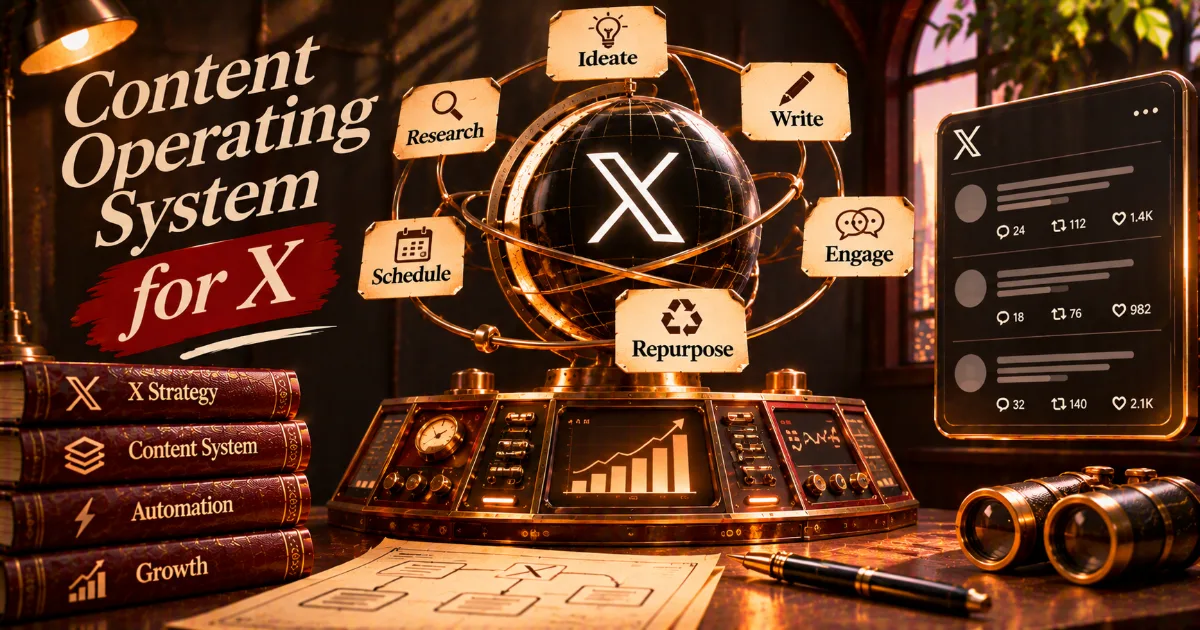
On X, the system has less to do than on any other platform, and that is the point of designing it carefully. A content operating system for X (formerly Twitter) turns what your business knows into original posts, schedules them through the API, and stops there. X’s automation rules forbid keyword auto-replies, automated likes and automatic posting about trends, and since April 2026 its pay-per-use API charges far more for a post that carries a link. Below is what the system can still do on X, what X now forbids, and what a person on your team keeps.
What an X account could automate, and what the rules leave
- posts, replies, likes, follows, reposts and trend posts Everything an account does
- original posts and posts from an RSS feed Allowed by the rules
- posts, without likes, follows or quote posts Left in the API
- original posts a person approved What the system runs
- What a content operating system for X is for
- What X’s automation rules allow and forbid
- What pay-per-use pricing changes
- Which parts of the system change on X
- What n8n can still do on X, and which tools stopped
- The weekly post workflow
- What the system posts, and what a person keeps
- Worked example: auditing a feed that auto-replied
- What an X system costs to run
- Frequently asked questions
- Where to start
What a content operating system for X is for: short original posts, on a rhythm, from what you know
A content operating system for X exists to publish short, original posts on a steady rhythm, each one drawn from something your business has actually worked out. It is not there to reply at scale, to chase what is trending, or to make an account look busier than it is. X is a conversation platform, and the conversation itself is the part a system may not run for you.
The same five parts, each made smaller for X
- 01Knowledge basesingle claims that stand alone in one short post
- 02Voice rulesa short X section that survives compression
- 03Workflowdrafts and schedules original posts only
- 04Reviewone person approves every post before it is queued
- 05Recordthe log every draft is checked against for repeats
Relative, not measured
If you have read how to build a Content Operating System from scratch, the parts are the same ones: what the business knows, written down; the rules for how it sounds; the steps that draft from that knowledge; one person who approves; and a log of every post. On X each part gets smaller and sharper. A post is short, so the knowledge base has to hold single claims that stand on their own. The voice rules have to survive compression. And the record matters more than usual, because X’s rules turn on whether posts repeat each other.
A content operating system for a business gives X the smallest job of any channel, so we build it as one part of a content operating system that starts from what your business knows, never as a place to paste the opening of every article. One idea that became a long piece elsewhere arrives on X as its sharpest sentence, written for the feed. The multi-platform guide’s section on X and Reddit as the conversation platforms explains why both reward people who answer, and why neither rewards a broadcast.
Reddit is the clearest comparison. There, a Content Operating System for Reddit publishes almost nothing and brings questions back. On X it publishes, but only the part X allows a machine to do: original posts, written from the knowledge base, scheduled through the API, with everything that touches another person left to a person.
What X’s automation rules allow, and what they forbid outright
X’s automation rules allow automated original posts and forbid automated engagement with other people. X’s Automation rules, updated in April 2026, say you may post automated posts “for entertainment, informational, or novelty purposes”, and may post from outside information “such as an RSS feed” when you are authorised to publish it. The same page says “sending automated replies to posts based on keyword searches alone is not permitted”, and “You may not like posts or hide replies in an automated manner.”
Where X’s automation rules put each kind of post
Original posts on a schedule
Posts from an RSS feed you may publish
Keyword auto-replies
Automated likes and trend posts
Across: from publishing your own posts to acting on other people’s
Up: from forbidden by X’s rules to allowed for automation
Four more lines decide what a system can be. “You may not automatically post about trending topics on X, or use automation to attempt to influence or manipulate trending topics.” You may not post “duplicative or substantially similar posts on one account or over multiple accounts you operate.” An AI that writes replies needs permission first: “the deployment or operation of any AI reply bot requires prior written and explicit approval from X.” And scripting the website instead of using the API “may result in the permanent suspension of your account.”
Replies are not banned outright. An automated reply is allowed when the person asked for it, for example by replying to your post or sending you a Direct Message, when they can opt out, and when only one reply goes per interaction. The page adds that advertisers, publishers and brands running auto-response campaigns “must request approval from X”. A follow, it notes, is not on its own an opt-in.
X’s wider policy on authenticity and platform manipulation covers the engagement side. It prohibits “engaging with posts aggressively or through the use of automation to drive traffic or attention to accounts, websites, products, services, or initiatives”, and coordinating to exchange likes, replies, reposts or follows. Read together, the two pages draw the line a Content Operating System for X is built around: the system may publish what the business wrote, and it may not act as the business in someone else’s conversation.
The rules also say what happens on a breach. X may filter an account’s posts from search results or suspend it, and it may rate limit or end a developer’s API access. X publishes no threshold for any of this, so the design question is not how far a system can go before X notices, but which actions never belong to it.
What pay-per-use pricing changes for a small business account
X’s API now charges for every request, and the price shapes what a system should post. X’s API pricing page describes pay-per-usage with “no subscriptions”: you buy credits, they are deducted as requests are made, and writes are “charged per request”. On the current table, creating a post that contains a URL costs more than thirteen times as much as creating a plain post. Reading your own data is billed as an “Owned Read”, at one fifth of the price of reading other people’s posts.
What each kind of API request costs on X, cheapest first
- 01Reading your own posts
billed as an Owned Read, the lowest read price
- 02Reading other people’s posts
billed per post returned, and capped each billing cycle
- 03Creating a plain post
charged per request, the cheapest way to publish
- 04Posting with a link
more than thirteen times the price of a plain post
The change came in steps. Social Media Today reported in October 2025 that X was moving its API to usage-based charges instead of a monthly flat fee, first as a beta. Then X’s API changelog for 16 April 2026 set the current write prices and added a line that removed three actions for most builders: “Following, Likes, and Quote-Posts via the API have been removed from all self-serve tiers.”
TechCrunch covered what the link price did in practice. Its report that X made posting links through its API more expensive quotes X describing the change as a way to curb spam and “vectors of misuse”, and notes that the aggregator Techmeme stopped putting links in its posts that week. For a business, the lesson is narrower than it looks. A system can still post a link; it just has to be worth it, and most posts should carry the whole point in the text.
Two more limits from the pricing page are useful. You can set a spending limit, and when it is reached “API requests will be blocked until the next billing cycle”, which is how a small account keeps a runaway workflow from becoming a bill. And reads are deduplicated within a UTC day, so a workflow that checks its own recent posts several times a day is not charged for each check. We write no prices here; X content automation pricing sets out what the build costs, and X’s own console is where the API rates live. A website's Search Console API has published limits of its own, and staying inside them is built into our Content Operating System for website SEO.
Which parts of a Content Operating System change on X, and which stay the same
Most of the system is unchanged on X; what changes is the size of each piece and where the system stops. The knowledge base, the voice rules and the review step are the same parts that run every other channel. The distribution step shrinks to scheduling original posts, and every action aimed at another account leaves the system entirely.
Six parts of the system, on most platforms and on X
Most platformsOn X
Knowledge base
topics and answers a piece can draw on
single claims that stand alone in a short post
Voice rules
tone for long and short forms
rules for compression, one idea per post
Workflow
draft, repurpose and publish
draft and schedule original posts only
Review
a person approves each piece
a person approves each post and checks it for repeats
Record
what was published, where and when
also the duplicate check against earlier posts
Engagement
often partly assisted
entirely a person, every reply, like and follow
| Part of the system | On most platforms | On X |
|---|---|---|
| Knowledge base | Topics, answers and examples a piece can draw on | Single claims that stand alone in one short post, each with its source note |
| Voice rules | Tone, vocabulary and structure for long and short forms | Rules for compression: one idea, no thread filler, no hashtags that add nothing |
| Workflow | Draft, repurpose, publish | Draft and schedule original posts only; no replies, likes or follows |
| Review | A person approves each piece | A person approves each post, and checks it against the record for repeats |
| Record | What was published, where and when | Also the duplicate check: no post substantially similar to an earlier one |
| Engagement | Often partly assisted | Entirely a person: replies, likes, follows, reposts of others |
The record deserves the most attention. On most channels it is a log; on X it is a control, because the rule against “substantially similar posts” applies to one account over time, not only across accounts. A system that rewrites the same idea every fortnight is building toward exactly the pattern the rule names, so the record has to be checked before a draft reaches the reviewer. Keeping that record current as the account and its rules change is part of keeping a Content Operating System from going stale.
What n8n can still do on X, and which tools stopped
Of the three automation tools most businesses use, only n8n still connects to X. n8n’s X (Formerly Twitter) node can create a post or a reply, delete a post, search posts, like and retweet, create a Direct Message, get a user and add a member to a list, and it can be handed to an AI agent as a tool. Its X integration page shows how it joins the rest of a workflow. The node uses your own X developer credentials, so every request is billed to your credits. The platforms most businesses start with are a different picture, and what n8n can publish for a business goes through them node by node.
Which automation tools still reach X, in date order
August 2023
Zapier stopsZapier says its Twitter integration stopped working after the API pricing change
April 2025
Make removes XMake’s release notes remove the X app; scenarios ran until 30 May 2025
April 2026
Self-serve narrowsX removes likes, follows and quote posts from self-serve API access
November 2026
n8n remainsn8n’s X node still creates posts with your own developer credentials
Zapier stopped first. Its Twitter integration page says that “due to Twitter’s decision to change its API policy and pricing, Zapier’s current Twitter integration has stopped working (effective August 31, 2023)”, and Zapier’s help centre posted a notice on the Twitter integration removal. Make followed: its 2025 release notes say “the X (formerly Twitter) app integration is removed due to API policy and pricing”, and existing scenarios ran until 30 May 2025.
A node that can do something is not permission to do it. n8n’s X node can like a post, but X’s rules forbid liking in an automated manner, and the April 2026 changelog removed likes from self-serve API access anyway. The node can reply, but keyword-triggered replies are banned and AI reply bots need X’s written approval. So the honest list of what a system does with n8n on X is short: create original posts, read its own recent posts and mentions, and hand those mentions to a person.
One newer route is worth knowing. X’s changelog for 10 November 2026 added a read-only mode for X’s server for the Model Context Protocol, which leaves out every tool that posts, sends messages or changes anything, “even if your token has write scopes”. For research, that is the safest way to let an AI assistant read X: it can look, and it cannot act. Our news analysis of X’s read-only MCP mode for a research agent shows how to set up that reading connection apart from any step that posts.
The weekly post workflow, from one knowledge entry to a scheduled post
The workflow runs once a week and ends with a short queue of approved original posts, each scheduled through the API. It starts from the knowledge base, not from the feed. A person picks the week’s three or four ideas from entries that have not been used on X, the system drafts a post for each, and a reviewer approves, edits or drops them before anything is scheduled.
One week of X posts, from knowledge entry to schedule
- 01Knowledge entrya person picks an idea never used on X
- 02DraftClaude Code writes the post from the voice file
- 03Record checkthe draft is compared with every earlier post
- 04Approval pausethe Wait node holds it until a reviewer decides
- 05Scheduled postthe approved post is queued through the API
Drafting uses the same voice file as every other channel, with a short X section added. In Claude Code that file is loaded at the start of every session, which is how Claude Code’s project memory works, so the draft starts from your rules rather than from a fresh prompt. Each draft comes back as named fields rather than free text, using structured outputs: the post, the knowledge entry it came from, whether it needs a link, and the record entries it is closest to. How the drafting fits a wider build is covered in Claude Code for content automation.
The approval step is a pause in the workflow, not a message someone might miss. n8n’s Wait node holds each draft until a reviewer responds, and n8n’s own guide to human-in-the-loop automation sets out the same pattern: the machine prepares, a person decides. We keep the X workflow small and separate from the others, the approach in content automation with n8n, so a failure on X never blocks the rest of the system.
Two checks run before a draft reaches the reviewer. The first compares it with the record and flags any earlier post that makes the same point in similar words. The second asks whether the link earns its cost; most posts should say the whole thing in the text. Originality matters on X for a second reason too: TechCrunch reported that X replaced its revenue sharing with Original Content Rewards, and that posts copied from another account or reposted “without meaningful transformation” do not count as original.
What the system posts to X, and what a person keeps
The system posts original posts that a person approved, and nothing else; every interaction with another account stays with a person. That line comes from X’s own rules, not from caution. Replies, likes, follows, reposts of other people’s posts and Direct Messages are all either forbidden to automation, restricted to people who opted in, or removed from self-serve API access.
What the system does on X, and what stays with a person
the system publishes, a person engages
original posts from the knowledge base
every reply, in their own words
approved posts through the API
likes, follows and reposts of others
its own recent posts and mentions
whether to say anything about the news
- The system drafts and schedules: original posts from the knowledge base, each approved before it is queued, each checked against the record for repeats.
- The system reads: its own recent posts and the mentions they drew, so a person sees what needs an answer.
- A person replies: every reply, in their own words. A suggested reply can be drafted for them to rewrite, but it is never sent by the system.
- A person engages: likes, follows, reposts and quote posts. X forbids automated likes and has removed likes, follows and quote posts from self-serve access.
- A person decides on trends: X forbids automatic posting about trending topics, so whether to say anything about the day’s news is never the system’s call.
This is the same principle as what to automate in your content, and what not to, applied to the strictest platform. Judgement about other people stays human everywhere; on X the platform has written it down. A team that wants help answering at volume should ask X about its AI reply bot approval first, because a bot built without it breaks the rules from its first reply. LinkedIn writes it into its User Agreement rather than a separate automation page, and the Content Operating System for LinkedIn follows the same split on a founder's profile.
Worked example: auditing a feed that auto-replied by keyword
Take an illustrative business, not a client: a small company that sells inventory software to restaurants. Its X account was set up by a previous agency, and the feed has three parts. There are announcement posts copied from the company blog with a link in every one. There is a weekly “tip” that is the same five tips in rotation. And there is an automation that replies to any post mentioning “food waste” or “stock count” with a line about the product.
One restaurant software feed, sorted by the audit
breaks X’s rules or repeats itself
- keyword replies
- rotating tips
useful, but leans on a link
- announcement posts
the founder’s own answers
- the voice model
An audit sorts each part into keep, rewrite or retire, the same way a content audit sorts an archive. The keyword replies are retired first, and today, because they are exactly what X’s rules name: automated replies “based on keyword searches alone”, to people who never asked. The rotating tips are retired as well. Five tips posted in turn are substantially similar posts on one account, and they would not survive the record check.
The announcement posts are rewritten. Each one becomes a post that states the useful fact in the text, a supplier lead time that changed or a count that takes ten minutes instead of an hour, with a link only when the reader genuinely needs the page. What gets kept is the small number of posts where the founder answered a question in their own words; those become the model for the voice file’s X section.
The new system then starts from the knowledge base the company already had for its blog. Each week a person picks three entries never used on X, the system drafts one post per entry, the founder approves them in one sitting, and n8n schedules them. Mentions are collected into a short list each morning for the founder to answer. The account posts less than it did, and everything it posts is something only this company could have said.
What an X system costs to run, in time and in API credits
An X system costs a reviewer’s time each week, a person’s time for replies, and API credits for every request it makes. The review is short because the posts are short: approving three or four drafts takes one sitting. Replies take longer and vary with how many people answer, which is the part of X worth the time.
Where the running cost of an X system goes
Running cost
- Replies a person’s time answering mentions
- Review one sitting to approve the week’s drafts
- API credits requests billed under a spending limit
Rough shares — a shape, not a measurement
The credits are real money, so the build includes a spending limit from day one and keeps reads of other people’s posts to a minimum. Reading your own posts and mentions is billed at the lower Owned Read rate, and a post without a link costs a fraction of one with a link. X’s Developer Console holds the current rates, and the pricing page warns that they are subject to change, so a system checks them rather than assuming them. The build itself is quoted on our X pricing page, and what content automation services cost explains what drives a scope up or down.
X also pairs naturally with a newsletter, because a post can carry the sharpest line of an issue. A Content Operating System for Substack covers that channel, and Substack newsletter pricing shows the pair from the newsletter’s side. Running several channels from one source is what multi-platform content automation is for.
The less visible cost is patience. An X account that stops auto-replying and posts three original posts a week will look quieter at first. That is the trade the rules force, and it is worth measuring honestly; how to measure whether a content system works sets out which signals to watch instead of follower counts.
Frequently asked questions
Can a Content Operating System reply to people on X automatically?
Only in narrow cases, and not with AI unless X approves it first. X’s automation rules forbid automated replies based on keyword searches alone and allow an automated reply only to someone who opted in, with an easy opt-out and one reply per interaction. Any AI reply bot needs X’s prior written approval, so in our builds a person writes every reply.
Can scheduled X posts be drafted with AI and published through the API?
Yes, as long as each one is original and a person approves it. X allows automated posts for informational purposes and posts drawn from outside sources you are authorised to publish. It forbids duplicative or substantially similar posts, so the system checks every draft against what the account has already posted.
Why does a post with a link cost more to publish through X’s API?
X priced it that way in April 2026. Its pricing page lists a post containing a URL at more than thirteen times the price of a plain post, and TechCrunch reported X describing the change as a way to curb spam. A system therefore puts the point in the text and adds a link only when the reader needs it.
If n8n’s X node can like and retweet, can the system use those actions?
No for likes, and rarely for reposts. X’s rules forbid liking posts in an automated manner, and its April 2026 changelog removed likes, follows and quote posts from self-serve API access. Automated reposts are allowed for informational purposes but bulk reposting breaks the rules, so we leave engagement to a person.
Which automation tools still connect to X after the API changes?
Only n8n, of the three most businesses use. Zapier’s Twitter integration stopped working on 31 August 2023 after the API pricing change, and Make removed its X integration in 2025, with existing scenarios running until 30 May 2025. n8n still has an X node, which uses your own developer credentials and credits.
What happens to an X account that breaks the automation rules?
X may filter its posts from search results or suspend it, and it may rate limit or end the developer’s API access. Scripting the X website instead of using the API can lead to permanent suspension. X publishes no threshold for when this happens, so the system is designed never to take the actions the rules name.
Where to start
Start with an audit of what your X account already does automatically. Turn off anything that replies, likes or follows on its own, and anything that posts about trends, before you build anything new. Then list the ten things your business knows that a reader on X would stop for, and write them as single claims in a knowledge base.
From there the system is small: a voice file with an X section, a weekly drafting run, a record that catches repeats, an approval pause, and a schedule. Our guides to Content Operating Systems cover the parts in depth, and LinkedIn, YouTube and Instagram are the channels where a system can do more; content automation for LinkedIn, YouTube and Instagram shows how the same knowledge base feeds them. On YouTube the system grows rather than shrinks, because it plans around the expert's recording sessions, as our Content Operating System for YouTube shows.
If you would rather have the system built, the call is about your knowledge and your rules, not a template. Book a 30-minute call and we will look at your account with you, decide what the system should post, and agree what stays with your team.
Disclosure
This post was written by Shreyas Dave, founder of Paper Eagle AI. We sell content automation services, which is the category this article is about, so we have a commercial interest in you concluding that a system beats ad-hoc effort — read it knowing that. No tool vendor was involved in writing it, nobody paid for a mention, and there are no affiliate links anywhere on this site. Where a third-party figure appears, it’s attributed to the publisher it came from; anything we couldn’t source is written as a direction rather than a number.
Paper Eagle AI builds Content Operating Systems that turn a business’s knowledge and expertise into consistent, multi-platform content, and we deliver them as content automation services. Working as a content automation specialist, we capture what a business knows and how it sounds, set the strategy, and build the workflows that research, draft, repurpose and publish — with a named person approving every piece before it goes out. Every build runs through discovery, design, build and handoff. The system lives in the client’s own accounts, it is documented, the team is trained to run it, and the business owns it outright. We don’t write content on a retainer, and we don’t build lead generation, CRM or sales automation.
One source of thinking becomes native content for every platform a business publishes on: the founder’s LinkedIn and the company page, YouTube and Shorts, Instagram and Reels, TikTok, Reddit, Medium, newsletters, and the company’s own website, written to be found in Google and understood by AI search. Our multi-platform content automation page shows how they share one source, and our case studies document the systems behind our own publishing, file by file. You can follow the work on the company’s own channels: Paper Eagle AI on Instagram, Paper Eagle AI on YouTube, the Paper Eagle AI company page on LinkedIn, Paper Eagle AI on Substack, Paper Eagle AI on Reddit and Paper Eagle AI on Medium. Paper Eagle AI is also listed where clients can review its work: Paper Eagle AI on Clutch, Paper Eagle AI on GoodFirms and the Paper Eagle AI Google Business Profile.
Keep reading
- Can a Content Operating System run Reddit without breaking its rules? — the other conversation platform, where the system publishes almost nothing.
- A Content Operating System for Substack has to pass Substack’s purpose test — the newsletter an X post can point to.
- What to automate in your content, and what not to — the general line X’s rules write down.