What to Automate in Your Content, and What Not To
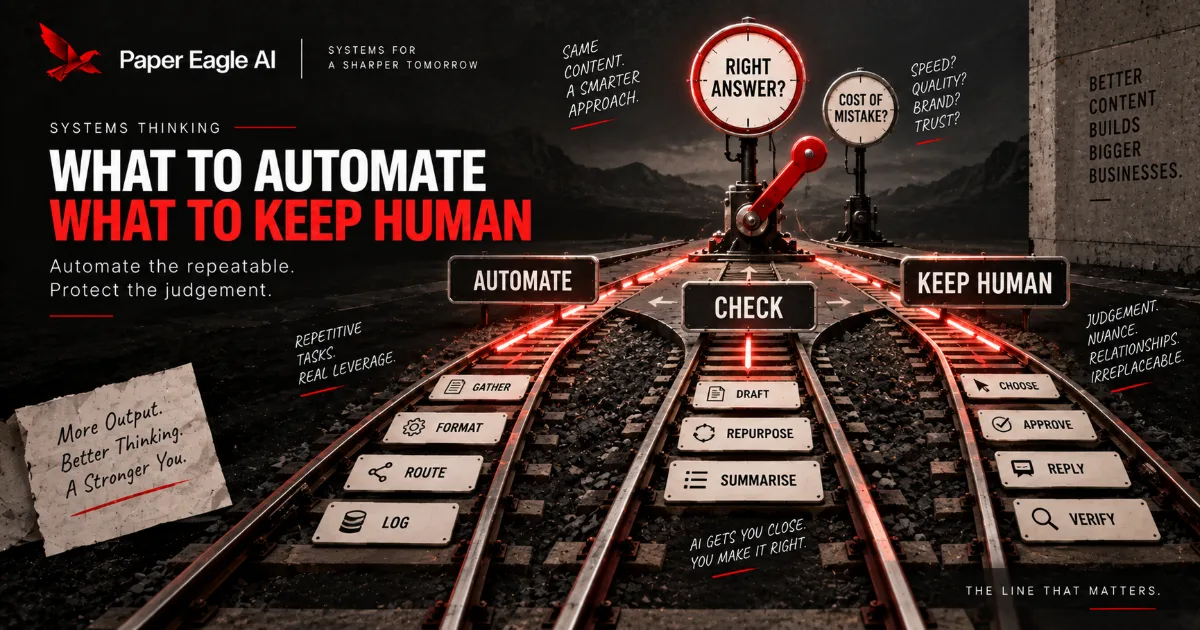
Almost every conversation about content automation starts with the wrong question. "How much of this can we automate?" invites an answer on a scale from a little to everything, and the number you land on has almost nothing to do with whether the result is any good. The better question is smaller and much easier to answer: which of these steps has a right answer, and which one is the reason anybody reads us at all. Once those two are separated, the line draws itself — and it turns out to fall in roughly the same place for nearly every business.
One content pipeline, with the line drawn through the middle, as a board in n8n
Gather the source, the brief, last quarter's numbers
Shape format, resize, cut, caption, schedule
Send and log route to each destination, record what went out
Choose what is worth saying this week, and why
Approve the last gate before anything carries your name
Respond the reply to a real person, written by a person
The two lanes interleave in one workflow — and the middle node on the right is the only one that must never be removed, whatever else changes
- Why "how much" is the wrong question
- The four questions that place any step
- What should always be automated
- What should never be
- The grey middle, where most of the value is
- Why a machine cannot hold the standard
- A worked example: one idea, five destinations
- What keeping a person in honestly costs
- Draw the line once, and write it down
- When the line legitimately moves
- Frequently asked questions
Why "how much" is the wrong question
Asked as a quantity, the automation question produces two bad answers and no good one. Answer it low and you have bought a slightly faster version of doing everything by hand, which is where most teams stall — a few templates, a scheduler, and the same person still writing everything at eleven at night. Answer it high and you produce a great deal of content that is fluent, on-time, and indistinguishable from what a competitor using the same tools is producing. Neither of those is a system.
Google draws the line in the same place and says so plainly: appropriate use of AI or automation is not against its guidelines unless it is used to generate content primarily to manipulate rankings (Google Search Central, 2023) — which its spam policies then name as scaled content abuse, generating many pages that add no value for anybody, no matter how they were made.
The reason the quantity framing fails is that steps in a content workflow are not more or less automatable along a single scale. They differ in kind. Resizing an image and deciding what this week's article should argue are not the same activity performed at different difficulties — one has a correct answer that can be specified in advance and the other does not, and no amount of capability collapses that distinction.
So the useful axes are not "easy to hard". They are whether the step is repeatable, and what a mistake in it costs. Those two produce four groups, and each group has a different right answer that stays right as the tools improve. Design is the clearest example of a group that does not move: an AI that cannot see its own output cannot tell you whether the output looks right.
There is a second reason the quantity framing is worth resisting, and it is about what gets reported. A percentage is a number somebody can be proud of, so it becomes the thing measured — and once "how automated is it" is on a slide, every remaining human step looks like debt to be paid down. Nobody ever set out to remove the approval step; they set out to raise a number, and the approval step was the cheapest place to find it. Framing the question as a line rather than a percentage removes the incentive entirely, because a line has a correct place and moving it in the wrong direction is visibly wrong rather than visibly progress.
Repeatable, against what a mistake costs
Repeatable · cheap to get wrong
Automate it entirelyFormatting, resizing, scheduling, routing, logging. Nobody should be doing these by hand.
Repeatable · expensive to get wrong
Automate, then checkDrafting, repurposing, summarising. A machine does the pass; a person signs it off.
Not repeatable · cheap to get wrong
Do it by hand, quicklyOne-off experiments, a reply to a comment, a post about something that just happened.
Not repeatable · expensive to get wrong
A person, alwaysWhat is worth saying, what you claim, and anything a real human is waiting on.
Left column: it happens the same way every time
Top row: a mistake is cheap
The four questions that place any step
In practice you do not need the grid. Four questions, asked in order, place any step in a content workflow, and the first one you answer yes to decides it. This post answers what to hand over; if you also need the build order — source, standard, workflow, then automation — that is how to automate content creation, taken layer by layer.
Does this step have a right answer? If a competent person following your written standard would produce the same result every time, it is mechanical, and a machine should be doing it. Resizing to a platform's dimensions has a right answer. Choosing this week's subject does not.
Would a mistake be visible before it reached anybody? If a bad output is obvious in the workflow — a missing image, an empty field, a broken link — automate freely, because the failure announces itself. If a bad output is fluent, plausible and wrong, a person has to look, because nothing downstream will catch it.
Does it need something that is not written down? If the step depends on knowing that a particular client is sensitive about a word, or that you stopped offering something last month, the honest answer is to write that down first. Then the question changes: once it is written, the step may well become mechanical, and that is the most common way work moves across the line legitimately.
Is this the part that makes it yours? The judgement, the opinion, the example only you have, the thing you refuse to say. If yes, it stays with a person permanently — not because a machine could not produce something in its place, but because what it produces would be the thing everybody else is publishing. It's the belief our own agency is built on, and we set it out in why the best content automation agency leaves this part to you.
The four questions, asked in order, on any step
- 01Right answer?yes → automate it
- 02Mistake visible?no → keep a check
- 03Needs the unwritten?yes → write it down first
- 04Is it yours?yes → a person, permanently
What should always be automated
This list is longer and duller than most people expect, and it is where nearly all of the recovered time actually comes from. None of it is glamorous, none of it involves a model writing anything, and all of it is work a person is currently doing badly because it is boring.
Gathering: pulling the source material a brief needs, collecting last month's numbers, fetching the transcript. Shaping: reformatting one piece for a platform's requirements, resizing, cutting a long recording into clips, generating the caption structure. Moving: routing each output to where it goes, scheduling it, posting it. Recording: logging what went out, when, in what form, produced from which source. Watching: noticing that a source page is past its review date, that a step returned nothing, that volume has dropped.
Two things are worth noticing about that list. Every item has a right answer, so a machine is not merely faster at it — it is more accurate, because it does not get bored. And not one of them is the part anybody enjoys, which is why the honest pitch for automation is not that it replaces writers; it is that it deletes the two hours around the writing.
Mechanically, all five categories start at the same place — an event that says there is something to do. Every tool in this space calls it the same thing and builds the workflow around it, whether that is setting up a trigger in Zapier or a schedule in n8n. That is worth saying because it makes the list cheaper than it sounds: the hard part is deciding what belongs on it, not wiring it up.
The test for "automate this entirely", stated field by field
- The rule can be written
- In a sentence somebody else could follow without asking you
- The output is checkable
- Right or wrong is obvious at a glance, not a matter of opinion
- Failure is loud
- When it goes wrong it stops, rather than continuing plausibly
- Nobody enjoys it
- Not a requirement, but a very reliable indicator
- The test
- You would be annoyed to find a person still doing it by hand next year
What should never be
Four things, and the list is short on purpose. A long list of exceptions is how a system ends up automating nothing; a short one is defensible.
Deciding what is worth saying. A model can generate a hundred topics and will happily rank them. What it cannot do is know that a client asked something difficult on Tuesday and the honest answer is worth an article. The best content any business publishes almost always comes from something that happened, and nothing in a workflow knows what happened to you.
The final approval. Not a review step somewhere in the middle — the last gate before something carries your name in public. It takes a minute, it is the cheapest insurance in the system, and it is the first thing dropped when the workflow has been reliable for a while.
Replying to a real person. An automated reply that reads as though you wrote it is worse than no reply, because the person finds out eventually, and what they find out is that you were willing to fake a conversation. This is the one line where the cost of crossing it is not quality but trust.
Any claim you have not checked. A statistic, a result, a client outcome, a comparison with a competitor. A model will produce a confident number with a plausible source — hallucination is a named, surveyed failure mode of text generation rather than a rare glitch (Ji et al., 2022), and Anthropic’s own guidance on reducing it is to let the model say it does not know and to make every claim carry a quote (Anthropic). That number is the single most expensive thing that can appear under your name.
The list is four items rather than fourteen on purpose, and it is worth saying why. A long list of exceptions reads as caution and functions as paralysis: every step has a plausible reason to keep a person on it, so nothing gets automated and the system never arrives. Four is short enough to remember without looking it up, short enough that nobody can claim they forgot, and short enough to defend in a meeting where somebody is arguing for speed. Anything you would add to it is almost certainly a grey-middle step that wants a check rather than a permanent human owner, and the two are not the same commitment.
The same workflow, with and without the four kept steps
Fully automated, end to end
- Topics chosen by pattern, so they read like everyone else's.
- Nothing checked, so a wrong claim publishes at full speed.
- Replies that sound like you until somebody looks twice.
- Volume up, and no reason for anyone to choose you.
Automated, with four steps kept
- Topics come from what actually happened this week.
- A minute of reading stands between a draft and your name.
- Replies are short, late sometimes, and genuinely from you.
- Volume up, and the reason to choose you is intact.
The grey middle, where most of the value is
Between "always" and "never" sits the interesting part: drafting, outlining, repurposing one piece into another shape, summarising research, proposing headlines. These are genuinely repeatable and genuinely consequential, and the answer for all of them is the same — the machine does the pass, a person makes the call. The pattern is common enough to be built in: n8n calls it human-in-the-loop, where the workflow pauses and a person approves or denies before the step runs (n8n Docs).
What makes this work is being precise about what the machine is being asked for. A first draft is not a publication; it is a starting position that saves the worst forty minutes of the job, which is the blank page. A set of ten headlines is not a decision; it is a menu. Repurposing a long piece into five short ones is a transformation with a right answer if the standard is written down, and a mess if it is not.
The failure in this band is always the same and it is not a technology failure. Somebody starts treating the pass as the output. The draft goes out because it was fine, and the next one goes out because the last one was fine, and three months later the person who was supposed to be deciding has become a person who clicks approve. That is not a decision anyone made; it is what happens when the standard exists only as an intention.
What makes a draft usable rather than a starting point you throw away is almost entirely the standard it was drafted against, and standards fail in a predictable way: they get written as adjectives. "Clear, confident, human" is not a standard — three different people will produce three different things from it and all of them can argue they complied. What works is specifics that can be checked. Sentence length you actually use. Words you refuse, with the reason. How you handle a claim you cannot fully support. Whether you open with the problem or the conclusion. Half a day writing that down is worth more to draft quality than any amount of prompt engineering on top of a vague one.
What the machine hands over, from raw to finished
Why a machine cannot hold the standard
It is worth being precise about this rather than gesturing at creativity, because "AI cannot be creative" is both unfalsifiable and beside the point. The practical problem is narrower and much easier to state: a model has no stake in the outcome.
Judgement is not only the ability to tell good from bad. It is being the one who has to live with having got it wrong — the one who takes the call from the client, who explains the claim that turned out to be false, who notices six months later that the writing has drifted somewhere they do not want to be. A system can be given a standard and will apply it consistently. It cannot notice that the standard has become the wrong standard, because noticing that requires caring how it turns out.
That is why the four never-automate steps are the four they are. Each one is a place where somebody has to be accountable, and accountability is not a capability you can add to a workflow. It is the honest limit of AI automation, and stating it plainly is more useful than either of the two things the category usually does — promising it away, or pretending the whole thing is a threat.
Nor is it only an internal concern. Google's guidance asks publishers to make it self-evident who authored a piece — a byline that leads somewhere, rather than a name — and to be straightforward about how it was produced. A named person satisfies that and a workflow structurally cannot, because the question is asked of whoever is answerable for the page. What a workflow can hold is the written standard that person decided on, which is the job content scoring exists to do.
One accountable person, and what actually attaches to them
named, and not the tool
a judgement about this week, not a pattern
checkable, and somebody has to check
only visible across a quarter
the one thing no standard can contain
A worked example: one idea, five destinations
Concretely, here is where the line falls in a workflow we would actually build. One idea becomes an article, two short posts, a video script and a newsletter section. Eleven steps, and the split is not close.
Wednesday · one idea, taken to five destinations
- >The idea is the refund conversation from Tuesday. Build the brief and draft the article against the voice guide.
- ·Reading the voice guide and four source pages. Eleven steps: seven mechanical, four need you.
- +Brief built from the source, draft written, five destination formats generated.
- ·Waiting on you: the draft asserts a number about industry refund rates. I did not find it in your sources.
- >Cut the number. Say "most of the ones we see" instead, and leave the rest.
- +Cut. Queued for your approval — nothing publishes until you press it.
- Elapsed · about forty minutes · seven steps automated, four kept, one invented statistic caught
What keeping a person in honestly costs
Roughly ten minutes a working day, and it is worth naming it because the alternative pitch — full automation — is really a pitch to not spend those ten minutes.
Choosing the week's subjects is twenty minutes once a week, and it is the highest-leverage twenty minutes in the whole system. Approving what goes out is a minute or two per piece. The edit that makes a draft yours is usually five to ten minutes and gets faster as the standard gets more precise. Checking a claim takes as long as it takes and is not negotiable.
Against that, the automated half removes hours — the gathering, the reformatting, the resizing, the scheduling, the routing, the logging. The exchange is heavily in your favour and it is worth stating in those terms, because the interesting question was never how much time you save. It is which time you save.
What a week looks like as the line settles
Before anything is automated
All of it is yoursGathering, writing, reformatting, scheduling, chasing. The writing is maybe a fifth of it.
The first month
The mechanical half goesGathering, formatting, routing and logging stop being anybody's job. The hours come back immediately.
Months two and three
The grey middle settlesDrafts arrive good enough to edit rather than rewrite, as the standard gets written down properly.
Steady state
Ten minutes a day, and the choosingTwenty minutes a week deciding what is worth saying, and a minute per piece before it goes out.
Draw the line once, and write it down
Make this a decision rather than a habit, because a habit erodes and a written decision has to be argued with. It takes about an hour: list the steps, run the four questions down them, and write two lists with a sentence each on why. Keep it beside the workflow rather than in somebody's head.
Then give the never list a name against it, so there is somebody whose job it is to notice when a step has quietly crossed over. In most businesses that is the founder for the first year and somebody else after that, and the handover of that specific responsibility is worth doing deliberately rather than by drift.
Every step in the content week, divided once
right answer, loud failure, nobody enjoys it
- Gather
- Format
- Route
- Log
repeatable, but expensive to get wrong
- Draft
- Repurpose
- Summarise
a judgement somebody has to answer for
- Choose
- Approve
- Reply
- Verify
| The step | Who does it | Because |
|---|---|---|
| Gathering the source and the brief | Machine, entirely | Right answer, loud failure, nobody enjoys it |
| Choosing what to say this week | Person, always | Depends on what happened, which nothing else knows |
| The first draft | Machine, then a person | Repeatable against a written standard, expensive if wrong |
| Any claim or number | Person, always | Fluent and wrong is the worst possible failure mode |
| Reformatting for each platform | Machine, entirely | A specification, not a judgement |
| The last look before publishing | Person, always | A minute, and it is the cheapest insurance in the system |
| Scheduling, routing, logging | Machine, entirely | More accurate than a person, because it does not get bored |
| Replying to a real person | Person, always | A faked conversation costs trust, not quality |
When the line legitimately moves
The line is not fixed forever, and treating it as sacred is its own mistake. It moves in one direction honestly and in one direction dishonestly, and the difference is easy to state.
It moves honestly when something that was in somebody's head gets written down. Doing that deliberately, and building the workflow on top of it, is the whole job of a content automation specialist. A step that needed a person because it depended on unwritten knowledge becomes mechanical the moment that knowledge is a document. That is the most common and most valuable kind of progress in a content system, and it is why the third question in the test is the one worth asking hardest.
It moves dishonestly when a step is dropped because the workflow has been reliable and nobody has been burned recently. That is not a decision that the step is unnecessary — it is the absence of a decision, and it is exactly how a system that produced good work in month one produces embarrassing work in month nine. If the line is moving, somebody should be able to say what changed and write it in the document. If nobody can, it is erosion, and erosion is the failure mode every decayed content workflow has in common.
Being clear about this is most of what separates a content automation AI agency worth hiring from one that is selling volume. At Paper Eagle AI the never list is part of what we hand over, precisely because it is the part a client is most likely to give away later without noticing. The rest of the machine is content automation; this is the part of it that decides whether anybody wants to read the output.
A sensible cadence is to review the two lists whenever the workflow itself changes and at least once a quarter regardless, which is the same rhythm as everything else worth keeping in a content system. The review is short: read the never list aloud, and for each one ask whether it still happened every time this quarter. That question is deliberately about behaviour rather than intent, because everybody intends to approve things. What you are looking for is the step that has been formally kept and practically dropped, and it will not announce itself any other way.
Frequently asked questions
What should never be automated in content?
Four things. Deciding what is worth saying, because it depends on what actually happened to you this week and nothing in a workflow knows that. The final approval before something carries your name. Replying to a real person, because a faked conversation costs trust rather than quality. And any claim or number you have not checked, because a model will produce a confident figure with a plausible source and that is the most expensive thing that can appear under your name.
How do I decide whether a specific step can be automated?
Ask four questions in order and stop at the first yes. Does it have a right answer a competent person would reach every time? Would a mistake be visible before it reached anybody? Does it depend on something that is not written down? Is it the part that makes the work yours? The first question sends it to the machine, the second decides whether a check is needed, the third usually means writing a document, and the fourth keeps it with a person permanently.
Can AI write the first draft?
Yes, and that is one of the better uses of it — a draft is a starting position rather than a publication, and it removes the worst forty minutes of the job, which is the blank page. The condition is that the standard it drafts against is actually written down. A draft against an unwritten standard produces something that reads well and sounds like nobody, and the usual conclusion drawn from that is that the model cannot do it, when what is missing is the document.
Isn't keeping a person in the loop just slower?
It costs roughly ten minutes a working day, against hours removed from gathering, formatting, routing and scheduling. The trade is heavily in your favour, and the interesting question was never how much time you save but which time — the ten minutes kept are the choosing and the approving, which is the part that makes anything worth reading. Removing them is not efficiency; it is spending the wrong saving.
What about replying to comments and messages?
Automate the noticing, never the reply. A workflow that gathers everything needing a response into one place, flags what looks urgent and drafts nothing is genuinely useful. An automated reply that reads as though you wrote it is worse than a slow reply, because people find out, and what they find out is that you were willing to fake a conversation with them.
Does this change as the models get better?
The first three questions move; the fourth does not. Better models will keep pushing work across the line, mostly by making the second question easier to answer. But the fourth is not about capability — it is about accountability, and a system cannot be the one who has to live with having got it wrong. That is why the never list is short and why it has not changed as the tools have.
How do I stop the line quietly moving?
Write it down and give it an owner. A written line has to be argued with; an unwritten one erodes one reasonable shortcut at a time, and nobody ever decides to remove the approval step — it just stops happening after a hundred good runs. Name somebody whose job is to notice, and review the two lists when the workflow changes rather than only when something goes wrong.
Disclosure
This post was written by Shreyas Dave, founder of Paper Eagle AI. We sell content automation services, which is the category this article is about, so we have a commercial interest in you concluding that a system beats ad-hoc effort — read it knowing that. No tool vendor was involved in writing it, nobody paid for a mention, and there are no affiliate links anywhere on this site. Where a third-party figure appears, it’s attributed to the publisher it came from; anything we couldn’t source is written as a direction rather than a number.
Paper Eagle AI builds Content Operating Systems that turn a business’s knowledge and expertise into consistent, multi-platform content, and we deliver them as content automation services. Working as a content automation specialist, we capture what a business knows and how it sounds, set the strategy, and build the workflows that research, draft, repurpose and publish — with a named person approving every piece before it goes out. Every build runs through discovery, design, build and handoff. The system lives in the client’s own accounts, it is documented, the team is trained to run it, and the business owns it outright. We don’t write content on a retainer, and we don’t build lead generation, CRM or sales automation.
One source of thinking becomes native content for every platform a business publishes on: the founder’s LinkedIn and the company page, YouTube and Shorts, Instagram and Reels, TikTok, Reddit, Medium, newsletters, and the company’s own website, written to be found in Google and understood by AI search. Our multi-platform content automation page shows how they share one source, and our case studies document the systems behind our own publishing, file by file. You can follow the work on the company’s own channels: Paper Eagle AI on Instagram, Paper Eagle AI on YouTube, the Paper Eagle AI company page on LinkedIn, Paper Eagle AI on Substack, Paper Eagle AI on Reddit and Paper Eagle AI on Medium.
Keep reading
- Why automated content stops working — what happens when the kept steps quietly stop happening.
- n8n vs Zapier vs Make — choosing the layer that runs the automated half.
- How to measure whether a content system works — telling whether the split you chose is producing anything.