Claude Code for Content Automation: The Real Version
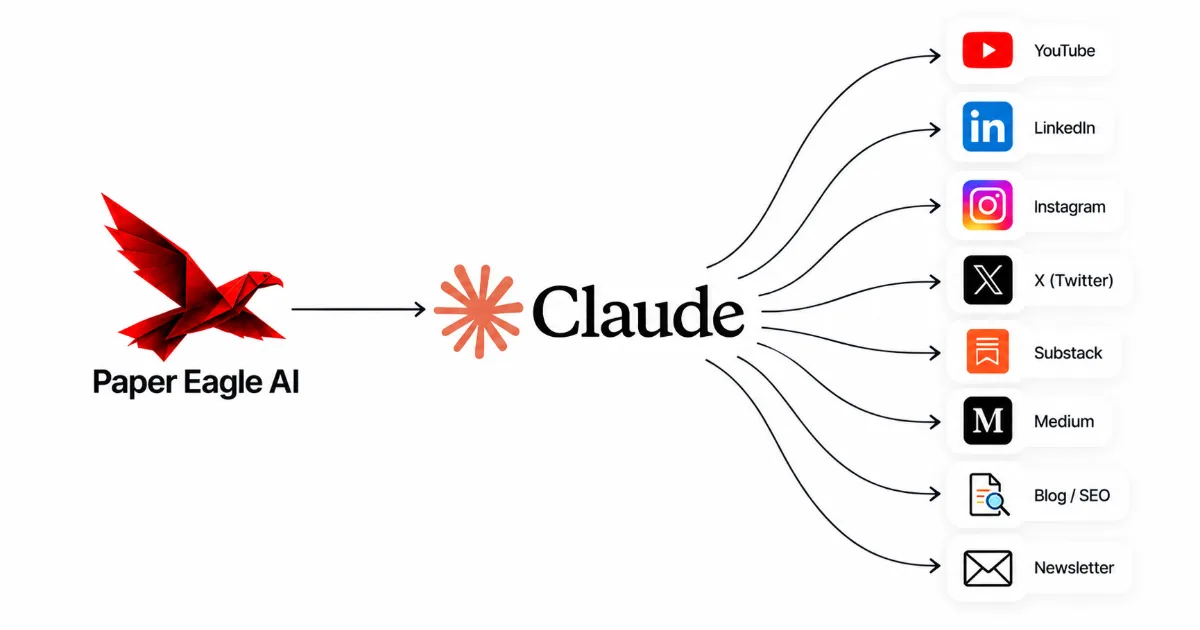
Using Claude Code for content automation means running your blog posts, your LinkedIn and Instagram carousels, and your video scripts out of a folder on your own machine, with an AI that reads that folder before it writes anything. It works, and it is not the version you have seen demonstrated. Claude writes and researches at a standard that genuinely changes what one person can ship, and it has no eye at all, so everything visual has to be constrained by a template it is not allowed to touch. This is what the build actually involves: what you have to learn, what files you end up with, where it fails, and what it costs in hours rather than in features.
What the work needs, against what Claude is good at
Language · judgement
Research and draftingReads your material, holds an argument, writes to a standard. The strongest case.
Language · mechanical
Structure and registrationSchema, metadata, indexes, cross-references. Tedious, rule-bound, and reliable.
Visual · mechanical
Filling a fixed templateWhere visual work belongs. Claude supplies data; the design is already decided.
Visual · judgement
Designing the thingComposition, restraint, does-this-look-right. It cannot see, so it cannot tell.
Left column: work made of words.
Right column: work made of pixels.
- What Claude Code for content automation actually means
- What you have to learn to automate content with AI
- The bare minimum to start
- What files you actually end up with
- Platform by platform: what a Claude Code content workflow produces
- Where Claude is genuinely weak: design
- A worked example: one idea through the whole AI content pipeline
- Which APIs you need, and which you don't
- What it honestly costs
- Frequently asked questions
- Where to start
What Claude Code for content automation actually means
It means the machine that writes your content can read everything you have already decided, before it writes a word. That is the whole difference, and it is not a small one. A chat window starts empty every time, so you spend the first ten minutes of every session re-explaining your business, your voice, and the thing you said last week. Claude Code runs in a terminal inside a folder, and it opens the files in that folder the way a new hire opens the handbook. Your positioning, your rules, your last thirty posts and the reason you rejected an angle in March are all just files it can read.
Where the hours in one published piece actually go
- Deciding what to say, and whether it is true — yours, permanently
- Producing drafting, structuring, adapting per platform — the automatable middle
- Registering metadata, indexes, links, records — mechanical, and always skipped
The shape of the problem, not a measurement
So "automation" here does not mean a machine publishing on your behalf while you sleep. It means the gap between having a thought and having that thought published, in five formats, correctly registered, stops being a three-day gap. You still decide. You still read it before it ships. What disappears is the part of the job that was never judgement in the first place. That means adapting the same argument into a caption, writing the metadata, and remembering which post needs a link to the new one. It also means keeping a record of what you already published, so you do not repeat yourself in month four.
The distinction matters because it sets your expectations correctly, and wrong expectations are why most people abandon this in week three. If you arrive expecting a content robot, the first draft that needs real editing feels like failure. If you arrive expecting a very fast, very well-read assistant who has memorised your entire back catalogue and cannot design, every result makes sense. We have written elsewhere about where the line between the two actually falls, and that line is the same one here.
What you have to learn to automate content with AI
Five things, and none of them is programming. This is the question people are most wrong about in both directions: they either assume it needs a developer, or they assume it needs nothing at all. What it needs is a small, specific literacy that takes a few weekends, and the reason it is worth naming precisely is that people give up while learning the wrong thing.
The path, bottom to top
- 01The terminal, at walking pace
Change folder, list files, run one command. About four commands in total.
- 02Files as memory
Anything you want remembered is a file. Nothing else persists.
- 03Plain writing as instruction
Your rules are markdown. Vague rules produce vague output.
- 04Data apart from design
The words live in one file; how they look lives in another you freeze.
- 05Reading a change before accepting it
Seeing what was altered, and being willing to say no.
Rung four is where most people stall, and it is the one that carries the whole system. The instinct is to ask Claude to produce a finished carousel. What you want instead is a strict separation: a data file holding only the words, and a template holding every decision about type, spacing, colour and layout. Claude fills the first and may never edit the second. Everything good about the visual half of this depends on that split, and section six is really an argument for why.
Rung five sounds like the soft one and is not. Claude will confidently restructure something you did not ask it to touch, and if you accept changes without reading them you will discover in week six that a rule you wrote in week one has quietly gone. Learning to skim a change and reject two thirds of it is the skill that keeps a system honest. It is also the habit that stops the slow drift we have described as the reason automated content stops working — nobody breaks it; it erodes.
The bare minimum to start
An account with Claude Code access, a terminal, an empty folder, and one file in it. That is genuinely the whole list, and you can have it running this evening. The bare minimum is worth stating flatly because the tutorials make it look like a stack, and a perceived stack is what stops people beginning.
What you need on day one, and what you have been told you need
- A paid Claude plan. Claude Code is included with the paid plans, and it draws on the same usage allowance as your chats.
- A terminal and a folder. Already on your computer. The folder can be empty.
- One instructions file. A single markdown file describing your business and your rules.
- A template to render into. Needed the day you want images, not the day you start writing.
- A separate API key. Not needed to begin, and section eight explains when it becomes worth it.
- A database or a server. Never, for this. Files on your own disk are the system.
- Programming. You will read code before you write any, and you may never write any.
The one file is the part that does the work, so spend the first evening on it rather than on tooling. In Claude Code that file is conventionally called CLAUDE.md, and it is loaded at the start of every session and stays there. Write what you sell, who you sell it to, the words you use and the words you refuse, and the things you have already decided so that nobody re-decides them. Three hundred honest words beat three thousand generic ones, because every line in it is a line you will be arguing with later.
Then add the two habits that make the file compound. When Claude gets something wrong in a way you know will recur, write the correction into the file rather than into the chat, because a correction in a conversation dies with the conversation. And when a rule turns out to have a reason, write the reason down beside it. A rule with no reason attached gets overturned by the next session in good faith.
What files you actually end up with
Six kinds of file, and the folder itself becomes the system. There is no application to log into and no dashboard: what you own at the end is a directory you could read with nothing but a text editor, which is also why nobody can take it away from you or put it behind a subscription you did not choose.
What the folder holds after a few months
- content/ the root — this is the system
- CLAUDE.md who we are, what we refuse, read every session
- skills/ procedures, loaded only when relevant
- write-a-blog-post/SKILL.md the sixteen steps, with a default for each
- write-a-carousel/SKILL.md frame count, budgets, what must never happen
- input/ words only — what Claude writes into
- 2026-09-audit-post.js one piece of content as pure data
- templates/ the design — frozen, never edited by Claude
- scripts/ render, check, export
- output/ the finished files you upload
- LEDGER.md what shipped, when, and what is still open
Plain text and a handful of scripts. No server, no database, no account but your own.
Two of these deserve more than a line. Skills are the one feature that changes how much you can ask for in a single sentence: a skill is a folder with a SKILL.md file of instructions that Claude loads when the task is relevant, and because the body only loads on use, a long and painfully specific procedure costs you almost nothing until the moment it is needed. This is where your real standards go. Not "write in our brand voice", but the actual procedure, with a default for every decision, so the output does not depend on how well you happened to phrase the request.
The ledger is the one people leave out and regret. It is a plain list of what has been published, what it argued, and what is still open. Without it, every session begins by guessing, and in month three you will write something you already wrote. With it, "what should we publish next" stops being a creative act performed under pressure and becomes a lookup. It is the same argument as content automation generally: the value is not the generation, it is that the next decision is already made.
Platform by platform: what a Claude Code content workflow produces
One argument goes in and five different artefacts come out, but the amount of human judgement each one needs afterwards varies more than anyone admits. A Claude Code content workflow is not uniform across platforms: the text-heavy end is close to finished, and the design-heavy end needs you to look at it. Planning for that unevenness is the difference between a system you keep and one you quietly stop using.
One session, several destinations
Blog post research, draft, structure, metadata
Video script same argument, spoken shape, timed
Is it true? every claim checked against a source
Carousel copy per-frame words, inside a character budget
Does it fit? a script measures the render and refuses overflow
Both branches land in the same folder, and you read everything before anything is uploaded
SEO blogs are the strongest case, and not mainly because of the writing. A long post is a structural object as much as an argument: it needs a heading outline that answers questions in the right order, structured data that matches the visible page, internal links in both directions, and an entry in every index that makes it findable. That work is exact, rule-bound and dull, which is precisely the profile of work a machine does better than a tired person at 11pm. The drafting is genuinely good; the registration is where the hours actually come back.
Carousels are the honest split. The words for a ten-frame LinkedIn or Instagram deck, written to a character budget per frame so nothing overflows, are a task Claude does well and quickly. The design of those frames is a task it cannot do at all, for reasons the next section takes seriously. What an image model can add is the picture on the frame, never the design decisions around it; that half of the problem is set out in content creation with Claude Code and Higgsfield. Video scripts sit in between: the structure, the argument and the timing are reliable, and the last pass is always yours, because a script is a transcript of a person and it has to sound like the person it is a transcript of.
| Format | What Claude does well | What stays yours | The gate that catches it |
|---|---|---|---|
| SEO blog post | Research, draft, outline, metadata, links, indexes | The argument, and whether each claim is true | A script that checks structure and registration |
| LinkedIn post | The argument compressed, the opening line, the rhythm | Whether it sounds like you said it | Reading it aloud once |
| Carousel, any platform | Per-frame copy inside a strict budget | Every visual decision, decided once in the template | A render that measures the frame and refuses overflow |
| Video script | Structure, beats, timing, the spoken shape | The delivery, the asides, the half-sentence you actually say | Saying it out loud before recording |
| Repurposing an old piece | Finding what is reusable across the whole archive | Whether it is still true | The ledger, and a date on every claim |
Where Claude is genuinely weak: design
Claude cannot see the thing it just made, so it cannot tell you whether it looks right. This is the single most important limitation to understand before you build anything visual with it, and it is the one that every demonstration skips, because a demonstration ends at the point where a person would normally look at the screen and wince.
How reliable the output is, against how visual the task is
Long-form writing
Naming things
Filling a fixed template
Designing a layout
Across: how much of the task is visual.
Up: how much you can trust the first result.
The failure is not that the output is ugly, which would be easy to catch. It is that the output is plausible. Ask for a "clean, premium" carousel and you get something competent and slightly generic, because the average of everything ever labelled premium is a serif headline, wide letter-spacing and a cream background. We built exactly that and only understood it when it was described back to us as looking like a wedding invitation rather than an AI company. Nothing was broken. Every rule had been followed. It simply argued the wrong thing about who made it.
The second failure is subtler and more expensive: a model reaches for the statistical centre of its training data, so the accent colour it picks unprompted is the same blue-violet every AI product already uses. It will do this while following an instruction to be distinctive, because it has no way to know what it has seen too often. And the third failure is that it cannot check its own work in the one way that matters. We shipped an element that rendered correctly, validated correctly, exported correctly, and was invisible at the size people actually view it, because it had been drawn underneath something opaque. No automated check saw it. A person looking at the picture saw it in a second.
So the remedy is structural rather than a better prompt. Decide the design once, with a person, and freeze it in a template Claude may not edit. Give it a data file with nothing in it but words. Then write scripts that refuse what a machine can measure: text that overflows its frame, a missing required field, a colour that is not on the list. Everything a script cannot measure, you catch by exporting the image and looking at it, which takes ten seconds and is not optional. That division of labour is the only one we have found that survives contact with a real publishing schedule.
A worked example: one idea through the whole AI content pipeline
Here is a single run, end to end, so the abstract version has something underneath it. The idea is one you already had: clients keep asking why their content stops working after a few months. Running that through an AI content pipeline built in Claude Code takes an afternoon rather than a fortnight, and the shape of the afternoon is worth seeing.
One idea, and what survives each stage
- Everything the folder already knows back catalogue, rules, ledger
- The angles nobody has published yet checked against the ledger
- One brief you approve before a word is written the hard stop
- A post, a carousel, a script, all registered the run
You open the terminal in the folder and describe the idea in a sentence. Claude reads the instructions file, notices the task matches the blog skill, and loads that procedure. It checks the ledger to confirm the angle is not one of the thirty you have already published, then hands back a brief: the argument, the search phrase it targets, the nine sections, what each one answers, and which existing posts will link to it. You reject the third section and replace it, which costs you a sentence.
Then the long stretch runs mostly without you. It drafts, cites, builds the structured data, writes the entries into every index the piece needs to appear in, and goes back to edit two older posts so the new one is not an orphan. For the carousel it writes only a data file: ten frames of words inside a per-frame character budget, with no opinion about how any of it looks. A script renders that data into the frozen template and exports the images. Another script measures the result and refuses the run if anything overflows, which on a real deck happens often enough to be worth the twenty lines it took to write.
The last ten minutes are yours and cannot be delegated. You read the post for whether it is true and whether it sounds like you. You open the exported images and look at them, because that is the check nothing else performs. You record what shipped in the ledger, which is what makes the next run start from a better position than this one did. The subagent feature is worth knowing here: a side task that would otherwise flood the session with search results runs in its own context and returns only its summary, which is the difference between a run that stays coherent and one that forgets its own brief halfway through.
Which APIs you need, and which you don't
To start, none: a paid Claude plan includes Claude Code, and that is enough to run everything described here. The question of API keys comes up early because people assume automation implies wiring services together, and for this kind of work it mostly does not. Everything hangs off one account.
What everything hangs off
The terminal sessions and the chat window draw on the same allowance
The writing itself, and reading your whole archive to inform it
Built in. Nothing to connect, nothing to authorise
Render, measure, export — it runs the commands you already have
Built in, and the reason the research step needs no second service
A separate key from the Claude Developer Platform becomes worth having for exactly one reason: you want something to run without you sitting there. A scheduled job that drafts next week's outlines on a Sunday night is a program, and a program needs credentials of its own. That is a genuine second stage and not a beginner's step, and the honest advice is to postpone it until you have published often enough by hand to know what is worth scheduling. When you reach it, the scheduling half is a different tool: content automation with n8n is how we wire a timer, a filter and an approval gate around the drafting step described here, and how to automate content with n8n builds the publishing half, from a finished draft to an approved post.
Two things are worth knowing before you get there. Claude Code shares your plan's usage allowance with your chats, so a heavy afternoon in the terminal draws on the same pool, and Anthropic's own guidance on using Claude Code with a paid plan is the place to check how that currently works rather than a blog post with a date on it. Those limits also move: Anthropic raised the Claude Code rate limits for paid plans, which is a reason to check the source rather than trust a number you read last quarter. Beyond that, do not add services because a tutorial did. Every integration is something that breaks on somebody else's schedule.
What it honestly costs
The subscription is the smallest line in the budget and your attention is the largest, which is the opposite of how this is usually presented. We publish no prices on this site, ours or anyone's, and the live figures for a paid plan are on Claude's own pricing page, where they will be correct after this post has aged. What does not change, and what nobody puts in the comparison table, is the sequence below.
The real cost, over the first few months
The first weekend
Slower than doing it by handYou write the instructions file and publish nothing. This feels like a bad trade and is the whole investment.
Weeks two and three
Roughly break-even, and irritatingOutput is close but not right. Every correction goes into the rules rather than the chat, or none of this compounds.
Weeks four to eight
The return arrivesThe folder now knows enough that a session starts where the last one finished. This is the point people never reach, because they quit in week two.
Month three onward
A standing maintenance billAn hour a week or so. Rules go stale, tools change, and a system nobody tends degrades quietly rather than loudly.
Put in hours, the first build is a few weekends if you already write regularly and know what you want to say. The recurring cost is an hour a week of tending: a rule that no longer matches how you work, a template that needs adjusting, a check that started passing for the wrong reason. That last one is worth watching for specifically, because a broken check does not announce itself. It prints the same green tick a working one does.
And there is a cost nobody bills you for, which is that you now have to decide things you were previously too busy to decide. When producing content stops being the bottleneck, choosing what to say becomes the bottleneck, and that is harder work. It is also the work that was always worth your time. If you would rather not carry that build yourself, that is the point at which handing it over is a reasonable decision rather than an evasion.
Frequently asked questions
Do I need to know how to code to use Claude Code for content?
No, and this is the most common reason people rule it out wrongly. You need to be able to open a terminal, move into a folder and run a command, which is about four things to memorise, and you need to be willing to read a change before accepting it. You will read code before you write any, and many people running a content system this way never write a line of it themselves. What the work genuinely demands is the ability to write down clearly what you want, which is an editorial skill rather than a technical one.
Can Claude design my carousels and thumbnails?
No, and you should design against that limitation rather than around it. Claude cannot see the image it has produced, so it cannot tell you whether the result looks right, and its unprompted aesthetic choices drift toward the average of everything it has been trained on. The working arrangement is that a person decides the design once and freezes it in a template, Claude supplies only the words that fill that template, and a script refuses anything that overflows. Then you export the image and look at it, every time.
What is the bare minimum setup to start today?
A paid Claude plan, a terminal, an empty folder and one markdown file describing your business and your rules. That is the entire list, and everything else people describe as necessary is either a later stage or a preference. Spend the first evening on the instructions file rather than on tooling, because the quality of that file determines the quality of everything afterwards, and a short file full of your own specifics beats a long file full of generalities.
Do I need an API key as well as a subscription?
Not to begin, and possibly not ever. A paid plan includes Claude Code and covers interactive work, which is everything described in this post. A separate key from the Claude Developer Platform becomes useful only when you want something to run while you are not there, such as a scheduled job that drafts next week's outlines overnight. Postpone that until you have published enough by hand to know which part of the routine is actually worth scheduling.
How long before this saves me time rather than costing me time?
Expect the first weekend to be slower than doing the work by hand, and the return to arrive somewhere in the second month. The first build is an investment with no output attached, weeks two and three are roughly break-even while you correct the system's habits, and the compounding only starts once the folder knows enough that a session begins where the last one ended. Most attempts fail in week two, which is precisely before the point where the arrangement starts paying.
Will content produced this way get penalised by search engines?
Not for being AI-assisted as such: Google's own position is that appropriate use of AI or automation is not against its guidelines, and what its spam policies target is content produced primarily to manipulate rankings rather than to help a reader. The practical risk is not detection but sameness. A system that generates without a person deciding what is worth saying produces content that is technically fine and argues nothing, and that has always been penalised, by readers first.
What happens when the tools change?
Things break, and you maintain it, which is why the honest cost includes roughly an hour a week rather than nothing. Features are added, behaviour shifts, and a rule you wrote in month one can quietly stop matching how you work. The safeguard is to write down why each rule exists beside the rule itself, because a rule with a reason attached survives contact with a future session and a rule without one gets overturned in good faith by the next person reading it.
Where to start
Tonight, make an empty folder and write one file in it called CLAUDE.md. Put in it what you sell, who you sell it to, three things you always say and three things you refuse to say, and the two or three decisions you are tired of re-explaining. Then open Claude Code in that folder and ask it to draft one thing you were going to write this week anyway, and see what it produces when it has read all of that first.
That single evening answers the question this post cannot answer for you, which is whether the gap between what it produces and what you would have written is a gap you can close by writing better rules. If it is, you have the beginning of a system and the rest is repetition. If the honest answer is that you do not want to spend the weekends, that is worth knowing tonight rather than in month two.
Disclosure
This post was written by Shreyas Dave, founder of Paper Eagle AI. We sell content automation services, which is the category this article is about, so we have a commercial interest in you concluding that a system beats ad-hoc effort — read it knowing that. No tool vendor was involved in writing it, nobody paid for a mention, and there are no affiliate links anywhere on this site. Where a third-party figure appears, it’s attributed to the publisher it came from; anything we couldn’t source is written as a direction rather than a number.
Paper Eagle AI builds Content Operating Systems that turn a business’s knowledge and expertise into consistent, multi-platform content, and we deliver them as content automation services. Working as a content automation specialist, we capture what a business knows and how it sounds, set the strategy, and build the workflows that research, draft, repurpose and publish — with a named person approving every piece before it goes out. Every build runs through discovery, design, build and handoff. The system lives in the client’s own accounts, it is documented, the team is trained to run it, and the business owns it outright. We don’t write content on a retainer, and we don’t build lead generation, CRM or sales automation.
One source of thinking becomes native content for every platform a business publishes on: the founder’s LinkedIn and the company page, YouTube and Shorts, Instagram and Reels, TikTok, Reddit, Medium, newsletters, and the company’s own website, written to be found in Google and understood by AI search. Our multi-platform content automation page shows how they share one source, and our case studies document the systems behind our own publishing, file by file. You can follow the work on the company’s own channels: Paper Eagle AI on Instagram, Paper Eagle AI on YouTube, the Paper Eagle AI company page on LinkedIn, Paper Eagle AI on Substack, Paper Eagle AI on Reddit and Paper Eagle AI on Medium.
Keep reading
- How to automate content creation — the same job described tool-agnostically, if you want the principles before the terminal.
- What to automate in your content — where the line between machine work and judgement actually falls.
- Why automated content stops working — what goes wrong in month three, and the maintenance this post budgets an hour a week for.