Content Repurposing vs Content Creation: Which Should You Invest In?
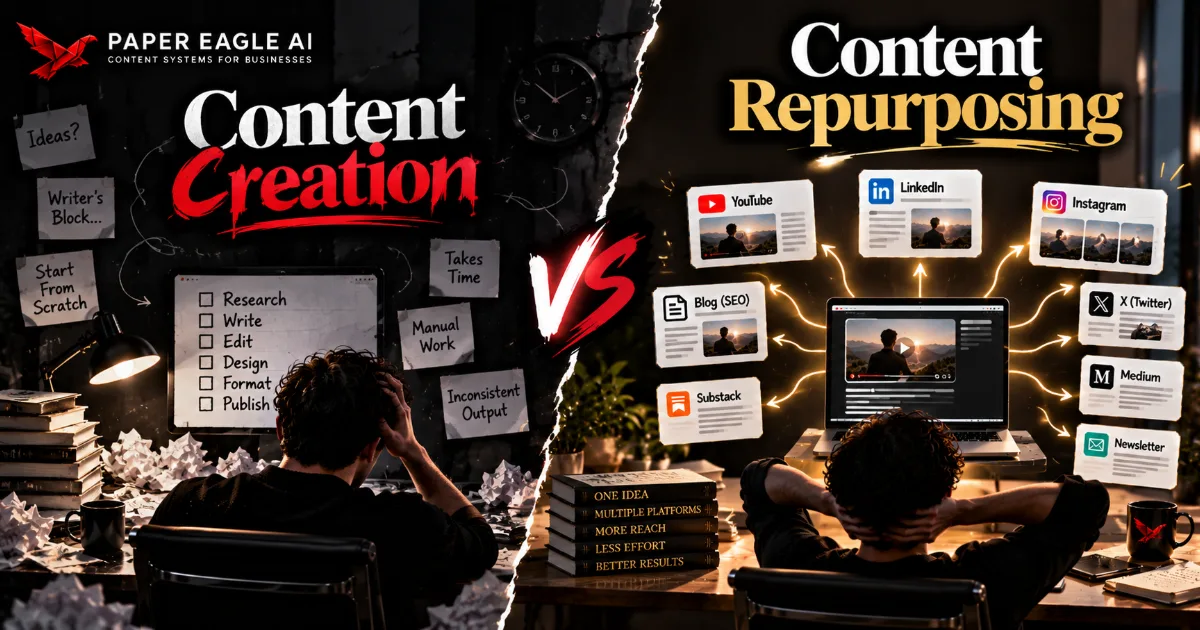
Creation adds a new idea; repurposing carries an idea you’ve already proven to people who haven’t met it yet. Invest in creation when you have something new to say, when the facts under an older piece have changed, or when your existing material has been carried as far as your audiences will tolerate. Invest in repurposing when your best ideas live on one platform and your buyers live on several. Most businesses need both, in a content mix set by three things: how much proven source material you hold, how fast your subject goes out of date, and how much your audiences overlap.
The three things that set the content mix
how much proven material you hold
- long pieces
- recordings
- documents
how fast your subject goes out of date
- tools
- platform rules
- your service
how many people follow you in more than one place
- newsletter
- The one difference that matters
- What each one actually buys you
- Compared on cost, speed, reach and fatigue
- When new content is the better investment
- When repurposing is the better investment
- How to tell reuse has stopped paying
- What is automated, and what stays human
- Three requests, one decision table
- What each costs, and how to set the split
- Frequently asked questions
- Where to start
What is the real difference between content repurposing and content creation?
The real difference is what each one adds: content creation adds a new idea, and content repurposing adds new readers to an idea you already have. A LinkedIn post can be pure repurposing if the thought came from last month’s webinar, and a rewritten article can be genuine creation if the argument inside it is new. So the useful question is never whether something is a new file. It’s whether it carries a new thought, or a new audience for an old one.
Pasting the same text versus repurposing it
Pasting the same text
- Adds nothing but a new destination
- The same words on five platforms
- Treated by platforms as duplication
Repurposing it properly
- Adds new readers to an idea you already have
- The shape changes for each place it lands
- Read as native on each platform
That distinction matters because the two are paid for in different currencies. Creation spends expertise: the hours of the person who knows the subject, thinking until there’s something worth saying. Repurposing spends judgment and craft: deciding which idea deserves a second life, then rebuilding it so it reads as native on a platform with different habits. A business that treats them as one budget line usually runs out of the scarcer currency first, and the scarcer one is almost always the expert’s time.
A third thing often gets mistaken for repurposing, and it’s worth ruling out early. Pasting the same text onto five platforms isn’t repurposing; it’s duplication, and it sits near the top of the common misconceptions about content systems for good reason. Real repurposing changes the shape of the piece for each place it lands. If nothing about the piece changed except where it was posted, nothing was repurposed, and the platforms will treat it accordingly.
What does each one actually buy you?
Content creation buys the one thing only it can: a reason for people who already know your work to keep paying attention. New research, a new opinion, a new method, a new answer to a question buyers started asking this quarter — these keep a follower a follower and give search engines and AI answer engines something original to cite. Google’s guidance on creating helpful, reliable, people-first content asks whether a page provides “original information, reporting, research, or analysis”, and no amount of reformatting supplies that.
What creation and repurposing each buy
original
a reason to keep paying attention, something to cite
very little
plenty of content that says very little
wide reach
weeks of material for platforms the original never reached
A judgment, not a score
Its cost is that it’s slow and uncertain. A genuinely new piece needs the person who holds the knowledge, and that person is usually running the business too. Not every new piece lands, either: you don’t learn which ideas resonate until they’ve been published and watched for a while. That uncertainty is the quiet argument for repurposing: once an idea has proven itself in public, carrying it further is a far safer bet.
Content repurposing buys reach for ideas that have already earned it. Its strength is leverage: one conversation, call or long article can hold weeks of material for platforms the original never reached. It’s faster per piece, cheaper per piece and lower in risk, because the idea has been tested in public. Its weakness is that it can only be as good as its source, and it can’t tell you anything new. A repurposing operation running on a thin source produces plenty of content that says very little. The method itself — how one long piece becomes many native ones — is set out in how one piece becomes ten; this post is about whether to buy it.
Repurposing vs creation on cost, speed, reach and fatigue
Side by side, repurposing wins on cost per piece, speed and reach across platforms, while creation wins on originality, search and AI citation, and resistance to audience fatigue. The table compares them on the nine things a business actually weighs when it decides where next month’s content hours go. None of the rows carries a number, because honest numbers depend on your source, team and platforms.
Creation and repurposing judged on the same six
- 01Cost per piece
- 02Speed
- 03Reach across platforms
- 04Originality
- 05AI citation
- 06Fatigue resistance
- content creation
- content repurposing
A judgment, not a score
| Dimension | Content creation | Content repurposing |
|---|---|---|
| What it adds | A new idea | New readers for an existing idea |
| Cost per piece | High: the expert’s time, plus drafting and editing | Lower: an editor’s judgment and a rebuild for each platform |
| Speed | Slow, bound to when the expert can think and talk | Fast once the source exists, bound to review |
| Reach across platforms | One platform at a time unless it is carried further | Its whole purpose |
| Risk | The idea may not land | The idea has already landed somewhere |
| Search and AI citation | Strong: original material is what gets cited | Weak on its own; leans on the original as the source |
| Audience fatigue | Resets it | Builds it when the same people see the same idea too often |
| Depends on | Expertise and time | A deep enough source and a person with editorial judgment |
| How it fails | Nobody has time, so nothing ships | The source runs dry, so the output says the same thing louder |
Read the table as a pair of failure modes rather than a scorecard. A creation-only business fails by going quiet: the expert gets busy, nothing ships for three weeks, and a cadence that took months to build is gone. A repurposing-only business fails by going hollow: the same handful of ideas circulate in ever-thinner versions until even loyal followers scroll past. Each is cured by more of the other.
One row deserves a second look, and it’s search. Google groups pages that look like copies and shows the one it judges most representative, a process its documentation on URL canonicalization also calls deduplication. So a repurposed article that closely mirrors one you published elsewhere is competing with itself. Medium’s help article on how to set a canonical link makes the same point from the other side, asking writers who post in two places to mark one copy as the original, which is how our Medium guides handle it. Repurposing for search means rewriting for a different question, not republishing the same answer.
When is new content the better investment?
New content is the better investment whenever you have something to say that your existing material doesn’t already say. In practice that comes down to four situations. You’ve learned something since you last published on the subject. The facts under an older piece have changed, whether that’s a tool, a platform rule or the way your own service works. Your buyers are asking a question nothing you’ve published answers. Or your source stock has been carried as far as it can go, and each repurposed piece now repeats one that went out recently.
When new content is the better investment
- You’ve learned something since you last published only creation supplies new thinking
- The facts under an older piece have changed repurposing it would multiply the correction
- Buyers ask a question nothing published answers there is no source to carry
- The source stock is carried as far as it goes each repurposed piece repeats a recent one
- A proven idea hasn’t reached your other platforms that is a repurposing job
The second situation is the one most often missed, because the old piece still looks fine. A webinar from a year ago that walks through a platform’s rules may be wrong today, and a repurposing run turns one out-of-date claim into ten. Repurposing a stale source doesn’t save time; it multiplies a correction you’ll have to make on every platform it reached. When the facts have moved, write the new piece first and let the old one feed nothing until it’s been brought up to date. Platforms change what they reward without notice, which is the decay described in why automated content stops working when the platform changes.
Creation also wins at the very start. A business with almost nothing published has nothing to repurpose, so the early months are the time to build source stock on purpose: the long, specific pieces that will feed everything else later. The question then isn’t which one to buy but which pieces to create so that repurposing has something to work with. Usually that means a few deep pieces built around the subjects you know best, the ones you’d find by working through how to identify your knowledge pillars, rather than a stream of short posts.
Said plainly: if your team has the time and something new to say, and your platforms are already covered, creation is the better buy and repurposing can wait. Plenty of businesses publishing on one platform to one audience don’t need repurposing at all. When someone asks us whether to repurpose or create new content, that’s the first case we try to rule out.
When is repurposing the better investment?
Repurposing is the better investment when your best ideas live on one platform and your buyers live on several. The clearest signal is an imbalance: a podcast, a YouTube channel or a long-running blog that’s been doing its job for months, beside a LinkedIn page, an Instagram account or a newsletter that gets whatever is left over. The ideas are proven; they just haven’t travelled, so the business pays the full cost of creation and collects the return on one platform.
One proven source, several platforms waiting
a podcast, a YouTube channel or a long-running blog
the proven ideas, rebuilt as posts
the same ideas, rebuilt for the feed
a proven idea, written for readers
short clips cut from one long video
The audiences really are spread out. In the Pew Research Center report Americans’ Social Media Use 2025, based on a survey of 5,022 US adults run between February and June 2025, 84% said they use YouTube, half said they use Instagram, 37% said they use TikTok and 26% said they use Reddit. Those are national figures about adults in general, not about your buyers, so treat them as a direction. Some of the people you want will only ever meet you on the platform you neglect.
Repurposing also wins when the expert’s time is the constraint. A founder who can give one focused hour a week can’t sustain daily creation, but they can sustain one good recording a week that becomes material for every platform the business uses. That’s the shape of repurposing built on what you’ve already published, and its success rests on a person with editorial judgment rebuilding each piece rather than a script copying it. If you’re weighing buying that as a service against building it, the hours worksheet for content repurposing ROI is the place to do the sums.
Said plainly the other way: if your source is thin, repurposing will make that obvious on more platforms at once. A couple of blog posts and a handful of LinkedIn updates won’t feed a plan that spans several platforms, and stretching them only teaches four audiences that you don’t have much to say.
How can you tell reuse has stopped paying?
Reuse has stopped paying when the people who see your work start meeting the same idea twice, and when the platforms start treating your output as unoriginal. Both signals can be read without inventing a benchmark. The first shows up in your own numbers: replies pointing out you’ve said this before, saves and shares falling on repurposed pieces while new ones hold steady, and engagement dropping fastest on the platforms where your audience overlaps most. The second shows up in the platforms’ own rules, which have become quite specific about unoriginal content.
Where audience fatigue gets said out loud
You’ve said this before
FOLLOWER REPLIESOnly the original is recommended
INSTAGRAM ORIGINALITYWithout significant original commentary
YOUTUBE MONETIZATIONIdentical or nearly identical posts
X ON SPAM
YouTube’s channel monetization policies define reused content as material repurposed “without adding significant original commentary, substantive modifications, or educational or entertainment value”, and say the policy applies to a channel as a whole. Instagram’s page on recommendations and originality says that when it finds two or more identical pieces of content it will only recommend the original. X’s authenticity rules list “repeatedly posting identical or nearly identical posts” as spam. None of these punishes repurposing; all of them punish duplication, which is what repurposing becomes when the rebuild step is skipped.
Inside your own audience, the cause of fatigue is overlap. The more of your LinkedIn followers also read your newsletter, the less room a single idea has before it reads as repetition. How to space one idea across platforms when audiences overlap is covered in how to automate content repurposing for an audience that follows you everywhere; the investment question here is simpler. When most of the people you reach already follow you in two or more places, each extra repurposed version buys less new reach, and that hour is better spent on a new idea. It shows first in short clips cut from one long video, the format our Shorts and Reels guides cover.
Fatigue has an internal version too: a team tires of its own ideas long before the audience does. The test is the data, not the team’s mood. If repurposed pieces still perform close to new ones on a platform, keep going there; if they’ve fallen well behind, the source needs fresh material rather than another rearrangement of the old.
What is automated, and what stays human, in each?
In both, the mechanical work can be automated and the judgment can’t: software can draft, reformat, schedule and track, but a person decides what’s worth saying and approves every piece before it goes out. In repurposing, most of the work is mechanical once a person has chosen the source and the angle; in creation, most of it is the thinking, which is a large part of why repurposing costs less.
Who holds a repurposed piece at each stage
- 01n8nPick upa new transcript as soon as a recording lands
- 02Claude CodeDrafta version for each platform in the brand’s voice
- 03Your editorChoose and approvewhich idea goes where, cut repeats, approve the rest
- 04n8nSchedulea weekly batch starts on the Schedule Trigger
On the repurposing side, an automation can pick up a new transcript as soon as a recording lands, break it into candidate ideas, draft a version for each platform in the brand’s voice and queue the drafts for review. n8n handles the plumbing, and its Schedule Trigger node, which the documentation says runs “workflows at fixed intervals and times”, is how a weekly batch starts without anyone remembering to start it. A model working inside Claude Code can draft from the business’s own notes and examples. What stays human is choosing which idea goes where, cutting drafts that repeat something already published, and approving the rest.
On the creation side, automation helps around the edges rather than at the centre. It can gather research, transcribe an interview with the expert, sort notes against the subjects the business covers and propose a first structure. The argument itself — what the business believes and has seen — has to come from a person. A draft written without that input is the generic output described in whether you can just use ChatGPT for content, and no platform rewards it. Our fuller view of where the line sits across a whole content operation is in what to automate in your content, and what not to.
The platforms are drawing a similar line. LinkedIn’s pressroom post on supporting authentic content and conversations says comments posted by “a browser extension, script, or third party tool” aren’t allowed, and that posts which look artificially boosted may be shown less. And one judgment belongs to neither side of the split, because it is the split: deciding each month how much of the team’s time goes to new ideas and how much to carrying old ones further. A system can report what each kind of piece is doing; it shouldn’t decide what to invest in next.
A worked example: three requests through one decision table
Here is the decision applied to three requests of the kind a content team gets in one week; they’re illustrations, not clients. The table asks four questions in order, and the first one that fails decides the job. Is there a source for this? Are its facts still current? Has this platform’s audience already seen the idea? Does the request need something only the expert can say? Pass all four and it’s a repurposing job; fail any one and it’s creation, at least first.
The decision table, asked in order
- 01A source?is there one at all — the new service line fails here
- 02Current facts?are they still true — the year-old webinar fails here
- 03Unseen idea?has this audience met it — if so, write something new
- 04Expert needed?does only the expert know it — if so, creation first
- 05Repurposethe podcast backlog passes all four
The first request comes from a business with a long backlog of podcast episodes that wants to start publishing on Instagram and LinkedIn. Every question passes. There’s a deep source, most episodes discuss principles that haven’t changed, neither new platform has seen the material, and the expert has already said what needs saying, on tape. That’s a repurposing job. In n8n, a workflow walks the episode archive, hands each transcript to Claude Code along with the business’s voice notes, and writes candidate posts into a review table. The approver picks a few each week and drops anything that has dated.
The second request: the same business launches a new service and wants content about it everywhere. The table stops at the first question, because there is no source. Nothing published explains the new service, and the thinking behind it lives in the head of the person who designed it and in a few sales calls. That’s a creation job and should be run as one. The right move is a single deep piece first, built from an interview with that person and published on the business’s own site as the original. Once it exists, the same n8n workflow can pick it up like any other source.
The third request: a well-attended webinar from a year ago explains how a platform ranks content, and someone wants it cut into short clips. There’s a source, but the second question fails. The platform has changed its rules since, and several of the webinar’s claims are now wrong. Clipping it would publish outdated advice on every platform at once. So the answer is creation first, in the narrow form of an update: re-record or rewrite the sections that changed, check them against the platform’s current documentation, and only then let the corrected version feed the repurposing workflow.
Across the three, the table produced one repurposing job and two creation jobs, which is typical of a business that’s adding something new. The value isn’t in the individual answers but in the order of the questions. Asking about the source and its freshness before asking about reach is what stops a repurposing operation from multiplying the wrong thing.
What each costs in hours and attention, and how to set the split
Creation costs expert hours and repurposing costs editorial hours, so the split between them should follow whichever kind of hour you have spare. We don’t publish a ratio, because any fixed number would be invented. A business with a deep archive and a busy founder needs nearly the opposite split from a young one whose expert enjoys writing.
Where a month of content hours goes
- 01Monthly content hoursthe time the team can give
- 02Expert hourscreation: the thinking only they can do
- 03Editorial hoursrepurposing: rebuilding each piece
- 04Review attentionchecking each version against what went out
- 05Spare hourswhichever kind is spare decides the split
Relative, not measured
Start by counting your source stock: every long piece, recording and document holding an idea you’d still stand behind today. Nielsen Norman Group’s Content Inventory and Auditing 101 describes an inventory as “a list of every piece of digital content you currently have” and an audit as the step that decides whether each piece “needs to be updated or removed”. That keep, update or remove call is exactly the freshness question from the decision table, and the full method is in how to conduct a content audit. If the stock is deep and mostly current, lean towards repurposing until fatigue shows on the platforms that overlap most. If it’s thin or dated, lean towards creation until there’s enough to carry.
Then account for the cost people forget, which is attention. Repurposing doesn’t only cost an editor’s hours; it costs a reviewer’s attention every week, because each version has to be checked against what already went out and against the platform’s current rules. Creation costs the expert’s attention less predictably, because thinking doesn’t arrive on a schedule. A plan that ignores attention looks cheap on paper and stalls in the second month, when the reviewer falls behind or the expert stops turning up for recordings.
Finally, revisit the split on a fixed rhythm rather than by feel. Once a quarter, look at how much unused source stock is left, how repurposed pieces perform against new ones on each platform, and whether anything in the archive has gone out of date. Pieces that hold up for years are the cheapest source stock of all, which is the argument behind content that compounds over time. If you’d rather have the whole system built and handed over than run the split by hand, what a content automation project includes sets out what we deliver.
Frequently asked questions
Is content repurposing cheaper than content creation?
Per piece, yes: repurposing reuses an idea that already exists, so it costs an editor’s judgment and a rebuild for each platform rather than the expert’s thinking time. Over a whole year it’s only cheaper if the source is deep enough to carry it. Repurposing a thin or outdated source produces cheap pieces that nobody engages with, which makes the real cost per useful piece higher than it looks.
Can repurposed content hurt my SEO?
Repurposed content hurts search only when it’s a near-copy of a page that already exists, because Google groups duplicates and shows one of them. Rewrite each version for a different question, keep one canonical original on your own site, and mark copies on platforms like Medium with a canonical link.
How do I know my audience is tired of repurposed content?
Your audience is tired of repurposed content when repurposed pieces start falling well behind new ones on the same platform, especially where followers also see you elsewhere. Look for replies noting you’ve said it before, falling saves and shares, and sharper drops on the platforms your audiences overlap most.
Should a small business start with creation or repurposing?
A small business with little published should start with creation, because repurposing needs a source to work from. Spend the first months building a few deep, specific pieces on the subjects you know best, published on your own site. Once those exist and have shown which ideas resonate, repurposing them onto the platforms your buyers use becomes the cheaper way to keep publishing.
Can AI handle content creation as well as repurposing?
AI handles the mechanical parts of both well and the core of creation poorly. It can transcribe, research, structure, draft platform versions and schedule them. What it can’t supply is the business’s own experience and opinion, which is what makes new content worth reading, so a person still has to provide the argument and approve every piece.
How much of my content should be repurposed versus new?
There’s no correct fixed ratio; the split should follow your source stock, how quickly your subject dates and how much your audiences overlap. A deep, current archive and buyers on platforms you haven’t covered favour repurposing; a thin or outdated archive, or audiences that already see everything you publish, favour creation. Review the split quarterly using how repurposed pieces perform against new ones, and move it when those readings move.
Does repurposed content count as original on YouTube and Instagram?
Repurposed content counts as original on both when it’s meaningfully changed, and doesn’t when it’s a straight copy. YouTube’s monetization policies allow reused material when viewers can tell there’s a meaningful difference from the original, and Instagram recommends only the original when it finds identical pieces. A version rebuilt for the platform, with new framing and commentary, is treated as its own work.
Where to start
This week, list your source stock. Write down every long piece, recording and document you’ve published, and next to each one mark whether you’d keep it as it is, update it, or retire it. Then look at the keep column against the platforms your buyers use: if it’s long and most of those platforms have never seen it, your next month belongs to repurposing; if it’s short or mostly needs updating, it belongs to creation.
Disclosure
This post was written by Shreyas Dave, founder of Paper Eagle AI. We sell content automation services, which is the category this article is about, so we have a commercial interest in you concluding that a system beats ad-hoc effort — read it knowing that. No tool vendor was involved in writing it, nobody paid for a mention, and there are no affiliate links anywhere on this site. Where a third-party figure appears, it’s attributed to the publisher it came from; anything we couldn’t source is written as a direction rather than a number.
Paper Eagle AI builds Content Operating Systems that turn a business’s knowledge and expertise into consistent, multi-platform content, and we deliver them as content automation services. Working as a content automation specialist, we capture what a business knows and how it sounds, set the strategy, and build the workflows that research, draft, repurpose and publish — with a named person approving every piece before it goes out. Every build runs through discovery, design, build and handoff. The system lives in the client’s own accounts, it is documented, the team is trained to run it, and the business owns it outright. We don’t write content on a retainer, and we don’t build lead generation, CRM or sales automation.
One source of thinking becomes native content for every platform a business publishes on: the founder’s LinkedIn and the company page, YouTube and Shorts, Instagram and Reels, TikTok, Reddit, Medium, newsletters, and the company’s own website, written to be found in Google and understood by AI search. Our multi-platform content automation page shows how they share one source, and our case studies document the systems behind our own publishing, file by file. You can follow the work on the company’s own channels: Paper Eagle AI on Instagram, Paper Eagle AI on YouTube, the Paper Eagle AI company page on LinkedIn, Paper Eagle AI on Substack, Paper Eagle AI on Reddit and Paper Eagle AI on Medium.
Keep reading
- How to automate content repurposing without echoes — the controls that keep repurposed pieces from repeating each other once you’ve decided to repurpose.
- Content multiplication — the method for turning one deep source into native pieces for every platform.
- What do content repurposing services include? — what you get if you buy repurposing rather than build it.