Why Automated Content Stops Working
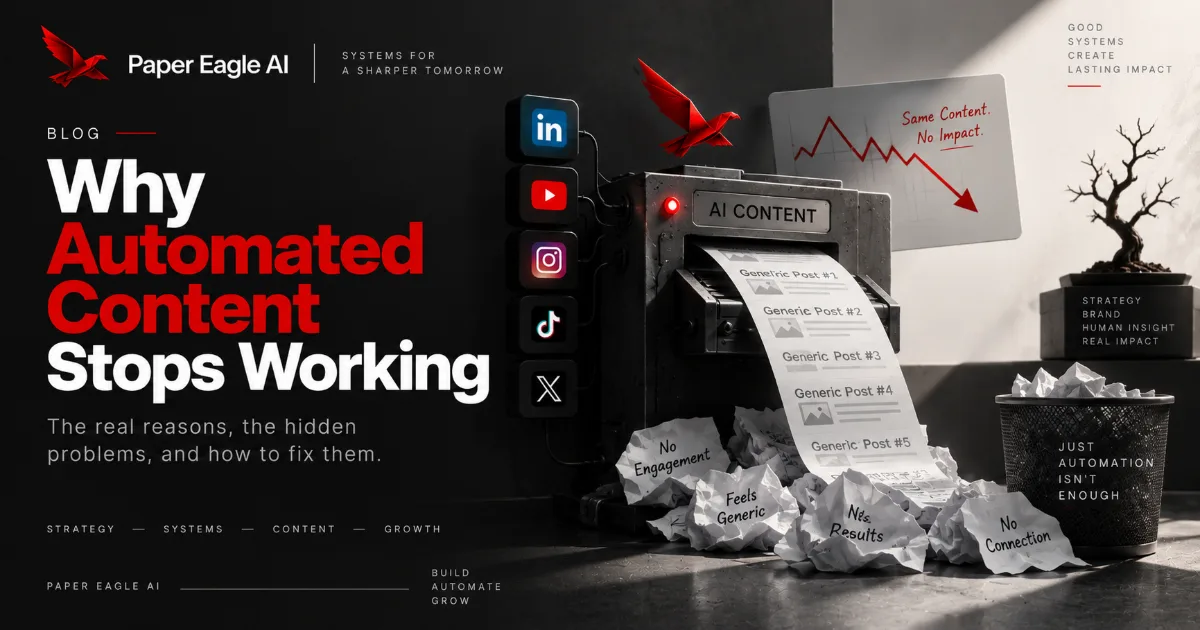
The first month of an automated content workflow is the easy month. The source material was written a fortnight ago, the prompts were tuned against real examples, and somebody read every output because it was new. Four months later the same workflow runs on the same schedule and produces things nobody would have approved on day one. Nothing crashed, no error was logged, and no one can name the week it went wrong. That is the failure worth planning for, because it is the one that never announces itself.
What an automated content workflow actually rests on
- The software runs on schedule, almost never the thing that fails
- What the business knows true on the day somebody wrote it down
- The voice it writes in a standard that needs a person to hold it
- What the platform rewards changes without telling anybody
The shape of the dependency, not a measurement
- The shape of the failure: nothing breaks, it fades
- Four things decay, and the software is not one of them
- Decay one: what you told it is no longer true
- Decay two: the voice drifts and nobody re-reads
- Decay three: the model changes underneath you
- Decay four: the platform changes what it rewards
- Why nobody notices for a quarter
- The upkeep that actually holds a system up
- What the upkeep honestly costs
- When "it stopped working" means something else
- Frequently asked questions
The shape of the failure: nothing breaks, it fades
Software that fails loudly gets fixed within the hour. Somebody gets an alert, opens the run history, finds the red step and repairs it. That is the good case, and it is not the case that costs businesses their content system.
The expensive failure is the quiet one. The workflow keeps running. Every step returns green. Posts continue to appear on the schedule they always appeared on. What changes is the quality of the judgement inside them, one small increment at a time, and no monitoring system on earth has a check for that. By the time somebody says out loud that the content has got worse, the drift has been accumulating for a quarter and is impossible to date.
We see the same arc often enough to draw it. Month one is genuinely good, because everything was current and somebody was watching. Month two is fine. Around month four somebody senior reads a post and winces. By month six the workflow is either switched off or, worse, still running while everyone has stopped reading its output — which is the same as switched off, except you are still paying for it and it is still publishing under your name.
The usual first diagnosis is that the model got worse, and it is almost always wrong. It is an appealing explanation because it is external, it requires no uncomfortable questions about who was supposed to be watching, and there is always a forum thread agreeing with it. It is also the one explanation that leads nowhere useful: swapping providers moves you to a different model with the same stale inputs behind it, and three months later you are having the same conversation about the new one.
The life of a workflow that nobody maintained
Month one
It is genuinely goodThe source was written a fortnight ago, the prompts were tuned this week, and somebody reads every output because it is new.
Months two and three
Nobody reads the draftsIt has earned trust, so the review step becomes a glance. That is the correct reward for reliability and it is also the moment the watching stops.
Around month four
Somebody wincesA post describes a service you stopped selling, in a voice that is nearly yours. No step failed. Nothing can be pointed at.
Month six onward
Running, and ignoredEither it gets switched off, or it keeps publishing while the team quietly stops treating the output as theirs.
Four things decay, and the software is not one of them
It is worth being precise about what an automation layer actually promises, because the gap between that promise and what people assume it covers is where the whole problem lives. A workflow tool guarantees that a sequence of steps runs when you said it should, in the order you specified, and tells you when a step returns an error — n8n documents exactly that, an error workflow that runs if an execution fails and alerts you (n8n Docs). Every one of those guarantees is kept, reliably, for years. The one honest qualifier is that a major version can still ask something of you — n8n's 3.0 breaking changes require self-hosted installs to move to Docker, for instance — but that arrives announced, dated and in writing, which is exactly what the four decays below never do.
None of them is a guarantee about whether the thing produced is true, current, on-brand or worth publishing. That is not a criticism of the software — nothing in the category claims otherwise. It is a criticism of how the system around the software gets designed, which is usually not at all.
What the automation layer actually guarantees, scored honestly
- "It will run when I said, every time." True, and it is the reason these tools are worth having.
- "It will tell me when a step errors." True, and the alerting is genuinely good.
- "It will do the same thing every run." True, and that is the problem as often as it is the point.
- "It will keep producing good work." Only for as long as everything it reads stays true.
- "It will notice when the output gets worse." Nothing in any of these products has this job.
So the four things that decay are the four inputs, and they decay independently: what the business knows, the voice standard the output is measured against, the model doing the writing, and the platform the work is published to. Each has its own rate of change and its own warning sign, which is why one quarterly review of "the automation" catches none of them.
Decay one: what you told it is no longer true
A content system writes from what your business knows — how you describe what you do, who it is for, what you charge for it in principle, what you refuse to do, the examples you use, the objections you answer. Somebody wrote that down once, carefully, at the start of the build. It was accurate that week.
Then the business moved, as businesses do. You dropped a service. You changed who you sell to. A positioning line that took three months to get right replaced the one you had been using. Somebody left and the story you tell about the team changed. Every one of those is a good sign for the business and an unannounced regression for the workflow, because the source document did not move with them.
It helps to be specific about what is actually in that source material, because "what the business knows" sounds abstract until you list it. In most builds it is six or seven things: how you describe each service, who each one is for, the objections you answer and how, the examples and results you are allowed to cite, the words you use and the ones you refuse, and the things you have decided not to do. Those change at wildly different rates. The words you refuse might hold for years. The service descriptions move whenever the offer does. The examples go out of date the moment a client relationship ends. One review cadence across all of them is either too slow for half and wasted effort on the rest, which is why the review window belongs on the page rather than on the calendar.
The result is fluent, well-structured content about a company that no longer exists in that form. Google’s own self-assessment questions for helpful, reliable, people-first content ask whether a page is trustworthy and written by somebody who knows the subject (Google Search Central) — and fluent prose about the business as it was two years ago fails that quietly. It is more dangerous than obviously broken output, because it reads correctly. Nobody skims a post and thinks "this describes our old pricing model"; they think it reads fine and move on.
Whether it is current, against whether anyone owns it
Current · unowned
LuckTrue today because nothing has changed yet. This is where most source material starts.
Current · owned
A live sourceSomebody is named against it and reviews it on a date, so drift gets caught in weeks.
Stale · unowned
Confident nonsenseThe workflow keeps writing from it. Nothing anywhere flags a contradiction.
Stale · owned
A known debtOut of date, but somebody knows and it is on a list. Recoverable in an afternoon.
Top row: it still matches the business
Right column: a name is attached
Decay two: the voice drifts and nobody re-reads
Voice drift is the decay people feel first and can explain last. Each individual post is defensible. Read fifty in a row and something has moved: the sentences got longer, a hedge crept in, the openings all start the same way, an adjective you would never use has become normal. Nobody approved any of it, and nobody can point at the post where it started. The same slow drift happens between the versions of one piece when each is rewritten from the last instead of from the original, which is why a repurposing pipeline should build every version from the source.
The mechanism is simple. A brand voice is a standard, and a standard only exists while somebody applies it. That is why a written standard is the second of the four layers in how to automate content creation, underneath the workflow and the automation rather than beside them. In month one that person read every draft. By month three they read the first two lines. By month five they read the subject line of the notification. The standard did not change; the act of applying it stopped, quietly, as a reasonable response to a system that had been reliable for a hundred runs.
The fix is not more review — that is the thing that already failed. It is a review that is small enough to survive being boring: a fixed sample, on a fixed day, read cold. Five recent pieces and five from a quarter ago, side by side, with no context about which is which. Drift is invisible one post at a time and unmistakable across a quarter, and the only way to see it is to look at the quarter.
A quarter of drafts, and what actually got checked
- Everything the workflow produced every run, every platform
- Opened by a human at all survives the notification pile
- Read past the first paragraph survives the glance
- Compared against the voice standard survives the habit
Decay three: the model changes underneath you
This is the part of AI automation that gets talked about least and causes the most confusion when it happens. The model behind a writing step is not a fixed component. Versions get deprecated on the provider’s schedule, not yours: Anthropic publishes a retirement date for every model and commits to at least 60 days’ notice before one is retired (Anthropic, 2026); OpenAI keeps an equivalent list, noting plainly that software relying on its models may need occasional updates to keep working. Defaults change. A prompt that was tuned against one model — its habits, its verbosity, the way it responds to a particular instruction — behaves differently on the next one, and "differently" is not always "worse", which makes it harder to spot.
What people experience is that the writing changed character for no reason they can identify. The instinct is to blame the model and start evaluating a replacement. Usually the prompt is the thing that is out of date: it was written to correct behaviours the old model had, and those corrections are now either unnecessary or actively fighting the new one.
Two practices remove nearly all of this pain, and both are unglamorous. Pin the model version explicitly rather than accepting a moving alias, so an upgrade is something you choose on a Tuesday rather than something that arrives. And keep every prompt in one readable place with a note on what it is for — because the second failure mode here is not the model at all, it is that nobody can say which of the eleven prompt variants scattered across the workflow is the one currently running.
Where the prompts ended up after nine months of small fixes
- content-workflow/ built once, patched eleven times
- prompts/ three people have edited these
- post-draft-v2-FINAL.txt v3 exists in the workflow itself
- post-draft-new.txt older than v2
- notes/ why decisions were made, empty
- voice-guide.txt last edited before the rebrand
Nobody in the building can say which prompt ran this morning
Decay four: the platform changes what it rewards
The fourth input is the one you have least control over. Platforms change what they surface, and most of them do it without a changelog you can subscribe to. Search is the exception worth knowing about: Google publishes every ranking update with a start date and a duration on its Search Status Dashboard (Google). For everything else you are reading tea leaves. A format that carried reach for a year stops. Link handling changes. A length that performed becomes a length that does not.
Search shifts toward answering the question directly instead of sending a click — and the controls governing how your pages appear in those answers are the ordinary robots directives, not a separate setting (Google Search Central) — so a post written to rank has to earn its place a different way. Because each platform changes on its own schedule, the rules for each one are best kept in their own file, which is how the translation layer works in repurposing one video for every platform.
An automated workflow is exceptionally good at continuing to do the thing that used to work. That is the whole value proposition, and it is the exact liability here: consistency is what you bought, and consistency is what keeps producing last year's format at this year's audience.
Two signals separate a real platform change from a rumour, and neither of them is a post about the algorithm. The first is your own trailing numbers on that platform against the eight weeks before, which is why logging what went out is worth the ten minutes it costs to set up — without it every conversation about reach is a memory competition. The second is whether the change is visible in the product rather than in commentary: a new format in the composer, a field that disappeared, a link that renders differently. Commentary about what a platform is rewarding is guesswork by definition, since nobody outside the company has the data. Your own numbers and the product itself are the two things you can actually read.
The mistake to avoid is the opposite overcorrection — chasing every platform rumour and rebuilding the workflow quarterly, which costs more than the drift did. What works is deciding in advance who is allowed to change what, so a real change gets acted on in a week and a rumour gets ignored without a meeting.
Who is allowed to change the workflow when a platform moves
- 01Anyone running it
Format, length, posting time, hashtags, thumbnail conventions — anything inside the standard already published.
- 02Whoever owns the channel
Dropping a format, adding one, changing cadence. Recorded in the log, not escalated to a meeting.
- 03Whoever owns the strategy
Leaving a platform, entering one, or changing what the content is for. Rare, and it should be.
Why nobody notices for a quarter
Each of those four decays is individually easy to catch. What makes them survive a quarter is that catching them is nobody's job, and the reason it is nobody's job is that the system was delivered as a thing that runs rather than a thing that is kept.
There is a second reason, and it is more human. A workflow that has been reliable for months has earned the team's trust, and trust is expressed by not checking. The better the first three months go, the less anybody looks in month four. So the systems that decay furthest before anyone notices are the ones that started out best, which is genuinely counterintuitive and worth saying to anyone who is about to hand one over.
The same workflow, with the four missing checks attached
unchanged, unrebuilt, still on the same schedule
so "the business changed" reaches the system
five recent pieces against five old ones
so a change is a decision, not a surprise
so a real shift moves in a week
The upkeep that actually holds a system up
Upkeep sounds like a maintenance contract and it is not. It is four small habits with names against them, and they are the difference between a system that compounds and one that has a half-life. None of it is glamorous, and all of it decides whether a system survives its first year. Hire a content automation AI agency that will not discuss upkeep and you are buying a workflow rather than a system — which is why we write these four into the handover instead of leaving them as good intentions.
The four jobs, stated plainly, are these. Somebody owns each source page and reviews it on the window written at the top of it. Somebody reads a fixed sample of output on a fixed day each month, cold. The model version is pinned and every prompt lives in one place with a line saying what it is for. And it is written down, in advance, who may change what when a platform moves. That is the whole list. None of it requires new software, none of it takes a specialist, and the total is measured in hours a month rather than days.
Some of the noticing can be automated, and it should be. A workflow can check whether a source page has gone past its review date, whether output volume has dropped, whether a step is quietly returning empty, or whether the pinned model version has been marked for deprecation. What it cannot do is decide whether any of that matters. Detection automates well; judgement does not, and pretending otherwise is how you end up with a monitoring system that also needs maintaining.
Watching the content workflow, as a board in n8n
Read the source pages title, owner and last edit, from wherever they live
Past its review window? ninety days for an offer, a year for a principle
Nudge the named owner one page, one link, in the tool they already use
Log what went out platform, length, format, which prompt produced it
Volume or length moved sharply? against the trailing eight weeks, not against a target
Flag it for the cold read so the monthly review has somewhere to start
Both branches write to one log — the page the quarterly review actually opens
Set the two side by side and the difference is not the technology. It is whether four jobs have names against them.
| A workflow left alone | The same workflow, kept | |
|---|---|---|
| The business changes its offer | Keeps writing about the old one, fluently | The source owner updates it; the next run is correct |
| The voice moves by degrees | Invisible until somebody senior reads fifty posts | Caught at the monthly cold read, while it is still small |
| The provider deprecates a model | The writing changes character on a random Tuesday | An upgrade you schedule, test and approve |
| A platform changes what it rewards | Consistency keeps producing last year's format | Whoever owns the channel changes it that week |
| A step starts returning nothing | Output volume drops and nobody counts | Flagged after one run, because volume is logged |
| Somebody leaves | The prompts become unreadable folklore | One prompt store, with a note on what each is for |
What the upkeep honestly costs
About an hour a month, plus half a day each quarter. That is the real number, and it is small enough that people do not believe it until they have done a year of it.
The hour is the cold read: five recent pieces, five old ones, read without knowing which is which, and a note of anything that has moved. The half-day is the source review — walking the pages the system writes from and asking whether each still describes the business, which is a genuinely useful exercise whether or not you automate anything. Pinning the model and consolidating the prompts is a one-off afternoon. Writing down who may change what is one conversation and a paragraph.
Against that, the cost of not doing it is a quarter of published work that quietly misrepresents the business, plus a rebuild that solves the wrong problem. The rebuild is the expensive part and it is the usual reflex, because a rebuild feels like action. It replaces the one component that did not fail and carries the stale inputs straight across into the new pipeline.
The four things you could do, by cost and by effect
Name owners
Cold read
Pin the model
Rebuild it
Across: what it costs you
Up: how much it changes
When "it stopped working" means something else
Sometimes the decay story is the wrong story, and it is worth checking before spending anything.
If the content was never getting results and now still is not, nothing decayed — the strategy was wrong from the start and automating it made the same mistake faster. That is a different conversation and no amount of upkeep will fix it. If a platform genuinely changed its economics, the honest answer may be to stop publishing there rather than to tune harder. And if what stopped working is something that should never have been automated in the first place, the fix is to take the machine out of that step and put a person back in.
The threshold is roughly this. If the outputs used to be good and are now worse while the workflow still runs, the fault is in the inputs and upkeep is the answer. If the outputs were never good, look at what you asked for rather than how it was produced. Both are worth a conversation; only one of them is a maintenance problem, and telling them apart takes about twenty minutes and saves a quarter.
Frequently asked questions
Why does automated content get worse over time?
Because everything it reads keeps moving and the workflow does not. The software runs exactly the same way on day four hundred as on day one, while the offer changed, the positioning changed, the model behind the writing step was replaced and the platform changed what it rewards. None of that produces an error, so nothing tells you. Decay here is not a fault in the automation; it is the absence of anything watching the four inputs it depends on.
How often should we review a content automation workflow?
Monthly for the outputs and quarterly for the source material, plus immediately whenever the business changes what it sells. In practice that is about an hour a month and half a day a quarter. The monthly hour is a cold read of a fixed sample; the quarterly half-day walks the pages the system writes from and asks whether each still describes the business.
Is the model getting worse, or is our prompt out of date?
Almost always the second. Providers deprecate versions and change defaults on their own schedule, and a prompt tuned against one model was partly written to correct that model's specific habits. On the next one those corrections are unnecessary at best and counterproductive at worst. Pin the version explicitly, keep every prompt in one readable place, and re-test deliberately when you change either.
How do we spot voice drift before a client does?
Read five recent pieces and five from three months ago side by side, cold, without knowing which is which. Drift is invisible one post at a time because every individual post is defensible; it is unmistakable across a quarter. This is why the check has to be a fixed sample on a fixed day rather than a general intention to keep an eye on quality.
Can we automate the maintenance as well?
Partly, and it is worth doing. A workflow can notice that a source page is past its review date, that output volume has dropped, that a step is returning empty, or that a pinned model has been marked for deprecation, and tell a named person. What it cannot do is decide whether any of that matters. Detection automates well and judgement does not, so a watchdog that tries to judge becomes the second thing nobody maintains.
Whose job is upkeep after handover?
Somebody on your team, named, with about an hour a month in their calendar. At Paper Eagle AI we hand the upkeep calendar over with the system and teach it rather than retaining it, because a system whose maintenance lives with the agency is a dependency rather than an asset. A system with nobody's name on it stops working on a schedule you could have predicted.
Should we rebuild the workflow or fix it?
Fix it, nearly always. If the workflow still runs and the outputs got worse, the fault is in the inputs, and a rebuild replaces the one component that did not fail while carrying the stale inputs straight across. Rebuild when what you want has genuinely changed — a new platform, a different kind of output, a different decision structure — not because the current one has drifted.
The upkeep is the system, as much as the workflow is. If you want the fuller picture of what the workflow itself is made of, that is what a content automation specialist builds.
Disclosure
This post was written by Shreyas Dave, founder of Paper Eagle AI. We sell content automation services, which is the category this article is about, so we have a commercial interest in you concluding that a system beats ad-hoc effort — read it knowing that. No tool vendor was involved in writing it, nobody paid for a mention, and there are no affiliate links anywhere on this site. Where a third-party figure appears, it’s attributed to the publisher it came from; anything we couldn’t source is written as a direction rather than a number.
Paper Eagle AI builds Content Operating Systems that turn a business’s knowledge and expertise into consistent, multi-platform content, and we deliver them as content automation services. Working as a content automation specialist, we capture what a business knows and how it sounds, set the strategy, and build the workflows that research, draft, repurpose and publish — with a named person approving every piece before it goes out. Every build runs through discovery, design, build and handoff. The system lives in the client’s own accounts, it is documented, the team is trained to run it, and the business owns it outright. We don’t write content on a retainer, and we don’t build lead generation, CRM or sales automation.
One source of thinking becomes native content for every platform a business publishes on: the founder’s LinkedIn and the company page, YouTube and Shorts, Instagram and Reels, TikTok, Reddit, Medium, newsletters, and the company’s own website, written to be found in Google and understood by AI search. Our multi-platform content automation page shows how they share one source, and our case studies document the systems behind our own publishing, file by file. You can follow the work on the company’s own channels: Paper Eagle AI on Instagram, Paper Eagle AI on YouTube, the Paper Eagle AI company page on LinkedIn, Paper Eagle AI on Substack, Paper Eagle AI on Reddit and Paper Eagle AI on Medium.
Keep reading
- The definitive guide to a Content OS — what the system around the automation is actually made of.
- How to run a content audit — the structured version of the cold read, for when drift has already happened.
- How to choose content tools — picking a stack you can still maintain in a year.