Can You Just Use ChatGPT for Content?
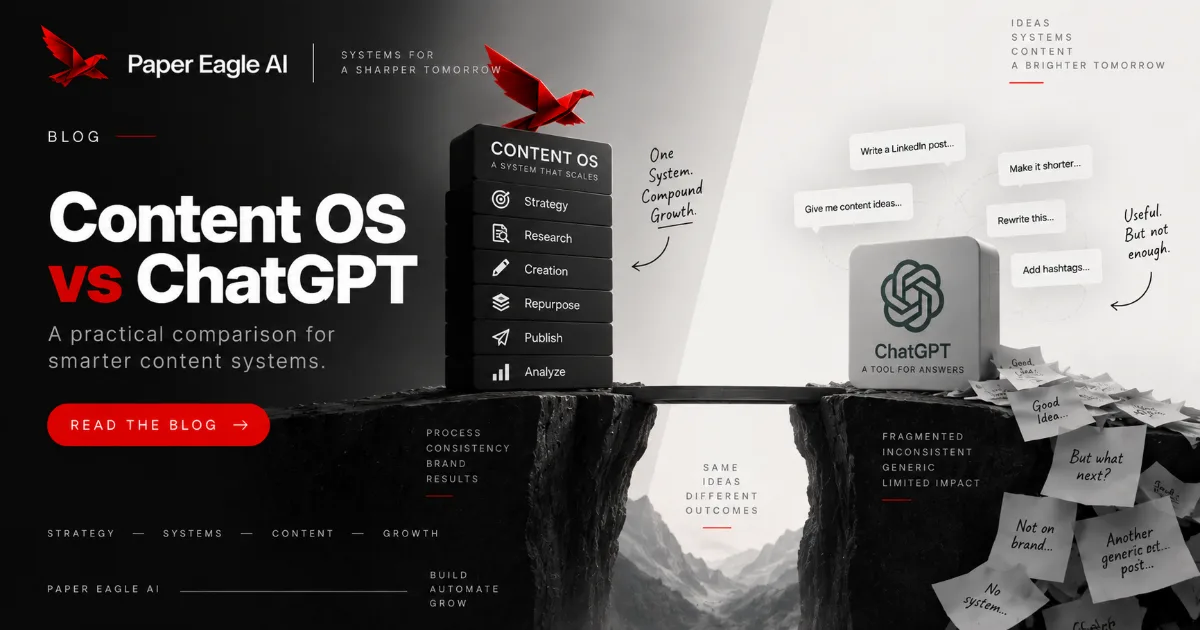
It's a fair question, and it deserves a straight answer rather than a defensive one. You have access to the same models we do. They write quickly, they write competently, and they cost almost nothing. So what exactly would a system add? The honest answer is that a language model solves one part of the content problem extremely well, and leaves the other four largely untouched — and most of the frustration people report with AI content comes from those four, not from the writing.
Everything that has to happen for a piece of content to be worth publishing
- Deciding what to say the topic, the angle, the thing only you know
- Writing it turning a clear instruction into competent prose
- Keeping it consistent and cumulative voice, standard, and what each piece teaches the next
The shape of the work, not a measurement
- The question behind the question
- What a general AI tool genuinely does well
- The first gap: nobody decides what to write
- The second gap: it doesn't know your business
- The third gap: the output drifts
- The fourth gap: nothing holds a standard
- The fifth gap: nothing accumulates
- The same request, run two ways
- The two side by side
- When ChatGPT on its own is the right answer
- What the alternative honestly costs
- Frequently asked questions
- The bottom line
The question behind the question
When someone asks whether they can just use ChatGPT, they're rarely asking about writing quality. They've already seen that the writing is fine. What they're actually asking is why, six months into using it, their content situation hasn't obviously improved.
The question people ask, against the one that decides the answer
What gets asked
"Can it write well enough?"- Is the prose competent?
- Does it sound professional?
- Is it faster than writing by hand?
- Is it cheap?
- Answer, on all four: yes.
What actually decides it
"Why hasn't anything improved?"- Who chose this topic, and why that one?
- What's in it that only we could have said?
- Does it sound like the last twelve pieces?
- Is the two-hundredth piece cheaper than the first?
- Answer, on all four: nothing in the tool addresses this.
That's the interesting question, and it has a specific answer. Producing a piece of writing was never the bottleneck in most businesses. The bottleneck was deciding what was worth writing, knowing enough to say something only you could say, keeping it consistent across everyone who touches it, and doing all of that repeatedly for long enough that it compounds. A language model is a remarkable solution to the one part that wasn't the constraint.
This isn't an argument against AI. At Paper Eagle AI we build with these models daily — Claude Code and n8n run most of what we deliver. It's an argument about what has to surround a model before its output becomes an asset rather than a stack of documents.
What a general AI tool genuinely does well
It's worth being precise about the strengths, because a comparison that undersells the alternative isn't useful to anyone. A capable general model is excellent at turning a clear instruction into competent prose. It restructures messy thinking into something ordered. It produces a serviceable first draft far faster than a person can, which matters enormously if the alternative is a blank page for three days.
Six jobs, and how a bare general model actually handles each
- Turn a clear instruction into competent prose. Genuinely excellent, and faster than any person.
- Restructure messy thinking into something ordered. Reliably good, and undervalued.
- Argue against a position, or reframe an idea five ways. A real thinking partner, cheaply.
- Sound like your business. Only for as long as someone keeps pasting the context in.
- Decide what is worth writing about. It will write about anything you name and will not name anything.
- Remember what last month taught you. Every session starts from nothing.
It's also a genuinely good thinking partner. Asked to argue against a position, list the objections to a plan, or reframe an idea five ways, it does that well and cheaply. For a founder who knows what they think but struggles to get it out of their head and onto a page, that alone is worth the subscription.
And it has effectively removed the excuse of not having time to write. Whatever else is true, that's a real shift, and any honest account of the last few years has to start there.
The first gap: nobody decides what to write
Open a chat window and it will write about anything you name. It will not tell you what to name. That sounds trivial and it's the single biggest reason AI content programmes stall.
The pipeline as most AI content programmes actually run it
- 01Choose the topicnobody owns this — it defaults to whatever occurred to someone that morning
- 02Draft itfast, competent, no complaints
- 03Publish iton time, and unrelated to the last one
- 04Twelve months ona body of work with no shape, on subjects chosen by mood
Without a plan, topic selection defaults to whatever occurred to someone that morning. The result is a body of work with no shape — twelve pieces that don't reinforce each other, scattered across subjects chosen by mood. Search engines and answer engines both read that as a site with no particular authority on anything, because that's an accurate reading of it. They are also reading the same signals: Google's own guidance on AI Overviews and AI Mode says there are no additional requirements to appear in them, and no special optimisation for them — which means there is no separate trick that rescues an incoherent body of work from either.
A system decides first and drafts second. Topics come from a deliberate map of what the business knows, what its buyers actually ask, and where the gaps are. Each piece is chosen partly because of what it sits next to. That's the difference between publishing and building a content cluster, and it's a decision no model can make for you, because it depends on facts about your business and market that were never in its training data.
The second gap: it doesn't know your business
This is the real one, and it's worth sitting with. A language model knows an enormous amount about the world in general and nothing whatsoever about you specifically. It has never spoken to your customers, sat in your delivery meetings, or watched a deal fall through for a reason you now build your whole pitch around.
What the model would need to read, and where it currently lives
- what-only-you-know/ none of this was in the training data
- positioning.md in the founder's head
- customer-language.md in call recordings nobody re-reads
- arguments-we-have-earned.md in three years of delivery
- claims-we-refuse.md learned from a deal that fell through
- what-clients-actually-ask.md in a Slack thread from March
A Content OS is largely the act of moving this column from the right to the left.
So when you ask it to write about your subject, it writes the median version — the average of everything written on that topic by everyone. That output isn't wrong. It's just indistinguishable, which for content meant to differentiate you is the same as being wrong. The reason so much AI content reads as hollow isn't that a machine produced it. It's that nobody gave the machine anything only they knew.
You can close some of this gap by hand, and people do, pasting background into every session. ChatGPT has a tidier version of the same move — a project keeps related chats, files, instructions and sources together, so the background stops being retyped — and it is worth using. What neither closes is ownership: the context lives in one person's habits and one vendor's account, gets stale without anyone being responsible for noticing, and describes only whatever that person thought to upload. A Content OS closes it structurally instead. The knowledge is captured once — positioning, voice, customer language, the arguments you've earned the right to make, the things you refuse to claim — and every draft starts from it automatically. We wrote about what that capture involves in how to identify your knowledge pillars.
The general principle is one of our beliefs: technology is a tool, never the goal. The model isn't the valuable part. The organized knowledge you point it at is.
The third gap: the output drifts
Ask for the same thing on two different days and you'll get two different voices. Both defensible, neither the same. Add a second person writing their own prompts and the spread widens again.
How much each piece sounds like the last one, across a year of publishing
Left to right: piece after piece
Bottom to top: how much it sounds like you
- Prompted from taste — defensible every time, consistent never
- Drafted against a documented voice
Drift is tolerable when one person writes everything and edits by instinct. It becomes a real problem the moment content is a team activity, because there's no shared definition of right — just individual taste, applied inconsistently. Readers notice before anyone internally does. The brand stops sounding like one company.
Documented voice fixes this, and it's more tractable than people assume. Voice feels subjective because it's usually undocumented. Written down properly — sentence rhythm, the words you use and the ones you refuse, how you handle a claim you can't fully support — it becomes a standard a draft can be measured against, by a person or by a model. It doesn't flatten the voice. It stops the voice depending on who happened to write that day.
This is a well-worn shape in tooling, not a content-team invention: Claude Code reads its standing instructions from ordinary files at the start of every session for exactly the same reason — a rule in a file gets read every time, and a rule in somebody's head gets read when they remember it. Writing the standard down is only half of it, though — a standard has to be applied on a schedule or it quietly stops being applied at all, which is how automated content stops working without anyone noticing.
The fourth gap: nothing holds a standard
A model will tell you a draft is good if you ask it. It has no stake in the answer and no view of what you've already published, so it can't tell you the piece repeats something you ran in March, or that the claim in paragraph four is one you've decided not to make.
Is there a written standard, against is anything checking against it
Written · checked
A standardEvery draft is measured against the same explicit bar, by a person or a model. Disagreements are about the bar, not about taste.
Not written · checked
One person's tasteWorks beautifully until that person is busy, and can't be delegated because it was never articulated.
Written · not checked
A documentThe rubric exists, nothing runs it, and everyone assumes someone else is.
Not written · not checked
"Does this look alright?"Where most AI content programmes actually sit. The model says yes, because you asked it.
Left column: the standard is written down
Top row: something checks against it
Quality control is a function of the system around the writing, not of the writing tool. That means an explicit standard applied every time: is this accurate, is it genuinely ours, does it say something the reader can't get elsewhere, does it earn its place next to what we've already published? We set out one version of that in content scoring. The specific rubric matters less than having one at all — an unwritten standard is indistinguishable from no standard once more than one person is involved. If you want a starting rubric you didn't write yourself, Google publishes one: a list of self-assessment questions for people-first content, including whether a piece offers original information and demonstrates first-hand expertise. It is not your standard — it can't be, it knows nothing about you — but it is a defensible floor to build one on top of.
The fifth gap: nothing accumulates
This is the quietest problem and the most expensive over time. Every chat session starts from nothing, and that is the architecture rather than an oversight: OpenAI's own documentation notes that each text-generation request is independent and stateless, with continuity supplied by whatever gets sent along with it. Whatever you worked out last month — the framing that finally landed, the objection that keeps coming up, the phrase customers repeat back to you — is gone. You supply it again, or you don't and the work is slightly worse.
What the first, tenth and two-hundredth piece each cost to produce
Piece one
Explain the business from scratchPaste in the positioning, the audience, the tone you want. It works. It takes a while.
Piece ten
Explain the business from scratchYou've got faster at pasting. The context is slightly different each time, because you're recalling it rather than reading it.
Piece two hundred
Explain the business from scratchIdentical cost to piece one. Nothing about the previous 199 has made this one cheaper or better.
The same year, with a system
Each piece leaves something behindA position gets recorded, a client question gets logged, a phrase that landed gets kept — so piece two hundred starts from all of it.
That means the two-hundredth piece costs roughly what the first one did. There's no leverage, which is the whole reason systems are worth building. A Content OS is designed so the opposite happens: each piece feeds the knowledge base, each published result informs the next choice of topic, and the marginal cost of good work falls. That's what we mean by content that compounds, and it's structural. It doesn't happen because you tried harder.
The same request, run two ways
Five gaps described in the abstract is four too many to hold in your head, so here is all of it collapsed into one request, made twice. Same model, same subscription, same person typing. The only difference is what the model can read before it starts.
The first run is what most people mean by "just using ChatGPT": a clear, well-written prompt, typed from memory. The second run is the identical request pointed at a knowledge layer.
One request, two runs, and the difference is the input
- >Run 1 — bare: "Write an article about how we handle client handovers. We're a consultancy. Keep it practical."
- ·Produced 1,100 words. Competent. Structure: what a handover is, why it matters, five best practices, a checklist.
- ·Nothing in it is untrue. Nothing in it is yours. The five best practices are the five everyone publishes.
- >Run 2 — same request, but read knowledge/ and voice/ first.
- ·Read positions.md — you hold that handovers are written, never spoken, and the reasoning is recorded.
- ·Read questions-clients-ask.md — three clients asked this, and all three phrased it as a worry about losing context.
- ·Read never-say.md — dropped "seamless", "best practices" and two others.
- +Produced 1,300 words opening on the losing-context worry, arguing the written-not-spoken position, in your sentence rhythm.
- Same model · same cost · the second one could only have come from you
Notice which of the five gaps that closes and which it doesn't. Run two fixes context and voice, because both were written down. It does not fix topic selection — a person still decided handovers were worth writing about, and in a real system that decision comes from the knowledge layer noticing three clients asked. It doesn't hold a standard either; nothing checked run two against what was published in March. And on its own it still doesn't accumulate: the position it used was recorded by a person in a file, not learned by the model.
That's the honest shape of it. The tooling — Claude Code reading the folder, n8n moving the approved draft into the distribution queue — closes two gaps outright and makes the other three cheap to close with a scheduled review, which is the build we set out step by step in how to automate content creation. None of that is a criticism of the model. It's the difference between an engine and a car, and the argument of this post is only ever that you need the rest of the car.
The two side by side
Set out plainly, the division is clearer than the debate usually suggests. The left column isn't a competitor to the right one — it's a component of it.
| A general AI tool on its own | A Content OS (with the same tools inside it) | |
|---|---|---|
| Deciding what to write | Whatever you think of that day | A map of pillars, gaps, and real buyer questions |
| What it knows about you | Only what you paste in, each session | Captured once, supplied to every draft automatically |
| Voice | Varies by prompt, by person, by day | Documented, so it can be checked rather than felt |
| Quality control | Whoever is reviewing, however they feel | An explicit standard applied to every piece |
| Who can run it | Anyone — but each to their own standard | Anyone — to the same standard |
| What accumulates | Nothing; every session starts cold | Knowledge, and the results that inform what's next |
| Cost of the 200th piece | About the same as the first | Lower, because the groundwork is already done |
| If the person running it leaves | Their prompts and context go with them | The system stays; someone else picks it up |
Read down the left column and notice that none of the entries are complaints about writing quality. Every one of them is about something happening outside the chat window — who chose the topic, what the model was given to work from, whether anything checked the result, what survived to the next piece. That's the reason "the models are getting better" doesn't resolve the left column: better models write the left column's drafts more fluently and leave every one of those rows exactly where it is.
The second thing worth noticing is that the right column doesn't remove the left one. A Content OS runs on the same models, typed into by the same people. What changes is what surrounds the draft — which is why the honest framing isn't "system versus tool" but "tool with nothing around it versus tool with something around it." Nobody in the right-hand column stopped using AI. They stopped asking it to supply the parts it structurally cannot.
When ChatGPT on its own is the right answer
Sometimes it genuinely is, and it would be dishonest to pretend otherwise given what we do for a living.
How much it has to sound like you, against how many people touch it
A one-off launch page
Internal notes
A solo founder's blog
A real acquisition channel
Across: how many people touch the content
Up: how much it has to sound like you
If you're publishing occasionally and it isn't a meaningful route to customers, a system is overhead you don't need. If you're one person who writes well, holds the voice in your head, and has no plan to hand it to anyone, a saved prompt and good instincts will carry you a long way. If you're still working out what your business is — pre-product, pre-positioning — then the knowledge a system would capture isn't stable enough to be worth capturing yet. Build the business; systematize when there's something settled to systematize.
The threshold is roughly this: a system starts paying when more than one person touches the content, when consistency across time matters more than any single piece, or when content is a real acquisition channel rather than an occasional signal of life. Below that line, use the tool directly and spend the saved effort elsewhere. We'd rather tell you that than sell you something premature.
Frequently asked questions
Does a Content OS replace ChatGPT?
No. A Content OS uses tools like ChatGPT and Claude — they sit inside it as the drafting layer. What the system adds is everything around the draft: what to write and why, the knowledge the model draws on, the standard the output is measured against, and where the piece goes once it's finished. The model is the engine, not the car.
Won't better AI models make content systems unnecessary?
It's the other way around. Every improvement in model quality raises the value of good context, because a more capable model does more with what you give it and still can't invent what you never told it. The gap between businesses using AI well and badly isn't model access — everyone has the same models. It's whether their knowledge was organized enough to hand over.
Can't I just save a long prompt with all my brand guidelines?
You can, and it helps — a saved prompt or a custom GPT is a real improvement over starting cold. It breaks down at scale rather than in principle. One person's saved prompt doesn't cover a second writer, doesn't get updated when positioning shifts, doesn't decide what to write next, and doesn't survive that person leaving. A prompt is a note to yourself; a system is infrastructure.
Is AI-written content bad for search visibility?
How it was produced matters less than whether it's genuinely useful and genuinely yours. Search engines and answer engines both reward content with real substance, a clear point of view, and information nobody else has. Generic AI output fails that test not because a model wrote it, but because it contains nothing specific. The same model, given real expertise to work from, produces something worth citing.
What if I'm a solo founder with no team?
Then the system matters more, not less — you're the single point of failure. A solo founder using AI without structure spends their scarcest resource, attention, re-explaining the business every session. Documenting the knowledge once means every future draft starts from it, and it's already there the day you hire someone or step back.
Why does AI-written content sound generic?
Because a language model writes the median version of any topic — the average of everything written about it by everyone — unless you give it something only you know. The hollowness isn't caused by a machine doing the writing. It's caused by nobody supplying the specific positioning, customer language and hard-won arguments that would have made the piece yours. Fix the input and the same model produces something unrecognisably better.
Can custom instructions or a project file replace a Content OS?
They close part of the gap and they are worth using. What they don't do is survive contact with a second person or with time. Custom instructions live in one person's account, drift out of date silently, and cover context but not the other four gaps — nothing in them decides what to write, holds a quality standard, or accumulates what each piece taught you. Think of them as the smallest possible version of the knowledge layer, which is genuinely a good place to start.
Do you use AI to write content yourselves?
Yes, daily — Claude Code and n8n run most of what we deliver. The distinction we draw isn't between using AI and not using it. It's between pointing a model at a blank prompt and pointing it at an organised knowledge layer, a documented voice and an explicit quality standard. Same model, same cost, completely different output, because the valuable part was never the model.
What the alternative honestly costs
It would be easy to end there, and it would leave out the part that actually decides this. The comparison isn't fair on cost, and pretending otherwise helps nobody. A subscription is twenty dollars a month and starts working in the time it takes to open a tab. A Content OS is weeks of work before it returns anything at all, and most of those weeks are yours.
The bill is mostly attention, not money. The expensive item is knowledge capture — sitting with the questions your customers actually ask, the framings that land, the objections you answer on every call, and writing them down properly. That work can't be delegated, because it's the thing only you know; that's the entire point of it. In our experience it's somewhere between two and five sessions of a few hours, spread over a fortnight, and founders consistently find it the least comfortable part. Not because it's difficult, but because it surfaces how much of the business has only ever existed in one person's head.
After that the costs drop sharply. Writing the standard is an afternoon. Wiring the repetitive steps is a few days of setup, and tools like Claude Code and n8n compress it further — but they compress the assembly, never the thinking. The first month is genuinely slower than just using the model directly, which is worth knowing before you start rather than discovering in week three. The crossover comes when the second person uses the system without asking you anything, or when the twentieth piece takes noticeably less out of you than the fifth did.
And it can fail to pay back. Three ways, all of them avoidable: the knowledge base gets built once and never fed again, so it ages into a museum; someone else builds it and hands it over without training anyone to run it, so it works until the first thing breaks; or it was built before the business settled, capturing positioning that changed two months later. None of those is a failure of the idea. They're the three ways people buy structure without buying the habit that keeps it alive, and any honest version of this argument has to say so.
The bottom line
The question was never ChatGPT or a system, because a Content OS is largely a structure for using tools like ChatGPT properly. The models are the cheapest, most commoditised part of the arrangement — you have the same ones your competitors have, which is exactly why the model can't be the advantage.
What differs between two businesses using identical tools is what surrounds them: whether anyone decided what was worth writing, whether the machine was given something only that business knows, whether there's a standard, and whether any of it accumulates. That's the part worth building. The writing was never the hard bit.
The system around the model is the part that takes work. That's what content automation is — the pipeline a chat window can never be on its own. If you're still weighing it up, three myths about content systems covers the objections we hear most.
Disclosure
This post was written by Shreyas Dave, founder of Paper Eagle AI. We sell content automation services, which is the category this article is about, so we have a commercial interest in you concluding that a system beats ad-hoc effort — read it knowing that. No tool vendor was involved in writing it, nobody paid for a mention, and there are no affiliate links anywhere on this site. Where a third-party figure appears, it’s attributed to the publisher it came from; anything we couldn’t source is written as a direction rather than a number.
Paper Eagle AI builds Content Operating Systems that turn a business’s knowledge and expertise into consistent, multi-platform content, and we deliver them as content automation services. Working as a content automation specialist, we capture what a business knows and how it sounds, set the strategy, and build the workflows that research, draft, repurpose and publish — with a named person approving every piece before it goes out. Every build runs through discovery, design, build and handoff. The system lives in the client’s own accounts, it is documented, the team is trained to run it, and the business owns it outright. We don’t write content on a retainer, and we don’t build lead generation, CRM or sales automation.
One source of thinking becomes native content for every platform a business publishes on: the founder’s LinkedIn and the company page, YouTube and Shorts, Instagram and Reels, TikTok, Reddit, Medium, newsletters, and the company’s own website, written to be found in Google and understood by AI search. Our multi-platform content automation page shows how they share one source, and our case studies document the systems behind our own publishing, file by file. You can follow the work on the company’s own channels: Paper Eagle AI on Instagram, Paper Eagle AI on YouTube, the Paper Eagle AI company page on LinkedIn, Paper Eagle AI on Substack, Paper Eagle AI on Reddit and Paper Eagle AI on Medium.
Keep reading
- What is a Content OS? — the definitive guide to the system this article keeps referring to.
- Content OS vs. content agency — the same comparison against the other common alternative.
- How LLMs use content — what models actually do with what you publish, and how to be cited.