How to Automate Content Repurposing Without Creating Echoes
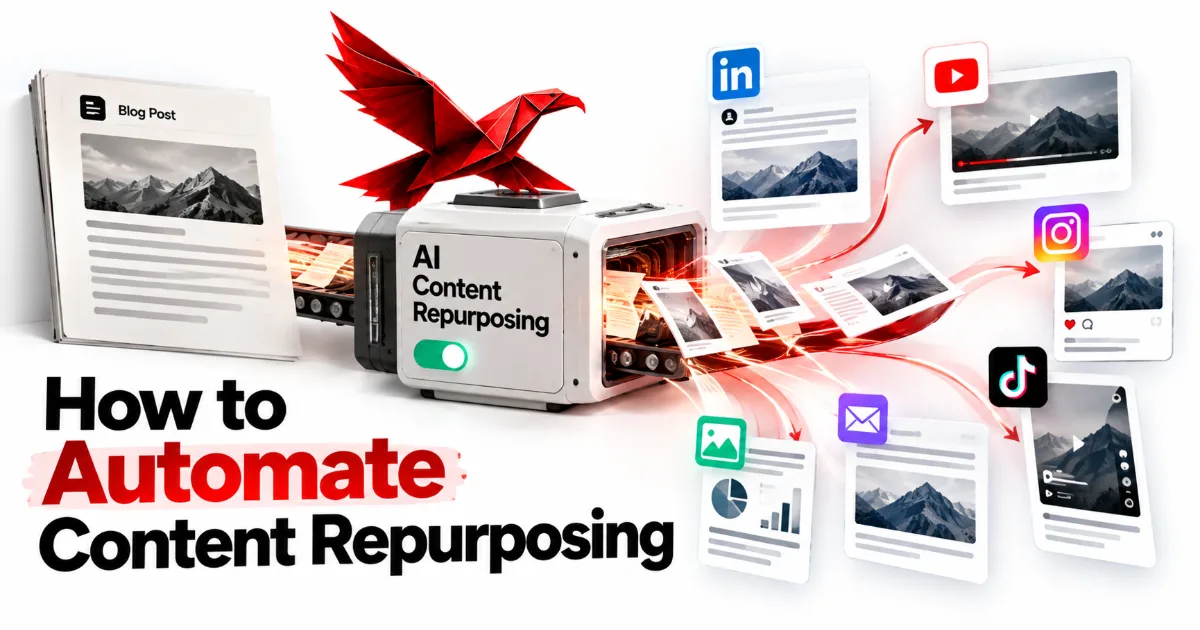
Here is how to automate content repurposing without turning one good idea into six tired copies: build the controls first and the copying last. Automated content repurposing takes one source, such as a video, a recorded talk or an article, and turns it into a version written for every platform you publish on, and it fails in six predictable ways. Thin sources get amplified, facts drift between rewrites, near-duplicates pile up, numbers appear that nobody said, one audience meets the same idea three times, and material that should never travel gets published. This guide gives the control that stops each one, draws the line between what a machine runs and what a person decides, and runs the whole sequence on one of our own videos.
One source, six controls, every platform
- 01Gateis this source worth repeating at all
- 02Extractthe distinct ideas, each tagged to the source
- 03Ledgerone home per idea: a platform, later, or cut
- 04Builda native version per platform, read from the source
- 05Checkoverlap and numbers, against the source
- 06Approvea person reads every version side by side
- How to automate content repurposing: the six controls
- The six content repurposing mistakes automation makes faster
- Repurpose from the source, never from a copy
- The idea ledger, and what content should not be repurposed
- Is repurposed content duplicate content?
- The audience who follows you everywhere
- Worked example: one of our own videos, through the six controls
- What is automated, and what stays human
- What it honestly costs to run
- Frequently asked questions
- Where to start
How to automate content repurposing: the six controls
You automate repurposing safely by putting six controls around the copying: a source gate, a rule that every version is built from the source, an idea ledger, an overlap check, a number check and one human pass. The copying itself, turning a transcript into a LinkedIn post or an article into a carousel script, is the part any capable model now does adequately. What separates a repurposing system from a content spinner is everything around that step. Without the controls, automation makes the same mistakes manual repurposing makes, only faster, and at a volume nobody reads before it goes out.
A repurposing system, stated as a datasheet
- Input
- One source a person chose to repeat: a video, a recorded talk, an article, a long post
- Unit of work
- One idea, not one post; a good source holds several
- Derivation rule
- Every version reads the source, never another version
- Record
- A ledger line per idea: where it went, when, or why it was cut
- Checks
- Shared sentences between versions, and every number against the source
- Human gate
- One read of all versions together, before anything publishes
- In one line
- Six controls around one copying step, and the copying step is the cheap part
Each control answers one failure, and the failures are worth naming before the fixes, because none of them looks like a failure on the day it happens. A drifted quote reads perfectly well. A LinkedIn post and a newsletter paragraph that share half their sentences each look fine on their own. A rounded-up number looks more persuasive than the vague phrase it replaced. Every one of these passes a quick read of a single version, which is exactly the review most teams do, and that is why they ship.
The order matters too. The source gate comes first because nothing downstream can rescue a thin idea, and the human pass comes last because it is the only step that sees all the versions at once. Everything in between can be automated in Claude Code and n8n, and in the systems we build as a content automation specialist for businesses, it is. The rest of this guide takes the failures one at a time, runs the whole sequence on a real source of ours, and then draws the line between the machine and the person.
The six content repurposing mistakes automation makes faster
The six content repurposing mistakes are amplifying a thin source, rewriting from copies instead of the source, publishing near-duplicates, letting in numbers the source never said, hitting one audience with one idea several times, and repurposing material that should never have travelled. None of them is new. Every one happens when a person repurposes by hand on a busy afternoon. What automation changes is the rate: a mistake a person makes once a month, a pipeline makes in every batch, and it makes it with complete confidence.
The same mistake, made by hand and made by a pipeline
By hand
- It happens when someone is rushed.
- It touches one or two versions.
- Someone usually notices the next day.
- The fix is a quiet edit.
- The person learns from it.
By a pipeline with no controls
- It happens on every run.
- It touches every version in the batch.
- Nobody notices until a reader does.
- The fix is a pipeline change, then a clean-up.
- Nothing learns until it is written into a rule.
Here are the six, with what each looks like in practice and the control that stops it. The last column matters most. It says whether the control is something a machine can run or something a person has to decide, and the split comes out at three and three.
| The mistake | What it looks like | The control | Who runs it |
|---|---|---|---|
| A thin source, amplified | Six posts from an idea that barely carried one | A source gate before extraction | A person |
| Rewriting from copies | A quote that changes a little in each version | Every version reads the source directly | The machine |
| Near-duplicates | The same paragraph, lightly reworded, on three platforms | An overlap check across all versions | The machine |
| Invented numbers | "Some clients" becomes "most clients", or a percentage appears | Every number checked against the source | The machine |
| One idea, everywhere at once | Followers meet the same point three times in a day | A ledger with a sequence and a new angle per platform | A person decides, the machine schedules |
| Material that should not travel | A client story, dated news or an offer, moved somewhere it no longer fits | A written list of what never travels | A person |
Read down the last column and a pattern shows. The controls a machine can run are all checks against the source: did this version come from it, does it repeat another version, does every number appear in it. The controls a person has to run are all judgements about the source: is it worth repeating, should this part travel at all, is the result good enough to carry the company's name. That split is the design of the whole system, and it comes back in every section below.
Repurpose from the source, never from a copy
Every version of a repurposed piece should be built from the original source, never from another version, because each rewrite of a rewrite moves a little further from what was actually said. It is the oldest failure in copying, the game where a whispered sentence reaches the end of a line as something else, and automated pipelines reproduce it by default. The convenient design is a chain: the video becomes an article, the article becomes a LinkedIn post, the post becomes a carousel. Each step is cheaper because its input is shorter. Each step also inherits every simplification the step before it made, and adds its own.
One question decides where a version may get its facts
It can be checked against the recording or the original text
- a quote
- a claim
- an example
- a step
Go back to the source and write it again from there
- a summary of a summary
- a tightened quote
- a shortened example
A rewrite added it, and nobody ever said it
- a number
- a result
- a client
- a promise
The design that holds is a star. The source sits in the middle, and every version, whatever platform it is for, reads the source directly along with that platform's written rules. In practice that means the transcript or article is passed into every drafting step, not just the first one. It costs more processing per run, which is a real cost and a small one. In exchange, every claim in every version is one step from something a person actually said, and every check can compare a version to the source rather than to its parent.
The star also makes corrections cheap. When someone catches a mistake in the source, a misheard product name or a figure the speaker got wrong, the fix happens once, and every version rebuilt afterwards inherits it. In a chain, the same correction has to be found and made in each generation separately, and the one that gets missed is the one somebody screenshots. If your current pipeline hands the LinkedIn draft to the carousel step, that is the first change worth making.
The idea ledger, and what content should not be repurposed
An idea ledger is a list of every distinct idea in a source, with exactly one home written against each: a platform, a later post, or cut with a reason. It is the control that stops one idea appearing everywhere while three other ideas from the same source appear nowhere. We run the same law in our own Instagram and LinkedIn systems, where it is part of the distribution method each one follows: the source is broken into tagged pieces, nothing new is added, and every leftover lands exactly once. A person sees the ledger before anything is drafted, because that is the cheapest moment to say no.
What sits between a source and a platform
The ledger is also where content that should not be repurposed gets stopped, because "cut, with a reason" is one of its three answers. Some material is right once and wrong anywhere else. A client's story told in a private call does not travel without that client's agreement. News with a date on it goes stale the moment it moves to a slower platform. An offer, or anything with terms attached, should live in one place you can keep correct. And an argument that only works with the full context of the original, a careful position or a joke that relies on the room, is better left whole than cut into pieces that each say something slightly untrue.
There is a quieter category as well: the weakest parts of the source. Every long conversation contains filler, restated points and half-finished thoughts, and a pipeline told to extract ideas will extract those too. Writing them into the ledger as cut is not waste. It is the record that someone looked and decided, which is the difference between a system that publishes its best thinking and one that publishes all of it.
Is repurposed content duplicate content?
Repurposed content is not duplicate content when each version is rebuilt for its platform; it becomes duplicate content when the same sentences are published in several places with light changes. Google's guidance on duplicates is about choosing between them, not punishing them: when it finds very similar pages, Google says it will identify which version of the URL is objectively the best version to show and show that one. The real risk sits in its spam policies, which name scaled content abuse, and one of the examples given is generating pages through automated transformations like synonymizing, translating, or other obfuscation techniques. That sentence describes a careless repurposing pipeline almost exactly.
How much a reader or a search engine sees twice
Cross-posting unchanged the same text in several places
Light rewording synonyms swapped, sentences reshuffled
A short summary that points to the original a few lines, then a link
Rebuilt for the platform one idea, new structure, new sentences
A judgement, not a score
We measure this on our own publishing rather than guess at it. Paper Eagle AI writes educational posts on Paper Eagle AI's Substack, Paper Eagle AI's Medium and Paper Eagle AI's Reddit account, often from shared research, and a script compares every pair of posts across the three before anything goes up. It counts the runs of eight consecutive words that two posts share, and any pair above 8% has one of the two rewritten. When the first Substack piece was checked against the first Medium story, they shared 3.1%: the same research, in different words. That threshold is our own judgement, not a published standard, and we set it strict on purpose.
Platforms draw the same line in their own terms. Instagram's originality guidance gives a test that works for any repurposed piece: if someone could remove your contribution and the content would be virtually the same, it probably needs more of you in it. Where you genuinely want the same article in two places, the honest route is a canonical link, and Medium's import tool sets one pointing back to the original, which tells search engines which copy is the source. What does not work is the middle ground, a lightly spun copy, which is neither the original nor anything new.
The audience who follows you everywhere
Your most engaged followers are the ones most likely to see every version, so repurposing has to be sequenced, not just distributed. The person who watches your videos, reads your newsletter and follows the founder on LinkedIn is not three audiences. To them, the same argument on three platforms in one afternoon is not reach. It is an echo, and an echo teaches them that two of the three channels can be skipped.
Attention to an idea, each time the same reader meets it
Left to right: times one reader meets the idea
Bottom to top: attention they give it
- The same version, posted everywhere at once
- A new angle each time, spaced out
The control is a sequence, and it lives in the ledger. Each idea gets a first platform, chosen because the idea suits that platform best, then later platforms in a written order with space between them. The later versions are not the same point said again. They come at it from a different side: the example the video skipped, the objection a commenter raised, the step-by-step a short post had no room for. A machine is good at holding that schedule. Deciding which angle is genuinely new is a person's call, and it is usually a quick one once the ledger is in front of them.
There is no reliable number for how long the gap should be, and anyone who quotes one is guessing about an audience that isn't yours. What we can give is the direction. The more your followers overlap between platforms, the more the gap and the change of angle matter, so a company whose LinkedIn and newsletter readers are largely the same people needs more distance between versions than one whose YouTube viewers barely know the newsletter exists. Your own analytics, read monthly, answer the question better than any rule of thumb.
Worked example: one of our own videos, through the six controls
Here is the sequence run on a real source: our video What do we believe in Paper Eagle AI, six minutes and seven seconds long, published in August 2026 and playable at the end of this post. Its argument is short. Most businesses do not have a talent problem; they have a system problem. Work stops because publishing depends on someone remembering to do it, and that someone has a job. A system keeps running when the person who started it is busy, which is why we describe what we build as an operating system rather than a service.
An illustration of the ledger step, run in Claude Code
- >Read the transcript of the what-we-believe video. List every distinct idea, tag each one to where it is said, and add nothing the video does not say.
- ·Read transcripts/what-we-believe.md and ledger/published.md. Four distinct ideas found; one restated point merged into the first.
- +Created ledger/what-we-believe.md: four ideas, each with its place in the video and an empty "home" column.
- ·Idea three, that a system keeps running when its owner is busy, is already the argument of a published blog post. Marked it "not another article" and suggested a short-video angle instead.
- ·Waiting on you: idea four explains why we say operating system. Keep it for the newsletter, or cut it as too company-specific?
- Output · one ledger, one flag, one question · nothing drafted, nothing published
The first control was passed before the session started. The source gate asks whether a piece is worth repeating, and this one is: it is the company's core argument, said out loud by the person who builds the systems. The ledger then did the useful thing a plain extraction would miss. The third idea is already a full post on the blog, why systems beat effort every time, so a new article on it would be exactly the near-duplicate this guide warns about. The ledger records it as covered and sends the idea to a format the blog does not have, such as a short vertical video.
From there, the drafting steps run in the star shape. Each platform draft reads the transcript and that platform's written rules, never the article or another draft, and each one is tagged with the ideas it uses, so the ledger fills in as it goes. The overlap check compares the new drafts with each other and with what is already published, and the number check confirms that every figure in every draft appears in the source. This source contains no statistics at all, so any number that shows up in a draft is invented by definition, and it gets cut. In a client build, the triggers, the schedule and the checks usually run in n8n, started when a new source lands in a folder, with Claude Code doing the reading and drafting.
Then a person reads everything at once. That last step is not a formality. It is where someone notices that two drafts open on the same line, that the newsletter version leans on a phrase the company stopped using, or that the short-video script makes a claim the video only hinted at. We have deliberately put no view counts or results next to this example. The point is the sequence, and the sequence is the same for a six-minute video as for a forty-minute call.
What is automated, and what stays human
In automated repurposing, the machine runs extraction, drafting, formatting, scheduling and every check against the source, and a person keeps the choice of source, the cuts, the order of angles and the final approval. The dividing question is the one we use across all content work, set out in what to automate in your content, and what not to: does this step have an answer you could check? Whether one version shares too many sentences with another has a checkable answer. Whether an idea deserves a second outing does not.
Human judgement needed at each step, most to least
A ranking, not a measurement
That shape is also why fully hands-off repurposing is the wrong goal. The middle of the pipeline is where most of the hours used to go, and it is where automation saves them. The two ends cost a person a few minutes per source, and they are where the quality is decided, so removing them saves almost nothing and risks everything the company publishes under its name. The same split holds across a whole multi-platform operation, which we draw out stage by stage in how to build a multi-platform content pipeline.
One more thing stays human, and it is easy to forget: the rules themselves. Each platform's written rules, the list of what never travels and the overlap threshold are decisions a person made, and a person should revisit them. When the human pass keeps correcting the same thing, the fix belongs in the rules, so the correction is made once instead of every week.
What it honestly costs to run
The honest cost of automated repurposing is not the build; it is the weekly review that keeps the controls honest, a short, regular block of a person's time for as long as the system runs. The build is a one-off piece of work: writing each platform's rules, setting up the ledger, and wiring the drafting steps and checks in Claude Code and n8n. After that, the machine time per source is small. The person's time is what stays.
The weekly review, and what it feeds back
A person picks this week's source and it passes the gate
Ideas listed, homes chosen, cuts written down with a reason
Versions drafted from the source, one per platform the ledger names
Overlap and numbers checked; anything that fails goes back to the build
One read of all versions together, then the sequence runs
The thing that goes wrong in month two is predictable. The ledger stops being read, because the drafts look fine and the review starts to feel like overhead. Then a near-duplicate ships, or one idea runs on three platforms in a week, and nobody can say how, because the record that would explain it was not kept. The answer is not more checks. It is keeping the review short enough that it actually happens, which is why a good system puts the ledger, the overlap report and the drafts on one screen.
There is a cost on the other side as well. A pipeline with these controls produces fewer pieces per source than one without them, because some ideas get cut and some platforms get skipped. That is the point. The number worth watching is not versions per source; it is how many of those versions a reader was glad to see. This is the shape of the content repurposing automation we build, handed over to run in the business's own accounts once it is done.
Frequently asked questions
What is automated content repurposing?
Automated content repurposing is using software to turn one source, such as a video, a recorded talk or an article, into versions written for several platforms, with the extraction, drafting, formatting and scheduling done by machine. Done well, it also automates the checks: that every version came from the source, that versions do not repeat each other's sentences, and that no new numbers appeared. A person still chooses the source and approves what goes out.
Is repurposing the same as cross-posting?
No. Cross-posting publishes the same text in several places, while repurposing rebuilds one idea into a version written for each platform. Cross-posting is quick and produces near-duplicates that platforms and readers both discount. Repurposing takes longer per piece, but each version has its own structure, opening and sentences, which is what makes it worth a separate post.
Will Google penalise us for publishing the same idea on several platforms?
No, an idea told in different words on different platforms is not a duplicate-content problem. Google's guidance on duplicates is about choosing which copy of near-identical pages to show, and its spam policies target pages mass-produced through automated rewording that adds nothing for readers. The risk starts when the same sentences are published again and again with light changes, so rebuild each version rather than spinning it.
How many versions should one source become?
As many as it has distinct ideas worth repeating, and no more. A dense forty-minute conversation can feed several platforms, while a six-minute video with one argument might honestly support three or four pieces. The idea ledger answers this for each source: count the ideas, give each one a home, and cut the rest, rather than aiming for a fixed number of posts.
How long should you wait before posting the same idea on another platform?
There is no reliable universal gap, so set it from how much your audiences overlap. If the same people follow you on several platforms, space the versions out and change the angle each time; if your audiences barely overlap, the gap matters less. Check your own analytics monthly rather than trusting a rule of thumb built on someone else's audience.
Can AI repurpose content without a human reviewing it?
It can, and it shouldn't. Models now draft platform versions well, but they cannot tell whether an idea deserves a second outing, whether a client's story may travel, or whether a version quietly overstates the source. A short human read of all the versions together catches those, and it is the step that decides whether the system publishes good work or just more work.
Which tools does a repurposing system need?
A drafting model, an automation layer and a place to keep the ledger. We build with Claude Code for reading sources and drafting versions, and n8n for triggers, scheduling and running the checks; other automation tools can fill n8n's role in simpler setups. The tools matter less than the controls, because any of them can run a star-shaped pipeline with a ledger and an overlap check.
Where to start
Pick one piece you have already repurposed and lay every version of it side by side. Mark each sentence with where it came from: the source, another version, or nowhere. Then count the ideas in the source and note how many were used once, how many were used twice, and how many never left it. That half hour tells you which of the six controls you are missing, and it costs nothing to do before any automation is built.
The source used in the worked example
The six-minute video the worked example runs through the six controls, from the Paper Eagle AI video library, where you can also follow Paper Eagle AI on YouTube. The player loads from YouTube only when you press play, so nothing is requested from Google before that.
Disclosure
This post was written by Shreyas Dave, founder of Paper Eagle AI. We sell content automation services, which is the category this article is about, so we have a commercial interest in you concluding that a system beats ad-hoc effort — read it knowing that. No tool vendor was involved in writing it, nobody paid for a mention, and there are no affiliate links anywhere on this site. Where a third-party figure appears, it’s attributed to the publisher it came from; anything we couldn’t source is written as a direction rather than a number.
Paper Eagle AI builds Content Operating Systems that turn a business’s knowledge and expertise into consistent, multi-platform content, and we deliver them as content automation services. Working as a content automation specialist, we capture what a business knows and how it sounds, set the strategy, and build the workflows that research, draft, repurpose and publish — with a named person approving every piece before it goes out. Every build runs through discovery, design, build and handoff. The system lives in the client’s own accounts, it is documented, the team is trained to run it, and the business owns it outright. We don’t write content on a retainer, and we don’t build lead generation, CRM or sales automation.
One source of thinking becomes native content for every platform a business publishes on: the founder’s LinkedIn and the company page, YouTube and Shorts, Instagram and Reels, TikTok, Reddit, Medium, newsletters, and the company’s own website, written to be found in Google and understood by AI search. Our multi-platform content automation page shows how they share one source, and our case studies document the systems behind our own publishing, file by file. You can follow the work on the company’s own channels: Paper Eagle AI on Instagram, Paper Eagle AI on YouTube, the Paper Eagle AI company page on LinkedIn, Paper Eagle AI on Substack, Paper Eagle AI on Reddit and Paper Eagle AI on Medium.
Keep reading
- Content Multiplication: Do More With What You Have — why one idea should become several pieces in the first place, before you automate any of it.
- Content Automation Specialist for Multi-Platform Content — how one video is translated into something native for each platform.
- Why Automated Content Stops Working — what happens to an automated system once nobody is reading the review.