Content Operating System vs Content Agency: Which Builds a Lasting Asset?
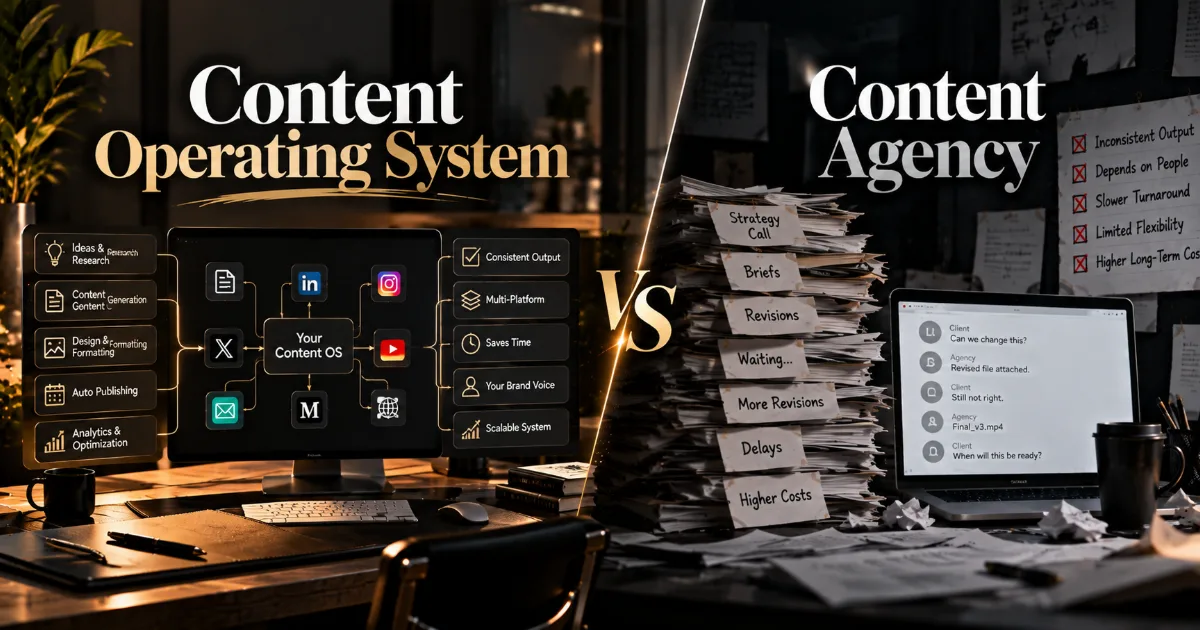
Most comparisons of a content operating system vs content agency weigh speed and price, but the more useful test is what is still working for you a year after the contract ends. A content agency leaves a published archive, which is a real asset when it lives on your own domain and channels. A Content OS leaves that archive too, plus the four things that produced it: the business’s knowledge written down, a reference for its voice, the workflows, and a record of what worked. Those four only last while a named person keeps them current, so the honest answer depends as much on who will own the upkeep as on which model you buy.
The asset test, walked through an agency retainer and a Content OS
Agency retainerContent OS
Written down
in the writers’ heads and the agency’s notes
in files the business can read
In your accounts
the archive, if published on your domain
all five assets, in the business’s own accounts
Runnable by others
only the published pieces
the workflows and the voice reference
Keeps its value
the archive keeps much of it
only while a named person keeps it current
- Content operating system vs content agency: the difference that outlasts the contract
- What a content agency retainer leaves you that lasts
- What a content operating system leaves you that lasts
- Content as a business asset: the ledger, line by line
- Owned is not the same as lasting: how each asset decays
- When an agency is the better buy, and when a Content OS is
- What a system can keep, and what only people carry
- Worked example: three requests put through the asset test
- What a lasting content asset costs to build and keep
- Frequently asked questions
- Where to start
Content operating system vs content agency: the difference that outlasts the contract
The difference between a content operating system and a content agency is what each one leaves behind once the people who built it stop working on it. An agency’s work lasts as published content: the articles, posts and videos that keep answering searches and sitting in your feeds after the retainer ends. A Content OS lasts as published content and as the machinery that produced it, held in your accounts and written down so that someone else can run it. Both leave something real; they differ in how much, where it lives, and how fast it stops being useful.
The four questions of the asset test
- 01Written downnot carried in someone’s head
- 02In your accountsin an account the business controls
- 03Run by othersa new person could run it from what is written
- 04Keeps its valueit does not lose value without the original team
Accounting offers a strict definition of a lasting asset. The IFRS Foundation’s standard IAS 38 Intangible Assets calls an intangible asset identifiable when it is separable or when it “arises from contractual or other legal rights”, and asks whether future economic benefits are probable. Nobody puts a content system on a balance sheet, but those are the right two questions: can you hold it apart from the people who made it, and will it keep paying out once they have gone?
In practice we use four plainer questions, and the rest of this post applies them to every item a content engagement can leave you. Is it written down, rather than carried in someone’s head? Is it in an account the business controls? Could a new person run it from what is written? Does it keep its value without the original team, or lose it? We call that the asset test. Our piece on a Content OS vs a content agency and the choice between renting and owning argues why ownership matters; this one asks which of the things you own will still be worth something next year.
What a content agency retainer leaves you that lasts
A content agency retainer leaves you one asset that lasts, the published archive, and it lasts only when it was published on your domain and your channels, under accounts you control. An article that answers a real question can bring readers for years, and a library of good pieces is still yours when the agency moves on. Almost everything else that made those pieces good stays with the agency, because that is where its own value as a business sits.
What stays where after a content agency retainer
A retainer’s work
- Published archive the pieces on your domain and channels
- Briefs and interview notes what your experts told the agency
- Editor’s sense what you would never say
- Record of what landed which topics worked
Rough shares — a shape, not a measurement
Where the archive lives decides whether it holds its value. Google’s documentation on site moves and migrations explains that properly redirected pages give Google time “to transfer all signals to the new URLs”, and it tells site owners to “expect temporary fluctuation in site ranking during the move.” An archive published on an agency’s blog, a guest network or a domain the agency registered is search value you would have to move later, at a cost, if you were allowed to move it at all. Published on your own site, it stays put.
What stays behind with the agency is everything upstream of the published piece. That means the interview notes with your experts, the brief for each article, the editor’s growing sense of what you would never say, and the record of which topics actually landed. None of it is held back in bad faith; it lives in the agency’s drive and its writers’ heads because that is where the work was done. When you leave, all of it stays behind. The pieces were the part of the work that got used once; the notes were the part that would have kept working.
Who owns the pieces themselves is a contract question. Most retainers assign the published work to the client, but read the intellectual property clause rather than assume, and have a lawyer read anything you are about to sign. Our comparison of a content automation agency vs a content agency walks through what to look for in that contract. The question here is the next one: once the posts are yours, what else ought to be?
What a content operating system leaves you that lasts
A content operating system leaves five things that last: the published archive, the business’s knowledge written down, a reference for how it sounds, the workflows that turn the knowledge into content, and a record of what worked. All five sit in the business’s own accounts. The archive is the same asset an agency leaves, and the other four are the whole difference. They are why a Content OS keeps producing after its builders have handed it over.
What a content operating system leaves behind
- Published archive
- the same asset an agency leaves, on your domain
- Knowledge
- positions, proof and customer words, filed so a model can find them
- Voice reference
- how the business sounds, written down
- Workflows
- portable files, backed up or handed to a new developer
- Record of what worked
- analytics and a decision log beside the workflows
- Where it lives
- all five in the business’s own accounts
The knowledge is the largest of the four. It is the positions the business holds, the proof behind each one, the words its customers use for their problems, and the claims it will not make, filed so that a person or a model can find the two entries that matter for a given idea. Anthropic’s engineering team calls the discipline of choosing what a model sees effective context engineering for AI agents, and describes the aim as “finding the smallest possible set of high-signal tokens”. A knowledge base built to that standard serves every writer and every model the business will ever use, which is precisely what lets it outlast any one of them. The way to file it is in our guide to organizing business knowledge so it compounds.
The workflows are the second difference, and they only last because they can be carried. n8n, the tool we build most automation in, states in its guide to exporting and importing n8n workflows that it “saves workflows in JSON format”, so a workflow running in your instance can be backed up, moved, or handed to a new developer as a single file. Instructions written for Claude Code behave the same way: they are plain text in a repository you own, readable by a person and followable by the model.
The record of what worked is the asset most often left out of the count. Which topics brought readers, which drafts the approver sent back and why, which platform stopped rewarding a format: written down, that is the business’s own playbook, and our guide to measuring whether a content system works covers what is worth recording. Kept in your own analytics with a decision log beside the workflows, it is what the next person reads on day one. All five belong to a content operating system built around what your business knows, and the rest of our content operating system guides take each part further.
Content as a business asset: the ledger, line by line
Content as a business asset is easiest to judge line by line, so the table lists every asset a content engagement can leave, where each one ends up under each model, and what keeps it alive. For each row, ask whether that asset ends up somewhere you control, in a form someone else could use.
How much of each asset stays with you after an agency retainer
Published archive yours, if published on your domain
Channel accounts often run through the agency’s logins
Performance record a monthly report the agency sends
Knowledge base in the agency’s interview notes and briefs
Workflows and prompts in the agency’s own workspace
A judgment, not a score
| Asset | After an agency retainer | After a Content OS build | Loses value when | Kept alive by |
|---|---|---|---|---|
| Published archive | Yours, if published on your domain and channels | Yours, on your domain and channels | Pages move without redirects, or old facts go out of date | Redirects for any moved page, and a review of the pieces that still bring readers |
| Channel accounts and analytics | Often run through the agency’s logins | In your name, with the builder given a role and then removed | Ownership sits with someone who has left | A named owner on every account, and contractors as users |
| Knowledge base | Spread across the agency’s interview notes and briefs | Files in your accounts, organised by subject | Positions change and nobody updates the file | A monthly pass by the person who approves content |
| Voice reference | In the writers’ heads and the agency’s style notes | A file of rules and approved examples | Examples go stale, or the business changes how it speaks | Adding each newly approved piece and retiring old ones |
| Workflows and prompts | In the agency’s own workspace | Exported, documented, and in your accounts | A model is retired or a platform changes its API | A named maintainer and a checked list of dependencies |
| Review rules | Agreed in emails with an account manager | Written into the workflow: who approves what | Approvers change and the rule is never rewritten | Updating the rule the day the person changes |
| Performance record | A monthly report the agency sends | Your own analytics plus a decision log | Nobody reads it before choosing the next topic | Making the log the first input to planning |
Two rows decide most comparisons. The archive appears in both columns, which is why an agency is never wasted money if its work was published on your own site. The accounts row decides whether you can keep anything else, because a knowledge base or a workflow inside an account you do not control is still on loan. Google is explicit about this for Search Console: its help page on managing Search Console owners, users and permissions says an owner “has full control over properties”, and that if every verified owner is removed, “all remaining users and delegated owners will lose access to the property after a grace period.” The business should be the verified owner and the vendor a user, whichever kind of vendor it is.
YouTube draws the same line on its own platform. Its help page on YouTube channel permissions lets several people manage one channel at different levels, and only the Owner can delete the channel; a Manager or an Editor cannot. An agency or a builder should hold a Manager or Editor role on a channel you own, and never the other way round.
Owned is not the same as lasting: how each asset decays
Owning a content asset does not make it last; every asset in the ledger loses value on its own schedule, and a Content OS left alone decays faster than an agency’s archive. An article written two years ago keeps much of its value with an occasional update. A workflow that nobody has touched for the same two years has probably stopped running, because the things it depends on have changed underneath it. What that upkeep looks like as a written part of the system, part by part, is set out in how to keep a content operating system from going stale.
An archive and an untended workflow, over the same two years
a model is retired or a platform changes its API
Left to right: about two years
Bottom to top: how much of its value the asset still has
- an archive with an occasional update
- a workflow nobody maintains
The models change first. OpenAI’s page on OpenAI API deprecations uses “sunset” and “shut down” to mean a model or endpoint “is no longer accessible”, and tells developers to migrate before the date. Even a model that stays available can shift. A study on arXiv by Lingjiao Chen, Matei Zaharia and James Zou, How is ChatGPT’s behavior changing over time?, found that “the behavior of the ‘same’ LLM service can change substantially in a relatively short amount of time”, and called for continuous monitoring.
The platforms change next. LinkedIn’s documentation on LinkedIn Marketing API versioning says versions are released monthly and each is “supported and stable for a minimum of one year before sunset”, and it adds that integrations go best when they are “regularly maintained (at least once per year).” A publishing connection built once and never revisited has an expiry date, even if nobody ever wrote that date down.
The knowledge changes last and most quietly. A model’s own sense of what is current is often older than it looks: a paper on arXiv, Dated Data: Tracing Knowledge Cutoffs in Large Language Models, found that “effective cutoffs often differ from reported cutoffs”. That is a good reason to keep the business’s current positions in its own files rather than trust a model to know them, and it is also why those files need someone to keep them up to date. The upkeep for each kind of decay is in why automated content stops working. The four extra assets a Content OS leaves are worth more than an archive only while somebody looks after them.
When an agency is the better buy, and when a Content OS is
An agency is the better buy when the need is short, the knowledge is not yet settled enough to write down, or nobody in the business could own a system; a Content OS is the better buy when the expertise recurs, the need is permanent, and a named person can give a few hours a week to keeping it current. The asset test makes the situation visible before money is spent.
Which to buy, by the need and the owner
Named owner · short need
Agencya launch or campaign needs skilled output soon
Named owner · recurring need
Content OSthe expertise recurs and someone keeps it current
No owner · short need
Agencynobody could own a system and the knowledge is unsettled
No owner · recurring need
Agency with handoversgood handover terms until someone can own the upkeep
Left column: the need is short
Right column: the expertise recurs
A launch, a campaign, a one-off series, or a year spent finding your positioning are all good uses of an agency. In each, what you mostly need is skilled output soon, and the knowledge worth capturing does not exist yet in a stable form. Employing people is a third route, set out in content automation services vs hiring a content team, and a single contractor is a fourth, covered in content automation specialist vs freelancer.
A Content OS earns its build when the same expertise has to reach readers week after week. Think of a firm whose partners answer the same client questions on every call, a founder who explains the same ideas on stage and in sales meetings, or a team publishing on several platforms from one body of knowledge. The knowledge base and workflows are used every week, so keeping them current costs little next to starting again. If you are choosing someone to build it, how to choose a content automation agency lists the checks and the evidence each one needs.
If an agency is the right call, you can still make it leave more than posts. Ask for five things in the contract, delivered into your own drive as the work happens rather than at the end: the brief for every piece, the notes from every interview with your people, a running style sheet of the voice decisions the editors make, the analytics in accounts you own, and the source files of anything designed. Together they become the first draft of a knowledge base. The account matters as much as the file. Zapier’s page on managing assets in your Zapier account describes changing a Zap’s owner as a transfer to “another user in your account”, so automations an agency builds inside its own Zapier account do not come with you when you leave.
What a system can keep, and what only people carry
A system can keep everything that can be written down and run again; what only people carry is the judgement about what is worth saying, and that judgement sits with the agency’s team in one model and with your named approver in the other. That is the real line in this comparison. Automation keeps the research, the drafting rules, the routing and the record; it cannot keep the sense that an accurate draft is still not something this business should publish.
What a system can keep, and what stays with people
- Research it can be written down and run again
- Drafting rules written once, followed on every draft
- Routing the workflow sends each draft on
- The record kept beside the workflows
- A rejection reason an asset only once it is written down
- Judgement about what is worth saying it stays with the agency’s team or your named approver
In the agency model that judgement is part of what you rent, and it is often very good, but it goes when the editor goes. In a Content OS the system asks for that judgement at a fixed point, a person in the business approving each piece, and it records the reason whenever they reject one, so that some of the judgement turns into written rules over time.
Our guide to what to automate in your content and what not to draws the general line between machine and person. For this comparison, the useful detail is narrower: a rejection reason that gets written down is the one piece of human judgement that becomes an asset. Neither model removes people. The agency keeps the judgement outside the business, close to the writing; the Content OS keeps it inside, close to the knowledge, at the cost of a few hours of a senior person’s week.
Worked example: three requests put through the asset test
The asset test is easiest to see applied to three requests, so here are three typical ones of the kind a content engagement starts from, each run through the four questions and given an answer. They are illustrations, not client stories, and each business is a composite.
Three requests put through the asset test
positioning unsettled, nobody to own a system
- Agency
- five handovers
stable client questions, a partner who approves
- Content OS
an agency writes well, the voice sits in its drive
- Both
- your own files
The first is a software company launching a product in six weeks. It wants launch articles, a LinkedIn series and an FAQ for the landing page. The positioning is still being argued about internally, and the marketing lead is the only person who could own a system, with no spare hours at all. Run the test: little is written down, the knowledge will change, and nobody could run a workflow. The answer is an agency, with the five handovers written into the contract, so that the briefs and interview notes can seed a knowledge base once the positioning settles.
The second is a firm of tax advisers whose partners answer the same handful of client questions on calls every week. It publishes on its site and on LinkedIn in bursts, whenever a partner has a free evening. Its knowledge is stable, recurring and spoken aloud daily, and one partner is willing to approve content for a couple of hours a week. The test points to a Content OS. The client questions become knowledge entries, the partners’ answers become the voice reference, and the workflows draft from both. The archive grows as it did before, but now the four assets behind it grow alongside it.
The third is a training company that already pays an agency for two articles a month and likes the quality, but each new writer the agency assigns takes weeks to sound right. Here the test shows the gap precisely. The archive belongs to the company, while everything that would let a new writer start well sits in the agency’s drive. The answer is both: build the knowledge base, voice reference and review rules in the company’s own accounts, and have the agency write inside them. The next writer starts from the file instead of from nothing, and if the company ever changes agencies, the file stays where it is.
Notice what decided each case: not the platform, and not whether AI was involved, but whether the knowledge was ready to write down, whether someone could own it, and whose accounts the files would live in.
What a lasting content asset costs to build and keep
A lasting content asset costs time before it costs money: a build that draws on the people who hold the knowledge, and then a few hours a week from a named owner to keep it current, set against an agency fee that keeps output coming but builds little you keep. The upkeep is the cost that decides whether the asset lasts, and the one most often missing from a proposal. Our own builds are one-time setups, and one that spans more than our platform setups cover is quoted as a custom Content OS from a published starting price.
Where a named owner’s week goes once the system is handed over
Relative, not measured
During a build, the expensive input is rarely the tools but the time of the people whose knowledge the system is built from: interviews, reviewing the first knowledge entries, approving the first drafts. Our guide to what content automation services cost breaks a build into its drivers, the tools themselves are billed separately from any build, and our content automation articles cover how each workflow inside it is built.
After handoff the upkeep is small and regular: approving drafts, adding each approved piece to the examples, a monthly pass over the knowledge entries, and a check of the dependencies whenever a model or a platform announces a change, which leaves the rest of the owner’s week for the work they were hired to do. Keeping workflows under version control makes that check easier. n8n’s guide to using n8n source control and environments describes instances backed by Git branches, though the feature sits on its Business and Enterprise plans. Skip the upkeep and the system does not fail on a single day; it drifts, and nobody notices until the drafts stop sounding like the business.
An agency’s cost is simpler to read and harder to step away from. Output stops when payment stops, and whatever it learned about you starts again with the next vendor. That is a fair trade for a short need. For a permanent one, keeping an owned system current is usually the cheaper way to hold something that lasts, if the business will really do the upkeep. If it will not, an agency with good handover terms is the more lasting choice, because an archive that keeps growing beats a system that quietly stopped.
Frequently asked questions
Is content an asset or an expense for a business?
Published content on a domain and channels the business controls is an asset, because it keeps bringing readers after it has been paid for; the spend that produces it is an expense. The workflows, knowledge files and voice reference behind it are assets too, but only while someone keeps them current, so count their upkeep as part of the cost of holding them.
What happens to the articles when a content agency contract ends?
The articles usually stay with the business if they were published on its own site and the contract assigns them to it, so read the intellectual property clause before signing. What usually stays with the agency is everything behind the articles: the briefs, the interview notes, the style decisions and the record of what performed.
Can a content operating system lose its value over time?
Yes, and faster than a published archive if nobody maintains it. Models are retired, platform APIs move to new versions and a business’s positions change, so the workflows and knowledge files need a named owner and a regular review to keep doing their job.
What should a content agency hand over during a retainer?
Ask for five things delivered into your own drive as the work happens: the brief for each piece, the notes from interviews with your people, a running style sheet of voice decisions, analytics in accounts you own, and the source files for designed work. Together they become the start of a knowledge base that stays with you.
Can an agency write inside a content operating system the business owns?
Yes, and it is often the best of both. The business holds the knowledge base, voice reference, workflows and review rules in its own accounts, and the agency writes from them, so a new writer starts from the files and nothing is lost if the business later changes agency.
Which builds more search value, a content agency or a Content OS?
Both build search value through the articles they publish, and that value stays with whoever controls the domain the articles live on. A Content OS adds the knowledge and records that make later articles more specific, but neither can guarantee a ranking, and an archive on someone else’s domain is value you would have to move.
How much time does a business need to keep a content operating system current?
Usually a few hours a week from one named person who approves content, plus a monthly pass over the knowledge entries and a check whenever a model or platform announces a change. Without that owner, an agency with good handover terms is often the more durable choice.
Where to start
List every content asset your current arrangement has produced in the last year, using the seven rows of the ledger above, and write beside each one where it lives and who could open it tomorrow without asking anyone. The rows that say “the agency’s drive” or “nobody knows” are your first conversation, whatever you decide to buy next. Most find the archive is theirs and little behind it is; a Content OS, or a better contract, closes that gap.
Disclosure
This post was written by Shreyas Dave, founder of Paper Eagle AI. We sell content automation services, which is the category this article is about, so we have a commercial interest in you concluding that a system beats ad-hoc effort — read it knowing that. No tool vendor was involved in writing it, nobody paid for a mention, and there are no affiliate links anywhere on this site. Where a third-party figure appears, it’s attributed to the publisher it came from; anything we couldn’t source is written as a direction rather than a number.
Paper Eagle AI builds Content Operating Systems that turn a business’s knowledge and expertise into consistent, multi-platform content, and we deliver them as content automation services. Working as a content automation specialist, we capture what a business knows and how it sounds, set the strategy, and build the workflows that research, draft, repurpose and publish — with a named person approving every piece before it goes out. Every build runs through discovery, design, build and handoff. The system lives in the client’s own accounts, it is documented, the team is trained to run it, and the business owns it outright. We don’t write content on a retainer, and we don’t build lead generation, CRM or sales automation.
One source of thinking becomes native content for every platform a business publishes on: the founder’s LinkedIn and the company page, YouTube and Shorts, Instagram and Reels, TikTok, Reddit, Medium, newsletters, and the company’s own website, written to be found in Google and understood by AI search. Our multi-platform content automation page shows how they share one source, and our case studies document the systems behind our own publishing, file by file. You can follow the work on the company’s own channels: Paper Eagle AI on Instagram, Paper Eagle AI on YouTube, the Paper Eagle AI company page on LinkedIn, Paper Eagle AI on Substack, Paper Eagle AI on Reddit and Paper Eagle AI on Medium.
Keep reading
- Content OS vs. content agency: what’s the difference? — the rent-or-own argument in full, with the in-house team as a third option.
- Content automation agency vs content agency — how to tell from a proposal which kind of vendor you are actually being offered.
- Why automated content stops working — the upkeep that keeps an owned system from drifting, decay by decay.