Content Automation Agency vs Content Agency: What Are You Actually Buying?
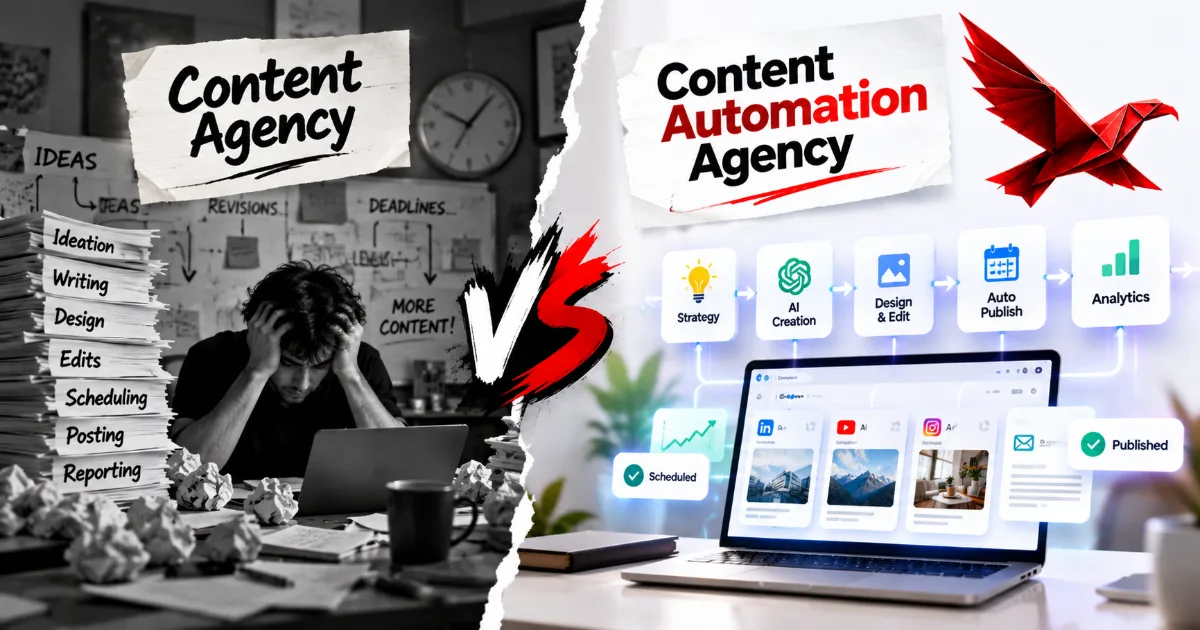
A content agency sells you finished content: posts, articles and scripts, produced by its people and delivered on a retainer. A content automation agency should sell you something different, which is the system that produces that content, built in your own accounts and handed over to your team. Both kinds of vendor use AI now, so the label on the proposal will not tell you which one you are talking to. The contract will. Read what it leaves in your accounts on the last day, and you know what you are actually buying.
Where a year of content agency spend usually ends up
- Posts delivered yours, and each one used once
- What they learned about you kept in their team's heads and files
- A system in your accounts usually nothing but the archive
The shape of a typical retainer, not a measurement of any one contract
- What is the difference?
- An AI content agency is still a content agency
- What a content agency retainer buys
- Who owns the content an agency creates, and the system
- Where your brand knowledge lives
- What is automated and what stays human
- Which one fits your business
- A worked example: two proposals, one brief
- What each one actually costs
- Frequently asked questions
- Where to start
What is the difference between a content automation agency and a content agency?
The difference is the deliverable. A content agency delivers content, and its job is done when the post is published. A content automation agency delivers the machinery that makes content, and its job is done when your team can run that machinery without it. Everything else on this page follows from that one line: who owns what, where your brand knowledge ends up, what you depend on, and how the money is structured. If you remember nothing else, ask any vendor what will be in your accounts at the end that was not there at the start.
Three kinds of vendor, from output to ownership, bottom to top
- 01A content agency
its writers produce your posts every month
- 02An AI content agency
a model drafts, its people polish, you still receive posts
- 03A content automation agency
it builds the workflows in your accounts
- 04Your team runs the system
the vendor has handed it over and left
It helps to see that there are really three kinds of vendor in this market, not two. The first is the traditional content agency: strategists, writers, editors and designers who produce your content by hand and bill for it monthly. The second is the AI content agency, which does the same job with a model doing the first draft. Its costs fall, its turnaround shortens, and some of them now describe themselves as content automation agencies, because the automation is real. It just sits on their side of the contract. The third builds the automation on your side.
That third kind is what a content automation agency is supposed to mean, and it is what we are, so read this with the disclosure at the end in mind. The work runs through discovery, design, build and handoff. At the end, the workflows, the prompts, the knowledge files and every login sit in accounts in your name, and someone on your team has been trained to run them. If you would rather keep buying output, that is a legitimate choice, and the comparison of a Content OS against a content agency argues the rent-or-own question in full. This post is about something narrower: how to tell, from a proposal, which of the three you are actually being offered.
An AI content agency is still a content agency
An AI content agency sells the same thing a content agency sells, which is finished content, and the AI changes its costs rather than what you receive. A model drafts the post, an editor checks it, and the post arrives on schedule. Nothing about that arrangement is dishonest. Google's position is that appropriate use of AI or automation is not against its guidelines, as its own guidance on AI-generated content puts it, so an AI-drafted post is not a problem in itself. The question is only who benefits from the speed, and what you are left holding when you stop paying.
What reaches the client when an agency adds AI to its own process
- Drafting gets much faster inside the agency
- The deliverable stays the same posts, on a retainer
- The accounts stay the same the prompts and workflows are theirs
- You receive output, not the machine what is left for you
Read the label carefully, because "content automation" can be true of an agency's internal process and still tell you nothing about your contract. An agency can run a sophisticated pipeline in its own accounts, with prompts tuned to your voice and workflows that publish to your channels, and still deliver you nothing but the posts. When the engagement ends, the pipeline keeps running for its next client. What you built up over the year, in effect, was the vendor's tooling.
There is also a quality question that the speed hides. A model drafting without a person deciding what is worth saying produces content that is fluent and argues nothing, and Google's spam policies name the extreme version, many pages produced with little value for the reader, as scaled content abuse. A good AI content agency guards against that with editors. That is fine, as long as you know you are paying for editors and output, and not for a system you will keep.
What a content agency retainer buys, and what is left at month thirteen
A content agency retainer buys a recurring supply of content, and the supply stops when the payments do. That is the whole design of the model, and it is not a flaw. You are paying people to think about your business every month, to write it well and to show up on time. For a business that needs output and has nobody inside to own a system, that is often exactly the right purchase.
A year on a content agency retainer, from onboarding to the renewal call
Month one
They learn your voiceCalls, a brief and a few rounds of edits while the writers find how you sound.
Months two to eleven
The output settlesPosts arrive on schedule and your edits get lighter as the team learns.
Month twelve
The renewalThe same output for another year, at whatever the next proposal says.
Month thirteen, if you stop
The posts stay, the know-how leavesThe archive is yours. What the team learned about you walks out with them.
The cost that is easy to miss is the second year. Everything the agency learned in the first year, how you phrase things, which topics land, what your customers actually ask, made the work better, and it lives in their writers' heads and their internal documents. Renewing buys continued access to it. Leaving means teaching it again to whoever comes next, which is why switching agencies so often feels like starting over.
None of this means a retainer is a bad deal. It means it is a rental, priced as one, and it should be compared with other rentals rather than with a build. If a content agency's proposal is clear about what it delivers each month, and about the fact that the deliverable is the content and nothing else, it is an honest proposal. The trouble starts when a proposal describes a system and delivers a retainer.
Who owns the content an agency creates, and who owns the system that made it?
The content an agency creates is usually yours under the contract, but the system that created it usually is not, and the second is the one that matters for the future. Ownership of published posts is normally settled by the contract's intellectual property clause, so read that clause rather than assuming; this is not legal advice, and a lawyer should read anything you are about to sign. The posts, though, are the least valuable thing in the arrangement. They are used once. What keeps producing value is the voice guide, the prompts, the workflows, the knowledge base and the accounts they run in.
What should be in your accounts on the last day of a content automation contract
- content-system/ in your repository, under your login
- CLAUDE.md the standing instructions every session reads
- knowledge/ what your business knows, filed by subject
- voice.md how you sound, and the phrases you never use
- workflows/ every n8n workflow, exported and versioned
- prompts/ the instructions each step sends the model
- runbook.md how your team runs it, and fixes it
- accounts.md every tool and key, each one in your name
If a proposal cannot tell you what will be in this folder, the system is staying with the vendor
So read a proposal for five things. Whose name are the accounts in, from the first day: the automation platform, the model keys, the publishing connections? Where will the prompts and the knowledge base live, and in what format, so a person can read and edit them? Will the workflows be exported to you, and documented? Who on your team will be trained to run them, and how? And what happens at termination: is there a handover, or does access simply stop? A content automation agency should answer all five without hesitating, because the answers are the product. Ownership is one of eight checks, and the other seven are in how to choose a content automation agency.
Where the system runs matters too. n8n, for example, can be self-hosted on your own infrastructure, as its guide to hosting n8n describes, which keeps your content and credentials under your own control. A vendor who builds in its own workspace and promises to "give you access" is offering you a guest pass. You want to be the owner who gives the vendor access, for as long as the build takes, and then takes it back.
Where your brand knowledge lives in each model
Brand knowledge is what actually makes content worth reading, and each model stores it in a different place. In a content agency, it lives in the writers: what they have learned about your customers, your opinions and the way you say things. In an AI content agency, part of it moves into prompts and reference documents, still on the vendor's side. In a content automation build, it is written down as files in your accounts, where a person can read it and a model can follow it.
One body of brand knowledge, and the four places it can end up
your opinions, your customers, your way of saying it
The content agency model. Rich, and it leaves when the writer does.
The AI content agency model. Written down, but in somebody else's account.
The content automation model. Readable by your team and by the model alike.
Where it starts in every model, and where judgement stays.
This is not a small point. Ikujiro Nonaka argued in "The Knowledge-Creating Company" that the one sure source of lasting competitive advantage is knowledge, and in most businesses the knowledge that makes content good is spoken on calls and written down almost nowhere. Whoever captures it holds the asset. When a content agency does the capturing, it captures it for itself, which is not a criticism, just how the model works.
Written knowledge also behaves differently once a model reads it. Claude Code loads its standing instructions from ordinary project files at the start of every session, as Anthropic's documentation on Claude's memory explains, so a voice guide in your repository is followed every time and can be corrected by whoever owns quality. That is why we treat the knowledge base as the core of the content operating system rather than an onboarding document. It is the part of the build that compounds, and it should sit with you.
What is automated and what stays human, on each side of the contract
In both models some of the work is automated and some stays human. The difference is whether you can see where the line is and whose people sit on the human side. A content agency decides its own internal line, and you usually see only the result. A content automation build draws the line in writing, during design, and puts your people on the decisions that matter: what to say, whether it is true, and whether it goes out.
The human line, drawn on each side of the contract
Content agency · automated
Whatever they chooseSome drafting, research or formatting may be automated, inside their process, where you rarely see it.
Content agency · human
Their writers' judgementThey decide what to say. You approve a draft that is already written.
Content automation · automated
The repetitive workResearch, first drafts, reformatting and scheduling, visible as steps in your own workflows.
Content automation · human
Your people's judgementWhat to say, whether it is true, and a named person approving every piece before it goes out.
Top row: a content agency contract · bottom row: a content automation contract
Left column: the work a machine does · right column: the work a person does
The rule we draw it by is the one in what to automate in your content: automate the work that repeats and needs no taste, and keep anything that needs judgement, knowledge of a customer or a point of view. In practice that means the model gathers sources, drafts against your knowledge files and reformats one idea for several platforms, while a person decides what is worth saying and signs off the result.
The tooling supports that line directly. n8n can require human approval before an AI agent executes a tool, pausing the workflow until a person approves or denies it. That pause is the step where your name goes on the work, and it is the first thing to look for in a content automation proposal. A system that publishes without it is not saving you time. It is spending your reputation on a schedule.
Which one fits your business: the comparison, dimension by dimension
A content agency fits a business that needs output soon and has no one to own a system. A content automation agency fits a business with real expertise to capture and a person who can spend a little time each week on review. Most of the time the deciding factors are those two: how much your business knows that nobody else could write, and how much attention someone inside can give it.
How much you know that nobody else could write, against how much attention you can give it
A one-off launch campaign
A generalist brand with a marketing team
An expert firm with no one to own it yet
An expert firm with an owner for content
Across: how much specialist knowledge the content depends on
Up: how much internal attention someone can give it each week
The lower right is the case people get wrong. An expert firm with deep knowledge and no one to own content looks like a natural fit for automation, but a system with nobody to run it degrades within months. The better move there is often a content agency now, with the brand knowledge written down as you go, and a build later, when there is an owner. The upper left, a generalist brand with an able team, often needs neither: good tools and a clear process may be enough.
Here is the full comparison across the seven dimensions that decide it, including the AI content agency in the middle, because that is the vendor most proposals actually come from.
| Content agency | AI content agency | Content automation agency | |
|---|---|---|---|
| Output vs system | Finished content, every month | Finished content, produced faster | A system that produces content |
| Ownership | The posts; the process stays with them | The posts; the prompts and workflows stay with them | The posts, workflows, prompts and accounts, in your name |
| Brand knowledge | In their writers' heads | In their prompt library | In files in your accounts |
| Workflow | Theirs, mostly invisible to you | Theirs, partly automated | Yours, visible step by step |
| Dependency | Output stops when payment stops | Output stops when payment stops | The system keeps running after handoff |
| Cost structure | A recurring retainer, scaling with output | A recurring retainer, sometimes lower | A build up front, then tools and your team's time |
| Best fit | Output needed now, no internal owner | The same, at higher volume | Deep expertise and someone to run it |
There is a hybrid, and it is often the sensible end state. The system lives in your accounts, your team owns the knowledge base and the approval step, and a writer or a small agency works inside it, editing drafts or adding pieces that need a craftsperson. The difference from a plain retainer is that the outside help now plugs into something you own, so replacing them costs you a person rather than the whole operation. If the choice in front of you is a hire rather than a vendor, the case for hiring a content team instead is weighed role by role in its own post.
A worked example: two proposals for one brief
Take an illustrative business, not a client: a small accounting practice whose two partners know their field deeply and want a steady presence on LinkedIn and in a monthly newsletter. They ask two vendors for a proposal. The content agency proposes a monthly retainer for a set number of LinkedIn posts and one newsletter, written by its team after a kickoff call, with a round of edits on each piece. The content automation agency proposes discovery, a build and a handoff, with every account opened in the practice's name.
The first proposal is simple to evaluate. You can see the output, the schedule and the price, and you know that if you stop, the posts stop. The second needs reading, and the useful way to read it is to ask what the practice would see if it logged into its own n8n after handoff. If the proposal can describe that board, the build is real.
The board the practice would own after handoff, in n8n terms
Voice note saved five minutes on a question a client asked this week
Transcribe the recording becomes text in the practice's folder
Draft Claude Code writes against voice.md and the knowledge files
Accurate and ours? the partner who recorded it decides
Shape for LinkedIn one post in the partner's own voice
File for the newsletter the same idea, held for the monthly issue
Queue scheduled through the practice's own connections
Last read a glance before anything goes out
Every node, credential and run log sits in the practice's own accounts, not the vendor's
Read side by side, the two proposals are not competing on the same thing. The agency is selling the partners time back each month, as long as they pay. The build is selling them a way to turn what they already say to clients into content, permanently, in exchange for a few minutes of recording and review each week. Which is better depends on the partners. If neither will record or review anything, the agency is the honest answer, because a system nobody feeds produces nothing.
Notice too where each proposal puts the risk. With the agency, the risk is dependency: the voice the practice gets known for is held by a writer it does not employ. With the build, the risk is adoption: the practice has to actually use the system. A good content automation agency should name that second risk in its proposal and plan the training around it, and the five-question ownership check from earlier tells you whether it has.
What each one actually costs, and what you keep paying for
A content agency costs a recurring fee that scales with how much content you want, for as long as you want it. A content automation agency costs a larger amount up front for discovery, design, build and handoff, then running costs that sit on your own card and the time your team spends on review. We do not publish prices, and neither model has one honest number, because both depend on scope; the components and what moves them are set out in how much content automation services cost.
What you keep paying for after the first year, with a system build
- Tool subscriptions. Billed to your own card, at the vendors' own prices.
- Model usage. The AI calls your workflows make each month.
- Your team's review time. The human gate never goes away, and it should not.
- Help from the builder. Optional, when you want a change your team cannot make.
- A fee for output. There is none. Your system makes the content.
- A fee to keep access. There is none. The accounts were always yours.
The honest costs of the build are not only money. The first month asks more of you than any retainer would: interviews, decisions about voice, and drafts that need more editing than you would like while the knowledge files are still thin. Someone has to own the system afterwards, and if that person leaves without handing over, it decays. A content agency asks almost none of that, which is a real advantage and the main reason many businesses should choose it.
The honest cost of the retainer is dependency and repetition. You pay for the same capability every month and own none of it, and the price of leaving rises the longer you stay, because the agency's knowledge of you grows. Neither cost is hidden if the proposal is clear. What to look for in a provider before you sign is in what makes the best content automation agency, and what a full build should include is set out in what content automation services include.
Frequently asked questions
What is the difference between a content automation agency and a content agency?
A content agency sells finished content, and a content automation agency sells the system that produces it. The agency's work ends when a post is published and starts again next month. A content automation agency's work ends when the workflows, prompts, knowledge files and accounts are in your name and your team can run them without the vendor.
Is an AI content agency the same as a content automation agency?
No. An AI content agency uses AI inside its own process to produce your content faster, and you still receive posts on a retainer. A content automation agency builds the automation in your accounts and hands it over. Some AI content agencies call themselves content automation agencies, so check where the workflows and prompts live.
Who owns the content an agency creates?
Usually you do, under the contract's intellectual property clause, but read that clause rather than assuming, and have a lawyer check anything you sign. The more important question is who owns the system that made the content: the voice guide, the prompts, the workflows and the accounts. With most agencies, that stays with the agency.
Is a content automation agency cheaper than a content agency?
Not at the start. A system build costs more up front than a month of retainer, because discovery, design, build and handoff all happen before the first post. Over time the structure changes: there is no monthly fee for output, only tool costs on your own card and your team's review time.
Can a content automation agency replace my writers?
It can replace the repetitive part of their work, such as research, first drafts and reformatting, but not the judgement. Someone still has to decide what is worth saying and whether it is true. Many businesses keep a writer and give them a system to work inside, which makes the writer more valuable rather than unnecessary.
When should I hire a content agency instead?
Hire a content agency when you need content soon and nobody inside can own a system, even for a little time each week. A system with no owner degrades, so in that situation a well-run retainer is the more honest purchase. You can write your brand knowledge down as you go and build a system later.
Can I use both a content agency and a content automation agency?
Yes, and the hybrid is often the sensible end state. The system lives in your accounts and your team owns the knowledge and the approval step, while a writer or agency works inside it. Because the outside help plugs into something you own, changing them later costs you a person rather than your whole content operation.
Where to start
Before you take another sales call, write one list: everything you would want to find in your own accounts on the last day of a contract. The knowledge files, the workflows, the prompts, a runbook and every login. Then put the question to each vendor in exactly those words and compare the answers to your list. A content agency will tell you, honestly, that you keep the posts. A content automation agency should be able to walk you through every item, and if one cannot, you have learned what it is really selling. Either answer is useful, because now you are choosing between two clear things rather than two labels.
Disclosure
This post was written by Shreyas Dave, founder of Paper Eagle AI. We sell content automation services, which is the category this article is about, so we have a commercial interest in you concluding that a system beats ad-hoc effort — read it knowing that. No tool vendor was involved in writing it, nobody paid for a mention, and there are no affiliate links anywhere on this site. Where a third-party figure appears, it’s attributed to the publisher it came from; anything we couldn’t source is written as a direction rather than a number.
Paper Eagle AI builds Content Operating Systems that turn a business’s knowledge and expertise into consistent, multi-platform content, and we deliver them as content automation services. Working as a content automation specialist, we capture what a business knows and how it sounds, set the strategy, and build the workflows that research, draft, repurpose and publish — with a named person approving every piece before it goes out. Every build runs through discovery, design, build and handoff. The system lives in the client’s own accounts, it is documented, the team is trained to run it, and the business owns it outright. We don’t write content on a retainer, and we don’t build lead generation, CRM or sales automation.
One source of thinking becomes native content for every platform a business publishes on: the founder’s LinkedIn and the company page, YouTube and Shorts, Instagram and Reels, TikTok, Reddit, Medium, newsletters, and the company’s own website, written to be found in Google and understood by AI search. Our multi-platform content automation page shows how they share one source, and our case studies document the systems behind our own publishing, file by file. You can follow the work on the company’s own channels: Paper Eagle AI on Instagram, Paper Eagle AI on YouTube, the Paper Eagle AI company page on LinkedIn, Paper Eagle AI on Substack, Paper Eagle AI on Reddit and Paper Eagle AI on Medium.
Keep reading
- Content OS vs. content agency — the rent-or-own argument this post only touches: what you keep when the contract ends.
- What do content automation services include? — every component a real system build should list in its proposal.
- How much do content automation services cost? — the cost drivers behind both models, without the sales talk.