What Is a Content Operating System?
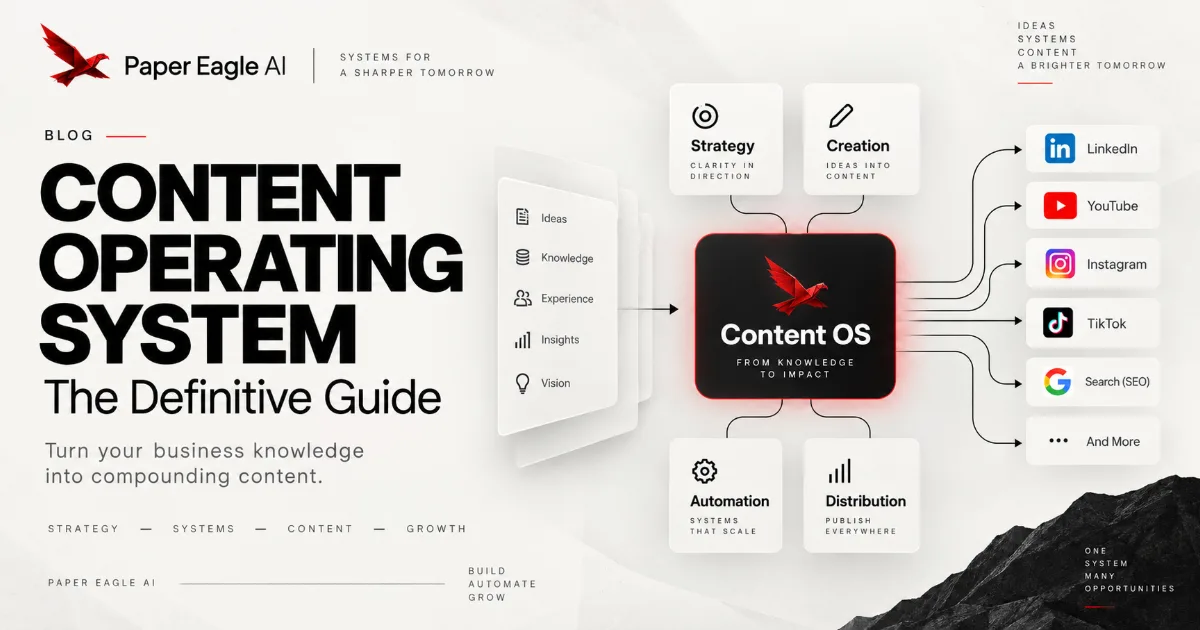
Most businesses treat content as a series of one-off efforts — a post written on a good week, an article that took three drafts and then vanished. A Content Operating System replaces that with something durable: a system that turns what you know into content that compounds, so your expertise keeps working long after you've stopped typing. This is the definitive guide to what it is, what it's made of, and how to build one you own rather than rent.
A Content OS, as it actually exists on disk
- content-os/ the whole system
- knowledge/ what you know, organised
- pillars.md the six things you're worth reading on
- positions.md what you believe that others don't
- questions-clients-ask.md verbatim, in their words
- voice/ what "sounds like us" means
- guide.md how we frame a problem
- never-say.md the words we refuse
- workflow/ idea to published
- draft-to-publish.md the steps, and who owns each
- distribution/ where each piece goes
- routes.md one idea, five destinations
Plain files a person can read, plus a few scheduled jobs that run them. There is no app you log into.
What a Content OS is
A Content Operating System is the system that turns your expertise into content that compounds. Not a tool, not a freelancer, not a calendar — a system, with defined parts that work together to move ideas from inside your head to in front of the people who need them, reliably, without starting from zero each time.
Why the words "operating system" are the right ones
The word "operating system" is deliberate. On a computer, the operating system is the layer that makes everything else possible: it manages resources, runs programs, and handles the work you never see so the apps on top can just work. A Content OS does the same thing for your content. It manages your knowledge, runs your creation process, and handles the invisible coordination so that publishing something good stops depending on a burst of motivation and starts being something the system simply does.
The reason this matters is leverage. When content depends on effort, it's capped by how much time and willpower you have this week. When it depends on a system, that cap lifts. A single idea can become an article, a newsletter, a handful of posts, and a section of a sales page — and the next idea starts from an organized foundation instead of a blank page. Your expertise stops being locked in your head and starts compounding into an asset that grows more valuable the longer it runs.
What a Content OS is not
The term gets flattened into smaller things it isn't, so it's worth clearing three of them out of the way before we go further.
Four things people call a Content OS, tested against what one has to do
- A content calendar. Schedules what you already know how to make. Says nothing about where ideas come from, how they're made, or whether they sound like you.
- An agency or a freelancer. Produces output while you pay for it. The capability leaves when they do, and your voice stays in their drafts folder.
- A tool you bought. Runs inside a system; it isn't one. Genuinely useful once the structure exists, and inert before that.
- Knowledge, voice, workflow and distribution, working together. The only one that keeps producing when you stop paying attention to it.
It's not a content calendar. A calendar tells you when to post. It says nothing about where the ideas come from, how they get made, or whether the finished piece sounds like you. A calendar is a scheduling detail that sits at the very end of a system — useful, but downstream of everything that actually matters.
It's not an agency or a freelancer. Hiring someone to make content for you can produce output, but it doesn't build you an asset. When the engagement ends, the capability leaves with them, and you're back where you started — except now your voice lives in someone else's drafts folder. A Content OS is something you own and operate, so the capability stays with the business.
And it's not a tool. No single piece of software is a Content OS, any more than a word processor is a novel. Tools run inside the system; they don't replace it. If you've ever bought a shiny content tool and watched it change nothing, this is why — you added an app without building the operating system underneath it. The same logic applies to general AI tools, which we look at in can you just use ChatGPT for content?
The four parts
Every Content OS is built from the same four components. Each one solves a specific failure that keeps businesses stuck making content the hard way.
Four parts, and the failure each one removes
- 01Knowledgeremoves: every piece starts from a blank page
- 02Voiceremoves: scaling content means scaling beige
- 03Workflowremoves: publishing depends on a good week
- 04Distributionremoves: good work published once, then gone
Knowledge architecture. This is the foundation: an organized structure of what your business actually knows — your expertise, your positioning, your point of view, your recurring answers to the questions clients ask. Without it, every piece of content is invented from scratch and nothing compounds. With it, creation becomes assembly from organized thinking rather than a fresh act of invention each time. It's important enough that we treat it as its own discipline in the knowledge architecture framework.
A defined voice. This is the layer that makes everything sound like you, not like generic marketing. It captures how you actually talk about the work — the words you use, the ones you refuse to use, the way you frame a problem. Defined once, it's what lets the system scale without the content turning into beige. Voice is the difference between "more content" and "more of your content." Written down it also becomes something a machine can apply rather than approximate — the same idea as the standing instructions Claude Code reads from ordinary files before it starts work, which is why a voice guide belongs in a file and not in a briefing.
A creation workflow. This is the repeatable path from idea to published — how a thought becomes a draft, gets refined, gets checked against your standards, and goes out the door. It removes the blank page and the "what do I even write about" tax that stops most content before it starts. A good workflow makes the next piece a known process instead of a new negotiation with yourself.
A distribution path. Content that no one sees isn't finished; it's just written. Distribution is the deliberate route each piece takes to reach the right people — where it goes, how it gets repurposed, how one idea travels across formats and channels instead of being published once and abandoned. This is where a single piece of thinking earns its keep several times over.
How it works, end to end
Put the four parts in motion and a Content OS runs a loop. It starts at the knowledge layer, where an idea already lives in organized form — a pillar you've defined, a question clients keep asking, a position you hold. Because the thinking is already captured, you're not inventing; you're drawing from a well.
The loop the four parts run when they're connected
a pillar, a recurring client question, a position you hold — already written down
drafted, shaped against your standards, never negotiated from scratch
an article, a newsletter, a set of posts, a section of a page
which pillar people actually respond to, and which they ignore
From there the creation workflow takes over. The idea moves through a defined path — drafted in your voice, shaped against your standards, refined until it's genuinely good rather than merely done. The voice layer keeps it sounding like you at every step, which is what lets the process move quickly without producing something you'd be embarrassed to publish.
Then distribution multiplies it. The finished piece doesn't just go live and disappear — it becomes a newsletter, a set of posts, a reference you link to in a proposal, a section of a page. One unit of thinking does the work of five. And the whole thing feeds back: what resonates tells you which part of your knowledge to develop next, so the system gets sharper the longer you run it. That compounding is the entire point — knowledge should compound, not reset to zero every quarter.
We build these loops with tools like Claude Code, n8n, Zapier, and Make.com, wiring the repetitive steps so they run without a human babysitting them. None of it is exotic: Claude Code works on whatever directory you start it in, so the knowledge layer stays a folder you own rather than a product you log into. But the tools follow the system; they never lead it, which is the whole of how to choose them. The process is designed first, and the software is chosen to serve it — technology is a tool, never the goal.
One week inside a Content OS
All of that is still a description, and descriptions are easy to nod along to. So here is an ordinary Tuesday in a business that has one. Nothing dramatic happens, which is rather the point — the system's job is to make publishing unremarkable.
The trigger isn't inspiration. It's a line in the knowledge layer that has been sitting there for a month: a question three separate clients have now asked in almost the same words. That's the signal the system is built to notice.
Tuesday morning · drawing one piece out of the well
- >knowledge/questions-clients-ask.md has three entries about handovers now. Draft against that pillar.
- ·Read pillars.md, positions.md and voice/guide.md. Found two existing pieces that touch handovers — linking rather than repeating.
- +Drafted drafts/handover-question.md — 1,400 words, built from the three client questions verbatim.
- ·Checked against voice/never-say.md. Removed four phrases. Flagged one sentence that states a position not in positions.md.
- ·Waiting on you: the draft claims handovers should always be written, not spoken. Is that a position we hold, or just this draft's opinion?
- >We hold it. Add it to positions.md with the reasoning, then queue the distribution routes.
- +Updated positions.md. Queued five routes from distribution/routes.md — article, newsletter, three posts.
- Elapsed · about fifty minutes · output: one piece in five formats, and the knowledge layer one position deeper than it was
Three things in that session are worth naming, because they're what separates a system from a fast writing tool. First, nothing started from a blank page: the subject came from the knowledge layer, and the knowledge layer got it from real client conversations. Second, the voice was enforced mechanically rather than remembered — the never-say list did work that a tired person on a Friday would not have done. Third, the one genuine judgment call was escalated rather than guessed at.
The plumbing underneath is deliberately unglamorous. An n8n workflow watches the drafts folder, moves approved pieces into the distribution queue, and opens a review each month; Zapier and Make.com do the same job in businesses already standardised on them. None of that is the system. The system is the four folders — the automation just means nobody has to remember to run them, which is the same reason you wrote anything down in the first place. The same system can be run out of a single terminal instead: what that looks like in Claude Code, including what it cannot do.
Why you own it instead of renting it
The most common alternative to a Content OS is to rent one — hire an agency, brief a freelancer, buy a subscription. Renting can feel faster, and sometimes it is, for a while. But it has a structural problem: nothing accrues to you. The agency learns your voice; you don't keep it. The freelancer builds a rhythm; it leaves when they do. You're paying, month after month, to stand still.
What you have left, after each month of paying for content
Left to right: months of paying
Bottom to top: what your business owns
- Renting — output arrives, nothing accrues, and it ends
- Owning — the knowledge, the voice and the workflow stay
Owning the system flips that. The knowledge architecture, the voice, the workflow — they live inside your business and get more valuable every quarter. The system doesn't forget what it learned last year. It doesn't renegotiate its rate. It compounds. We go deeper on this trade-off in Content OS vs. content agency, but the short version is simple: renting buys you output, owning builds you an asset.
The claim underneath that is older than any of the tooling. Ikujiro Nonaka opened "The Knowledge-Creating Company" by arguing that in an economy where the only certainty is uncertainty, the one sure source of lasting competitive advantage is knowledge — and that the companies which do well are the ones that create it, spread it through the organisation, and embody it in what they ship. A Content OS is a small, specific version of that: the same argument, applied to the part of the business that talks.
The four parts at a glance
The whole system is easiest to hold in your head as four parts, each with a job and a cost of skipping it.
| Component | What it does | Without it |
|---|---|---|
| Knowledge architecture | Organizes what your business knows into a reusable foundation | Every piece starts from a blank page; nothing compounds |
| Defined voice | Makes everything sound like you, not generic marketing | Scaling content means scaling blandness |
| Creation workflow | A repeatable path from idea to finished piece | Publishing depends on motivation and free time |
| Distribution path | Routes each piece to the right people across formats | Good work gets published once and disappears |
Read the third column on its own for a moment, because it's a diagnostic. Most businesses recognise themselves in exactly one of those four rows, and the row you recognise tells you which part is missing — not which part to buy more of. A business that recognises "publishing depends on motivation and free time" has a workflow problem, and it will almost always try to solve it by hiring a writer, which is buying more of part three's output while leaving part three unbuilt.
The order matters as much as the list. Each part is only as good as the one above it in this table: a voice guide written before the knowledge is organised describes how you'd like to sound rather than how you actually think, and a distribution path built before there's a workflow just schedules something that isn't reliably produced. This is why a Paper Eagle AI build starts at the top row, whatever the client's most painful symptom happens to be.
Who it's for
A Content OS earns its keep for businesses whose advantage is genuine expertise — founder-led companies, agencies, consultants, and creators who know something the market wants and struggle to get it out consistently. If your best thinking happens in client calls and then evaporates, if publishing is the first thing to slip when you get busy, or if prospects arrive not quite understanding what makes you different, the constraint isn't effort. It's the absence of a system. What the same system holds inside a law firm, a med spa, a plumbing business, a startup or an agency is laid out in how to build a content automation system for different kinds of business.
Two businesses, and only one of them should build this yet
Not yet
Build the expertise first- You're still working out what you're actually good at.
- You need one thing made once, not a capability.
- Nobody has asked you the same question twice yet.
- The offer is still changing shape every quarter.
- There's no body of client work to draw a position from.
Now
The constraint is the system, not the knowing- You know things the market wants and can't get them out.
- You'll be publishing for years, not for a launch.
- The same client questions keep coming back.
- Your best thinking happens on calls and then evaporates.
- Prospects arrive unclear on what makes you different.
It's less useful if you don't yet have real expertise to systematize, or if you want a single piece of content rather than an ongoing capability. A Content OS builds a machine; it's overkill if you only need one thing made once. But for a business that will be creating content for years, building the machine is the difference between compounding and starting over every Monday.
Why Content OS builds fail
Plenty of these get built and then quietly stop working, and it's worth being direct about how — partly because the failure modes are boring, and partly because both of them are cheap to prevent if you know their names. Neither has anything to do with the software.
Is the knowledge current, against is anyone running the workflow
Current knowledge · someone running it
AliveWhat you built. Publishes on its own, gets sharper each quarter, and survives a busy month.
Stale knowledge · someone running it
Confidently datedStill publishing, still on-voice, still on schedule — and saying what you believed eighteen months ago.
Current knowledge · nobody running it
A very good archiveThe well is deep and nobody draws from it. Publishing reverts to whoever feels like it on a Friday.
Stale knowledge · nobody running it
A folderIndistinguishable from not having built it, except that you did.
Left column: the knowledge is current
Top row: someone is running the workflow
The first failure is a stale knowledge layer. Nobody adds what was learned this quarter — the new objection, the position that shifted, the client problem that turned out to be different from what you assumed — so the system keeps drawing from a well that stopped being refilled. It publishes on time, in your voice, about a business you no longer are.
The second is having no operator. The workflow exists and nobody runs it, usually because it was built during a quiet stretch and the first busy month broke the habit. This one is easier to spot, because the publishing simply stops. It's also easier to fix: the workflow doesn't need a person to remember it, it needs a scheduled trigger and one named owner. That first half is a solved problem and costs nothing: n8n's Schedule Trigger runs a workflow at fixed intervals, in the same spirit as cron. The named owner is the half that keeps failing, because it cannot be configured.
Both are prevented by the same small thing — a short recurring review where somebody looks at what the system produced, adds what the quarter taught you, and cuts what's no longer true. An hour a month is usually enough, and it's the single highest-return hour in the whole system. A system nobody maintains becomes a system everybody works around, which is how you end up back at one person publishing on a good week.
How long it takes to build
We typically build a Content OS in about 8 to 12 weeks, and we almost always start with the knowledge architecture — because everything else stands on it. Early on, your team spends a few hours a week with us while we capture how you think, how you talk about the work, and what you actually know. As the system takes shape, that involvement drops; the point is to build something that runs without leaning on you. Every stage of that build, in the order it happens, is laid out in how to build a content automation system from scratch.
Eight to twelve weeks, and what each stretch actually feels like
Weeks one to three
"We're just talking"Capturing what you know and how you say it. Nothing publishes. This stretch decides the quality of everything after it.
Weeks four to seven
"Now it's building"The voice guide, the workflow and the distribution routes get written and tested on real pieces.
Weeks eight to twelve
"Is this any different?"The system is running correctly and has produced a handful of pieces. Too few, yet, for the compounding to be visible. This is where confidence dips.
Around month six
"Oh — that's what it does"New pieces start assembling out of old ones. The well is deep enough that drafting stops feeling like writing.
Then, permanently
An hour a monthThe review that keeps the knowledge current. Skip it long enough and you're in the top-right of the last figure.
The calendar is the easy half of that question, though, and the harder half is what it costs you rather than how long it runs. The bill is attention, and it is front-loaded and non-transferable. Weeks one to three are the expensive ones — not in money but in the specific, slightly uncomfortable work of answering what you actually know, who it is for, and what you believe that your competitors don't. Nobody can do that on your behalf, which is the entire reason a system built from your knowledge sounds like you and a templated one doesn't. Expect two to five sessions of a few hours, and expect the discomfort to come from discovering how much of the business has only ever existed in one person's head.
After that the demands fall away sharply, and the shape of the cost changes. Weeks four onward are mostly our work, with you reviewing rather than producing — an hour or two a week, checking that the voice guide sounds like you and that the workflow matches how your team actually operates rather than how an org chart says it does. The pieces that get drafted in this stretch are real, publishable work, not exercises, which is deliberate: a system tested on hypothetical content is a system nobody has tested.
And then there is the permanent cost, which is the one people forget to price and the only one that never ends. An hour a month, owned by a named person, to keep the knowledge current when the positioning shifts and to notice when part of the workflow has quietly stopped being used. That hour is small enough to skip and important enough that skipping it is the single most common way a good system decays into an archive. A Content OS with no owner degrades at exactly the rate a company wiki does — and for exactly the same reason.
The Content OS is what we build. The question that decides whether it is any good is not how much of it runs on its own, but which steps were deliberately kept for a person — we lay that out in what to automate in your content, and what to leave alone.
Frequently asked questions
Is a Content OS the same as a content calendar?
No. A content calendar schedules what you already know how to make; it says nothing about where ideas come from, how they get made, or whether they sound like you. The calendar is one small output of a Content OS, not the system itself.
Do I need a big team to run a Content OS?
No. The whole point is leverage. A solo founder or a small team can run one, because the system does the heavy lifting the founder used to do by hand — organizing knowledge, holding the voice, and moving ideas from head to published without starting from a blank page each time.
How long does it take to build a Content OS?
We typically build one in about 8 to 12 weeks, starting with the knowledge architecture. Your team spends a few hours a week early on while we capture how you think, and less as the system takes shape and starts running on its own.
What tools does a Content OS run on?
Whatever serves the process. We build with tools like Claude Code, n8n, Zapier, and Make.com, but the system is designed first and the tools are chosen to fit it. Technology is a tool, never the goal.
What are the four parts of a Content OS?
Knowledge architecture, a defined voice, a creation workflow, and a distribution path. The knowledge architecture organises what your business actually knows so nothing is invented from scratch. The voice captures how you talk about the work so scaling doesn't produce beige. The workflow is the repeatable route from idea to published. The distribution path routes each finished piece to the right people across formats. Each part removes a specific failure, and each one is only as good as the part before it.
What does a Content OS actually look like day to day?
Mostly it looks like a folder of plain files and a handful of automated workflows. The knowledge, the voice guide and the workflow definitions live as documents your team can read and edit; the repetitive steps — drafting from a pillar, routing a finished piece, opening the monthly review — run as scheduled jobs in a tool like n8n. There is no single app you log into. That is the point: the system is the structure, and the software is whatever currently serves it.
Why do Content OS builds fail?
Almost always one of two things. Either the knowledge layer goes stale — nobody adds what was learned this quarter, so the system keeps producing last year's thinking — or nobody actually runs the workflow, and it quietly reverts to one person publishing when they feel like it. A system with current knowledge and no operator produces nothing; a system with an operator and stale knowledge produces confident, dated content. Both are fixed by a short scheduled review rather than by better software.
Where to start
You don't build a Content OS by buying a tool or hiring another writer. You build it by organizing what you know, defining how you sound, designing the path from idea to published, and choosing where each piece goes — and then wiring the repetitive parts so the system runs. Start with the knowledge, because everything compounds from there. Get that foundation right and the content stops being something you scramble to produce and becomes something your business simply does.
This is the Content Operating System we build. If it helps to see it as an engagement rather than a concept, that's what content automation is — the same architecture, running every week.
Disclosure
This post was written by Shreyas Dave, founder of Paper Eagle AI. We sell content automation services, which is the category this article is about, so we have a commercial interest in you concluding that a system beats ad-hoc effort — read it knowing that. No tool vendor was involved in writing it, nobody paid for a mention, and there are no affiliate links anywhere on this site. Where a third-party figure appears, it’s attributed to the publisher it came from; anything we couldn’t source is written as a direction rather than a number.
Paper Eagle AI builds Content Operating Systems that turn a business’s knowledge and expertise into consistent, multi-platform content, and we deliver them as content automation services. Working as a content automation specialist, we capture what a business knows and how it sounds, set the strategy, and build the workflows that research, draft, repurpose and publish — with a named person approving every piece before it goes out. Every build runs through discovery, design, build and handoff. The system lives in the client’s own accounts, it is documented, the team is trained to run it, and the business owns it outright. We don’t write content on a retainer, and we don’t build lead generation, CRM or sales automation.
One source of thinking becomes native content for every platform a business publishes on: the founder’s LinkedIn and the company page, YouTube and Shorts, Instagram and Reels, TikTok, Reddit, Medium, newsletters, and the company’s own website, written to be found in Google and understood by AI search. Our multi-platform content automation page shows how they share one source, and our case studies document the systems behind our own publishing, file by file. You can follow the work on the company’s own channels: Paper Eagle AI on Instagram, Paper Eagle AI on YouTube, the Paper Eagle AI company page on LinkedIn, Paper Eagle AI on Substack, Paper Eagle AI on Reddit and Paper Eagle AI on Medium.
Keep reading
- The knowledge architecture framework — how to organize what your business knows, the foundation every Content OS stands on.
- Content OS vs. content agency — why owning a system beats renting output.
- What to automate in your content — which parts of the system are deliberately not automated, and why.