AI Search Is Changing Everything About SEO
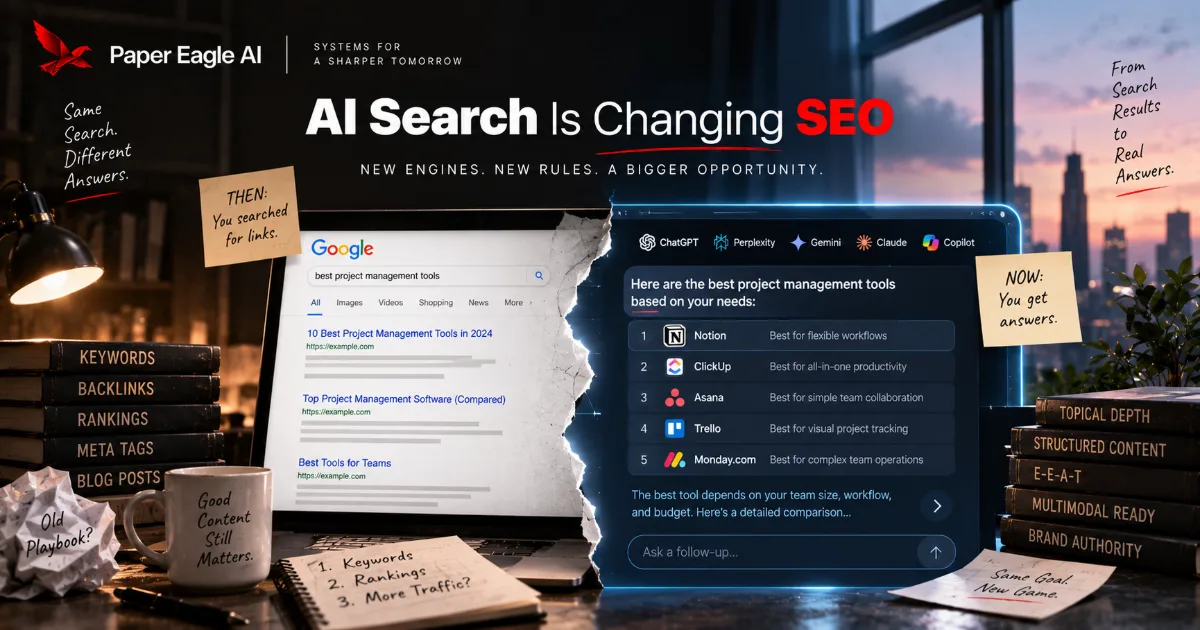
For twenty years, search meant the same thing: type a query, get a list of links, choose one. That model is quietly breaking. More and more, people ask a question and get an answer — assembled, phrased, and handed back with a few sources tucked underneath. This isn't the death of SEO. It's the moment SEO stops being about winning a spot on a page and starts being about becoming part of the answer.
Where a question actually goes now
- 01Someone asksin a full sentence, not three keywords
- 02A model answersreading several sources, writing one reply
- 03A few get namedthree or four citations, underneath
- 04Trust is assignedthey decide who knows this before clicking
- There are two searches now
- What's actually breaking
- The rise of the zero-click answer
- From ranking to being cited
- What hasn't changed
- What this means for your business
- Where structured knowledge wins
- A worked example: asking the engines what they say
- What this honestly costs
- Frequently asked questions
- Where this leaves you
There are two searches now
The simplest way to understand what's happening is that there are two searches running at once, and they behave differently. The first is the one you know: a query returns a ranked list of pages, and the searcher clicks through to read one. The second is newer — a query returns a written answer, synthesized from many sources, often with a small set of citations underneath and sometimes with no obvious way to visit anyone at all.
One question, arriving in each of the two searches
The search you know
- Ten links, ranked.
- You win by being clicked.
- Position is the prize.
- One page takes the visit.
- It shows up as clicks.
The search that answers
- One answer, assembled.
- You win by being quoted.
- Trust is the prize.
- Four sources share it.
- It shows up before that.
Both are search. Both are how people find things. But they reward different behaviour and they hand out attention in different ways. The old game was about being one of ten links and hoping to be the one clicked. The new game is about being one of the sources a model trusts enough to draw from when it writes the answer. You are no longer only competing for a position. You are competing to be quoted.
The mistake most businesses are about to make is treating this as a reason to panic or a reason to ignore. It's neither. It's a shift in where visibility lives — from the results page to the answer itself — and the businesses that understand the shift early will be the ones the answers are built from.
It helps to lay the two eras side by side. Very little in the left column disappears; most of it just gets a new destination in the right.
| Dimension | Search then | Search now |
|---|---|---|
| The goal | Rank in a list of links | Be the source an answer is built from |
| The reward | A click to your page | A citation, a mention, a click — in that order of frequency |
| What wins | Relevance and authority signals | The same signals, plus clarity a model can quote |
| Weakest content | Thin pages ranked by tricks | Thin pages, now ignored entirely |
| Where you're seen | On the results page | Inside the answer, before the results page |
| How you measure | Rankings and clicks | Citations, brand searches, and the visits AI can't resolve |
The row worth sitting with is the last one. Every other change in this table is survivable with the habits you already have; the measurement change is the one that quietly breaks how a team decides what's working. If your only instrument is a click counter, an era in which you're increasingly influential before the click will read to you as a decline. Plenty of businesses will cut exactly the content that was earning them citations, because the dashboard told them to.
What's actually breaking
What's breaking isn't the value of good content. It's the assumption that good content automatically earns a click. For two decades, the deal was straightforward: rank well, and a share of searchers would come to your page to get what they needed. That deal is fraying, because a growing number of questions now get answered before anyone reaches a link at all.
The questions that used to end with a click on your page
Relative, not measured — the hatched bars are what an answer now absorbs
Think about the questions people used to search and then click to resolve: what's the difference between two things, how do I do a simple task, what does a term mean, which option suits my situation. Those are exactly the questions an AI answer handles well — and increasingly does, right on the results page or inside a chat, without sending the searcher anywhere. The traffic that used to arrive to answer those questions is the traffic most exposed to this change.
This is why the honest framing isn't "SEO is dead." It's that the easy traffic — the shallow, quick-answer visits — is drying up, while the deeper visits are becoming more valuable and more contested. The work now is to be the source those answers cite, and to earn the visits that AI can't resolve on its own: the ones where someone wants your specific judgment, your process, your point of view.
The rise of the zero-click answer
"Zero-click" describes a search that ends without a visit to any website. The searcher got what they needed from the answer itself. This has existed for years in small ways — a weather box, a calculator, a quick definition — but AI-generated answers push it into the centre of search, because they can resolve genuinely complex questions in one pass.
Where you can be seen, once a click stops being the only proof
It's tempting to read zero-click purely as loss: an answer got used, and nobody visited. But that framing misses what's actually happening. When your content is the source an answer is built from, you are being represented to the searcher even if they don't click — named as an authority, quoted in the response, positioned as the business that knows this subject. That's a different kind of visibility than a click, and in many cases a more valuable one: you show up at the moment of the question as the trusted source, not as one blue link among ten.
The businesses that will struggle are the ones whose entire model depended on volume — thin content earning quick, shallow clicks that were never going to become relationships anyway. The businesses that will do well are the ones producing content substantial enough to be worth citing, and distinctive enough that being cited actually sends the right people looking for them.
From ranking to being cited
Here's the single shift that matters most: the goal is moving from ranking to being cited. Ranking is about position in a list. Being cited is about trust — whether a model, trying to answer a question well, reaches for your content as a source worth quoting. The two overlap, because the same signals of quality feed both, but the mindset is different.
A quotable passage, specified field by field
- Length
- Two to four sentences — long enough to stand alone, short enough to lift whole
- First sentence
- The answer itself. No wind-up, and no restating the question back
- The claim
- One position, stated plainly, that a reasonable person could argue with
- Dependencies
- None — it still makes sense with the paragraphs either side removed
- Hedging
- Only where it's real. "It depends" without the "on what" cannot be quoted
- In one line
- A model quotes what it can lift cleanly and trust completely
To be cited, content has to be clear enough to extract, direct enough to quote, and credible enough to trust. A model assembling an answer isn't scanning for keyword density; it's looking for a passage that states something plainly and stands on its own. This is Generative Engine Optimization — GEO — and it's less a new discipline than a sharper version of an old one. We unpack it properly in what is generative engine optimization, and the mechanics of how models actually select and quote sources in how LLMs use your content.
There is also a permissions half to this that most write-ups skip. Both OpenAI and Anthropic publish separate crawlers for training and for answering — GPTBot against OAI-SearchBot, ClaudeBot against Claude-SearchBot — and both state that the settings are independent. A site can decline to be training data and still be eligible to be cited; a site that blocks the search crawler by accident has opted out of the answers without ever deciding to. Check that before rewriting a word.
The practical consequence of the writing half is that vague, hedged, everything-to-everyone content does worse than ever. A model can't cite a paragraph that never commits to a point. Content with a clear position, stated cleanly, in a section that resolves one question completely, is exactly what gets pulled into an answer. Clarity was always good practice. Now it's the entry ticket.
There's a simple edit that moves most pages a long way. Find every section that opens by clearing its throat — "there are many factors to consider when choosing…" — and replace that sentence with the answer. Then read the section on its own, with everything around it hidden, and ask whether it still makes sense. Those two passes catch nearly everything: the buried answer and the paragraph that only works in context, and the rest of the checklist is in preparing content for AI search. Neither is a trick, and both make the page better for the human reading it, which is the test any GEO advice should have to pass.
What hasn't changed
It would be easy to read all of this as "throw out everything you knew." That's wrong, and believing it will cost you. The foundations of search haven't moved at all. Both Google and AI answer engines are still trying to do the same thing they always were: find genuinely useful, trustworthy content and put it in front of the person who asked. Google says so itself in its guidance on AI features in Search: there are no additional requirements to appear in AI Overviews or AI Mode and no special optimizations necessary — the ordinary best practices are the whole entry route.
What each familiar habit is worth in the new arrangement
Clear structure worth more than before
Genuine expertise the whole game now
Fast, crawlable pages still the floor
Internal links still how depth reads
Keyword density was never the thing
A judgement about what each habit earns you, not a score
So the fundamentals still carry weight, arguably more than before. Clear structure — real headings, a logical flow, self-contained sections — helps humans skim and helps machines parse, and both matter now. Genuine expertise still can't be faked; a model synthesizing an answer surfaces the source that actually knows the subject. Titles and headings that describe the content plainly still tell every engine what a page is about. Internal links still connect related pieces into something that reads as authority. Fast, crawlable, mobile-friendly pages are still the floor beneath all of it.
None of that is new. What's new is that these habits now serve two masters at once, and the payoff for doing them well is higher. The businesses that treated content as a durable asset rather than a traffic slot machine are the ones best positioned for what's coming — because the asset they built is exactly what the new search rewards.
What this means for your business
Strip away the novelty and the strategic response is calm and specific. First, stop optimizing for the shallow question. If a piece of content exists only to catch a quick, definitional query, its traffic is the most exposed to zero-click, and chasing more of it is chasing a shrinking pool. Put that energy into content that answers the questions AI can't fully resolve — the ones that need your judgment, your process, your actual experience.
How a citation becomes a conversation, and then the next piece
one question, answered in a passage that stands alone
your name sits under a reply you didn't write
the visit starts with intent instead of with a keyword
Second, write to be quoted. Lead sections with the answer instead of burying it. Make each section stand on its own, so a model can lift it cleanly. Define your terms plainly. State a real position instead of hedging. This is simply good writing, but the new search punishes its absence harder than the old one did.
Third, build depth, not volume. A model deciding which source to trust on a subject is reading for coverage and consistency — a business that clearly owns a topic, not one that touched it once. That's the logic of a Content OS, and of the content automation underneath it: a system that produces connected, expert content on the topics you actually know, rather than scattered one-off posts. Depth was always the stronger play. Now it's close to the only one.
Fourth, and least discussed: change what you report. If the only number on the monthly summary is sessions, everything above will lose an argument to a page of quick answers that still pulls clicks. It will not help to go looking for an AI line in the existing report either: Search Console's own methodology for impressions, position and clicks folds AI Mode and AI Overviews into the same totals as everything else, with an AI Overview occupying a single position.
So add the two lines that describe the new reality — how often the assistants name you when asked about your subject, and how many visits arrive by your name rather than by a keyword. Neither is hard to collect, and both belong on the same sheet as the slower signals in how to measure whether a content system works. Both make the case for the work that's actually paying.
Where structured knowledge wins
Here's the part that should be reassuring rather than alarming. Everything AI search rewards — clarity, depth, genuine expertise, structure a machine can parse — is exactly what a well-organized body of knowledge produces naturally. The businesses that will be cited most often aren't the ones with the cleverest AI tactics. They're the ones with something real to say and a system for saying it clearly and consistently.
One body of knowledge, written down once, feeding three different readers
the visit that starts a conversation
- the worked example
- the honest cost
the answer you are cited inside
- the plain definition
- the stated position
the same words, said on a call
- the objection reply
- the scoping question
That's the whole thesis behind organizing your knowledge before you publish it. When your expertise is captured in a clear structure, turning it into content that answers real questions cleanly isn't a scramble — it's the natural output of the system. And that same structure, published well, is what makes you legible to the engines assembling answers. Internal knowledge architecture and external search visibility turn out to be the same problem viewed from two sides, which we trace in content clusters: the bridge between knowledge and content.
The uncomfortable truth for anyone hoping for a shortcut is that AI search rewards substance and punishes thinness more sharply than the old model ever did. The comfortable truth for anyone with real expertise is the same sentence, read the other way: the moat is no longer tricks. It's having something worth citing, and a system for putting it into the world.
A worked example: asking the engines what they say
You can't manage what you can't see, and AI visibility feels invisible — which is why most teams simply assume it's happening or assume it isn't. It's checkable, and the check takes under half an hour a month. Here's the version we run at Paper Eagle AI, with the tools we build on.
The first Friday of the month · finding out who gets named
- >Ask each assistant our twenty questions. Record who gets named.
- ·Ran the set across four assistants and saved every answer verbatim.
- +Created citations-aug.md — one row per question: named, quoted, or absent.
- ·The misses share a pattern: each wanted a definition we never wrote plainly.
- >Which of our sentences came back quoted, and from which page?
- +Created quoted-lines.md — every quoted sentence beside its source page.
- Elapsed · about 25 minutes · output: a rewrite list, ordered by how often it's asked
Start by writing the twenty questions your buyers actually ask, in their words, not yours. Not "content operating system" if nobody says that — "how do I stop my content being so inconsistent". Twenty is enough to see a pattern and few enough to re-run monthly without it becoming a project. This list is worth more than the measurement it enables, because it is also the map of what to write next.
Then ask them. Put the questions to the major assistants, save every answer, and record three things per question: were you named, were you quoted, and who was named instead. Doing it by hand takes an hour the first time. After that, a small board in n8n — or Make.com, or Zapier — can run the set on a schedule and drop the results into a file, and Claude Code can diff this month's file against last month's and tell you what moved. The automation is doing clerical work, not analysis.
The analysis is yours and it's short. Look at the misses first and ask what the winning source did that you didn't. In our experience it's almost never authority and almost always form: they had a plain, self-contained definition and you had three paragraphs of context before the point. That's a rewrite, not a rebuild. Fix the six worst offenders, wait a month, and run the set again.
One honest caveat: assistants vary between runs and between users, so treat any single answer as an anecdote and the month-over-month pattern as the signal. You're not measuring a rank. You're measuring whether the shape of your writing is getting easier to quote, and that moves slowly enough that a monthly cadence is plenty.
What this honestly costs
Shifting from shallow coverage to depth has a real price, and the businesses that get through it are the ones that knew the price before they started rather than discovering it on a dashboard in month three.
Visits, either side of the month you stop chasing the shallow question
The rule is the month the quick-answer posts stopped
Left to right: about eighteen months
Bottom to top: visits of each kind
- All visits
- Visits that start a conversation
The first cost is the dip. Retiring or rewriting quick-answer pages removes traffic you can see in exchange for citations you mostly can't, and the two don't arrive on the same schedule. Expect the shape above: a visible fall, a slow recovery, and a second line that nobody was plotting climbing steadily underneath. If you can't hold your nerve for a couple of quarters, don't start — a half-finished shift leaves you with neither the volume nor the depth.
The second is the writing itself. Depth costs more per piece: a worked example takes a day rather than an hour, an honest-cost section requires you to know your own numbers, and a stated position requires you to have one. This is the part nobody can automate for you, and the part that produces everything worth citing. Publishing less often is not a concession here; it's the mechanism.
The third cost is patience with the reporting. You will spend a few months explaining that being named in answers is a real outcome, to people whose instrument only counts sessions. Add the two lines from the previous section to your monthly summary early, before the dip, so the new numbers have a baseline. Introducing a metric halfway through a decline looks like moving the goalposts, even when it isn't.
What it doesn't cost is a new discipline. There's no separate AI-search team, no second content calendar, no tooling to buy. The work is the work you already had, done more plainly and with more of yourself in it — which is why the businesses with something real to say find this shift cheap, and the ones without find it impossible.
Frequently asked questions
Is SEO dead now that AI search exists?
No. SEO is changing, not dying. Traditional search still drives most discovery, and AI answers sit on top of it rather than replacing it. The fundamentals that earn a good ranking on Google — clear structure, genuine expertise, content that answers a real question — are the same ones that get you selected and cited by AI. What's changing is the finish line, not the work.
What's the difference between SEO and GEO?
SEO aims to rank a page inside a list of results a person then clicks through. GEO — Generative Engine Optimization — aims to get your content selected, quoted, and cited inside an AI-generated answer, where there may be no list at all. Same foundations, different destination. Most of the work that serves one serves the other.
Do I have to choose between optimizing for Google and for AI answers?
No, and trying to would waste effort. Both reward the same underlying things: a clear structure, real expertise, and content that resolves a genuine question directly. Do that well and you satisfy both at once. The businesses that struggle are the ones producing thin, keyword-stuffed content that never satisfied either.
How do I tell whether AI search is sending me anything?
It's harder to see than a Google click, because an AI answer often resolves a question without the person ever visiting your site. Watch the indirect signals: brand searches and direct visits that rise after you're mentioned, and whether the major AI tools name or quote you when asked about your topic. Visibility increasingly happens before the click, not at it.
How do I get cited by AI assistants?
Write passages a model can lift whole and trust: two to four sentences that open with the answer, state one position plainly, and make sense with the paragraphs around them removed. Depth on a subject matters as much as form — assistants reach for sources that clearly own a topic rather than sources that touched it once. There is no submission process and no tag that requests a citation.
Will AI search reduce my traffic?
It will reduce the shallow part of it, and that part is usually larger than people expect. Questions with a definitional or how-do-I answer get resolved without a visit, while questions that need judgement, a worked example or your specific process still come to you. If most of your traffic arrives for quick answers, expect a visible fall and plan for it.
How often should I check whether AI tools cite me?
Once a month, using the same fixed set of about twenty buyer questions each time. Assistants vary between runs, so a single answer is an anecdote and the month-over-month pattern is the signal — and the shape of your writing changes too slowly for a weekly check to tell you anything a monthly one wouldn't.
Where this leaves you
AI search doesn't ask you to abandon what you know about being found. It asks you to aim it somewhere new. The shift is from earning a position to earning trust — from being a link on a page to being a source inside the answer. That reward goes to the same content it always did: clear, expert, structured, genuinely useful. The difference is that the bar for "genuinely useful" just went up, and the penalty for thin content just got steeper. If you've been treating content as an asset to build rather than a lever to pull, the ground is shifting in your favour. If you haven't, this is the moment to start.
Writing for both audiences at volume is a systems problem now, which is exactly what SEO content automation is for.
Disclosure
This post was written by Shreyas Dave, founder of Paper Eagle AI. We sell content automation services, which is the category this article is about, so we have a commercial interest in you concluding that a system beats ad-hoc effort — read it knowing that. No tool vendor was involved in writing it, nobody paid for a mention, and there are no affiliate links anywhere on this site. Where a third-party figure appears, it’s attributed to the publisher it came from; anything we couldn’t source is written as a direction rather than a number.
Paper Eagle AI builds Content Operating Systems that turn a business’s knowledge and expertise into consistent, multi-platform content, and we deliver them as content automation services. Working as a content automation specialist, we capture what a business knows and how it sounds, set the strategy, and build the workflows that research, draft, repurpose and publish — with a named person approving every piece before it goes out. Every build runs through discovery, design, build and handoff. The system lives in the client’s own accounts, it is documented, the team is trained to run it, and the business owns it outright. We don’t write content on a retainer, and we don’t build lead generation, CRM or sales automation.
One source of thinking becomes native content for every platform a business publishes on: the founder’s LinkedIn and the company page, YouTube and Shorts, Instagram and Reels, TikTok, Reddit, Medium, newsletters, and the company’s own website, written to be found in Google and understood by AI search. Our multi-platform content automation page shows how they share one source, and our case studies document the systems behind our own publishing, file by file. You can follow the work on the company’s own channels: Paper Eagle AI on Instagram, Paper Eagle AI on YouTube, the Paper Eagle AI company page on LinkedIn, Paper Eagle AI on Substack, Paper Eagle AI on Reddit and Paper Eagle AI on Medium.
Keep reading
- What is generative engine optimization? — the definition behind the shift, and how GEO differs from SEO.
- Preparing your content for AI search — the practical checklist for making your content citable.
- How LLMs use your content — the mechanics of how models select and quote sources.