Content Automation Services: What Businesses Actually Get
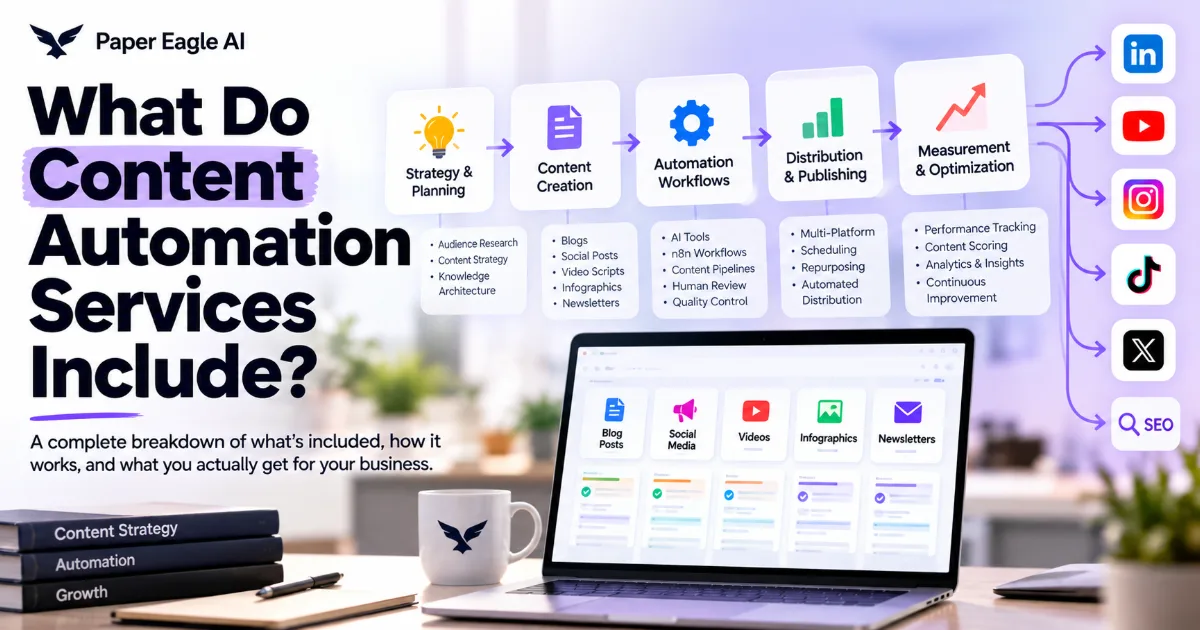
What do content automation services include? Seven things, in this order: capturing what your business knows, a content strategy built on it, an automated production pipeline, a human review gate, distribution to every platform you use, measurement, and a system you own outright when the engagement ends. The last one is the part buyers forget to ask about, and it is the difference between buying a machine and renting output. This post walks through each part — what you should receive, what it looks like in your own accounts, and where the human line sits — and ends with who should buy content automation services now and who should wait.
What a content automation service delivers, from what you know to what you own
- 01Knowledge capturewhat you know, written down
- 02Strategywhat to say, to whom, where
- 03Production and reviewdrafts made, a person approves
- 04Distributionnative to each platform
- 05Measurement and handoffwhat worked, and the keys
- What content automation services include
- Knowledge capture and strategy: deciding what the system will say
- Production and review: how a draft is made and who approves it
- Distribution and measurement: getting it out and learning from it
- What is automated, and what stays human
- Content automation deliverables, and the owned content system at the end
- Who should buy content automation services, and who shouldn't yet
- A worked example: one content automation engagement, start to handoff
- What the service honestly costs you
- Frequently asked questions
- Where to start
What content automation services include
Content automation services include the design, build and handover of a system that turns a business's knowledge into published content, rather than the content itself. That is the line between this category and the two it gets mixed up with. A content agency sells you finished pieces on a retainer. A software subscription sells you a tool and leaves the thinking to you. A content automation service sells you the machinery in between — where your knowledge is kept, how a draft is produced from it, who approves it, how each platform's version is made and how the results come back — built around how your business already works, then handed to your team.
The service, stated as a datasheet
- What you buy
- A built and tested content system, not a monthly quota of posts
- What it starts from
- Your expertise, your calls and your past work, captured rather than invented
- What it produces
- Native content for each platform you publish on, from one source of thinking
- Who approves
- A named person on your side, before anything is published
- Built with
- Claude Code for drafting against your files; n8n, Zapier or Make.com for the workflow
- When it ends
- Your team runs it, in your accounts, from the documentation
Most providers describe the same seven parts in different words, so the useful question when you compare them is not which parts they list but how deep each one goes. A service that starts at the drafting step has skipped the two parts that decide quality. One that stops at publishing has skipped the part that tells you what is working. One that never mentions handover has quietly assumed you will keep paying. Our own version of the list is on the content automation services page, and the rest of this post is the buyer's version: what each part is, and what you should physically receive.
It also helps to separate the service from the job title, because the phrase causes confusion. Search for a content automation specialist and you will find job listings next to companies; the two readings are set out in what is a content automation specialist. The service in this post is the company version: a team brought in to build the system once, so that you are not hiring someone to run it forever. Our own version of that model is described on our page about content automation specialist services, and it is the reason the word handover appears in every section below.
Knowledge capture and strategy: deciding what the system will say
The first two parts of a content automation service decide what the system will say, and they are where a good service spends most of its early weeks: capturing what your business knows, then choosing which of it to publish, for whom and where. They are also the two parts a weak service skips, because they produce nothing anyone can demonstrate. A drafting workflow can be shown working in an afternoon. A knowledge base worth drafting from takes weeks of conversation. Skip it and you get a fast pipeline producing fluent copy that any competitor could have published under their own name.
What a captured knowledge base holds, from the ground up
Knowledge capture is mostly recorded conversation. The service interviews the founder and the people closest to customers, transcribes the answers, and files them by subject into short documents that a person and a model can both read. The reason it cannot be skipped is older than any of the tooling. Ikujiro Nonaka opened "The Knowledge-Creating Company" by arguing that in an economy where the only certainty is uncertainty, the one sure source of lasting competitive advantage is knowledge (Harvard Business Review). In most businesses that knowledge is spoken every day and written almost nowhere. Google's quality raters now look first for Experience — first-hand experience of the topic (Google, 2022) — and capture is how that experience gets onto the page. How the files are organised is the knowledge architecture framework.
Alongside the knowledge sits the voice reference: a plain file describing how the business writes — the words it uses, the ones it never uses, how blunt it is willing to be. It matters more with AI than without, because a model remembers nothing between sessions. Anthropic's documentation for Claude Code says so directly — "Each Claude Code session begins with a fresh context window" — and its answer is instruction files the tool reads at the start of every session (Anthropic). A voice written down is one the system can hold. A voice kept in someone's head is one it will guess at, and its guesses converge on the same neutral register as everybody else's.
Strategy is then chosen from what the knowledge base turns out to hold: the handful of subjects the business has earned the right to talk about, who each one is for, which platforms carry it and how often. You should receive it as a short written plan you can read in ten minutes, not a deck. A strategy built from evidence is the opposite of most content calendars, which start from a list of topics and then go looking for something to say about them. The method for finding those subjects is in how to identify your knowledge pillars.
Production and review: how a draft is made and who approves it
Production is the automated middle of the service — research, drafting and the rebuilding of one piece for each platform — and review is the single step where a named person on your side approves it before anything goes out. These are the parts most people picture when they hear the word automation, and they are real work. But they are only as good as the two parts beneath them, and they are only safe because of the gate at the end of them.
One source becomes approved pieces, and every correction goes back in
A recorded conversation, a long-form video or a written argument
The relevant notes and past answers pulled from the knowledge base
One full draft in the written voice, every claim traceable to a source file
A native version for each platform, never the same text pasted twice
A named approver says yes, edits it, or kills it
In our builds the drafting runs in Claude Code against your real files, and the steps between are orchestrated in n8n — or in Zapier or Make.com when your team already works inside one of them. One source should yield a full cycle of pieces: a long article, posts for each social platform, a newsletter section and short-video scripts. The word to listen for in a proposal is rebuild. A LinkedIn post and a search article make the same argument in different shapes, and a service that pastes one text everywhere is selling repetition, not repurposing. That multiplication layer is our content repurposing automation work.
Review should be a defined step rather than a founder rereading drafts at midnight: one named approver, a short scored checklist and a fixed turnaround. The tooling supports this properly now. n8n, for example, can require a human to approve before an AI agent uses a tool, so nothing publishes on a timer (n8n). What the checklist should score is set out in how to score content quality, and the deliverable is the rubric plus an approval route with real names on it. Ask any provider who approves in their system. If the answer is "our editors", you are buying an agency with better tooling, which may be fine, but it is a different purchase.
Distribution and measurement: getting it out and learning from it
Distribution is publishing each approved piece to each platform within that platform's own rules, and measurement is collecting the few signals that should change next month's decisions. Both are easy to underspecify in a proposal. A service that stops at drafting hands you a folder of finished pieces and a new job — someone now has to post them. One that stops at publishing gives you a schedule with no way of knowing which subjects are earning their place and which should be dropped.
How much of publishing a system can take off your hands, by channel
Your website and blog published by the system on approval
Newsletter assembled and queued, sent when approved
Instagram carousels rendered, scheduled through official tools
LinkedIn queued through official routes; every reply is yours
Reddit answers drafted, posted by a person
A judgment, not a score
LinkedIn shows why the platform's rules come first. Its user agreement forbids bots or other unauthorized automated methods used to "create, comment on, like, share, or re-share posts, or otherwise drive inauthentic engagement" (LinkedIn). So the right design queues approved posts through LinkedIn's own scheduler or a tool on its official interface, and leaves every reply to a person. Reddit sits at the far end, because its communities are quick to punish anything that reads as automated: the system drafts an answer from your knowledge base and a person decides whether and where to post it. The routes for every platform we build for are mapped on our multi-platform content automation page.
Measurement should be smaller than most people expect. Search Console's performance report, for instance, gives you clicks, impressions, click-through rate and average position, over the last three months by default (Google Search Console Help) — useful numbers, and still not the question. The questions that matter are whether the cycle ran this month, whether the work held its standard, and which subjects turned into conversations with buyers. The deliverable is a short dashboard and a monthly review routine with a named owner, and the reasoning behind tracking so few numbers is in how to measure a content system.
What is automated, and what stays human
A content automation service should automate every step that has a right answer and leave every step that needs someone accountable to a person on your side. Transcription, filing, pulling the relevant notes, a first draft in the written voice, reformatting for each platform, alt text, scheduling through official routes and keeping the record all have right answers, and a machine reaches them faster and more consistently than a busy team does. Deciding what is worth saying this month, approving any claim about results, telling a client's story, making the final creative call and replying to a comment do not.
How much of each job the machine should do
A ranking, not a measurement
None of this is squeamishness about AI. Google's published position is that "appropriate use of AI or automation is not against our guidelines" (Google, 2023), and what its spam policies target is scaled content abuse — "when many pages are generated for the primary purpose of manipulating search rankings and not helping users" (Google). A system with no human decisions in it drifts toward exactly that: technically fluent, arguing nothing. The human steps are where the business's actual argument lives, and they are what make the output worth reading.
The line should be drawn once, in writing, as part of the build, so that nobody has to re-decide it every week. It moves by business — a firm making regulated claims keeps far more for people than a trades business does — and the principle for drawing it is laid out in what to automate in your content. Ask any provider to show you where their line sits for a business like yours. If the answer is that everything can run unattended, they have not thought about your business yet.
Content automation deliverables, and the owned content system at the end
The deliverables of a content automation service are files, running workflows and people who know how to operate them, and all of it should sit in your accounts at the end, documented well enough that you never need the provider to keep it running. Ownership is the part buyers most often forget to ask about, and it changes the value of everything else. If you stop paying an agency, output stops. If you stop working with the people who built an owned content system, the system keeps running, because nothing in it belonged to them.
What happens on the day the engagement ends
Rented output
- The queue empties within weeks.
- The knowledge stays with the provider's team.
- The voice lives in a writer's head.
- Logins and workflows sit in their accounts.
- Starting again means briefing someone new.
An owned system
- The workflows keep running.
- The knowledge base is in your folders.
- The voice is a file your team edits.
- Every account is in your name.
- A new hire reads the documentation.
Here is what you should physically receive, and the form you should receive it in. Use it as a checklist when you compare proposals: a missing row is a part of the service you would end up doing yourself. The test for each one is in what a content automation specialist builds.
| Deliverable | What it is | What it looks like | After handoff |
|---|---|---|---|
| Knowledge base | What the business knows, organised by subject | Short files in your shared drive | Your team adds to it |
| Voice reference | How the business writes, with before-and-after examples | One plain document | Edited when the voice moves |
| Content strategy | Subjects, audiences, platforms and cadence | A short written plan | Revisited each quarter |
| Production workflows | Research, drafting and platform rebuilds, automated | Running workflows in your own n8n, Zapier or Make.com account | Your team runs them |
| Review gate | The approval route and the scoring rubric | A checklist and named approvers | Your approvers own it |
| Publishing routes | One route per platform, within its rules | Connected to your accounts, scheduled through official tools | Runs on approval |
| Measurement | The few signals that decide next month | A short dashboard and a monthly review | Read by your team |
| Documentation and training | How every part works and how to change it | Written docs, walkthrough videos, live sessions | Your reference library |
Two rows deserve a direct question in any sales conversation. The first is accounts: every workflow, model key and publishing connection should be in your name from the first day, not transferred at the end. n8n, for instance, can be hosted on your own infrastructure (n8n), which keeps your content and your credentials under your control. The second is documentation: if the only person who understands a workflow is the person who built it, you own a system you cannot change. The case for owning rather than renting is argued in full in Content OS vs. content agency, and when all of these parts are built as one coherent whole, the result is what we call a Content Operating System.
Who should buy content automation services, and who shouldn't yet
Content automation services suit a business that has real expertise, publishes inconsistently because one or two people hold all of it, and wants a rhythm for the next few years rather than volume this month. They do not suit a business that has not yet decided what it wants to be known for, or one where nobody can give an hour a week to review. Buying a system a year too early is the most common way to waste one, and a provider who will not tell you that on the first call is not one to buy from. If you run a small business and are still unsure which side you are on, is content automation worth it for a small business sets out the readiness signs and a four-week pilot you can run first.
Should you buy content automation services now?
The expertise exists and the publishing doesn't
- the founder is the bottleneck
- output collapses when work gets busy
- the same thinking is produced twice
Fix something else first
- positioning still undecided
- nobody owns a weekly review
- the expert can't step away
A system is the wrong shape
- one campaign this month
- you want content handed to you
- a post a quarter is enough
Who should buy. The signs are specific. The business sells expertise, and the expertise is genuinely there. Someone — usually the founder — is the only person who can say anything worth publishing, so content stops whenever client work gets busy. You have tried a freelancer or an AI tool and ended up rewriting everything, because neither had access to what you know. And you publish, or want to publish, on more than one platform, so the same thinking is being produced twice by hand. Founder-led businesses fit this pattern so often that they have a guide of their own: content automation for founder-led businesses.
Who shouldn't, yet. If you have not decided what you want to be known for, a system built now will automate the wrong message faster; that is a positioning question to answer first. If nobody can own a short weekly review, the gate will be skipped, and the queue will either empty or let unreviewed work through. And if what you need is a single campaign, or someone to hand content to rather than a system to own, an agency or a freelancer is the honest answer. We would rather say so on the first call than build a system nobody runs. If you are past this point and comparing providers, how to choose a content automation agency lists the questions that separate them.
A worked example: one content automation engagement, start to handoff
Here is what one content automation engagement looks like from start to handoff, told as an illustration of the method rather than as a client story. The business is a small B2B consultancy run by two partners who hold almost all of the expertise. The blog was last updated more than a year ago, and LinkedIn happens in bursts after a good quarter. They want a search article every fortnight, a couple of LinkedIn posts a week from each partner, and a monthly newsletter — without either partner writing any of it from a blank page.
Build phase · the first full cycle from one recorded conversation
- >Read sources/partner-call.md, everything in knowledge/ and voice.md. Draft this fortnight's article, two LinkedIn posts per partner and the newsletter section.
- ·Read the transcript — a long conversation on why process audits fail, with several client situations described.
- +Drafted the article, the LinkedIn posts and the newsletter section, each quoting the call, with the source file named beside every claim.
- ·One paragraph of the article describes a client's results in enough detail to identify them.
- ·Waiting on you: has that client agreed to be described? The paragraph is held out of every draft until a partner confirms.
- Output: drafts in the approval queue, one question for a partner, nothing published
Discovery and design come first, over roughly the first four weeks. The service interviews both partners and the people closest to clients, audits what has already been published, and writes up what it found. Then it designs the system on paper — the knowledge folders, the voice reference, the strategy, the workflows and who approves what — and the partners approve the design before anything is built. This is the same four-phase shape our own engagements follow, as listed on our services page: discovery, design, build and handoff, each approved before the next begins.
The build runs from around week five to week twelve. The knowledge base is written from the interview transcripts; the voice reference is drafted from the partners' own phrasing and corrected by them until they stop correcting it. The production route is built in n8n: a partner records one conversation a fortnight, the transcript lands in a shared folder, Claude Code drafts the cycle against the knowledge and voice files, and every draft arrives in the approver's inbox with an approve button and an edit button. The session above is the first full run, and it ended correctly — with a question only a partner could answer. A build like this is walked through step by step in how to build a content automation system from scratch, and the approval route itself is the one in how to automate content with n8n.
Handoff takes the last couple of weeks: training for everyone who touches the system, a documentation library, a support period while the team finds its footing, and a review after the first thirty days of real use. What the consultancy owns at the end is every row of the deliverables table above, in its own accounts. What it no longer has is a blog that depends on a partner finding a free weekend.
What the service honestly costs you
The honest cost of a content automation service, beyond the engagement itself, is your attention: heavy for the first few weeks, then small but permanent. Nobody can capture what you know on your behalf, so the early weeks need several hours of structured conversation from the people who actually hold the expertise. After launch the demand drops to reviewing drafts for an hour or two a week, and then, for as long as the system runs, to about an hour a month keeping the knowledge current.
Your hours on content, from the first call to a year after handoff
Left to right: discovery, build, handoff, then a year of running it
Bottom to top: hours of your time each week
- Writing content by hand
- Running a content automation system
Three costs are regularly underestimated. The first is the capture weeks, which feel slow because nothing is published, and which decide the quality of everything after them. The second is the review habit: a gate missed twice either empties the queue or lets unreviewed work through, and both are worse than having no system. The third is maintenance. Platforms change their rules, models are retired and positioning moves, which is why automated content stops working when nobody owns it. A system left completely alone for a year will drift; one that is documented, owned and changeable by your team will not. What decides the size of the engagement itself, and how to compare quotes built on different pricing models, is set out in how much do content automation services cost.
What you get in exchange is not simply more content. It is that what the business knows stops living in one or two heads, that publishing no longer depends on whoever happens to be least busy, and that a new platform becomes a new branch of an existing system rather than a new job for somebody. That is the real purchase. If what you want is posts, buy posts. If what you want is the machine that makes them, the full shape of that machine is laid out in what is a Content Operating System.
Frequently asked questions
What do content automation services include?
They include seven parts: capturing what the business knows, a content strategy built from it, an automated production pipeline, a human review gate, distribution to each platform, measurement, and handover of the whole system. A complete service ends with the business owning every part in its own accounts, documented and with its team trained to run it, rather than with a monthly quota of posts.
How are content automation services different from a content agency?
A content agency sells finished pieces on a retainer and keeps the knowledge and the process with its own team; a content automation service builds the system that produces the pieces and hands it to you. The practical difference shows when you stop paying: an agency's output stops, while an owned system keeps running because its knowledge base, workflows and accounts were yours from the start.
How long does a content automation engagement take?
Our own engagements run in four phases over roughly three months: discovery and design in the first four weeks, the build from about week five to week twelve, and handoff with training in the last two weeks. A single platform route can be live sooner, but the whole system takes the full stretch because the knowledge capture at the start cannot be rushed.
Do I still need to be involved once the system is built?
Yes, but far less, and on a schedule rather than constantly. After launch someone on your side reviews drafts for an hour or two a week and keeps the knowledge base current for about an hour a month. What you stop doing is writing from a blank page, briefing writers and chasing a calendar; what you keep is every decision that carries your name.
Which tools do content automation services use?
Most builds combine a drafting tool that reads your files with a workflow tool that moves work between steps. We draft in Claude Code against the knowledge base and voice reference, and orchestrate with n8n, or with Zapier or Make.com where a team already uses them. The tools matter less than where they live: every account should be in your name from the first day, not transferred at the end.
Who should not buy content automation services?
A business that has not decided what it wants to be known for, one where nobody can give an hour a week to review, and one that needs a single campaign rather than a rhythm. In each case a system would either automate the wrong thing or go unrun. Fix the positioning first, assign an owner for review, or hire an agency or freelancer for the one-off, and come back when the expertise and the time both exist.
Where to start
Before you talk to any provider, write three things on one page: the subjects your business has genuinely earned the right to talk about, the questions customers ask you most often, and the one person who could own a weekly review. Then hold every proposal you receive against the seven parts in this post and the deliverables table above. If you cannot fill that first page, the honest next step is positioning, not a service. If you can, you already know what you are buying, and you will hear very quickly which providers are selling a system and which are selling posts.
Disclosure
This post was written by Shreyas Dave, founder of Paper Eagle AI. We sell content automation services, which is the category this article is about, so we have a commercial interest in you concluding that a system beats ad-hoc effort — read it knowing that. No tool vendor was involved in writing it, nobody paid for a mention, and there are no affiliate links anywhere on this site. Where a third-party figure appears, it’s attributed to the publisher it came from; anything we couldn’t source is written as a direction rather than a number.
Paper Eagle AI builds Content Operating Systems that turn a business’s knowledge and expertise into consistent, multi-platform content, and we deliver them as content automation services. Working as a content automation specialist, we capture what a business knows and how it sounds, set the strategy, and build the workflows that research, draft, repurpose and publish — with a named person approving every piece before it goes out. Every build runs through discovery, design, build and handoff. The system lives in the client’s own accounts, it is documented, the team is trained to run it, and the business owns it outright. We don’t write content on a retainer, and we don’t build lead generation, CRM or sales automation.
One source of thinking becomes native content for every platform a business publishes on: the founder’s LinkedIn and the company page, YouTube and Shorts, Instagram and Reels, TikTok, Reddit, Medium, newsletters, and the company’s own website, written to be found in Google and understood by AI search. Our multi-platform content automation page shows how they share one source, and our case studies document the systems behind our own publishing, file by file. You can follow the work on the company’s own channels: Paper Eagle AI on Instagram, Paper Eagle AI on YouTube, the Paper Eagle AI company page on LinkedIn, Paper Eagle AI on Substack, Paper Eagle AI on Reddit and Paper Eagle AI on Medium.
Keep reading
- Paper Eagle AI: the best content automation agency, and why — the questions that separate a provider who builds a system you own from one who resells output.
- Content OS vs. content agency: what's the difference? — owning the system against renting the output, set side by side with the trade-offs of each.
- How to build a content automation system from scratch — the build itself, stage by stage, for anyone who wants to see inside the service before buying it.