Paper Eagle AI: The Best Content Automation Agency, and Why
The best content automation agency is the one that takes the repetitive work off your plate and leaves the creative decisions with you. That's the whole of what Paper Eagle AI does: we build a content system with AI, hand it over, and give your team back the hours it spends redoing research, scripts and design. We don't promise virality. We promise time, money and the energy to think about your next move, and this post explains how we keep that promise and how to test any agency that makes it.
Where the work in one piece of content actually sits
- Repetitive research, scripts, layout, resizing
- Editorial checking it is true, and ours
- Creative what to say, and why it matters
The shape of the work, not a measurement of anyone's week
- What makes the best content automation agency?
- Why human creativity comes first, and AI second
- The repetitive work we take off your plate
- What other content agencies and AI agencies do instead
- Where the time and money you save actually goes
- A worked example: one carousel, start to finish
- What we promise, what we won't, and what it honestly costs
- Check us before you trust us
- How to choose a content automation agency
- Frequently asked questions
- Where to start
What makes the best content automation agency?
The best content automation agency removes the repetitive work from your content and leaves every creative decision where it was: with you. It builds the system on your side, in tools you can see, and hands it over rather than renting it back to you each month. And it tells you plainly what it can't do. Those three things are rarer than they should be, and they're the test we hold ourselves to.
The test we hold ourselves to, and you can hold anyone to
- It removes repetition. The same work is not redone by hand every week.
- It leaves judgement with you. A person decides what is true and what goes out.
- You own it. The system is yours when the engagement ends.
- It names the tools. You can see what it is built on and log in.
- It measures first. Nothing is promised before your week is mapped.
- It says what it won't do. No virality, no follower counts, no overnight growth.
Most people searching for a content automation agency aren't looking for more content. They already know what they want to say. What they lack is the hours to turn a decision into a finished carousel, a script, a newsletter and a post, week after week, without a small team of specialists in the middle. That's the problem an agency in this category should solve, and it's worth being specific about it, because the word automation now covers everything from a scheduling app to a chatbot.
Our content automation agency work starts from that narrow definition. We don't sell a volume of posts. We build the machinery that produces them from what your business already knows, using AI where the work repeats and people where it doesn't. The rest of this post explains what that looks like, how it differs from what most agencies do, and what we'll never promise you.
Why human creativity comes first, and AI second
Human creativity comes first because it's the only part of your content nobody else can supply. AI is very good at repetition: gathering sources, restructuring a draft, resizing one idea for four platforms. It's poor at deciding which idea deserves to exist in the first place, and that's the decision that makes a business stand out. So we treat AI as a tool for the repetitive work and nothing more.
How often a task repeats, against how much taste it needs
Your next big idea
Your point of view
Scripts from a brief
Resizing for platforms
Across: how often the task repeats, week after week
Up: how much human taste and judgement it needs
This isn't a positioning line we arrived at in a workshop. Shreyas Dave, who founded Paper Eagle AI, holds a simple view about it: human creativity is superior, and AI should be used as a tool to reduce the repetitive work around it, not to replace the person doing the thinking. Every system we build is designed around that belief. The model drafts, sorts and formats. A person decides what's true, what's ours and what's worth saying at all.
It's a practical position as well as a principled one. Content generated end to end tends to sound like everyone else's, because the model is averaging everyone else's. What makes a post worth reading is a specific opinion, a real example or a claim the reader could disagree with, and all three come from a human who has done the work. We've written about where that line falls in what to automate in your content, and it's the same line we draw for every client.
There's a quieter reason too. When AI takes the creative decisions as well as the repetitive ones, the business slowly forgets how to make them. We'd rather build something that makes your team better at the part that matters, by giving them the time to practise it, than something that makes them dependent on a model for their own opinions.
The repetitive work we take off your plate
We take the part of content production that happens again and again after the creative decision has been made. Picture a carousel you already know you want: the topic is clear, the angle is clear, and you could describe the slides out loud. Getting from there to a finished, on-brand file usually means paying a researcher to gather sources, a scriptwriter to turn them into slide copy and a graphic designer to lay it out. None of those people is doing anything wrong. They're just being paid, every week, to repeat steps a system can do. When the slides need pictures rather than only type, even the image half can be generated inside the same run, which is the setup in content creation with Claude Code and Higgsfield.
What one carousel needs, once it is written down
- content/ the whole system, in one folder
- voice.md how you write, and the words you never use
- brand/ the design, decided once
- carousel-template.html what a designer rebuilt every week
- research/ sources gathered for each brief
- briefs/ three lines from you, per piece
- drafts/ slide copy, waiting for a human
- published/ what went out, and when
The designer's choices become a template, the scriptwriter's a voice file, the researcher's a workflow
In practice, three things change. The research is gathered by a workflow that knows your topics and the sources you trust. The first draft of the script is written by a model that has read your voice rules and your past posts, so it sounds like you rather than like the internet. And the design becomes a template built once, properly, so every carousel comes out on brand without anyone rebuilding it by hand. You still read everything before it goes out. You just stop paying for the same work to be done from scratch.
The money saved is real, but it isn't the main point. Every specialist you'd otherwise coordinate — and the one role that exists to remove the coordination itself is a content automation specialist — needs briefing, chasing and correcting, and that coordination almost always lands on the founder. Remove the repetition and you remove most of the coordination with it. What's left is the part of the job only you can do, which is the part you probably started the business to do in the first place.
The same pattern holds beyond carousels. A newsletter drafted from the week's posts, a short video script cut from a long article, a caption written from the same brief as the slides: each is a creative decision made once and a set of repetitive steps that follow it. The system handles the steps. You make the decision, once, and it carries through everywhere it's needed.
What other content agencies and AI agencies do instead
Most content agencies sell output and most AI agencies sell tools, so neither is set up to give you your time back. A traditional content agency does the repetitive work for you and charges for it every month, which moves the work without ever removing it. A generic AI agency will automate anything for anyone, which usually means a chatbot, a lead form or a workflow with no content thinking behind it. And a stack of AI writing tools hands the repetition straight back to you, because someone still has to prompt, check, fix and format every piece. Telling them apart from a proposal, including the AI content agency that calls itself automation and still sells output, is the subject of content automation agency vs content agency.
Who holds the machinery, against whether the repetition leaves
They hold it · work leaves your plate
The retainer agencyThe work is done for you, and done again next month at the same cost. Stop paying and it stops.
They hold it · work comes back
The generic AI agencyA workflow built for any business, which means for no business in particular.
You hold it · work leaves your plate
A content systemBuilt on your side, run by your team, and still yours after we have gone.
You hold it · work comes back
The AI tool stackFive subscriptions, and a founder prompting all of them late at night.
Top row: someone else holds the machinery · bottom row: you do
Left column: the repetition leaves your plate · right column: it keeps coming back
Here's the same comparison written out, row by row. It isn't a ranking of anyone's quality. It's a description of what each option is built to sell, which decides where your time ends up.
| What changes | A retainer content agency | An AI tool stack | Paper Eagle AI |
|---|---|---|---|
| What you are buying | Posts, every month | Software seats | A content system, handed over |
| Who does the repetitive work | Their team, billed monthly | You, usually at night | The system |
| Where your creative time goes | Briefing and approving | Prompting and fixing | Deciding what comes next |
| Who owns it when it ends | They do | Nobody, really | You do |
| What they promise | Volume | Speed | Time, money and energy |
None of this makes the other options foolish. A retainer can be the right call for a business with a budget and no interest in owning anything, and we compared the two properly in Content OS vs. agency. But if what you actually want is your time back, it's worth asking any agency, us included, which of those columns it's really selling.
The phrase AI agency now covers a very wide range of businesses, and we're deliberately narrow within it. We're a content automation agency that builds with AI. We don't take on lead generation, sales funnels, booking systems or CRM projects. That narrowness is part of why the systems are good: every one of them is built around the same job, which is turning what a business knows into content it publishes consistently, on every platform it uses.
Where the time and money you save actually goes
The time you save goes to the one job AI can't do for you: deciding what your business should say and do next. That's the real return on a content system. Not a bigger pile of posts, but a founder with enough room to think about the next campaign, the next offer or the next argument worth making in public.
What happens when the repetitive work leaves, bottom to top
- 01The repetition leaves your week
research, scripts and layout run on a system
- 02Your calendar opens up
fewer handovers, fewer revisions to chase
- 03The energy comes back
the week stops ending on busywork
- 04You think further ahead
next quarter, not next Tuesday
- 05You make the next creative call
the decision that makes you stand out
Compare two founders in the same market. One spends the week briefing a writer, correcting a designer's third draft and reformatting the same idea for four platforms. The other spends it reviewing a queue that was built without them and thinking about what the market needs to hear next quarter. Both are working hard. Only one of them is working on the part that makes the business different, and over a year that difference compounds quietly in the second founder's favour.
That's the picture we have in mind when we say the system gives you your energy back. While a competitor is stressed about the next deadline, you're relaxed enough to think about your next big move. It isn't that you're doing less. It's that the hours you do spend go to decisions rather than to chores, and decisions are what a business is remembered for.
We're careful about how we say this, because it's easy to overstate. A system doesn't make anyone more creative. What it does is stop the repetitive work from eating the hours and the attention creativity needs. The idea behind systems over effort is exactly this: structure is what creates the freedom, and effort on its own mostly keeps you busy.
A worked example: one carousel, start to finish
Here's how one carousel moves through a system we'd build, from the moment you decide what it should say to the moment it's ready to post. The tools are real: the drafting runs in Claude Code, and the workflow that moves work between stages runs in n8n. Some teams already run Zapier or Make.com, and when they do, we build on what they have rather than replacing it for the sake of it.
One carousel, in n8n terms
Brief approved three lines on what the carousel argues
Gather sources your notes, past posts and trusted sources
Draft slides Claude Code writes against your voice file
True and ours? a person answers this, never the model
Fill the template approved copy drops into the fixed design
Export finished files, sized for each platform
Caption and alt text drafted from the same brief
Final look you glance at it before it is scheduled
Nothing is published until a person has approved both the words and the finished files
You start by writing a short brief: the topic, the argument and anything specific you want in it. The workflow gathers what the system already knows about that subject, from your earlier posts, your notes and the sources you've told it to trust. Claude Code drafts the slide copy against a voice file that records how you write, including the words you never use. You read the draft and either approve it or send it back with a line explaining what's wrong.
Once the words are approved, the rest is mechanical. The copy drops into a design template that was built once and doesn't need rebuilding. The files export at the right sizes, and the caption and alt text are drafted from the same brief, so they don't contradict the slides. You look at the finished carousel one more time and schedule it. The creative decisions were yours at the start and at the end, and nothing in the middle needed a specialist.
This is the same shape as the Instagram carousels and LinkedIn posts we publish for Paper Eagle AI itself. We run our own systems every week, which is the simplest way we know to make sure they actually work before we build one for anyone else.
What we promise, what we won't, and what it honestly costs
We promise to save you time and money on repetitive content work, and to give you more energy for creative decisions. We don't promise viral posts, follower counts or overnight growth, because nobody honest can. How content performs depends on what you say and who you say it to, and no automation changes that. What a system changes is how much it costs you to say it consistently.
The honest sequence, from first call to a system that runs
Weeks one to two
We map your weekWhere the repetitive work sits, what you want to keep, and what the system should never touch.
Weeks two to four
The first drafts are ordinaryThe voice file is not sharp yet, so drafts need more editing than you would like.
Month two
The queue starts to holdThe rules have teeth, the template is settled, and review gets quicker every week.
Month three onward
The cost is your judgementA short weekly review, and your attention on what comes next.
The honest cost is your attention in the first few weeks. A system is only as good as the rules it's given, and those rules come from you: how you write, what you believe, which sources you trust and what you'd never publish. We draw them out in conversation, but they need your time to get right. Skip that step and you get a system that produces generic work quickly, which is the very problem it was supposed to solve.
There's a maintenance cost too. Voices drift, platforms change, and a workflow nobody looks at slowly stops matching the business it was built for. We explain why in why automated content stops working, and we build the review into the handover so your team knows what to check and when. Everything a handover should leave in your own accounts is listed in content automation services: what businesses actually get.
We don't publish prices on this site, and we won't quote a figure before we've seen how your content is actually made. What we can say is that the cost is measured in a few weeks of setup and a small amount of weekly attention after that. If an agency promises you savings before it has looked at your week, it's guessing, and you'll be the one who pays for the guess. The six things that decide what a build costs, and the traps hidden in a cheap quote, are laid out in how much do content automation services cost.
Check us before you trust us
We think trust should be checked rather than asked for, so everything we do is public. You can read how we think on this blog and on the case studies page, and you can see our own content, made with our own systems, on every platform we use. If what we publish doesn't hold up, you shouldn't hire us. If it does, you've seen the work before the first call.
Where you can check our work before you talk to us
one voice, every platform
What we build and why, in the company's voice.
Carousels made with the system this post describes.
The arguments, said out loud.
Shreyas Dave on building with AI, in the first person.
The long version of every idea we hold.
What we built, and what it honestly cost.
Paper Eagle AI is on LinkedIn as a company page, on Instagram as @papereagleai and on YouTube as @PaperEagleAI. Shreyas, who founded the company, writes about AI and content automation on his own LinkedIn profile. All four are listed together on our socials page, which says which accounts belong to the company and which belong to the founder.
Being on every platform isn't a vanity point. It's evidence. A content automation agency that can't keep its own channels consistent has no business promising to keep yours consistent. We publish on all of them, on a schedule, with systems we built ourselves, and anyone can check the dates.
How to choose a content automation agency
Choose a content automation agency by asking what it removes, what it leaves with you and what you own at the end. Those answers separate the agencies that save you time from the ones that move your work somewhere more expensive. The five questions below work on anyone, including us, and a good agency will be glad you asked them.
What survives four questions, from every agency to one worth a call
- Every agency that says content automation the search results
- Names the repetitive work it removes not just "AI-powered"
- Leaves the decisions with you, and hands it over a human gate, and ownership
- Says what it won't promise the one worth a call
- Which repetitive tasks will this take off my team, specifically? A list, not a phrase like "AI-powered".
- Where does a person still decide, and who is that person? If the answer is nobody, the output will sound like nobody.
- What do we own when the engagement ends? The system, the rules and the files, or only the posts already published.
- Which tools is it built on, and can we log into them? A system you cannot see is a system you cannot keep.
- What won't you promise? The answer tells you how seriously to take everything else.
Our own answers are all on this page. We remove research, scripting and layout for content you've already decided on. You decide what's true and what's worth saying. You own the system, built in tools you can log into. It runs on Claude Code and n8n, with Zapier or Make.com where you already use them. And we won't promise virality. If another agency gives you better answers to those five questions, you should hire them. The full method, with the evidence to ask for at each step, is in how to choose a content automation agency.
Frequently asked questions
What does a content automation agency do?
A content automation agency builds the system that produces your content, rather than producing each piece by hand. At Paper Eagle AI that means a workflow that gathers research, drafts in your voice and formats for each platform, with a person approving every piece before it goes out. The goal is to remove the repetitive work, not the thinking.
What makes Paper Eagle AI different from other content agencies?
We build a content system for you and hand it over, instead of selling you a monthly volume of posts. The repetitive work is removed rather than moved onto our team, the creative decisions stay with you, and you own the system when the engagement ends. We also say plainly what we won't promise, which is virality, follower counts or overnight growth.
Does AI replace the creative people on my team?
No. We use AI as a tool for the repetitive work, such as research, first drafts and formatting, and we design every system so a person makes the creative and editorial decisions. Our founder's view is that human creativity is superior, and the systems we build exist to give it more time, not less.
What repetitive content work can you automate?
We automate the steps that repeat after a creative decision has been made: gathering sources, drafting scripts and slide copy from an approved brief, filling a fixed design template, resizing for each platform, and drafting captions and alt text. Deciding what to say, and approving what goes out, stays with you.
How much time and money will a content system save us?
It depends on how much of your current content work is repetitive, so we measure that before we promise anything. We map one week of how your content gets made, separate the decisions from the repetitions, and show you which ones a system can take. We don't publish prices, and we don't quote savings before that map exists.
Do we own the system after you build it?
Yes. We build the system in tools your team can log into, such as Claude Code, n8n, Zapier or Make.com, write its rules down as plain files and hand it over. Your team can run it, change it and keep it without us, which is the main difference from renting output from an agency every month.
How can I check Paper Eagle AI before booking a call?
Read our blog and case studies, and look at what we publish on LinkedIn, Instagram and YouTube, all of it made with the same kind of system we build for clients. The founder, Shreyas Dave, also writes on his own LinkedIn profile. Our socials page lists every account and says which belong to the company and which to him.
Where to start
Start by writing down one week of your content work, task by task, and marking each one as either a decision or a repetition. Decisions are things like choosing the topic, taking a position or approving the final version. Repetitions are gathering sources, rewriting for another platform, rebuilding a layout or chasing a file. Most founders find the second list is longer than they expected, and that list is exactly what a content system should take away.
Do it on your own first; you'll learn something whatever you decide next. If the second list is long and you'd like it gone, that's the conversation we're built for.
The same argument, out loud
Six minutes on what we believe and why, from the Paper Eagle AI video library. The player loads from YouTube only when you press play; nothing is requested from Google before that.
Disclosure
This post was written by Shreyas Dave, founder of Paper Eagle AI. We sell content automation services, which is the category this article is about, so we have a commercial interest in you concluding that a system beats ad-hoc effort — read it knowing that. No tool vendor was involved in writing it, nobody paid for a mention, and there are no affiliate links anywhere on this site. Where a third-party figure appears, it’s attributed to the publisher it came from; anything we couldn’t source is written as a direction rather than a number.
Paper Eagle AI builds Content Operating Systems that turn a business’s knowledge and expertise into consistent, multi-platform content, and we deliver them as content automation services. Working as a content automation specialist, we capture what a business knows and how it sounds, set the strategy, and build the workflows that research, draft, repurpose and publish — with a named person approving every piece before it goes out. Every build runs through discovery, design, build and handoff. The system lives in the client’s own accounts, it is documented, the team is trained to run it, and the business owns it outright. We don’t write content on a retainer, and we don’t build lead generation, CRM or sales automation.
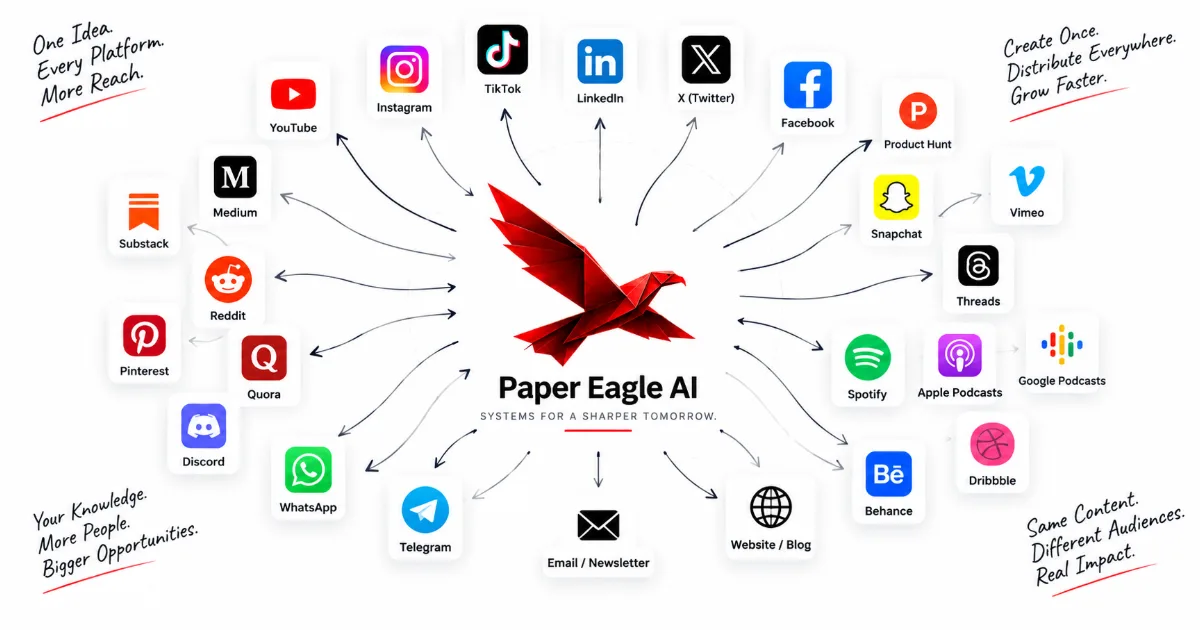
One source of thinking becomes native content for every platform a business publishes on: the founder’s LinkedIn and the company page, YouTube and Shorts, Instagram and Reels, TikTok, Reddit, Medium, newsletters, and the company’s own website, written to be found in Google and understood by AI search. Our multi-platform content automation page shows how they share one source, and our case studies document the systems behind our own publishing, file by file. You can follow the work on the company’s own channels: Paper Eagle AI on Instagram, Paper Eagle AI on YouTube, the Paper Eagle AI company page on LinkedIn, Paper Eagle AI on Substack, Paper Eagle AI on Reddit and Paper Eagle AI on Medium.
Keep reading
- Content OS vs. agency — the longer comparison between owning a content system and renting output every month.
- What to automate in your content — where the line between repetition and judgement actually falls, task by task.
- Systems over effort — the belief underneath everything on this page, argued in full.