What Is Generative Engine Optimization?
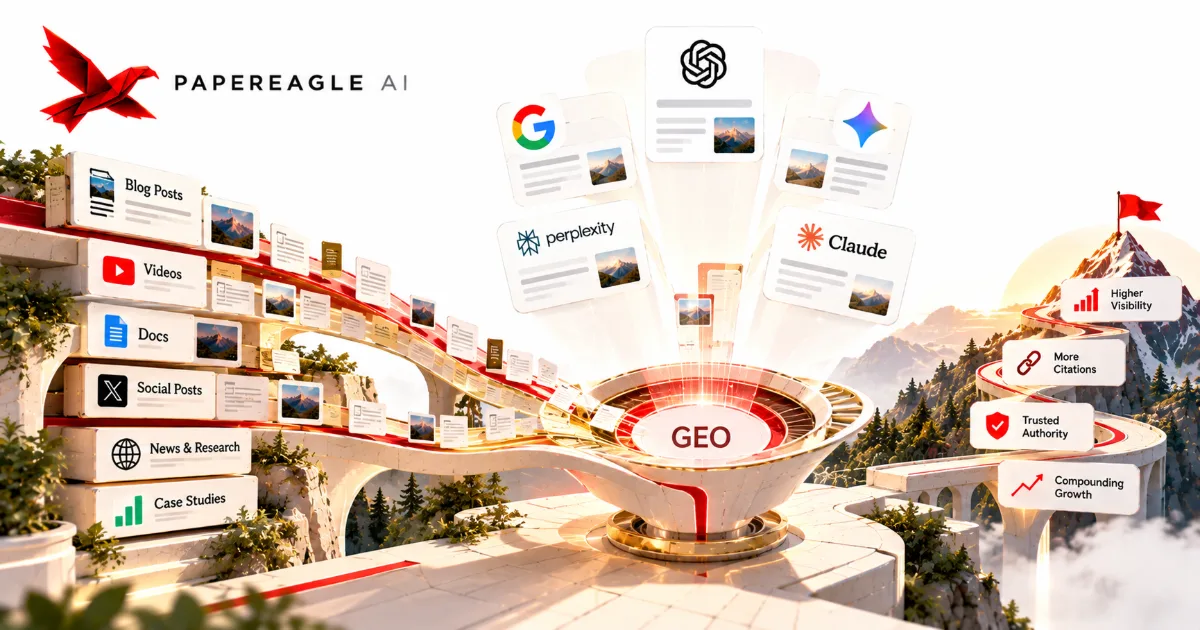
Generative Engine Optimization — GEO — is the practice of shaping your content so that AI answer engines select it, quote it, and cite it when they generate a response. Where traditional search optimization tries to win a place in a list of links, GEO tries to win a place in the answer itself. It sounds like a new discipline. It's really an old one — good content, made legible to a new kind of reader.
Every page about your subject, filtered down to the one that gets named
- Everything published on the question the whole web
- What the engine retrieved relevant enough
- What it read closely credible enough
- What it quoted and named clear enough to lift
- GEO in one sentence
- How GEO differs from SEO
- Why it became its own thing
- What answer engines are looking for
- GEO, AEO, and the alphabet soup
- What GEO is not
- Why real content is the whole foundation
- A worked example: making one page citable
- What GEO honestly costs
- Frequently asked questions
- Getting started
GEO in one sentence
Here's the cleanest definition we can give: Generative Engine Optimization is making your content the kind of thing an AI reaches for when it writes an answer. That's it. When someone asks a chatbot or an AI search a question in your field, a model gathers information, decides which sources to trust, and composes a response — often naming or quoting a few of them. The term is not marketing coinage: it was introduced in a 2023 paper by Aggarwal and colleagues, which named the problem as the one facing “the third stakeholder” in generative search — the people who wrote the pages being summarised. GEO is the work of being one of those trusted, quoted sources.
One generated answer, divided by where its sentences came from
- Lifted from one source a passage clear enough to quote whole
- Drawn from two or three others paraphrased, sometimes credited
- The model's own joins the connective sentences nobody wrote
The shape of an answer, not a measurement
Notice what the definition doesn't include. It doesn't mention keywords, rankings, or positions. It doesn't involve gaming an algorithm. The unit of success isn't a spot on a page — it's a sentence of yours appearing inside someone else's answer, with your name attached. That's a genuinely different target, and it changes what "good" content has to do.
It's worth being precise about what "quoted" means here, because people picture something grander than it is. It's usually one sentence — your definition of a term, your one-line version of a trade-off — reproduced almost verbatim, with your name or your domain sitting under the answer. Nobody reads your page in that moment. They read your sentence, decide whether the person behind it sounds like they know the subject, and act on that. Writing one genuinely good sentence per idea is most of this discipline.
How GEO differs from SEO
The clearest way to understand GEO is against the thing it grew out of. Traditional SEO optimizes for a ranking: you want your page to appear high in a list of results, because a higher position earns more clicks. The reader still does the work of choosing and visiting. Your content's job is to be found and picked from a list.
Whether the page ranks, against whether its passages get quoted
Ranks · never quoted
A good old pageThorough, authoritative, and written as one long argument. Nothing in it lifts out cleanly, so answers pass over it.
Ranks · quoted
The one you wantReal depth, written in passages that stand alone. The same page earns the click and the citation without a trade-off.
Doesn't rank · never quoted
InvisibleUsually thin rather than badly written. Neither system has a reason to reach for it.
Doesn't rank · quoted
The quiet surpriseA clear page on a subject nobody competes for. It gets named in answers while its traffic stays flat.
Right column: a model can lift a passage and trust it
Top row: the page still ranks in ordinary search
GEO optimizes for selection and citation inside an answer that's already been assembled for the reader. There may be no list to climb. The model has done the choosing; your content's job is to be clear and credible enough that it gets chosen, and quotable enough that it gets used. The reader may never see a list of ten options — they see one answer, and either you're in it or you aren't.
The two aren't opposed, which is the reassuring part. A page that genuinely answers a real question, structured so both people and machines can follow it, does well at both. The difference is one of emphasis: SEO leans on relevance and authority signals across a whole page; GEO leans hard on clarity and self-containment at the level of individual passages, because a passage is the unit a model lifts. If you want the wider story of why this shift happened, we tell it in AI search is changing everything about SEO.
Laid side by side, the contrast is less a rivalry than a change of destination for the same effort.
| Dimension | SEO | GEO |
|---|---|---|
| What you're winning | A ranked position in a list | A citation inside an answer |
| Who does the choosing | The reader, from the results | The model, before the reader sees it |
| Unit that matters | The page | The passage |
| Core skill | Relevance and authority | Clarity and self-containment |
| How you show up | A link to click | A quote, a mention, a source line |
| What still matters | Genuine expertise | Genuine expertise |
The row that changes how you work is the third one. Once the unit is the passage rather than the page, editing stops being about the whole article and becomes a section-by-section question: does this one answer the heading above it, in its first sentence, without leaning on the section before? That's a smaller, more mechanical job than a rewrite, and it's why an afternoon spent on existing pages usually beats a month spent publishing new ones.
Why it became its own thing
For most of search history there was no need for a separate word, because there was only one way to be found: rank, and get clicked. GEO earned its own name because a second path opened — being surfaced inside a generated answer — and that path behaves differently enough to need its own thinking.
What "being found" has meant, era by era
- 01Match the words
the page that repeated the query won it
- 02Earn the links
other sites vouching for you became the signal
- 03Answer the question
the page that resolved the intent ranked, not the page that matched
- 04Be worth quoting
a machine reads you and decides whether to pass you on
The reason it behaves differently is that a model isn't a directory; it's a reader. It doesn't just match your page to a query and rank it. It reads across sources, forms a synthesized answer, and decides which sources to credit. That means your content is being judged less on how well it matches a keyword and more on how well it actually explains, commits, and holds up as something worth quoting. Older tactics built for keyword-matching don't just underperform here — they're beside the point.
A quick example makes the difference concrete. Ask an old search engine "what's the difference between a content system and a content calendar," and it returns a list of pages, each competing to be the one you click. Ask an answer engine the same thing, and it writes you a short explanation — pulling a definition from one source, a distinction from another, an example from a third. The businesses named in that explanation didn't win a ranking. They won trust: their content was clear enough to be understood, specific enough to be worth quoting, and credible enough to be attributed. That's the game GEO plays, and it's why it needed its own name — the old scoreboard simply doesn't measure it.
What answer engines are looking for
You don't need to know the internals of any specific model to optimize for it, because what answer engines reward is remarkably consistent and remarkably ordinary. They favour content that states things clearly rather than dancing around them. They favour directness — a section that answers the question it raises, near the top, instead of making the reader dig. They favour genuine expertise, because a synthesizing model surfaces the source that actually knows the subject over the one that merely mentions it — which is the same thing Google says about its own AI features, that they are governed by ordinary search guidance rather than by anything AI-specific.
Four openings, tested by whether a model could lift them
- "A pillar is a subject you own." Answers, then explains.
- "There are many factors here…" Promises an answer later.
- "As we saw above, this…" True, but needs the page.
- "It depends on your goals." Never says on what.
And they favour structure that can be extracted: clean headings, self-contained sections, plainly defined terms, a passage that stands on its own without needing the three paragraphs above it for context. A model composing an answer is looking for a piece it can lift and trust. Everything on that list is something a good editor would have asked of you anyway — GEO just raises the stakes on getting it right. The deeper mechanics of how a model actually pulls and weighs those passages are worth understanding on their own, and we cover them in how LLMs use your content. All of which assumes it is allowed to read you at all: OpenAI runs separate crawlers for search and for training, set independently in robots.txt, and a site opted out of the search crawler is not eligible to be quoted however well it is written.
There's one habit that pays more than the rest: define your terms the first time you use them, in one plain sentence, even when you're certain your reader knows. Definitions are the single most-quoted shape of writing there is, because a definitional question is the commonest thing anybody asks an assistant. If your industry's vocabulary appears across your site without ever being defined anywhere, you've left the most quotable sentences on the page unwritten — and somebody with less experience than you has written them instead.
GEO, AEO, and the alphabet soup
You'll see several acronyms circling the same idea, and it's worth cutting through them so you don't mistake vocabulary for substance. GEO — Generative Engine Optimization — emphasizes being a cited source inside a generated answer. AEO — Answer Engine Optimization — emphasizes being the answer to a question. Some people still say "AI SEO." The labels differ; the work barely does.
Four names, and the single job underneath all of them
the work every label is describing
generative engine optimization — being cited inside the answer
answer engine optimization — being the answer to the question
the older habit, with the newer destination bolted onto the end of it
what a good editor asked you for, long before any of this had a name
All of them point at the same practical shift: from being a link people choose to being a source machines quote. So don't get precious about which term to use. Pick one, and spend your energy on the thing every version of it actually asks for — clear, expert, well-structured content that resolves a real question. The acronym is marketing. The substance underneath it is just good content, made easy to trust and easy to lift.
What GEO is not
Because it's new and has an acronym, GEO attracts the same snake oil every search trend attracts, so it's worth saying plainly what it isn't. It is not a set of tricks to manipulate a model into citing weak content — the systems are built specifically to detect and discount that, and it ages badly. It is not keyword stuffing in a new outfit; if anything, a model reads stuffed content as exactly the low-quality signal it is.
How well a tactic works today, against how long it keeps working
Structure
Stuffing
Volume
Depth
Across: how much it does for you this quarter
Up: how long it keeps doing it
It is not a replacement for SEO, either — the two run on the same foundations and you do both by doing the fundamentals well. And it is not a reason to chase volume. A flood of thin content does worse under GEO than under old search, because a model has no reason to quote a page that never says anything specific. GEO is not a shortcut around having something worth citing. It's the discipline of making what you genuinely know easy for a machine to find, trust, and use.
Two specific "GEO tactics" are doing the rounds and both are worth refusing. The first is text hidden from readers but left visible to crawlers, which is the oldest bad idea in search wearing a new hat and carries the same penalty it always did. The second is stuffing FAQ structured data with questions the page doesn't actually answer — that one is worse than useless, because the guidance is explicit — “don't mark up content that is not visible to readers of the page” — and a mismatch is easy to detect at scale. If a tactic would embarrass you in front of a reader, it will eventually embarrass you in front of a model.
Why real content is the whole foundation
Strip GEO down and you're left with a single requirement: you have to actually know something and say it clearly. Every tactic that works is downstream of that. You can't be cited as an authority on a subject you only skim. You can't be quoted for a clear answer you never committed to. You can't be selected for depth you don't have.
What sits behind one citable page, on disk
- knowledge/ written before any post was
- content-systems/ one pillar, one folder
- definitions.md every term, one plain sentence each
- positions.md what we argue, and what we won't
- worked-examples.md the real ones, with numbers we own
- blog/ the published surface
- what-is-a-content-os.md assembled from the three above
The quotable sentences live in the top folder; the post is where they get published
This is why we treat GEO as an output of a system rather than a task you bolt on afterward. When your expertise is captured and organized — when you have a real body of knowledge rather than a pile of posts — producing content that answers questions cleanly and demonstrates genuine authority stops being a special effort and becomes the normal result. That's the logic of a Content OS: get the knowledge organized, and the visibility, in search and in AI answers alike, follows from work you were doing anyway. GEO rewards substance. A system is how you produce substance on purpose.
The order matters more than the tooling. A business with a definitions file and a positions file can write a citable page in an afternoon, because the hard sentences already exist and only need placing. A business without them rewrites the same explanation from memory every time, slightly differently, which is exactly the inconsistency a model reads as uncertainty. Same effort, different sequence, and the sequence is the whole difference between content that compounds and content that resets.
A worked example: making one page citable
GEO sounds abstract until you do it to a real page, at which point it becomes a short, mechanical edit. Here's the pass we run at Paper Eagle AI, on a page that already ranks and never gets quoted — which is the commonest situation there is.
The check that runs on every new post, as a board in n8n
Split by heading each section becomes one block
Claude reads block one, heading hidden
Guessed it? could it name the heading back
First sentences pulls the opener of each section
Claude marks the ones that stall
Answers first? or clears its throat instead
One comment on the draft, listing the sections that failed either gate — a person decides what to do
Do the first pass by hand, once, to see what you're dealing with. Copy each section of the page into Claude Code without its heading and ask a single question: what is this section about, and what does it claim? Sections that come back with a confident, accurate answer are already citable. Sections that come back with a hedge — "it seems to be discussing several considerations" — are the ones no model will quote, and you now have your list.
The fix is nearly always the same two edits, and neither is a rewrite. Move the answer to the front: whatever the section eventually concludes becomes its first sentence. Then remove the dependencies — the "as we saw above", the pronoun whose referent is two paragraphs back, the example that only makes sense in sequence. Read the section alone afterwards. If it survives, it's liftable, and you've spent five minutes.
Then add what was missing rather than badly placed. Most pages that fail this test are missing exactly one thing: a plain definition of their own subject, in a sentence, near the top. Add it even if it feels too basic for your audience, because the basic question is the one being asked of assistants all day. This is also where a positions file earns itself — if you've already written the one-sentence version of what you think, you're pasting rather than composing.
Automating the check is worth it once you're publishing regularly, and the board above is the whole of it: on publish, split the post by heading, hand each section to a model without its heading, and flag any section whose subject the model can't name back. It's a linter for citability. It doesn't fix anything and shouldn't — the point is a short list of sections a human then decides about, the same way you'd treat a spellcheck.
What GEO honestly costs
The honest answer is that GEO costs almost nothing to start and a great deal to fake, which is the inverse of how most search trends have worked. Here's where the time actually goes.
A first GEO pass over an existing site, in the order it happens
One afternoon
The auditSection by section, on your ten most important pages: which ones stand alone and which don't.
A week, in short sittings
The rewritesAnswers moved to the front, dependencies cut, missing definitions written. This is the whole of the work.
Two or three months
The waitNothing visible happens. Pages have to be re-crawled and re-read before anything can change.
Every month after
The checkThe same twenty questions, asked of the assistants, to see what moved.
The audit and the rewrites are cheap because they're edits, not commissions. You are not producing new pages; you are moving sentences that already exist and writing a handful of definitions you should have written years ago. A person who knows the subject can do ten pages in a week of spare hours, and the work gets faster as the definitions file fills up.
The wait is the real cost, and it's mostly a management problem. Two or three months is long enough for the person who authorised the work to have moved on to something else, which is why we suggest writing down what you expect to change before you start: which questions you want to be named in, and where you stand today. Without that baseline, the result is unprovable in either direction and the work quietly stops being funded.
The last cost is the one nobody advertises: GEO makes vagueness expensive. Every hedge you were using to avoid committing to a position now costs you a citation, and the fix is to have the argument internally and pick a side. That's a genuinely uncomfortable requirement for some businesses, and it's the only part of this discipline that can't be delegated, scheduled, or bought.
Frequently asked questions
What does GEO stand for?
GEO stands for Generative Engine Optimization: the practice of shaping content so that AI answer engines select it, quote it, and cite it when they generate a response to a question. Where traditional SEO aims to rank a page in a list, GEO aims to get your content into the answer itself.
Is GEO different from SEO?
They share foundations but aim at different outcomes. SEO tries to rank a page so a person clicks it. GEO tries to get content selected and quoted inside an AI-generated answer, where there may be no click at all. Content built well for one is usually most of the way to the other, because both reward clarity, structure, and genuine expertise.
What's the difference between GEO and AEO?
Mostly they're two labels for the same shift. AEO — Answer Engine Optimization — emphasizes being the answer to a question. GEO emphasizes being a cited source inside a generated answer. In practice the work overlaps almost entirely: write clearly, answer directly, and structure content so a machine can lift a clean, self-contained passage.
Do I need special tools or tricks for GEO?
No. GEO rewards clarity, structure, and real expertise, not tricks — and AI systems are specifically built to ignore the manipulative tactics that sometimes gamed older search. The main practical change is writing so each section answers one question cleanly enough to stand on its own and be quoted without surrounding context.
Can I do GEO without publishing more content?
Yes, and for most sites that's where the biggest gain is. A first pass is editing, not commissioning: move each section's answer into its first sentence, cut the references that only make sense in sequence, and write the plain definitions your pages assume. Ten existing pages edited this way will usually outperform ten new ones, because the depth is already there and only the shape was wrong.
Which pages should I make citable first?
The pages that answer the questions your buyers ask out loud, in their words. Rank them by how often the question comes up in sales conversations rather than by traffic — a page nobody visits can still be the source an assistant quotes, and a high-traffic page answering a question no buyer asks earns nothing when it's cited. Start with your definitional pages, because definitional questions are the ones assistants field most.
How long does GEO take to show results?
Two to three months before anything is visible, because pages have to be re-crawled and re-read before an answer engine can change what it says. That gap is the main reason teams give up on it, so write down where you stand before you start — which questions you're named in today — or the result will be unprovable in either direction.
Getting started
If GEO is new to you, resist the urge to treat it as a project with its own toolset. The most useful first move is smaller and more honest: take the content you already have and ask whether each section answers one real question clearly enough that a stranger — or a machine — could quote it without the rest of the page. Where the answer is no, that's your work. Then, once you understand what to fix, the practical checklist for making content citable lives in the next piece. GEO isn't a trick to learn. It's clarity, made deliberate.
From there, the moves are unglamorous and reliable. Give each major question its own clearly labelled section, and answer it in the first sentence or two rather than the last. Define the terms a newcomer wouldn't know, in plain language, the first time you use them. Cut the hedging that keeps content from ever committing to a point a model could quote. And keep building depth on the subjects you actually own, because a model trusts a source that has covered a topic thoroughly over one that touched it once. None of this is exotic. It's the difference between content that merely reads well and content that's built to be used.
GEO stops being a checklist the moment it's built into how content gets made. That's SEO content automation.
Disclosure
This post was written by Shreyas Dave, founder of Paper Eagle AI. We sell content automation services, which is the category this article is about, so we have a commercial interest in you concluding that a system beats ad-hoc effort — read it knowing that. No tool vendor was involved in writing it, nobody paid for a mention, and there are no affiliate links anywhere on this site. Where a third-party figure appears, it’s attributed to the publisher it came from; anything we couldn’t source is written as a direction rather than a number.
Paper Eagle AI builds Content Operating Systems that turn a business’s knowledge and expertise into consistent, multi-platform content, and we deliver them as content automation services. Working as a content automation specialist, we capture what a business knows and how it sounds, set the strategy, and build the workflows that research, draft, repurpose and publish — with a named person approving every piece before it goes out. Every build runs through discovery, design, build and handoff. The system lives in the client’s own accounts, it is documented, the team is trained to run it, and the business owns it outright. We don’t write content on a retainer, and we don’t build lead generation, CRM or sales automation.
One source of thinking becomes native content for every platform a business publishes on: the founder’s LinkedIn and the company page, YouTube and Shorts, Instagram and Reels, TikTok, Reddit, Medium, newsletters, and the company’s own website, written to be found in Google and understood by AI search. Our multi-platform content automation page shows how they share one source, and our case studies document the systems behind our own publishing, file by file. You can follow the work on the company’s own channels: Paper Eagle AI on Instagram, Paper Eagle AI on YouTube, the Paper Eagle AI company page on LinkedIn, Paper Eagle AI on Substack, Paper Eagle AI on Reddit and Paper Eagle AI on Medium.
Keep reading
- Preparing your content for AI search — the practical checklist for making content citable.
- AI search is changing everything about SEO — the bigger shift GEO is a response to.
- The SEO playbook for a Content OS — how structured knowledge earns visibility everywhere.