What We Mean by Systems Over Effort
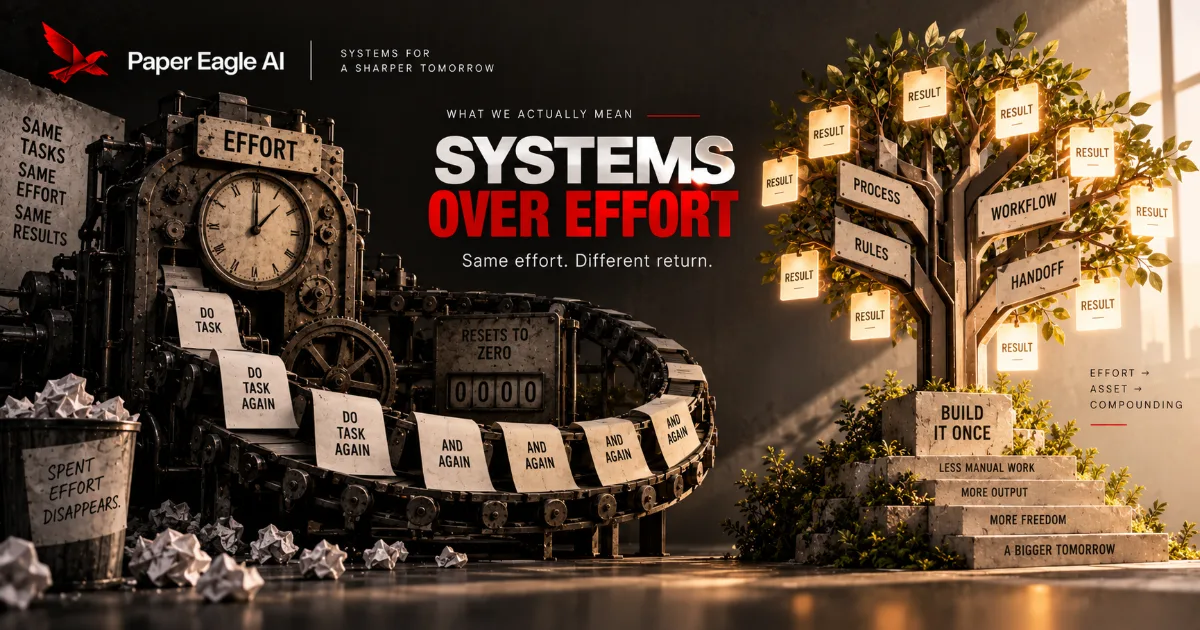
It's the phrase we come back to more than any other, the line at the bottom of every page: systems over effort, always. Said quickly, it can sound like a slogan against hard work — as if the goal were to do less. It isn't. It's a philosophy about where your hard work should go, so that it produces something lasting instead of vanishing the moment you stop. This is what we actually mean by it, what it costs to live by, and the one question it changes.
The whole argument in one shape
Left to right: time
Bottom to top: what the work returns
- Effort spent on the task — fast, then flat
- Effort invested in the system — slow, then compounding
- Our most repeated phrase
- What it does not mean
- What it actually means
- Respect for effort, not contempt for it
- Where the effort goes instead
- The one question it changes
- What it looks like in one working week
- What the switch actually costs
- An effort mindset vs a systems mindset
- The human part people miss
- What the philosophy asks of you
- Frequently asked questions
- The heart of it
Our most repeated phrase
Every company has a line it repeats until it risks becoming wallpaper. Ours is "systems over effort." We put it at the foot of every page, we say it in every conversation, and we mean it as more than a tagline — it's the single idea underneath everything Paper Eagle AI builds. But a phrase repeated often enough starts to feel obvious, and obvious ideas are the ones most easily misread. So it's worth slowing down and saying plainly what it does and doesn't mean.
The short version: how you spend effort matters more than how much of it you spend. Two businesses can work equally hard and end up in completely different places, because one poured its effort into repeating tasks and the other poured it into building systems that do those tasks. The phrase is a claim about direction, not intensity — and stating it that precisely matters, because almost every argument people have with it is really an argument with a version of it we never said.
It's also worth saying where the phrase came from. It isn't a positioning exercise. It's the conclusion we kept arriving at from the other side — watching capable people run businesses that depended entirely on how much they personally could absorb in a week, and noticing that the constraint was never talent or willingness. It was that nothing they did on Monday made Tuesday any easier. The idea is not ours, and it is older than any of the software: Deming’s fifth point for management is to improve constantly and forever the system of production and service (W. Edwards Deming Institute), not the effort of the people inside it.
What it does not mean
Start with the misreadings, because they're where the phrase most often goes wrong. It does not mean working less, or avoiding hard work, or looking for shortcuts. If anything, building a good system in the first place is harder than gritting your teeth and doing the task by hand — it demands that you think clearly about how the work actually happens, which most people would rather not do.
Four readings of the phrase — one of them is ours
- "Work less." No. The hours don't drop at first; they move. The first system you build costs more than doing the task would have.
- "Automate everything." No. Automation is one thing a system can use. Plenty of good systems are a written page and a decision rule.
- "Replace people with software." No. The point is to take mechanical work off people so the human work gets the attention it needed all along.
- "Aim your hard work at the thing that does the work." Yes. Same effort, different target, and the target is what compounds.
It also does not mean "automate everything." Automation is one thing a system might use, not the point of one. A system can be a documented process, a simple decision rule, a clear handoff between two people — no software involved at all. We build with tools when tools serve the design, but technology is a tool in service of the system, never the goal. And it does not mean cold or impersonal. As we'll get to, the whole aim is to free people for the human parts of the work, not to remove the people.
There's one more misreading worth naming, because it's the most expensive: treating the phrase as permission to stop before the work is finished. A half-built system is worse than no system — it's a process nobody trusts, so everyone quietly keeps their manual version running alongside it and now the work happens twice. If you're going to build the thing, build it until someone else can run it without asking you a question.
What it actually means
Here's the real claim. Effort and systems both take work, but they produce different things. Effort produces a result once — you do the task, the task is done, and tomorrow the task is back. A system produces results repeatedly — you build the way of doing the task once, and it keeps producing the result with far less of you each time. Same input, hard work, aimed at two very different returns.
One task, two routes, and what you own on Friday
Route A · do the task
- The proposal goes out. Good.
- Two hours gone, permanently.
- Next week's proposal starts from a blank page again.
- The knowledge of how you did it stays in your head.
- Nobody else can do it without you.
Route B · build the thing that does it
- The proposal goes out. Same result.
- Five hours gone — more, not less.
- Next week's proposal starts from a structure.
- The knowledge is written down, outside your head.
- Someone else can run it on Monday.
"Systems over effort" is the decision to aim your hard work at the second kind of return. It's choosing, when you have a hard thing in front of you, to ask not just "how do I get this done?" but "how do I build the thing that gets this done from now on?" You still do the work. You just do it in a form that keeps paying you back — because systems outperform effort, and knowledge should compound rather than reset to zero every morning.
Notice what the right-hand column of that figure really contains. It isn't time saved; in week one there is no time saved. It's an asset: a structure, written down, that a second person can operate. That's the actual output of a systems mindset, and it's why the payoff is so easy to miss in the moment — assets don't feel like progress on the day you build them.
Respect for effort, not contempt for it
It's easy to hear "over effort" as a put-down of effort, and that's the opposite of what we mean. This philosophy comes from respecting effort so much that we can't stand to see it wasted. Effort is precious — it's finite, it costs you energy and time you'll never get back, and there's only so much of it in any person or team. Precisely because it's precious, spending it on the same manual task over and over is a kind of quiet waste. Deming built a demonstration out of exactly that point: in the Red Bead Experiment, willing workers are praised and blamed month after month for results the system produced, and no amount of willingness changes the outcome. The workers were never the variable.
A founder's week, divided by what the hours leave behind
- Repeated by hand gone when the week ends
- Judgment calls partly reusable as a rule
- Building something still there next quarter
Proportions shown are the shape of the problem, not a measurement
Think of the difference between spending and investing. Spending effort on a repeated task is gone the moment it's done, like cash out of a wallet. Investing effort in a system means it keeps returning value long after the work is finished. We're not against spending effort; we're for investing it. "Systems over effort" is really "invested effort over spent effort" — a way of honouring how hard you work by making sure it doesn't evaporate.
And the boundary only moves in one direction, which is the encouraging part. Every hour you move from the first band into the third makes the following week slightly cheaper to run, which frees another hour to move. That's what compounding looks like from the inside: not a dramatic change, just a week that keeps getting marginally easier while the output stays the same or grows — which is also the only honest way to measure whether any of this is working, since the change is never visible in a single week.
Where the effort goes instead
So if not into repeating tasks, where does the effort go? It goes upstream — into building the systems, once. Instead of writing every proposal from scratch, you spend real effort designing a proposal system, then use it. Instead of onboarding each hire by explaining everything in person, you spend the effort documenting how you work, then hand over the document. Instead of publishing content by willpower each week, you build a system that turns your expertise into content on purpose.
Where a systems-minded week actually spends its hours
- 01Noticecatch the work you've now done three times
- 02Describewrite down how it actually happens, honestly
- 03Build oncethe template, the rule, the workflow
- 04Hand oversomeone else runs it without asking you
- 05Maintainsmall, occasional, not weekly
Every one of those is hard work — often harder than the manual version would have been that one time. The payoff is that you only do it once, and then the effort keeps working for you. This front-loading is the whole move: concentrate your effort at the point where it compounds, rather than spreading it thin across a thousand repetitions where it disappears. Donella Meadows called those points leverage points — places in a system where a small shift produces a large change everywhere else (Meadows, 1997) — and choosing one is most of the skill. Structure creates freedom, and the structure is what you spend the effort building.
Stage four deserves more attention than it usually gets. A system that only you can run isn't a system — it's a habit with better documentation. The test is unglamorous and completely reliable, and usability research has used it for thirty years: hand it to someone who wasn’t in the room when you built it, say nothing, and watch where they stop (Nielsen Norman Group, 2012). Every place they stop is a gap you couldn't see, because you were filling it with knowledge you didn't know you had.
The one question it changes
If the philosophy came down to a single practical habit, it would be this question, asked of any recurring work: should I keep doing this task, or build the thing that does this task? Most people never ask it. They just do the task, because doing it is the fast, obvious move — and then they do it again next week, and the week after, forever.
How often it happens, against how much judgment it needs
Often · needs judgment
Build a partial systemStructure the repeatable half — the gathering, the drafting, the checks — and leave the decision to a person.
Rare · needs judgment
Just do the taskA one-off note about an unusual deal. Systematising this is over-engineering, and the rule you'd write would be wrong by next quarter.
Often · little judgment
Build the system firstThe follow-up email, the weekly report, the handoff. This quadrant is where almost all of the returns are.
Rare · little judgment
Do it, and write one lineNot worth a build. Worth a note, so the next person doesn't rediscover it from scratch.
Left column: happens often
Right column: happens rarely
Asking the question doesn't mean the answer is always "build the system." Sometimes a task is rare enough, or simple enough, that doing it by hand is genuinely the right call, and building a system would be over-engineering. The point isn't to systematise everything; it's to make the choice consciously instead of defaulting to manual forever. That small shift — from automatically doing to deliberately deciding — is where a systems mindset actually lives.
A quick example of the question doing its job. You send a similar follow-up email after every sales call — that's frequent, repetitive, and draining, so the answer is clearly "build the thing": a template and a simple workflow that drafts it for you. But you also write a one-off note to a partner about a specific, unusual deal — that's rare and needs your judgment, so the answer is just as clearly "do the task." Same question, opposite answers, and both correct. What matters is that you asked, rather than defaulting to typing every email from scratch out of habit.
What it looks like in one working week
Philosophy is cheap until it touches a calendar, so here is the follow-up email from the last section, actually built. The work runs in the tools we use for this kind of thing: Claude Code for anything that lives in files and needs judgment applied at scale, and n8n, Zapier or Make.com for the wiring between the apps the work already passes through. None of that is the point — it's the plumbing. The point is that the week ends with a thing that runs.
Tuesday afternoon, building the follow-up system
- >Read the last 40 follow-ups I sent. What's actually the same in all of them?
- ·Reading 40 files. Four sections recur in 38 of them: what we discussed, what I heard as the real problem, what I'd suggest, one clear next step.
- ·The two that differ are both re-engagements after six months.
- >Write that as a template with the four sections. Keep my sentence rhythm, not a formal one.
- +Created follow-up-template.md — four sections, two variants.
- >Now the rule for which variant, so I don't have to decide each time.
- +Created rules.md — first contact within 14 days uses variant A, anything older uses B.
- ·Waiting on you: what should happen if the call had no clear next step?
- >Then it isn't a follow-up, it's a question. Draft it as one and flag it for me.
- Elapsed · about 90 minutes · output: two files and a rule
Three things in that session are worth pulling out, because they generalise to almost every system worth building. The first is that the work started with evidence — forty emails that already existed — rather than with someone imagining what their process ought to be. Systems designed from memory encode the process you wish you had; systems designed from evidence encode the one you actually run, which is the only one that works.
The second is that the interesting output wasn't the template. It was rules.md — the written-down decision that used to happen silently in the founder's head every time. That file is the part that lets someone else run this next month, and it's the part that would never have existed if the goal had just been "get the email out."
The third is the unanswered question. A good build surfaces the cases you'd been quietly improvising around, and forces a decision on them once instead of forty times. That's not a side effect of systematising work. For most businesses it's the largest single benefit, and it arrives in the first afternoon.
What the switch actually costs
We'd rather be honest about the trade than sell the upside, so here's the shape of the cost. Building a system is slower than doing the task, every time, in the beginning. There is a stretch — usually a week or two — where you are visibly doing more work for the same output, and it feels like the wrong decision. That stretch is real and it is the reason most businesses never make the switch.
The honest sequence, for a task that recurs weekly
-
Week one
Clearly slowerYou do the task and describe it at the same time. Everything takes longer and nothing looks different from the outside.
-
Weeks two to three
Roughly even, and awkwardThe system exists but you don't trust it yet, so you check its work. This is the stage people abandon.
-
Weeks four to eight
Ahead, and visiblyYou stop checking. The task stops appearing on your list. The freed hours are the first thing you actually feel.
-
Month three onward
CompoundingThe freed hours go into building the next system, and the second one is faster because you've done this before.
Two costs beyond time are worth naming. The first is that you have to write down how you actually work, which is uncomfortable — it usually reveals that the process you describe to clients and the process you run on a Thursday are not the same process. The second is that a system commits you to a decision. Improvising lets you have it both ways forever; a rule makes you choose, and choosing is harder than it sounds when the two options are both defensible.
What the switch does not cost is quality, and this is the objection we hear most. A system doesn't standardise your thinking — it standardises everything around your thinking, so more of your attention lands on the part that needed it. In practice the work usually gets better, because the mechanical parts stop competing for the same hour as the judgment.
An effort mindset vs a systems mindset
The two mindsets diverge across almost every situation a business faces. Laid side by side, the pattern is clear — and so is why they end up in such different places.
| An effort mindset | A systems mindset | |
|---|---|---|
| When work piles up | Work harder, add hours | Ask what could do this repeatedly |
| Measures success by | How much you got through | How much runs without you |
| Response to growth | Do more of the same, faster | Build capacity that scales |
| Where the founder sits | In the middle of everything | Above it, designing it |
| What scales | Only as far as your energy | Well past any one person |
| Hard work goes into | Repeating the task | Building the system once |
| A good week feels like | Exhausting and full | Quiet, with output unchanged |
| Knowledge lives | In people's heads | In written, runnable structure |
Two axes that decide what a business can become
Busy and stuck — high output, entirely on you
Quiet and small — low output, low dependence
Documented, not yet used
Runs without you — the only quadrant that grows
Across: how much runs without you
Up: how much the business produces
The top-left position is worth dwelling on, because it's the one nobody diagnoses in time. Output is high, clients are happy, revenue is fine — and every bit of it routes through one or two people. Nothing looks wrong until something ordinary happens: a holiday, an illness, a good month that turns into two. Effort has no failure mode other than running out, and it always runs out at the least convenient moment.
The human part people miss
The most misread part of this philosophy is that people assume systems are the enemy of the human touch. We believe the exact opposite, and it's the reason we do this work at all. Systems are how you protect the human part — not how you remove it.
What a system carries, and what it deliberately doesn't
Here's the logic. Most of what fills a working week is repetitive and mechanical: the same task, the same handoff, the same copy-paste, again and again. That work doesn't need a human's judgment; it just needs doing. When a system takes it off your plate, what's left is the work only people can do — the thinking, the creating, the deciding, the caring for a client. Creativity belongs to people, and a good system exists to give people more room for it, not less.
We don't build systems to make businesses less human. We build them so the humans can spend their hours on the things that actually needed a human. The clearest sign that a system is working isn't speed — it's that the conversations with clients get longer and better, because nobody is doing them with half their mind on the admin waiting afterwards.
What the philosophy asks of you
Living by "systems over effort" asks something real, and it's worth being honest about the cost. It asks for patience, because building a system is slower up front than just doing the task — you take the hit now for the payoff later, and that trade never feels good in the moment. It asks for the discipline to stop and design when every instinct says just push through. And it asks you to trust the compounding, to keep building even when the manual way would have been faster today.
It also asks for a specific kind of honesty. You have to be willing to write down how the work really happens, including the parts that are held together by one person remembering something, and to keep the description accurate as it changes. A system built on a flattering account of your process will quietly fail the first time reality diverges from the document.
That's a genuine ask, and not everyone takes it. Plenty of businesses choose the fast, manual path every time and stay busy forever — successful, even, but permanently at the mercy of how hard their people can grind. The ones that choose systems accept a harder first step in exchange for a business that eventually runs on structure instead of stamina. That trade is the whole philosophy, and it's the one we'd make every time.
Frequently asked questions
What does "systems over effort" actually mean?
It means aiming your hard work at building the thing that does the task, rather than at doing the task again. Effort produces a result once and resets; a system produces the result repeatedly with less of you each time. The phrase is a claim about the direction of effort, not the amount of it.
Does "systems over effort" mean working less hard?
No. It means directing hard work at building systems rather than at repeating tasks by hand. Building a good system is often more demanding than muscling through the work once. The difference is that the effort you spend building a system keeps paying off, while the effort you spend repeating a task disappears the moment it's done.
Is this just a way of saying "automate everything"?
No. Automation is one tool a system might use, not the point. A system is a designed, repeatable way of getting a result — it can be a documented process, a clear decision rule, or a workflow, with or without software. Technology is a tool in service of the system, never the goal itself.
How do I know which tasks are worth systematising?
Two questions decide it: how often does this recur, and how much of it genuinely needs your judgment? Frequent work that needs little judgment should be built into a system first. Rare work that needs deep judgment should stay manual. Frequent work that needs judgment gets a partial system — a checklist or a draft step — with the decision left to a person.
How long before building systems actually pays off?
The honest shape is: slower in the first week, roughly even within a month, and clearly ahead by the second or third month of running the same work through the system. The exact timing depends on how often the task recurs — a daily task pays back far sooner than a monthly one. What matters is that the curve bends the right way and keeps bending, which manual repetition never does.
Doesn't relying on systems make work impersonal?
It's the reverse. Systems handle the repetitive, mechanical work so that people are freed for the parts only people can do — judgment, creativity, relationships, care. A good system doesn't replace the human contribution; it clears space for more of it by removing the drudgery around it.
How do I start applying this philosophy?
Notice the work you repeat by hand, and ask one question of each: should I keep doing this task, or build the thing that does this task? Start with the most repetitive, most draining one, build a simple system for it once, and let the freed time compound into building the next. The philosophy is applied one task at a time.
The heart of it
Systems over effort isn't a rejection of hard work — it's the highest respect for it. It says your effort is too valuable to spend on the same task twice, and belongs instead in building the systems that make the task disappear. It trades a harder first step for a business that runs on structure rather than stamina, and it frees people for the work only people can do.
If you take one thing from this page, make it the question: should I keep doing this task, or build the thing that does this task? Ask it of the next piece of work that feels familiar. You'll be wrong about the answer sometimes, and that's fine — asking it at all is the whole shift. That's the heart of it, and it's why the phrase sits at the bottom of every page we write.
The phrase only means anything once it's built into something. For us that's usually content automation — the first work a business stops doing by hand.
The same argument, out loud
Six minutes making the same case out loud, from the Paper Eagle AI video library. The player loads from YouTube only when you press play — nothing is requested from Google before that.
Disclosure
This post was written by Shreyas Dave, founder of Paper Eagle AI. We sell content automation services, which is the category this article is about, so we have a commercial interest in you concluding that a system beats ad-hoc effort — read it knowing that. No tool vendor was involved in writing it, nobody paid for a mention, and there are no affiliate links anywhere on this site. Where a third-party figure appears, it’s attributed to the publisher it came from; anything we couldn’t source is written as a direction rather than a number.
Paper Eagle AI builds Content Operating Systems that turn a business’s knowledge and expertise into consistent, multi-platform content, and we deliver them as content automation services. Working as a content automation specialist, we capture what a business knows and how it sounds, set the strategy, and build the workflows that research, draft, repurpose and publish — with a named person approving every piece before it goes out. Every build runs through discovery, design, build and handoff. The system lives in the client’s own accounts, it is documented, the team is trained to run it, and the business owns it outright. We don’t write content on a retainer, and we don’t build lead generation, CRM or sales automation.
One source of thinking becomes native content for every platform a business publishes on: the founder’s LinkedIn and the company page, YouTube and Shorts, Instagram and Reels, TikTok, Reddit, Medium, newsletters, and the company’s own website, written to be found in Google and understood by AI search. Our multi-platform content automation page shows how they share one source, and our case studies document the systems behind our own publishing, file by file. You can follow the work on the company’s own channels: Paper Eagle AI on Instagram, Paper Eagle AI on YouTube, the Paper Eagle AI company page on LinkedIn, Paper Eagle AI on Substack, Paper Eagle AI on Reddit and Paper Eagle AI on Medium.
Keep reading
- Why systems beat effort every time — the mechanics behind the philosophy: why effort has a ceiling and systems compound.
- What to automate in your content — where this philosophy actually draws the line in practice.
- First principles vs. best practices — how to think when you're designing a system from scratch.