Why Templates Fail for Serious Businesses
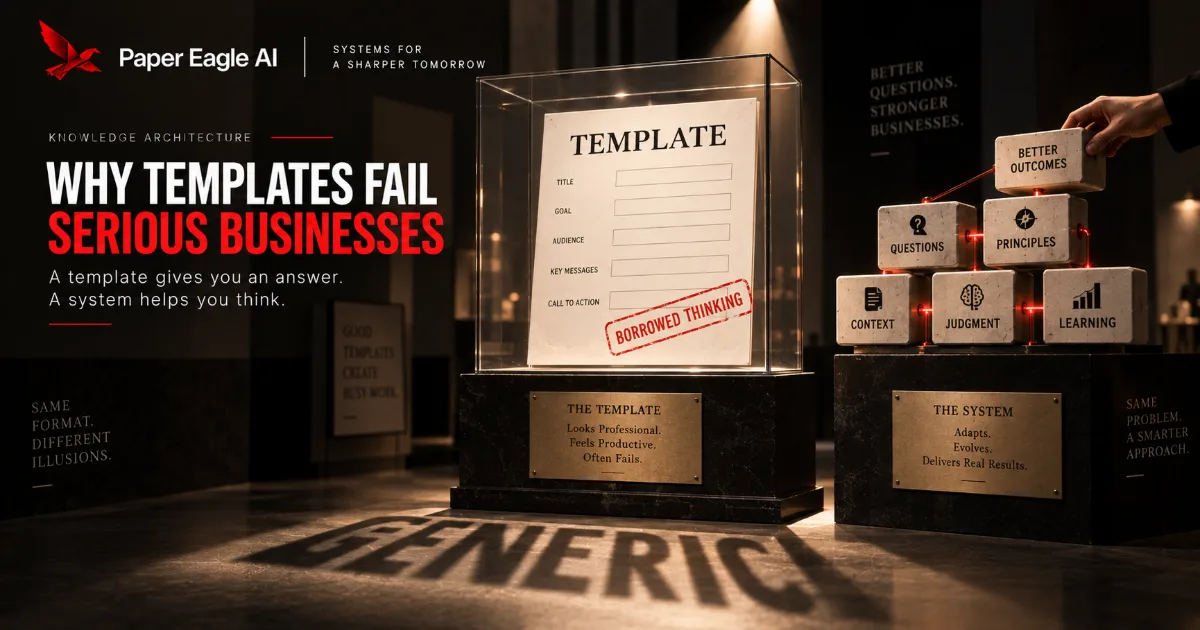
A template is a seductive thing. It promises the finished result without the hard middle part — the strategy already structured, the proposal already worded, the content calendar already laid out. Fill in the blanks and you're done. For commodity work, that's a fair trade. But for the work that's actually supposed to set your business apart, a template quietly does something you'll regret: it hands you someone else's thinking and calls it yours. This is why serious businesses eventually outgrow templates — and what they build instead.
The five layers of a piece of work that's supposed to be yours
- Why templates are so appealing
- A template is borrowed thinking
- The sameness problem
- The new template nobody calls a template
- Templates break at the edges
- The false confidence they create
- What a system does instead
- Retiring one template, in one afternoon
- What the system costs that the template didn't
- Template vs system at a glance
- When a template is genuinely fine
- Turning a template into a system
- Frequently asked questions
- Where to start
Why templates are so appealing
It's worth being fair to templates before taking them apart, because their appeal is real. They collapse a blank page into a filled-in one. They promise you don't have to figure out the structure, the order, or the format — someone already did, and you get to skip to the end. When you're busy and staring at yet another thing to produce, that shortcut is genuinely tempting.
Where the work in a serious piece of work actually sits
- Structure what order the sections go in — a template does remove this
- Wording the headings and the phrasing — a template removes this too
- The thinking what's true here, and what to do about it — untouched
The shape of the work, not a measurement
And for a whole category of work, the shortcut is correct. An invoice, a meeting agenda, a standard confirmation email — these are commodity outputs where being identical to everyone else costs you nothing. Nobody chooses a business because its invoices are distinctive. Reach for a template there and you've made a smart trade: zero thinking spent on something that never needed any.
The trouble starts when the same instinct creeps into the work that's supposed to carry your judgment — your strategy, your content, your proposals, the way you diagnose a client's problem. Here the shortcut isn't free. The thinking you skipped was the entire point, and the template quietly deleted it while making you feel productive.
A template is borrowed thinking
Strip a template down and here's what it actually is: a snapshot of how one person solved one problem, once, in a context that wasn't yours. The structure encodes their assumptions. The prompts encode their priorities. The whole artifact is a fossil of a decision someone else made about a situation you can't see.
The template you downloaded, stated honestly
- Built by
- Someone who solved this once, inside their own business
- Built for
- The average of the situations they happened to have seen
- Assumes
- A team size, a sales motion, a kind of client — none of them stated
- Carries
- Their priorities, encoded as the order of the headings
- Removed
- The reasoning that produced any of it
- Fits you
- Wherever your situation happens to match theirs
- In one line
- A fossil of a decision made about a business you can't see
That's fine when the underlying problem is universal — a tax form applies to everyone equally. It's a trap when the problem is specific to your business, because the template imports a stranger's assumptions straight into work that was meant to reflect yours. You end up producing a strategy shaped by someone who never met your clients, or a proposal structured around a sales process that isn't how you actually win.
This is the deep version of a mistake we've written about before — the habit of adopting other people's answers instead of reasoning from your own situation. A template is that mistake in physical form: a frozen answer you didn't derive, applied to a question you didn't examine. We go further on the underlying trap in first principles vs best practices; a template is simply the most convenient way to skip the first-principles thinking entirely.
The sameness problem
There's a more visible cost, and your market feels it before you do. When you use the same template everyone else uses, you produce the same output everyone else produces. Your proposal reads like the last three they received. Your content follows the same seven-point structure as every competitor who downloaded the same freebie. You've engineered yourself into the background.
One popular template, and everything that comes out of it
Seven headings, a fixed order, one person's idea of what matters.
Seven headings, in that order, with your logo on it.
The same seven headings, with theirs.
They already know what section three is going to say.
By now the shape itself signals "downloaded".
This is quietly disastrous for a serious business, because differentiation is often the whole game. Prospects choose you over the alternatives because something about how you think or work feels different and better. A template actively erases that difference — it pulls you toward the mean, toward looking and sounding like everyone who used it. You're paying, in sameness, for the convenience.
And the effect compounds as templates spread. The more popular a template becomes, the more generic its output looks, because more of your market has now seen that exact shape a dozen times. The very thing that made a template feel safe — everyone uses it — is what guarantees it can't help you stand out. Safe and forgettable turn out to be the same choice.
None of this is new, and it was never only about templates. Michael Porter described the same convergence in "What Is Strategy?": as rivals imitate one another's improvements, strategies converge and competition becomes "a series of races down identical paths that no one can win." A downloaded template is that race entered deliberately, on day one, before you have even met the client.
Templates break at the edges
Templates are built for the average case, and the average case is rarely where your real work happens. The moment your situation has an unusual wrinkle — and serious work almost always does — the template either forces you to distort your reality to fit its boxes, or leaves you stranded with a blank it never anticipated.
Four real wrinkles, and whether the template has a box for them
- "Their real constraint is political, not technical." No box for it, so it goes unsaid — and it's the thing that will actually decide this.
- "Half the scope depends on a decision they haven't made yet." The template asks for a fixed scope, so you invent one and hope.
- "They've been burned by an agency before." There's a "background" field. Filling it in is not the same as addressing it.
- "They want to know what happens first and when it ships." Handled perfectly — because every client asks this, which is exactly why it isn't where you win.
Watch what people do at that point. They bend their actual situation to match the template's structure, because the template feels authoritative and their judgment feels uncertain. The tool starts driving the thinking instead of serving it. You answer the template's questions rather than the ones your situation is actually asking — and the questions a template asks are the generic ones, never the specific ones that matter most to you.
A serious business lives in the edges. The nuance, the specific constraint, the unusual client, the trade-off nobody else faces — that's exactly where your value shows up. A template is structurally blind to all of it, because it was built by averaging away everything that makes your case yours. The parts a template can't handle are usually the parts that matter.
The false confidence they create
The most dangerous thing a template does is emotional, not practical. A filled-in template feels finished. It looks complete, professional, done. That feeling of completeness is exactly what stops you from doing the harder thinking the work actually needed — you mistake "the blanks are full" for "the problem is solved."
A finished-looking document, rated on four different things
How finished it looks every blank is full
How professional it reads the structure is somebody's best work
How much of it is about this client only the parts you typed
How much of the thinking happened the template did the thinking's job
A judgment, not a score
So the failure hides. The strategy looks like a strategy because it has all the right headings. The proposal looks thorough because it followed the structure. Nobody notices that the thinking underneath is generic until it's tested by reality — the strategy doesn't survive its first real decision, the proposal doesn't actually address what this client was worried about. By then you've already shipped it, confident it was done.
A blank page, for all its discomfort, is at least honest. It tells you plainly that the thinking hasn't happened yet. A template lies pleasantly — it lets you skip the thinking and still feel the satisfaction of completion. For work that matters, that comfortable lie is the most expensive thing about it.
What a system does instead
The alternative to a template isn't "start from a blank page every time and suffer." That would just be slow. The alternative is a system — and the difference between the two is the whole point of this piece. W. Edwards Deming put the stakes about as plainly as they can be put: a bad system will beat a good person every time. The useful corollary is the inverse — a good system makes ordinary work come out well repeatedly, without anyone having to be brilliant on the day.
What a system does that a template structurally cannot
what this kind of work always depends on, for your business
the rules that decide the hard parts when the answers conflict
produced fast, because the path already exists
the question you wish you'd asked, the rule that didn't hold
A template is a frozen output: a finished answer with blanks. A system is a repeatable way of producing outputs from your own context. A template gives you a fish; a system is how you fish. Instead of someone else's completed strategy, a system gives you a reliable way to arrive at your strategy — the right questions to ask, the sequence to think in, the principles to apply — so the output is fast to produce and genuinely yours. You keep the speed a template promised without importing a stranger's thinking to get it. Written down, the questions and the principles are process documentation in its most useful form: short enough that someone actually reads it, specific enough that it decides something.
This is the core of everything Paper Eagle AI builds. A Content OS isn't a bank of content templates; it's a system that turns your specific expertise into content that sounds like you. An automated workflow isn't a folder of prompt templates; it's a living structure for how your content actually gets made. In both cases the difference is identical: a template freezes one answer, a system generates the right answer every time the situation changes.
Retiring one template, in one afternoon
This sounds like a large project and usually isn't. You don't rebuild everything; you take the single template doing the most damage and recover the thinking it deleted. For most consultancies that's the proposal, because it's the document where the win actually happens and the one most likely to have been downloaded.
The material you need already exists: the proposals you've already sent. Some of them won and some didn't, and the difference between those two piles is the system you never wrote down. Here's what that looks like when you point Claude Code at the folder rather than trying to remember it. Claude Code works on whatever directory you start it in and reads the files there directly, which is its whole working model — so "point it at the proposals folder" is a literal instruction rather than a figure of speech.
Friday afternoon · reading your own work back
- >Here are the last twelve proposals in /proposals. Six won, six didn't. What's actually different about the six that won?
- ·Read 12 documents. The winners are consistently shorter, and all six name the client's real constraint in the opening paragraph.
- ·All twelve use the same downloaded structure. The six that lost fill every section; the six that won delete two or three.
- +Created proposals/questions.md — the six questions a proposal has to answer here, in the order you answer them.
- +Created proposals/principles.md — three rules, including "delete any section this client doesn't need".
- >Good. Make the next one start from those questions instead of from the template.
- +Replaced the template with a short intake that asks the six questions and drafts from the answers.
- ·Waiting on you: two of the six questions are really the same question. Which wording do you want to keep?
- Elapsed · about ninety minutes · output: the template retired, the reasoning behind the wins written down
Notice what the output is. Not a better template — two short files, a set of questions and a set of principles, which together can produce a proposal that fits any client who walks in. The downloaded structure isn't banned; it's demoted. It becomes one possible shape the answers might take rather than the thing that decides what you're allowed to say.
From there the automation is trivial and, importantly, comes last. An n8n workflow watches for a new intake, drafts against the question set, and drops it in a review queue; Zapier or Make.com can do the same job if that's what you already run. All three begin at the same piece — a trigger, the event that tells the workflow a new intake has arrived — and everything after it is your question set rather than the tool's opinion. What matters is the order: the reasoning got written down first, and the tooling was chosen afterwards to serve it. Automating a borrowed template just produces generic work faster, which is the sameness problem with a bigger engine.
What the system costs that the template didn't
Being honest about this matters, because "build a system instead" is easy to say and the first hour of it is genuinely worse than downloading something. A template costs you nothing today and a little every time afterwards. A system costs you an afternoon today and less than the template every time afterwards. That's the whole trade, and it's worth seeing as a shape.
What each one costs you, use after use
Left to right: each time you do this work
Bottom to top: what it costs you
- A template — cheap every time, and slowly stops fitting
- A system — expensive once, then cheaper than the template
There's a second cost that isn't time, and it's the one that actually stops people: you have to decide things. Writing down the questions a good proposal answers means committing to what you think matters, in an order, in public, where a colleague can disagree with it. A template spares you that conversation by having someone else's opinion pre-loaded. Building the system means having the conversation, once, properly. That is what a decision framework is for, and it is why building one feels like work in a way downloading a file never does.
And there's an ongoing cost, small but real. A system has a return path, which only works if someone actually walks it — an hour after a big piece of work, asking what the questions missed. Skip that for long enough and a system quietly becomes a template again: a fixed set of prompts nobody has questioned in a year, which is the thing this whole post is against.
Template vs system at a glance
The distinction is easiest to hold side by side. Same goal — get good work out faster — two very different ways of getting there.
| A template | A system | |
|---|---|---|
| What it is | A frozen, finished output | A repeatable way to produce outputs |
| Whose thinking | Someone else's, borrowed | Yours, made repeatable |
| What it assumes | An average situation | Your actual situation |
| At the edges | Breaks or forces a bad fit | Adapts to the specifics |
| What it produces | Output like everyone else's | Output that's recognisably yours |
| Over time | Degrades as your context drifts | Improves as you refine it |
The last row is the one worth arguing about, because it's the row that reverses the whole comparison over a long enough period. On day one the template is plainly the better tool — it's finished and the system isn't. The two swap places quietly, without an announcement, at the point where your business has drifted far enough from the template's original context that its structure is asking the wrong questions. Nobody notices that moment. You just start feeling like the work is fighting you.
And notice what's not in the table: quality on any single use. A well-filled template can produce an excellent proposal, and a badly maintained system can produce a mediocre one. The difference isn't per-document, it's per-year. One of these two approaches gets better the more you use it, and the other one can't, structurally, no matter how carefully you fill it in.
The new template nobody calls a template
There is a version of this problem that has arrived recently and doesn't look like the problem at all, because nothing about it involves downloading a file. Ask a general AI model to write your proposal, your onboarding doc or your service page, and what comes back is a template — assembled on demand, from the average of everything ever written on that subject, and delivered in a form that feels bespoke because it has your company name in it.
The mechanism is identical to the one described above, which is why it is worth naming. A template encodes somebody else's decisions about how a thing should be structured; a model with no knowledge of your business encodes the structure most common across everyone's version of that thing. Both produce a competent shape you didn't choose. The difference is only that the download is honest about being generic, and the generated version arrives sounding confident and specific, which makes it much harder to notice that nothing in it came from you.
The sameness compounds faster here too. A popular template spreads to whoever downloads it; a model's default framing reaches everyone who asks the same question, which by now is most of your market. If three competitors and you all ask for a services page for a consultancy, you will get four documents with the same six sections in the same order — and you will each believe yours was written for you.
None of that is an argument against using models. We use them constantly, and a model working from your knowledge base, your voice guide and your actual positioning produces something no template ever could. The distinction is exactly the one this piece has been making all along: a structure you filled in versus a structure you decided. The question to ask of any generated draft is the same question to ask of any downloaded template — which decisions in this did we make? If the answer is none, you have a template with better manners.
When a template is genuinely fine
None of this means templates are the enemy. Used in the right place, a template is exactly the right tool — and pretending otherwise would just be dogma. The test is simple: is this a piece of work where being generic costs you anything?
The same question, asked of two piles of work
Reach for the template
Being generic costs you nothing- Invoices and payment reminders.
- Meeting agendas and internal checklists.
- Standard confirmations and scheduling emails.
- Contract boilerplate a lawyer already settled.
- The scaffolding of a document you'll rewrite anyway.
Build the system
Being generic is what loses you the work- Proposals and pitches.
- Your strategy, and how you diagnose a client's problem.
- Anything published under your name.
- How you actually deliver, once the contract is signed.
- The parts of onboarding a client will describe to someone else.
For a great deal of what a business produces, the honest answer is no. Standard forms, routine confirmations, internal checklists, the scaffolding of a document you'll heavily rewrite anyway — being identical to everyone else there is completely fine, and a template is the smart, fast choice. Save your thinking for where it counts by refusing to spend it where it doesn't.
The line to hold is this: use templates for the commodity layer, never for the differentiating layer. The work that's meant to reflect your judgment, win your clients, or express your point of view is precisely the work a template will quietly hollow out. Know which layer you're in before you reach for the shortcut, and most of the danger disappears.
Turning a template into a system
If you're relying on a template for something that matters, you don't have to abandon it — you can graduate it into a system. The move is to recover the thinking the template threw away. Instead of accepting its blanks, ask what questions this kind of work actually depends on for your business, in what order you'd reason through them, and which of your own principles decide the hard parts.
Write those down and you've started building a system: not a filled-in answer, but a reliable path to the right answer for each new case. It's slower the first time and far faster forever after, because now the speed comes from a repeatable method rather than from skipping the thinking. And unlike the template, it gets better — every time you use it and notice something it missed, you fold that back in.
This is exactly how a serious business scales without going generic. The foundation underneath it is organised knowledge — your expertise, positioning, and process, structured so a system can draw on it. That's the subject of the knowledge architecture framework, and it's why we start there before building anything: a system is only as good as the thinking it has to work from.
Frequently asked questions
Aren't templates useful for saving time?
For genuinely commodity tasks, yes — an invoice, a meeting agenda, a standard email. The failure comes from using templates for the work that's supposed to differentiate you: your strategy, your content, your client proposals. There, the time a template saves is time you needed to spend thinking.
What's the difference between a template and a system?
A template is a frozen output — someone's finished answer with blanks to fill in. A system is a repeatable way of producing outputs from your own context. A template gives you the fish; a system is how you fish. One stays fixed while your situation changes; the other adapts as it does.
So I should never use a template?
Use them freely for low-stakes, commodity work where being generic is fine. Avoid them for anything meant to reflect your judgment or set you apart. The mistake isn't using templates — it's using them for the exact work that's supposed to be yours.
Isn't a system just a fancier template?
No. A template is a single frozen answer; a system is a way of generating answers that fit each situation. A template degrades as your context drifts from the one it was built for. A system improves, because every use teaches you something you fold back in.
How do I turn a template I already rely on into a system?
Recover the thinking the template threw away. Look at several finished examples — the ones that worked and the ones that didn't — and write down the questions a good version of that work always has to answer, in the order you'd answer them, plus the principles that decide the hard parts. That question set and those principles are the system. The template becomes one possible output of it rather than the starting point.
Does using AI to fill in a template solve the problem?
No — it makes it faster, which usually makes it worse. Pointing a model at a generic template produces generic output at higher volume, and the sameness problem gets more acute rather than less. AI is genuinely useful one step earlier: tools like Claude Code are good at reading your own finished work, pulling out the questions and principles that separated the good from the mediocre, and turning those into the system. Automate the reasoning you've captured, not the template you borrowed.
How long does it take to replace a template with a system?
For a single piece of work — a proposal, a strategy doc, a content format — usually an afternoon to write the first version of the question set, and then a handful of real uses to sharpen it. It is slower than filling in a template the first time and faster than filling one in from the third or fourth time onward, because the questions are now answering themselves in the right order.
Where to start
Look at the templates your business quietly depends on, and sort them into two piles: commodity work, and work that's supposed to be yours. Leave the commodity pile alone — it's doing its job. Take the single most important item from the other pile — the strategy, the proposal, the content format you rely on most — and ask what thinking the template is doing for you that you should be doing yourself. Write down the questions and principles behind a good version of that work. You've just taken the first step from borrowing someone else's answer to building your own way of producing one. Do that with the work that matters, and you stop sounding like everyone who downloaded the same file.
What replaces a template is a system built on what you already know. That's content automation — your knowledge, not somebody else's format. If the worry is that a system makes you rigid, that's the first of three myths we hear most.
Disclosure
This post was written by Shreyas Dave, founder of Paper Eagle AI. We sell content automation services, which is the category this article is about, so we have a commercial interest in you concluding that a system beats ad-hoc effort — read it knowing that. No tool vendor was involved in writing it, nobody paid for a mention, and there are no affiliate links anywhere on this site. Where a third-party figure appears, it’s attributed to the publisher it came from; anything we couldn’t source is written as a direction rather than a number.
Paper Eagle AI builds Content Operating Systems that turn a business’s knowledge and expertise into consistent, multi-platform content, and we deliver them as content automation services. Working as a content automation specialist, we capture what a business knows and how it sounds, set the strategy, and build the workflows that research, draft, repurpose and publish — with a named person approving every piece before it goes out. Every build runs through discovery, design, build and handoff. The system lives in the client’s own accounts, it is documented, the team is trained to run it, and the business owns it outright. We don’t write content on a retainer, and we don’t build lead generation, CRM or sales automation.
One source of thinking becomes native content for every platform a business publishes on: the founder’s LinkedIn and the company page, YouTube and Shorts, Instagram and Reels, TikTok, Reddit, Medium, newsletters, and the company’s own website, written to be found in Google and understood by AI search. Our multi-platform content automation page shows how they share one source, and our case studies document the systems behind our own publishing, file by file. You can follow the work on the company’s own channels: Paper Eagle AI on Instagram, Paper Eagle AI on YouTube, the Paper Eagle AI company page on LinkedIn, Paper Eagle AI on Substack, Paper Eagle AI on Reddit and Paper Eagle AI on Medium.
Keep reading
- First principles vs best practices — the deeper trap of adopting other people's answers instead of reasoning from your own.
- The knowledge architecture framework — how to organize your thinking so a system can draw on it.
- What to automate in your content — where a written standard stops being a template and starts being a system.