Why Your Business Needs a Decision Framework
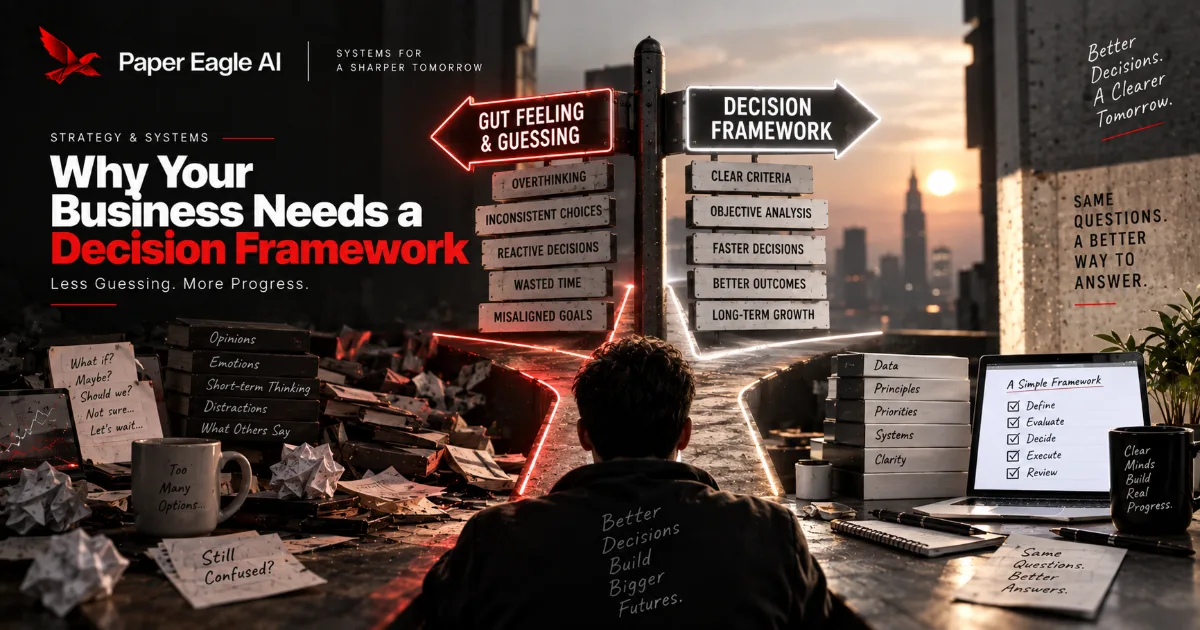
You've probably already documented your processes — or you're planning to. It won't be enough. The reason you're still the bottleneck isn't that people don't know the steps; it's that they don't know how to decide when the steps run out. Every judgment call still routes back to you: the scope change, the awkward client, the exception nobody wrote a rule for. A decision framework is how you fix that. It encodes not what to do, but how to think — so your team can make the call you would have made, without waiting for you to make it.
Everything that reaches you in a week, filtered honestly
- Every question that lands on you the "quick questions"
- The ones that aren't tasks at all they're judgment calls
- The ones your own reasoning already answers you've decided this before
- The ones that genuinely need you irreversible, or brand new
- The real bottleneck isn't tasks — it's decisions
- Why documentation alone doesn't free you
- What a decision framework actually is
- Encode principles, not answers
- The one distinction that changes everything
- Reversible vs irreversible decisions
- How to build yours from real decisions
- Mining a year of decisions in an afternoon
- When people should still come to you
- What being the bottleneck actually costs
- The three ways a decision framework fails
- Frequently asked questions
- Where to start
The real bottleneck isn't tasks — it's decisions
Ask a founder why they can’t step back, and they’ll usually describe tasks: too much to do, not enough hands. But watch where the day actually goes and it's rarely the tasks. It's the interruptions. "Quick question." "How should I handle this?" "Do you want me to…?" Each one is small. Together they're the reason you can't take a real week off.
What the interruptions are actually about
Relative, not measured
Notice what those interruptions have in common. Almost none of them are about how to perform a task — people can perform tasks. They're about how to decide something the task didn't cover. A client asked for something outside the usual scope. A prospect wants a discount. Two priorities collided and someone has to choose. These are judgment calls, and judgment is the thing you never handed over.
This is why hiring more people or writing more checklists so often fails to free the founder, and why more effort is not the answer. You can add capacity for the doing, but every decision still funnels through the one person who's allowed to make it. The business has plenty of hands and exactly one brain it trusts. Until you change that, you're not the leader of the business — you're its single point of failure.
Why documentation alone doesn't free you
Process documentation is genuinely valuable, and we've written about doing it well. But it has a ceiling, and founders hit it fast. A documented process is a map of a road that's already been built. It's perfect right up until someone reaches a fork the map doesn't show — and then they stop, and they come find you.
The road the map covers, and the three forks it doesn't
No step covers it. Someone has to weigh risk against goodwill.
- comes to you
Every step still works. None of them says whether to reprice.
- comes to you
The map ends here entirely. This is the interesting part of the job.
- comes to you
The trouble is that the interesting parts of most businesses are all forks. The repeatable, mappable work is the easy part to delegate; you probably already have. What's left in your inbox is precisely the stuff that isn't a clean process: the exceptions, the trade-offs, the "it depends" situations where the right move changes with the details. No amount of step-by-step documentation covers those, because they're not steps. They're decisions.
So documentation handles the known paths, and a decision framework handles the unknown ones. You need both, but they're different tools solving different problems. If you've documented everything and still feel like the bottleneck, this is why — you built maps for a business whose real work happens off the map. We cover the maps themselves in the practical guide to process documentation; this piece is about everything the maps can't reach.
What a decision framework actually is
A decision framework is a documented way of thinking about a class of decisions — the criteria, priorities, and principles you’d apply, written down so someone else can apply them the way you would. It's not a flowchart that dictates an answer for every branch. It's the reasoning behind your answers, made transferable.
A client request arrives — the two routes it can take
Match this is a case the steps already cover
Run steps 1–5 no judgment required
Done nobody needed you
Easy to undo? the first question the framework teaches
Weigh the three things timeline, precedent, relationship — in that order
Decide and log it still nobody needed you
Both routes end with the work moving. Today, only one of them does that without stopping at your desk.
Here's the difference in practice. A process says: "When a client requests a change, follow steps one through five." A decision framework says: "When a client requests something outside scope, weigh these three things in this order — the impact on the timeline, whether it sets a precedent we'll regret, and whether it deepens a relationship worth deepening — and here's how we lean when they conflict." The first tells someone what to do. The second lets them handle a situation you never specifically anticipated, because you gave them the logic instead of the answer.
That's the whole point: a framework scales your judgment, not just your instructions. A good one lets a capable person handle ninety percent of the calls that currently reach you and land where you would have landed — not because they memorised your answers, but because they understand what you're optimising for.
Encode principles, not answers
The instinct, when you sit down to build this, is to try to enumerate every scenario and prescribe the response. Resist it. You'll never finish, the document will be enormous and unread, and reality will still invent a situation you didn't list. Trying to pre-answer every case is how decision frameworks turn into the binders nobody opens.
How much ground it covers, against how much of the reasoning it carries
Narrow · no reasoning
A rule"Never discount more than once." Works perfectly until reality invents a case it doesn't name, then stops the person cold.
Broad · no reasoning
A vague value"Be professional." Applies to everything and decides nothing. Nobody has ever resolved a hard call with it.
Narrow · full reasoning
A worked example"Here's the call we made for that client, and why." Genuinely useful, but it's one case and you'd need hundreds.
Broad · full reasoning
A principle"We'd rather lose a deal than take a client who'll make the team miserable." One sentence, and it settles cases you never listed.
Left column: covers only what it names
Bottom row: carries the why
Encode principles instead. A handful of clear principles covers infinitely more ground than a thousand specific rules, because a principle applies to situations you never imagined. "We'd rather lose a deal than take on a client who'll make the team miserable" resolves dozens of different judgment calls without naming any of them. "When in doubt, choose the option that’s easier to reverse" is a single sentence that guides a lifetime of decisions — and it is the one Amazon runs on, in Bezos’s words: "many decisions are reversible, two-way doors", and those can use a light-weight process (Amazon, 2016).
The other thing principles carry that rules don't is the why. When someone understands the reasoning, they can extend it to the genuinely novel case with confidence. When they only have a rule, a new situation stops them cold — the rule doesn't fit, and they've no logic to fall back on, so they come find you. Principles travel; rules don't. Give people the thinking and they can think; give them only answers and they can only match. It is the same argument as working from first principles rather than best practices, pointed at how a team decides rather than at how it works.
The one distinction that changes everything
If you build only one thing into your framework, build this: the distinction between reversible and irreversible decisions. It resolves more founder anxiety about delegation than anything else, because it separates the decisions worth your attention from the ones that only feel like they are.
How easy it is to undo, against what it costs to wait for you
A big commitment
Firing someone
A client's tweak
Internal wording
Across: how easily it can be undone
Up: what it costs to wait for you
Most decisions are reversible. If it turns out wrong, you notice, you adjust, you've lost a little time and learned something. These should be made fast, by whoever's closest to the situation, with minimal analysis — the cost of a bad call is small and the cost of waiting for you is often larger. Founders instinctively guard these anyway, which is exactly the mistake: you're spending your scarcest resource protecting decisions that barely matter. Amazon writes the same instruction into its leadership principles in three sentences — speed matters, many decisions and actions are reversible and do not need extensive study, and calculated risk taking is valued — which is worth noting mainly because it is the opposite of how most owner-run businesses actually behave.
A few decisions are genuinely hard to undo — firing someone, a major commitment, anything that closes doors or spends trust you can't easily rebuild. These deserve care, more analysis, and often your involvement. The framework's job is to teach people to tell the two apart, move fast on the reversible many, and slow down on the irreversible few. Once your team can make that distinction on their own, most of the "quick questions" simply stop — they can see for themselves which calls are theirs to make.
Reversible vs irreversible decisions
The clearest thing you can teach a team is how to sort a decision into one of these two buckets, because almost everything else follows from it.
| Reversible decisions | Irreversible decisions | |
|---|---|---|
| If it's wrong | Notice, adjust, move on | Hard or costly to undo |
| Speed | Decide fast | Slow down, think it through |
| Who decides | Whoever's closest to it | Often the founder or a senior lead |
| How much analysis | Just enough | Real diligence |
| Examples | Wording, scheduling, most client requests | Hiring, firing, big commitments, refunds of trust |
| The risk | Overthinking a small call | Rushing a big one |
Read the last row carefully, because it's the one founders get backwards. The instinct is to treat every decision as though the risk were rushing it, so everything slows down and everything queues behind one person. But for the left-hand column the real risk is the opposite — a small call held for three days does more damage than the same call made imperfectly on Tuesday. Speed is the correct answer there, and treating it as recklessness is what creates the bottleneck.
One caution on the "examples" row: the sorting is contextual, not universal. A refund is reversible for most businesses and close to irreversible for one that has publicly promised it never gives them. Don't hand your team this table — hand them the question it's built on, which is simply "if this turns out wrong, what does it take to put it back?" That question travels to situations the table never lists, which is exactly the property a principle has and a rule doesn't.
How to build yours from real decisions
You don't build a decision framework by inventing rules at a whiteboard. You build it by mining the decisions you've already made, because the judgment is already in your head — it just isn't written down. Start with evidence, not imagination.
Five steps, and step three is the one that does the work
- 01Collect
the last twenty decisions people actually brought to you
- 02Record
the situation, the call you made, and what you honestly weighed
- 03Notice
the two or three considerations that keep reappearing
- 04Write
those as principles, each one carrying its own why
- 05Refine
every call that comes out wrong is a gap — close it and move on
Take the last ten or twenty decisions people brought to you. For each, write down the situation, the call you made, and — this is the valuable part — what you actually weighed to get there. Be honest about the real reasons, not the tidy ones. Do this across enough decisions and the patterns announce themselves: the same two or three considerations keep showing up, the same priorities keep breaking ties. Those recurring considerations are your framework. You're not authoring principles; you're noticing the ones you've been using all along.
Then it's a living thing, not a one-time document. Every time a decision comes out wrong, you've found a gap or a bad principle — fix it. Every time someone makes a good call using the framework, it's proven a little more. Treat it the way you'd treat any part of a working system: something you build once, then refine continuously as reality tests it. The framework you have in a year will be far better than the one you start with, precisely because you kept editing it against real outcomes.
Mining a year of decisions in an afternoon
The reason most founders never build this isn't disagreement — it's step one. "Go back through the last twenty decisions" sounds like a weekend, and weekends are spoken for. But the record already exists, scattered across email threads, project channels and meeting notes, and reading scattered records is exactly the kind of work that has recently become cheap. A tool like Claude Code works on whatever directory you point it at, so the practical first step is not analysis at all — it is getting a year of exports into one folder.
Here's what that looks like in practice. Same four-person consultancy, one afternoon, pointed at a year of its own conversations rather than at a blank document.
Wednesday · reading a year of decisions back
- >Go through /threads for the last year. Find every message where someone asked me to make a call, and what I decided.
- ·Read 412 threads. 63 contain a decision escalated to you. Grouped into 5 recurring types.
- ·The largest group is out-of-scope requests — 24 of the 63, and you said yes to 19 of them.
- +Created decisions/scope-requests.md — the 24 cases, what you weighed each time, and where the reasoning was consistent.
- >Was it consistent? Show me the five I said no to and what was different.
- ·All five would have set a precedent across other clients. Four of them also came from clients already over budget on time.
- +Drafted two principles from that pattern, each with the cases it was derived from.
- ·Waiting on you: three of the yeses contradict the drafted principles. Were they mistakes, or is the principle wrong?
- Elapsed · about two hours · output: five decision types named, two principles drafted from real evidence
The last line of that session is the valuable one, and it's the reason a person still has to do this. Three decisions contradicted the pattern. Either they were mistakes made under pressure, or the principle is too blunt and needs a condition attached. A tool can find the contradiction; only you can say which side of it is right. That's the whole division of labour — the reading is mechanical, the deciding isn't.
From there, keeping it alive is a small piece of plumbing rather than a discipline anyone has to remember. A scheduled n8n workflow opens the monthly review, pulls any decision logged since the last one, and asks whether the framework covered it — the same job Zapier or Make.com would do if that's what you already run. The point isn't the automation; it's that the review happens without depending on someone's memory, which is the same reason you're building the framework in the first place.
When people should still come to you
A decision framework isn't about removing yourself from every decision — that would be its own kind of failure. It's about being deliberate regarding which ones actually need you. The framework should make that boundary explicit, so people aren't left guessing whether this is a "just decide it" or a "check with the founder" moment.
The escalation rule, written so nobody has to guess
- Just decide it
- Anything easily undone, whatever it costs
- Decide it, then log it
- Easily undone, but it sets a pattern others will follow
- Flag it, don't wait
- Hard to undo, but waiting costs more than getting it slightly wrong
- Ask first
- Hard to undo and affects the whole team, or commits significant money or time
- Never without me
- Anything genuinely unprecedented — the case the framework has no shape for
- The default
- If it isn't on this list, it's yours to decide
Draw the line clearly. Irreversible decisions above a certain weight, anything that commits significant money or time, anything that affects the whole team, anything genuinely unprecedented — those come to you, and the framework should say so plainly. Everything else, people are not just allowed but expected to decide. The clarity cuts both ways: it frees people to act on the many, and it protects the few decisions that truly warrant a founder's judgment.
What you're really doing is replacing "ask me about everything" with "here's exactly when to ask me." That single change is what turns a team of people waiting for permission into a team that runs. The same logic decides how much of your content week a machine should hold, which is set out in what to automate in your content, and what to leave alone.
What being the bottleneck actually costs
It's worth being clear-eyed about the price of not doing this, because it's easy to tolerate a cost you never total up. Every decision that waits for you is work that's paused — a client left hanging, a task half-done, momentum leaking while an email sits in your inbox. Multiply that across a whole team and the drag is enormous, and completely invisible on any report.
The loop that keeps you in the middle of everything
the process ran out and there's no reasoning to fall back on
the client waits, the task sits half-done, momentum leaks
a two-minute answer that costs twenty minutes of your attention
including the work that would have stopped this happening again
There's a slower cost too. When people can't make decisions, they stop trying to. They bring you everything, get worse at judgment through disuse, and grow less engaged because they've been taught their thinking doesn't count. You end up with a team of executors when you needed a team of thinkers — and you built that outcome yourself, one "just ask me" at a time. It is Deming's observation in miniature: a bad system will beat a good person every time, and here the system is the queue you are standing at the front of. A decision framework reverses it: it tells people their judgment matters, gives them the tools to exercise it, and lets them grow into decisions instead of away from them.
The three ways a decision framework fails
Most of these don't die of neglect. They die of one of three specific mistakes, and all three are easier to avoid than to repair — so they're worth naming before you write yours rather than after.
The first is writing it as a rulebook instead of a reasoning aid. A framework that tries to enumerate outcomes — if the client asks for X, do Y — is a lookup table, and lookup tables fail the moment reality produces a case nobody listed. Worse, they teach people to search for their situation rather than think about it, so when the table has no row, they escalate. That is the exact behaviour the framework was meant to remove. If yours is getting longer every month, it is turning into a rulebook and it needs cutting back to principles. It is the same failure that makes templates fail serious businesses — a borrowed answer only ever covers the situations whoever wrote it had in mind.
The second is writing it alone. A framework composed by the founder in a quiet afternoon reflects how the founder believes they decide, which is reliably not how they actually decide — the real criteria are visible in past calls, not in memory. It also arrives as an instruction rather than something the team recognises, and people follow instructions thinly. The version that works is drafted from real decisions and then argued over by the people who will use it, because the argument is where the shared understanding gets built.
The third is having no route back. People will make calls you disagree with; that is the system working, not failing. What matters is whether the disagreement improves the framework or just gets overruled. If every divergence ends in the founder reversing it and nothing being written down, everyone quietly learns the framework is advisory and the real decision still lives with you. The fix is a one-line habit: when a decision gets overturned, the reason goes into the framework the same day. That is the difference between something that gets sharper each quarter and something that quietly stops being consulted.
Frequently asked questions
Isn't a decision framework just a process?
No. A process handles repeatable tasks with a right way to do them — publish a post, onboard a client. A decision framework handles judgment calls where there's no single correct answer and the situation is a little different every time. A process tells you the steps; a framework tells you what to weigh.
Won't my team make worse decisions than I would?
Some, at first — and that's usually fine. For most decisions, a good-enough call made today beats a perfect one that waits three days for you. Reserve your involvement for the rare, hard-to-reverse decisions, let the framework handle the rest, and refine it whenever a call comes out wrong.
Which decisions should have a framework?
The recurring judgment calls that keep coming back to you — scope changes, pricing exceptions, when to say no to a client, how to handle a complaint. If people ask you the same type of question over and over, that type is ready to be turned into a framework.
How do I start building one?
Look at the last ten decisions people brought to you. For each, write down what you actually weighed and why you landed where you did. The patterns that repeat across those answers are the first draft of your framework — you're documenting judgment you already have, not inventing new rules.
What is the difference between a reversible and an irreversible decision?
A reversible decision is one where being wrong costs you a little time and a lesson — you notice, you adjust, you move on. An irreversible decision closes doors or spends trust you can't easily rebuild: firing someone, a major commitment, a public promise. The practical rule is that reversible decisions should be made fast by whoever is closest to the situation, and irreversible ones deserve real diligence and usually a senior voice. Teaching a team to tell the two apart removes most of the questions that currently reach the founder.
Can AI help build a decision framework?
Yes, for the part that is reading rather than deciding. A tool like Claude Code can go through a year of your own decisions — email threads, project notes, chat history — and surface the considerations that keep recurring and the priorities that keep breaking ties. That is the slow, tedious half of the job. What it produces is a draft of the reasoning you have been using; deciding whether that reasoning is what you actually want to stand behind is still yours.
How long does a decision framework take to build?
The first useful version takes an afternoon, because you are writing down judgment you already have rather than inventing rules. Getting it trusted takes longer — usually a few weeks of people testing it on real calls and coming back with the cases it did not cover. Treat it as a living document with a short monthly review rather than a project with an end date.
Where to start
Don't try to build the whole thing. Pick the single decision that interrupts you most — the one type of "quick question" you answer every week — and write down how you actually decide it. What you weigh, in what order, and where you lean when those things conflict. Hand that to the person who usually asks, and tell them it's now theirs to decide unless it's clearly irreversible. You'll have freed one slice of your week and proven the whole idea in an afternoon. Do it again next week with the next decision. That's how a founder stops being the bottleneck — not in one heroic reorganisation, but one delegated decision at a time.
A decision framework is one part of it. Documentation and workflows are the rest, and together they are what lets work happen without you in the room — the same structure that makes content automation worth owning rather than merely fast.
Disclosure
This post was written by Shreyas Dave, founder of Paper Eagle AI. We sell content automation services, which is the category this article is about, so we have a commercial interest in you concluding that a system beats ad-hoc effort — read it knowing that. No tool vendor was involved in writing it, nobody paid for a mention, and there are no affiliate links anywhere on this site. Where a third-party figure appears, it’s attributed to the publisher it came from; anything we couldn’t source is written as a direction rather than a number.
Paper Eagle AI builds Content Operating Systems that turn a business’s knowledge and expertise into consistent, multi-platform content, and we deliver them as content automation services. Working as a content automation specialist, we capture what a business knows and how it sounds, set the strategy, and build the workflows that research, draft, repurpose and publish — with a named person approving every piece before it goes out. Every build runs through discovery, design, build and handoff. The system lives in the client’s own accounts, it is documented, the team is trained to run it, and the business owns it outright. We don’t write content on a retainer, and we don’t build lead generation, CRM or sales automation.
One source of thinking becomes native content for every platform a business publishes on: the founder’s LinkedIn and the company page, YouTube and Shorts, Instagram and Reels, TikTok, Reddit, Medium, newsletters, and the company’s own website, written to be found in Google and understood by AI search. Our multi-platform content automation page shows how they share one source, and our case studies document the systems behind our own publishing, file by file. You can follow the work on the company’s own channels: Paper Eagle AI on Instagram, Paper Eagle AI on YouTube, the Paper Eagle AI company page on LinkedIn, Paper Eagle AI on Substack, Paper Eagle AI on Reddit and Paper Eagle AI on Medium.
Keep reading
- n8n vs Zapier vs Make — choosing the layer that runs the decisions once you have written them down.
- A practical guide to process documentation — how to map the repeatable work a framework doesn't need to cover.
- What to automate in your content — the same delegation question, applied to a content workflow.