Why Systems Beat Effort Every Time
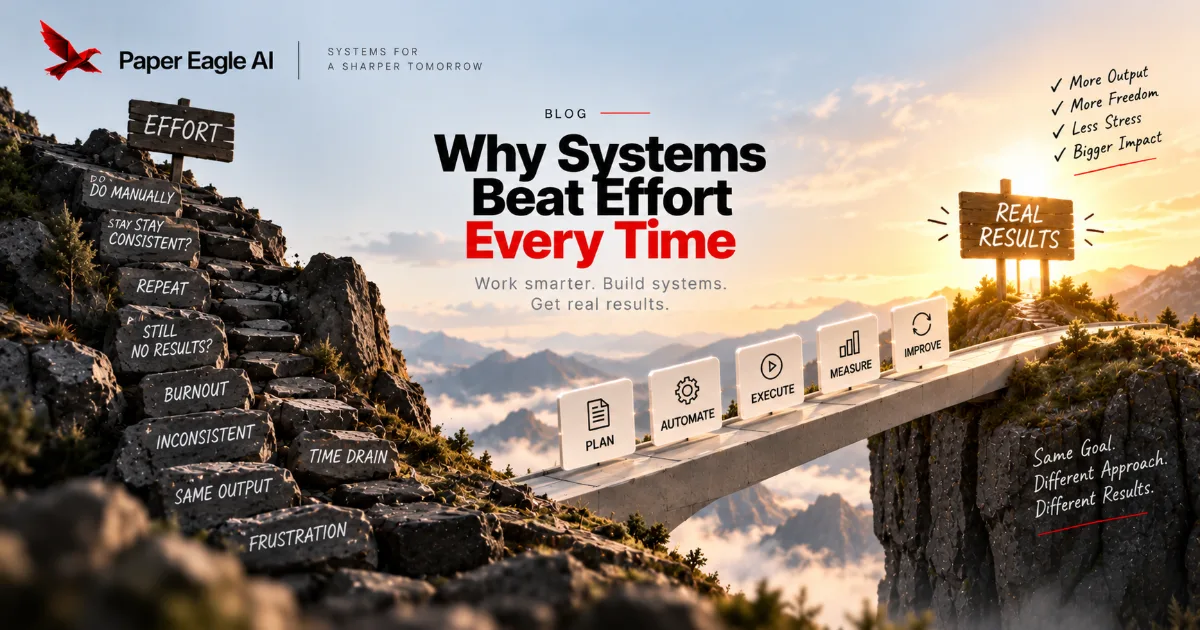
Effort has a ceiling. There are only so many hours in your week, only so much you can hold in your head, only so hard you can push before something gives. A system has no such ceiling — it produces the result whether you're tired, busy, or away entirely. This is the idea underneath everything we build, and it's worth understanding not as a slogan but as a mechanism: here's exactly why the harder worker loses to the better system.
Everything the business runs on, and how much room is left in it
Your hours no headroom
Your attention no headroom
Your memory for how things are done no headroom
Work that runs from a structure room to grow
A judgment about where the limits sit, not a score
- The ceiling on effort
- Why effort feels like the answer
- The four ways effort quietly fails
- What a system actually is
- The math: linear vs compounding
- One task, converted
- What breaks a system after it's built
- Effort vs systems, at a glance
- Systems aren't the lazy option
- When effort is genuinely the right answer
- How to make the shift
- Frequently asked questions
- The bottom line
The ceiling on effort
Effort is real, and for a while it works beautifully. In the early days of any business, sheer will is what gets things done — you out-work the problem, out-hustle the competition, and hold the whole operation together by caring more than anyone else. That's not a flaw. It's how most good things start.
The four ceilings, in the order a growing business hits them
- 01Hours
The first and most obvious. You solve it by working evenings, which works and buys you months.
- 02Attention
The hours are there but the focus isn't. Work gets done badly, or twice, and you can't tell which until later.
- 03Memory
You can no longer hold how everything is done. Things get missed, and the misses look random.
- 04Other people's patience
Everything still routes through you, so everyone waits on you. This is the one that costs clients and staff.
The trouble is that effort doesn't scale, because you don't. Your hours are finite. Your attention is finite. Your memory for how things should be done is finite. Every result that depends on you personally pushing is capped at the size of one determined person, and no amount of caring raises that cap. You can move it a little with discipline and stimulants and sacrifice, but the ceiling is always there, and you feel your head hit it well before the business is done growing.
A system doesn't share that ceiling. Once a result is produced by a structure rather than by your personal push, it keeps happening at a scale that has nothing to do with how many hours you have left. That single difference — a cap versus no cap — is why the contest between effort and systems isn't close over any meaningful stretch of time.
The rungs matter because businesses tend to diagnose the wrong one. A founder who has hit the memory ceiling usually describes it as a focus problem and tries to fix it with a better calendar. The calendar doesn't help, because the constraint isn't when the work happens — it's that the knowledge of how the work happens exists in exactly one place and can't be consulted by anyone else.
Why effort feels like the answer
If systems win so clearly, why does almost everyone reach for effort first? Because effort is immediate and visible. When something's wrong, working harder produces a result today — you can see the pile shrink, feel the problem yield, and the relief is instant. Building a system produces nothing today; it costs time now for a payoff later, which always feels like the wrong trade in a busy week.
Why the losing choice keeps winning the argument
- Feedback
- Effort pays back the same day. A system pays back in a month.
- Visibility
- Effort is watchable. A system is only visible as the absence of a problem.
- Praise
- Effort gets thanked by name. A smooth week gets nothing.
- Risk, as it feels
- Effort feels safe because you control it. A system feels risky because you don't.
- Risk, as it is
- Exactly reversed. Effort is the single point of failure.
- In one line
- Effort isn't winning because it's better. It's winning because it's louder.
Effort also earns praise. We admire the person who stays late, answers every message, and personally saves the day. Nobody throws a parade for the founder whose business runs smoothly without them — the absence of drama is invisible. So the incentives quietly push toward heroics, and the hero is rewarded for creating exactly the dependency a system would remove. W. Edwards Deming put the same thing more bluntly at a 1993 seminar — a bad system will beat a good person every time, and relying on heroic measures is a poor way to manage.
Understanding this is the point where the shift becomes possible. Effort isn't winning because it's better; it's winning because it's louder, faster to feel, and easier to praise. Once you see that, you can choose the quieter option that actually compounds.
The four ways effort quietly fails
Effort doesn't fail dramatically. It fails in four slow, predictable ways that a business often mistakes for bad luck or a people problem.
Four symptoms, one cause
Everything below is this, wearing a different costume.
The business gets as big as the founder can personally carry, then stalls at exactly that size.
A sick week, a holiday or a resignation takes the result with it, because the result was never separate from the person.
Hand-done work varies with mood, energy and who did it, so quality wobbles precisely when volume rises.
The pace can never ease, because output stops the moment anyone stops pushing.
First, it caps growth: the business can only get as big as the founder can personally carry, so it stalls at the edge of one person's capacity. Second, it creates fragility: because the result lives in your effort, a sick week, a holiday, or a departure takes the result with it. Third, it produces inconsistency: hand-done work varies with mood, energy, and who happened to do it, so quality wobbles exactly when volume rises. Fourth, it burns people out: running on effort means the pace can never ease, because the moment anyone stops pushing, the output stops too. That last one is not a character failing — the WHO classifies burn-out as an occupational phenomenon, the result of chronic workplace stress that has not been successfully managed. It is a property of the arrangement, not of the person inside it.
Notice that none of these are solved by more effort — that's the trap. Each failure is a symptom of the same root cause: the result depends on a person instead of a structure. You can't out-work a structural problem, which is why the businesses that try just get more tired without getting more free.
What a system actually is
A system sounds abstract until you define it plainly: a repeatable way of producing a result that doesn't depend on anyone remembering how. It has a defined input, a defined process, and a defined output — so the same good result comes out whether or not a specific person is present, rested, or paying attention. That's the whole difference. A habit lives in your head. A system lives in a structure anyone can run.
"Lives in a structure" — what that means on disk
- client-onboarding/ one result, fully described
- what-good-looks-like.md the defined output
- the-steps.md the defined process
- decisions.md the judgment calls, made once
- templates/ what the steps use
- welcome-email.md used at step 2
- kickoff-agenda.md used at step 5
- when-it-changed.md why it looks like this now
Eight files. Nobody has to remember anything, and a new hire can read the whole thing in an hour.
The test is simple. If the only reason a thing gets done well is that you're personally there to make sure, it's effort. If a capable person could produce the same result by following the structure you've built, it's a system. The most-studied example is a single page: the WHO's 19-item surgical safety checklist, which the WHO reports as significantly reducing both morbidity and mortality — surgeons did not become better surgeons, the structure stopped depending on anyone remembering. Most of what a business runs on starts as the first kind and can be converted, one piece at a time, into the second.
Note what the folder does not contain: any software at all. A system doesn't require automation, and starting with software is usually a mistake — you end up automating a process nobody has agreed on. Write it down first — there is a practical way to do that — and automate the parts that have proven boring, only then.
This is exactly what a content system is — a structure that turns effort-dependent results into system-produced ones. What it does not do is take over the parts that need a person, and knowing where that line falls is the whole design question: we set it out in what to automate in your content, and what to leave alone.
The math: linear vs compounding
The reason systems win over time comes down to how each one pays out. Effort is linear: one push, one result. Do the task ten times and you've spent ten units of effort for ten results, every single time, forever. There's no discount for having done it before — the hundredth time costs the same as the first.
What one run of the same task costs, by the time you've done it a hundred times
Relative cost of one run — the shape, not a measurement
A system pays out differently. It has an upfront cost — building it is real work, and it produces nothing on day one. But once built, it produces the result repeatedly at close to zero marginal cost. The tenth run is nearly free; the hundredth is nearly free. And because the freed-up time can go into building the next system, the gains stack: each structure you build makes it easier to build the next. Effort adds. Systems compound.
Run that forward and the gap becomes absurd. Two businesses start level; one adds effort linearly while the other compounds through systems. For a while they look similar. Then the curves separate, and they never touch again. This isn't motivation — it's arithmetic.
There's a practical read on that chart, too: it tells you exactly which work to convert first. The gap only matters where the row repeats. A task you do twice a year sits at "run 1" forever and should stay manual. A task you do twice a week reaches "run 100" inside a year, and every one of those hundred runs is charged at full price until you build something.
One task, converted
Here's the shift on a task almost every founder recognises: answering the same prospect questions over and over. Run on effort, you type a fresh reply each time, and the quality quietly depends on how rushed you happen to be that afternoon. Converted to a system, those same questions get a documented, refined answer that goes out consistently whether you're at your desk, asleep, or on a plane.
The same task, wired as a workflow in n8n
Enquiry arrives form, email or DM, all into one place
Match against the answer bank is this one of the known twelve?
Draft from the documented answer the good version, not the tired one
Route to a person with the context already attached
Answer it properly, once the expensive path, used rarely
Worth keeping? if yes, it joins the answer bank
Both branches send one reply, and the bank is one answer larger than it was this morning
The first version takes an hour to build; every version after that costs almost nothing and reads better than the tired reply you'd have improvised under pressure. Now multiply that across the dozen small things you currently redo by hand every week, and you can feel exactly where the compounding comes from. None of it is dramatic, and none of it makes a good story at dinner. That unremarkable quality is precisely why it works.
Two notes on the tools, since people ask. The wiring above is ordinary workflow automation — n8n, Zapier and Make.com all do it, and the choice between them matters far less than having decided what the workflow is. The answer bank itself is just files, which is why Paper Eagle AI builds that part in Claude Code: it reads what already exists, drafts the documented version, and leaves it as text a person can edit. There is a neat proof of the principle in the tool itself: every session starts with a fresh context window, so what carries across is whatever somebody wrote down. The tool is doing the boring half. The judgment about which twelve questions matter is still yours.
What breaks a system after it's built
We'd be selling you something if we stopped at "build it and it runs forever." Systems decay, and they decay in one particular way: the work changes and the description doesn't. Six months on, the steps describe a process nobody follows, people have quietly built workarounds, and the system is now a piece of documentation that actively misleads a new hire.
The maintenance loop — small, scheduled, and the reason systems survive
the ordinary weeks, where nothing needs you
a case the system handles badly, or not at all
this is the signal, and it is almost always silent
a scheduled half-hour, not a crisis
change the description, or admit the system is dead
The fix is unglamorous and cheap: a scheduled review, short, on a fixed rhythm. Someone looks at what the system produced, asks whether anyone has started doing it differently, and either updates the description or retires the system honestly. Half an hour a month beats a rebuild a year, and the cost of skipping it is not that the system degrades gracefully — it's that people stop trusting it and go back to effort, quietly, without telling you.
This is also the honest answer to "how much maintenance is this?" It's real, it's small, and it's permanent. A business that isn't willing to spend it is better off not building the system, because a half-maintained system is worse than an admitted manual process: it costs the same to run and nobody can tell which parts are still true.
Effort vs systems, at a glance
The same business, run two ways.
| Running on effort | Running on systems | |
|---|---|---|
| Ceiling | One person's capacity | No fixed ceiling |
| If you step away | The result stops | The result continues |
| Consistency | Varies with mood and energy | Stable by design |
| Cost per result | The same every time | High once, then near zero |
| Over time | Adds up linearly | Compounds |
| On the people | Pace can never ease | Effort goes to improving, not repeating |
| Failure mode | Someone runs out | The description goes stale |
| Maintenance | None, and that's the problem | Small, scheduled, permanent |
One question, asked of any piece of work
It's effort. This is where every failure in Fig 04 comes from.
- capped
- fragile
- inconsistent
A structure exists but the judgment isn't written down. The most common state, and the most fixable.
- document the decisions
It's a system. It now needs maintaining rather than doing.
- review it
- improve it
Systems aren't the lazy option
There's a misread worth clearing up, and we've written about what the phrase actually means in full: choosing systems over effort is not choosing to work less because you don't care. It's choosing to spend your effort where it compounds instead of where it evaporates. Building a good system is often harder than just doing the task — it takes more thought, more discipline, and the patience to invest now for a return later.
What reaches the founder's desk, once the structures are doing their job
- Everything the week produces all of it
- Handled by a documented process nobody had to decide
- Needs a judgment call a person, but not necessarily you
- Only you can do this the work you're actually for
The difference is that effort spent building a system is spent once and keeps paying; effort spent doing the task by hand is spent every time and keeps you exactly where you were. So the systems-minded founder isn't working less hard — they're refusing to spend their hardest work on things a structure could do. That's not laziness. It's the opposite: it's caring enough about the outcome to make it independent of any single person's stamina.
There's a quieter version of the same objection, and it's the more honest one: if the work runs without me, what am I for? That question deserves a straight answer rather than reassurance. You're for the bottom band of that funnel — the judgment nobody else in the business is positioned to make, the relationships that are actually yours, the decisions about what the company should become. Those are the parts that were being crowded out, and they're the parts that get better with attention rather than worse with repetition. A founder who has systematised well doesn't do less; they do the small amount of work that only they could have done, properly, instead of doing all of it badly.
When effort is genuinely the right answer
An argument this one-sided deserves the other side, and there is a real one. Systems are not free and they are not always correct. Building one is a bet that you will do this thing enough times for the structure to repay the cost of designing it — and there are situations where that bet is plainly bad.
The first is when you don't yet know what the task is. A system encodes a decision about how something should be done, and encoding a decision you haven't made yet just freezes your first guess. If you have run a process three times and done it differently each time, that is not a discipline problem — it is information that the shape hasn't settled. Do it by hand until the repetition is boring. Boredom is the signal, and it arrives on its own.
The second is volume. If a task happens twice a year, the honest arithmetic rarely works: the hours to design, document and maintain it exceed the hours it consumes. Building anyway is usually about something other than efficiency — a preference for tidiness, or the pleasant feeling of building. Both are real, neither is a return, and a business with fifteen carefully-built systems for things that happen quarterly has spent its structural budget in the wrong place.
And the third is genuine emergency. When something is on fire, effort is exactly the right tool: throw hours at it, fix it, and do not stop to design anything. The failure isn't using effort in a crisis — it's never coming back afterwards to ask why the crisis happened and whether it will happen again. That question, asked calmly a week later, is where the useful system actually comes from. Effort handles the incident; the system stops the fourth one.
How to make the shift
You don't move from effort to systems in one leap, and you shouldn't try. You do it one task at a time, starting with the one that costs you the most. Find the thing you repeat constantly that still depends entirely on you — the recurring task you dread, the decision that always routes through you, the work that only goes well when you're personally on it. Systematise that one first.
Building that first system frees up time and, just as importantly, proves the principle to yourself. You use the freed time to build the next one, and the next, and the compounding begins. The mindset shift that makes it stick is a single changed question: instead of asking "how do I get this done?" you start asking "how do I make sure this gets done without me?" Ask that often enough and a business built on effort slowly becomes a business built on structure.
It helps to know what "done" looks like, because otherwise the first system never quite finishes. Done is not "I've written it down." Done is: a person who wasn't in the room can produce the same result from the description, without asking you a question. That test is brutal and it's the only one worth using — it's also why the first attempt usually takes two passes. The first pass captures what you remember; the second captures everything the other person got stuck on, which is the knowledge you didn't know you were carrying.
One warning about the order. The temptation is to start with the biggest, most painful process in the business, because that's where the most time is. Don't. Start with something small enough that you'll finish it this week, because the thing you're actually building on the first attempt is your own belief that this works. A finished small system teaches you more than an abandoned large one, and it leaves you with an hour you didn't have before — which is what pays for the second attempt.
Frequently asked questions
Why do systems beat effort?
Because effort has a ceiling and a system doesn't. Effort is capped by one person's hours, attention and memory, and it pays out linearly — one push, one result, at the same cost every time. A system costs more to build once and then produces the result repeatedly at close to zero marginal cost, whether or not any particular person is available. Over any meaningful stretch of time that is arithmetic, not motivation.
Does relying on systems mean effort stops mattering?
No. Effort still matters — it's what builds the system in the first place, and what improves it over time. The shift is where the effort goes. Instead of spending it doing the same task by hand forever, you spend it once building the structure that does the task from then on. Systems don't replace effort; they multiply it.
What actually counts as a system?
A system is a repeatable way of producing a result that doesn't depend on someone remembering how. It has a defined input, a defined process, and a defined output, so the same good result happens whether or not a specific person is having a good day. A habit lives in your head; a system lives in a structure anyone can run.
Isn't building systems slower than just doing the work?
Building the system is slower once. Running it is faster every time after that. Effort pays out linearly — you get one result per push. A system has an upfront cost and then pays out repeatedly for free. The break-even comes fast for anything you do more than a handful of times, which is most of what a business does.
What makes a system fail after it's built?
Almost always the same thing: the work changed and the system didn't. A system is a description of how something is done, and descriptions go stale. The fix is a small, scheduled review — someone looks at what the system produced, notices where people have started working around it, and either updates it or retires it. A system nobody maintains becomes a system everybody bypasses.
Where should a business start shifting from effort to systems?
Start with the task you repeat most and dread most — the one you do over and over that still depends entirely on you. Systematise that one first. It gives the fastest relief and the clearest proof, and the time it frees up is what you use to build the next system. Start where the effort hurts most.
Do I need software to build a system?
Often not. A written page and a clear decision rule is a system, and it's usually the right first version because it's the cheapest thing to get wrong. Software comes in when the manual version is proven and the repetition is the expensive part — that's the point at which tools like n8n, Zapier, Make.com or Claude Code stop being complexity and start being leverage.
The bottom line
Effort and systems aren't enemies — effort is what builds the system. But if you're relying on effort alone to carry the business, you've bet everything on the one resource that can't scale and won't last. Systems win because they have no ceiling, they hold when you step away, and they compound while effort merely adds.
The practical version fits in a sentence. Find one thing you do every week that still depends entirely on you, spend an afternoon writing down how it actually happens, and hand it to someone else. Whatever you learn from where they get stuck is worth more than this entire page. Spend your effort building structures, and let the structures do the running. That's the whole idea: systems over effort, always.
The clearest place to test this is whatever you still do by hand every week. For most businesses that's content, which is what content automation replaces.
The same argument, out loud
Six minutes making the same case out loud, from the Paper Eagle AI video library. The player loads from YouTube only when you press play — nothing is requested from Google before that.
Disclosure
This post was written by Shreyas Dave, founder of Paper Eagle AI. We sell content automation services, which is the category this article is about, so we have a commercial interest in you concluding that a system beats ad-hoc effort — read it knowing that. No tool vendor was involved in writing it, nobody paid for a mention, and there are no affiliate links anywhere on this site. Where a third-party figure appears, it’s attributed to the publisher it came from; anything we couldn’t source is written as a direction rather than a number.
Paper Eagle AI builds Content Operating Systems that turn a business’s knowledge and expertise into consistent, multi-platform content, and we deliver them as content automation services. Working as a content automation specialist, we capture what a business knows and how it sounds, set the strategy, and build the workflows that research, draft, repurpose and publish — with a named person approving every piece before it goes out. Every build runs through discovery, design, build and handoff. The system lives in the client’s own accounts, it is documented, the team is trained to run it, and the business owns it outright. We don’t write content on a retainer, and we don’t build lead generation, CRM or sales automation.
One source of thinking becomes native content for every platform a business publishes on: the founder’s LinkedIn and the company page, YouTube and Shorts, Instagram and Reels, TikTok, Reddit, Medium, newsletters, and the company’s own website, written to be found in Google and understood by AI search. Our multi-platform content automation page shows how they share one source, and our case studies document the systems behind our own publishing, file by file. You can follow the work on the company’s own channels: Paper Eagle AI on Instagram, Paper Eagle AI on YouTube, the Paper Eagle AI company page on LinkedIn, Paper Eagle AI on Substack, Paper Eagle AI on Reddit and Paper Eagle AI on Medium.
Keep reading
- What to automate in your content — the four questions that decide which steps a machine should hold.
- n8n vs Zapier vs Make — picking the tool that turns a written process into a running one.
- First principles vs. best practices — how to think for yourself when designing those systems.